Translate

Showing posts with label Love. Show all posts

Sunday, April 26, 2020

Love above all...


Love for Christ knows no bounds, neither does love for your neighbour. It should extend everywhere, to the ends of the earth. Everywhere, to everyone.


Let me give you an example. There was a monk who had two disciples. He tried very hard to bring them up to scratch and make them better. But he was worried about whether they were really making any progress in the spiritual life, if they were making headway, and if they were ready for the kingdom of God. He waited for a sign from God about this, but didn’t get an answer. One day, there was going to be a vigil in another skete that was a good few hours away from theirs. They’d have to make their way through the desert. He sent his disciples off early, so that they’d get there early and get the church ready, while the Elder himself was to leave later in the afternoon. The disciples were well on their way when suddenly they heard groaning. There was a man there, badly hurt and asking for help;
– Take me with you, please. Ι’m stuck out here in the desert. Nobody ever comes by. I’ll never get any help. There’s two of you. Pick me up and carry me to the nearest village.
– We can’t. We’re in a hurry to get to the vigil. We’ve been told to get it ready.
– Please! Take me with you. If you don’t, I’ll die and get eaten by wild animals.
– We can’t. Sorry, but we have to do what we’ve been told.
And they left. In the afternoon, the Elder left for the vigil. He went along the same path. He got to the place where the injured man was lying. He saw him, went up to him and said:
– What’s the matter, man of God? What is it? How long have you been here? Didn’t anybody see you?
– This morning a couple of monks came by and I asked them to help me, but they were in a hurry to get to a vigil.
– I’ll take you. Don’t worry.
– You can’t. You’re an old man. You can’t lift me. No way!
– No, I’ll take you. I can’t leave you.
– But you can’t lift me’
– I’ll bend over and lift you on top of me. It’ll take time, but I’ll get to the nearest village. A little bit today, a little bit tomorrow, but I’ll get you there.
So he lifted him, difficult though it was, and started to trudge through the sand. He was sweating freely and thought: ‘Even if it takes three days, I’ll get there’. As he was tramping along, he began to feel that the burden was becoming lighter, and then, at one point, he seemed not to be carrying anything at all. He turned his head to see what was going on and, to his amazement, saw he was carrying an angel. The angel said to him:
– God sent me to tell you that your two disciples don’t deserve to enter the kingdom of God, because they don’t have any love.


Source: ΑγίαΖώνη, Periodical of the Church of the Holy Girdle, Patisia, vol. 19, 2010

Sunday, October 27, 2019

In this world there are two kinds of love: one that takes and one that gives. ( Mother Maria Skobtsova )


In this world there are two kinds of love: one that takes and one that gives. This is common to all types of love -- not only love for man. One can love a friend, one's family, children, scholarship, art, the motherland, one's own ideas, oneself -- and even God -- from either of these two points of view. Even those forms of love which by common consent are the highest can exhibit this dual character.
Take, for example, maternal love. A mother can often forget herself, sacrifice herself for her children. Yet this does not as yet warrant recognition as Christian love for her children. One needs to ask the question: what is it that she loves in them? She may love her own reflection, her second youth, an expansion of her own "I" into other "I"s which become separated from the rest of the world as "we." She may love in them her own flesh that she sees in them, the traits of her own character, the reflections of her own tastes, the continuation of her family. Then it becomes unclear where is the fundamental difference between an egotistical love of self and a seemingly sacrificial love of one's children, between "I" and "we." All this amounts to a passionate love of one's own which blinds one's vision, forcing one to ignore the rest of the world -- what is not one's own.
Such a mother will imagine that the merit of her own child is not comparable with the merit of other children, that his mishaps and illnesses are more severe than those of others, and, finally, that at times the well-being and success of other children can be sacrificed for the sake of the well-being and success of her own. She will think that the whole world (herself included) is called to serve her child, to feed him, quench his thirst, train him, make smooth all paths before him, deflect all obstacles and all rivals. This is a kind of passion-filled maternal love. Only that maternal love is truly Christian which sees in the child a true image of God, which is inherent not only in him but in all people, but given to her in trust, as her responsibility, as something she must develop and strengthen in him in preparation for the unavoidable life of sacrifice along the Christian path, for that cross-bearing challenge which faces every Christian. Only such a mother loves her child with truly Christian love. With this kind of love she will be more aware of other children's misfortunes, she will be more attentive toward them when they are neglected. As the result of the presence of Christian love in her heart her relationship with the rest of humanity will be a relationship in Christ. This is, of course, a very poignant example.
There can be no doubt but that love for anything that exists is divided into these two types. One may passionately love one's motherland, working to make sure that it develops gloriously and victoriously, overcoming and destroying all its enemies. Or one can love it in a Christian manner, working to see that the face of Christ's truth is revealed more and more clearly within it. One can passionately love knowledge and art, seeking to express oneself, to flaunt oneself in them. Or one can love them while remaining conscious of one's service through them, of one's responsibility for the exercise of God's gifts in these spheres.
One can also love the idea of one's own life simply because it is one's own -- and enviously and jealously set it over against all other ideas. Or one can see in it too a gift granted to one by God for the service of his eternal truth during the time of one's path on earth. One can love life itself both passionately and sacrificially. One can even relate to death in two different ways. And one can direct two kinds of love toward God. One of these will look on him as the heavenly protector of "my" or "our" earthly passions and desires. Another kind of love, however, will humbly and sacrificially offer one's tiny human soul into his hands. And apart from their name -- love -- and apart from their outward appearance, these two forms of love will have nothing in common.
In the light of such Christian love, what should man's ascetic effort be? What is that true asceticism whose existence is inescapably presupposed by the very presence of spiritual life? Its criterion is self-denying love for God and for one's fellow man. But an asceticism which puts one's own soul at the center of everything, which looks for its salvation, fencing it off from the world, and within its own narrow limits comes close to spiritual self-centeredness and a fear of dissipating, of wasting one's energies, even though it be through love -- this is not Christian asceticism.
What is the criterion that can be used to define and measure the various pathways of human life? What are their prototypes, their primary symbols, their boundaries? It is the path of Godmanhood, Christ's path upon earth. The Word became flesh, God became incarnate, born in a stable in Bethlehem. This alone should be fully sufficient for us to speak of the limitless, sacrificial, self-abnegating and self-humbling love of Christ. Everything else is present in this. The Son of Man lowered the whole of himself -- the whole of his divinity, his whole divine nature and his whole divine hypostasis -- beneath the vaults of that cave in Bethlehem. There are not two Gods, nor are there two Christs: one who abides in blessedness within the bosom of the Holy Trinity and another who took on the form of a servant. The Only-begotten Son of God, the Logos, has become Man, lowering himself to the level of mankind. The path of his later life -- the preaching, the miracles, the prophesies, the healings, the enduring of hunger and thirst, right through his trial before Pilate, the way of the cross and on to Golgotha and death -- all this is the path of his humiliated humanity, and together with him the path of God's condescension to humanity.
What was Christ's love like? Did it withhold anything? Did it observe or measure its own spiritual gifts? What did it regret? Where was it ever stingy? Christ's humanity was spit upon, struck, crucified. Christ's divinity was incarnate fully and to the end in his spit-upon, battered, humiliated and crucified humanity. The Cross -- an instrument of shameful death -- has become for the world a symbol of self-denying love. And at no time nor place -- neither from Bethlehem to Golgotha, neither in sermons nor parables, nor in the miracles he performed -- did Christ ever give any occasion to think that he did not sacrifice himself wholly and entirely for the salvation of the world, that there was in him something held back, some "holy of holies" which he did not want to offer or should not have offered.
He offered his own "holy of holies," his own divinity, for the sins of the world, and this is precisely wherein lies his divine and perfect love in all its fullness.
This is the only conclusion we can come to from the whole of Christ's earthly ministry. But can it be that the power of divine love is such because God, though offering himself, still remains God, that is, does not empty himself, does not perish in this dreadful sacrificial self-emptying?
Human love cannot be completely defined in terms of the laws of divine love, because along this path a man can lay himself waste and lose sight of what is essential: the salvation of his soul.
But here one need only pay attention to what Christ taught us. He said: "If any man would come after me, let him deny himself, and take up his cross." Self-denial is of the essence, and without it no one can follow him, without it there is no Christianity. Keep nothing for yourself. Lay aside not only material wealth but spiritual wealth as well, changing everything into Christ's love, taking it up as your cross. He also spoke -- not about himself and not about his perfect love, but about the love which human imperfection can assume -- "Greater love has no man than he who lays down his soul (AV, RSV: life) for his friends" (Jn. 15:13). How miserly and greedy it is to understand the word "soul" here as "life." Christ is speaking here precisely about the soul, about surrendering one's inner world, about utter and unconditional self-sacrifice as the supreme example of the love that is obligatory for Christians. Here again there is no room for looking after one's own spiritual treasures. Here everything is given up.
Christ's disciples followed in his path. This is made quite clear in an almost paradoxical expression of the Apostle Paul: "I could wish that I myself were accursed and cut off from Christ for the sake of my brethren" (Rom. 9:3). And he said this, having stated: "It is no longer I who live, but Christ who lives in me" (Gal. 2:20). For him such an estrangement from Christ is an estrangement from life not only in the transient, worldly sense of the word, but from the eternal and incorruptible life of the age to come.
These examples suffice to let us know where Christianity leads us. Here love truly does not seek its own, even if this be the salvation of one's own soul. Such love takes everything from us, deprives us of everything, almost as if it were devastating us. And where does it lead? To spiritual poverty. In the Beatitudes we are promised blessedness in return for being poor in spirit. This precept is so far removed from human understanding that some people attempt to read the word "spirit" as a later interpolation and explain these words as a call for material poverty and a rejection of earthly riches, while others almost slip into fanaticism, taking this as a call for intellectual poverty, the rejection of thought and of any kind of intellectual content. Yet how simply and clearly these words can be interpreted in the context of other evangelical texts. The person who is poor in spirit is the one who lays down his soul for his friends, offering this spirit out of love, not withholding his spiritual treasures.
Here the spiritual significance of the monastic vow of renunciation becomes evident. Of course it does not refer just to material renunciation or a basic absence of avarice. Here it is a question of spiritual renunciation.
What is the opposite of this? What vices correspond to the virtue of renunciation? There are two of them, and in real life they are frequently confused: stinginess and greed. One can be greedy but at the same time not be stingy, and even extravagant. One can also be stingy but not have a greedy desire to possess what is not one's own. Both are equally unacceptable. And if it is unacceptable in the material world, it is even less acceptable in the spiritual realm.
Renunciation teaches us not only that we should not greedily seek advantage for our soul, but that we must not be stingy with our soul, that we should squander our soul in love, that we should achieve spiritual nakedness, that spiritually we should be stripped bare. There should be nothing so sacred or valuable that we would not be ready to give it up in the name of Christ's love to those who have need of it.
Spiritual renunciation is the way of the holy fool. It is folly, foolishness in Christ. It is the opposite of the wisdom of this age. It is the blessedness of those who are poor in spirit. It is the outer limit of love, the sacrifice of one's own soul. It is separation from Christ in the name of one's brothers. It is the denial of oneself. And this is the true Christian path which is taught us by every word and every phrase of the Gospels.
Why is it that the wisdom of this world not only opposes this commandment of Christ but simply fails to understand it? Because the world has at all times lived by accommodating itself to the laws of material nature and is inclined to carry these laws over into the realm of spiritual nature. According to the laws of matter, I must accept that if I give away a piece of bread, then I became poorer by one piece of bread. If I give away a certain sum of money, then I have reduced my funds by that amount. Extending this law, the world thinks that if I give my love, I am impoverished by that amount of love, and if I give up my soul, then I am utterly ruined, for there is nothing left of me to save.
In this area, however, the laws of spiritual life are the exact opposite of the laws of the material world. According to spiritual law, every spiritual treasure given away not only returns to the giver like a whole and unbroken ruble given to a beggar, but it grows and becomes more valuable. He who gives, acquires, and he who becomes poor, becomes rich. We give away our human riches and in return we receive much greater gifts from God, while he who gives away his human soul, receives in return eternal bliss, the divine gift of possessing the Kingdom of heaven. How does he receive that gift? By absenting himself from Christ in an act of the uttermost self-renunciation and love, he offers himself to others. If this is indeed an act of Christian love, if this self-renunciation is genuine, then he meets Christ himself face to face in the one to whom he offers himself. And in communion with him he communes with Christ himself. That from which he absented himself he obtains anew, in love, and in a true communion with God. Thus the mystery of union with man becomes the mystery of union with God. What was given away returns, for the love which is poured out never diminishes the source of that love, for the source of love in our hearts is Love itself. It is Christ.
We are not speaking here about good deeds, nor about that love which measures and parcels out its various possibilities, which gives away the interest but keeps hold of the capital. Here we are speaking about a genuine draining of self, in partial imitation of Christ's self-emptying of himself when he became incarnate in mankind. In the same way we must empty ourselves completely, becoming incarnate, so to speak, in another human soul, offering to it the full strength of the divine image which is contained within ourselves.
This it is -- and only this -- which was rejected by the wisdom of this world, as being a kind of violation of its laws. It is this that made the Cross a symbol of divine love: foolishness for the Greeks and a stumbling block for the Jews, though for us it is the only path to salvation. There is not, nor can there be, any doubt but that in giving ourselves to another in love -- to the poor, the sick, the prisoner -- we will encounter in him Christ himself, face to face. He told us about this himself when he spoke of the Last Judgement: how he will call some to eternal life because they showed him love in the person of each unfortunate and miserable individual, while others he will send away from himself because their hearts were without love, because they did not help him in the person of his suffering human brethren in whom he revealed himself to them. If we harbor doubts about this on the basis of our unsuccessful everyday experience, then we ourselves are the only reason for these doubts: our loveless hearts, our stingy souls, our ineffective will, our lack of faith in Christ's help. One must really be a fool for Christ in order to travel this path to its end -- and at its end, again and again, encounter Christ. This alone is our all-consuming Christian calling.
And this, I believe, is the evangelical way of piety. It would be incorrect, however, to think that this has been revealed to us once and for all in the four Gospels and clarified in the Epistles. It is continually being revealed and is a constant presence in the world. It is also continually being accomplished in the world, and the form of its accomplishment is the Eucharist, the Church's most valuable treasure, its primary activity in the world. The Eucharist is the mystery of sacrificial love. Therein lies its whole meaning, all its symbolism, all its power. In it Christ again and again is voluntarily slain for the sins of the world. Again and again the sins of the world are raised by him upon the Cross. And he gives himself -- his Body and Blood -- for the salvation of the world. By offering himself as food for the world, by giving to the world communion in his Body and Blood, Christ not only saves the world by his sacrifice, but makes each person himself a "christ," and unites him to his own self-sacrificing love for the world. He takes flesh from the world, he deifies this human flesh, he gives it up for the salvation of the world and then unites the world again to this sacrificed flesh -- both for its salvation and for its participation in this sacrificial offering. Along with himself -- in himself -- Christ offers the world as well as a sacrifice for the expiation of our sins, as if demanding from the world this sacrifice of love as the only path toward union with him, that is, for salvation. He raises the world as well upon the Cross, making it a participant in his death and in his glory.
How profound is the resonance of these words of the Eucharist: "Thine own of thine own we offer unto thee, on behalf of all and for all." The Eucharist here is the Gospel in action. It is the eternally existing and eternally accomplished sacrifice of Christ and of Christ-like human beings for the sins of the world. Through it earthly flesh is deified and having been deified enters into communion again with earthly flesh. In this sense the Eucharist is true communion with the divine. And is it not strange that in it the path to communion with the divine is so closely bound up with our communion with each other. It assumes consent to the exclamation: "Let us love one another, that with one mind we may confess Father, Son and Holy Spirit: the Trinity, one in essence and undivided."
The Eucharist needs the flesh of this world as the "matter" of the mystery. It reveals to us Christ's sacrifice as a sacrifice on behalf of mankind, that is, as his union with mankind. It makes us into "christs," repeating again and again the great mystery of God meeting man, again and again making God incarnate in human flesh. And all this is accomplished in the name of sacrificial love for mankind.
But if at the center of the Church's life there is this sacrificial, self-giving eucharistic love, then where are the Church's boundaries, where is the periphery of this center? Here it is possible to speak of the whole of Christianity as an eternal offering of the Divine Liturgy beyond church walls. What does this mean? It means that we must offer the bloodless sacrifice, the sacrifice of self-surrendering love not only in a specific place, upon the altar of a particular temple; the whole world becomes the single altar of a single temple, and for this universal Liturgy we must offer our hearts, like bread and wine, in order that they may be transubstantiated into Christ's love, that he may be born in them, that they may become "Godmanhood" hearts, and that he may give these hearts of ours as food for the world, that he may bring the whole world into communion with these hearts of ours that have been offered up, so that in this way we may be one with him, not so that we should live anew but so that Christ should live in us, becoming incarnate in our flesh, offering our flesh upon the Cross of Golgotha, resurrecting our flesh, offering it as a sacrifice of love for the sins of the world, receiving it from us as a sacrifice of love to himself. Then truly in all ways Christ will be in all.
Here we see the measurelessness of Christian love. Here is the only path toward becoming Christ, the only path which the Gospel reveals to us. What does all this mean in a worldly, concrete sense? How can this be manifested in each human encounter, so that each encounter may be a real and genuine communion with God through communion with man? It implies that each time one must give up one's soul to Christ in order that he may offer it as a sacrifice for the salvation of that particular individual. It means uniting oneself with that person in the sacrifice of Christ, in flesh of Christ. This is the only injunction we have received through Christ's preaching of the Gospel, corroborated each day in the celebration of the Eucharist. Such is the only true path a Christian can follow. In the light of this path all others grow dim and hazy. One must not, however, judge those who follow other conventional, non-sacrificial paths, paths which do not require that one offer up oneself, paths which do not reveal the whole mystery of love. Nor, on the other hand, is it permitted to be silent about them. Perhaps in the past it was possible, but not today.
Such terrible times are coming. The world is so exhausted from its scabs and its sores. It so cries out to Christianity in the secret depths of its soul. But at the same time it is so far removed from Christianity that Christianity cannot, should not even dare to show a distorted, diminished, darkened image of itself. Christianity should singe the world with the fire of Christian love. Christianity should ascend the Cross on behalf of the world. It should incarnate Christ himself in the world. Even if this Cross, eternally raised again and again on high, be foolishness for our new Greeks and a stumbling block for our new Jews, for us it will still be "the power of God and the wisdom of God" (1 Cor. 1:24).
We who are called to be poor in spirit, to be fools for Christ, who are called to persecution and abuse -- we know that this is the only calling given to us by the persecuted, abused, disdained and humiliated Christ. And we not only believe in the Promised Land and the blessedness to come: now, at this very moment, in the midst of this cheerless and despairing world, we already taste this blessedness whenever, with God's help and at God's command, we deny ourselves, whenever we have the strength to offer our soul for our neighbors, whenever in love we do not seek our own.

Taken From Mother Maria Skobtsova"Types of Religious Lives"

Saturday, November 17, 2018

Love is greater than prayer ( St. Symeon the New Theologian )

Visit the sick , console the distressed, and do not make your longing for prayer a pretext for turning away from anyone who asks for your help ; for love is greater than prayer.


St. Symeon the New Theologian

Tuesday, April 19, 2016

Good people do not keep evil in their hearts, but neither do they keep their kindness to themselves. ( St. Paisios )

Good people do not keep evil in their hearts, but neither do they keep their kindness to themselves. For this reason, they do not possess elegant things and are not moved by the world’s beauties. In this, their fervent faith in God as well as their great love is made manifest.

St. Paisios

Friday, September 4, 2015

Learning to love our neighbor ( Bishop Panteleimon (Shatov) of Smolensk and Vyazma )


How can we love our neighbor? Who is our neighbor? Can we love our enemies? Bishop Panteleimon (Shatov) of Smolensk and Vyazma, chairman of the Synodal Department for Church Charity and Social Ministry of the Russian Orthodox Church, replies to these questions for our readers.


How can we love our neighbor?

This question troubles many people, myself included. Before responding to it, we need to understand who our neighbor is. The Lord explains in the Gospel that our neighbor is anyone who stands in need of our help – even if he’s a complete stranger to us, of a different nationality, or a member of another religion. This person might be unpleasant in appearance and we might not feel anything positive towards him, but anyone who needs help is our neighbor. It’s this very person that the Lord commands us to love.
There’s another commandment in the Gospel: to love our enemies. Wise people have said that this commandment is not about the enemies of our country, but about personal enemies. If we are to love our enemies, then shouldn’t it be easier to love our neighbor? But in actual fact, even this is very difficult for us – to say nothing of loving our enemies, which strikes us as impossible.
But if the Lord has given us this commandment, it means that He’s placed the ability to love in us. We probably find it difficult to love not because it’s beyond our strength, but because we’ve been corrupted by sin and because we love ourselves too much. In order to love our neighbor, we need to do something. But before we begin to do anything, we need to understand why we don’t have the love that should be in us.
God placed loved in our nature. But why doesn’t a husband love his wife, or parents love their children? Why don’t children love their parents? Why do infidelity and betrayal take place? Why has natural love for others become unnatural? If it’s difficult for us to love our own families, then what can be said about people who are different from us: the homeless, whom we contemptuously call bums, or guest workers and migrants?
Love has been placed in our nature; we were created by God for love. But for some reason this love isn’t in me! We might say that human nature, having been corrupted by sin, has lost this ability. This is in fact the case. We have been created in God’s likeness. God, in His essence, is Love. We were created by God in His image and likeness, with the ability to love placed in us. This is our nature, too. Just as the divine nature is love, so too is human nature love.
Therefore it isn’t strange that we should love our neighbors, but rather that we don’t love them. How has this happened? It’s because our nature has been corrupted by sin and our love has turned into self-love. We’ve turned in on ourselves, and therefore we’re unable to love.
But this raises another problem. The site “Orthodox and the World” is addressed to Orthodox readers. But Orthodox people, apart from having natural love, also have the gift of supernatural love. Every Orthodox Christian has been baptized in the Name of the Father, and of the Son, and of the Holy Spirit – in the name of the Trinity, Which in essence is love. And every baptized person has been anointed with holy myrrh, and the gift of the Holy Spirit – the gift of love, the gift of knowing the will of God, of participating in the sacred rites – has been given to him in this anointing. Why hasn’t this gift been realized in us?
Why do we think it’s difficult to love our neighbor? After all, this should be natural and joyful for us. I think the answer is clear: it’s because we’re sinful and because sin is active in us. Because we’ve trampled on the gifts given to us in Baptism and Chrismation and are unable to stir up this love in ourselves. We don’t live the way we should, instead we live like everyone around us.
Christians are part a certain twenty-first century arrangement in which there’s no room for love. In our lives we have career, money, pleasure, certain contractual relationships, politics, art, psychology (when things get bad, we can go to a psychologist), medicine to live longer, and entertainment – but there’s no room for love. For us, love comes in second place – or third, or fourth, or tenth. There’s no room for God in this arrangement, either.
Therefore, in order to learn to love our neighbor, we need to leave this world. This is what the Lord calls us to do: to leave this downward course that can ultimately carry us to the depths of hell; to get off this track upon which people are moving, people who look more like streetcars than people.
In order to love our neighbor, we need first of all to fulfill the first commandment. We need to love God with our whole heart, with our whole soul, and with all our thoughts and feelings. Without this, we can’t learn to love our neighbor, we can’t fix our nature that’s been corrupted by sin, we can’t be transformed, and we can’t accept God’s gifts in all their fullness.
A small seed of eternal life and heavenly joy has been planted in us, but it hasn’t flowered or grown. But this very seed can become a tree in which the birds of the air can lodge. But our lives get in the way of this.
We need to remember God, to remember Him always. We need to seek God, to seek unity with Christ. Through heartfelt and constant prayer, through reading our prayer rules, but not limiting ourselves to them. We need to seek Him by participating in the Mysteries of the Church, repenting of our sins, and participating in the Mystery of Holy Communion. Without this it’s impossible to learn to love God and neighbor. We need to read the Gospel not just like an ordinary book, but with faith that the Lord, through these words, can reveal His will to us, letting each person know what he should be doing. Because love is joy. If we don’t learn this joy, we’ll go through life for nothing.
After all, we can only fulfill the commandment to love our neighbor here on earth. In the Heavenly Kingdom love will be granted to all. There one won’t have to exert oneself or make an effort to love those whom one finds unpleasant. This can only be done only here on earth. It’s only here that we can deprive ourselves of something in order to show love to another by giving it to him. In the Heavenly Kingdom everybody will have enough of everything. There one won’t need to care for the sick, look after the homeless, or give part of our money to a widow with child – there the Lord will fill everything.
We can love our neighbor only here on earth. If we don’t do this, it means that we’re not alive, because we’re not fulfilling the purpose that God has placed before us; it means that we’ve deviated from the right path. I think that by thinking about all this, we can learn how to love. 

http://agapienxristou.blogspot.ca/2013/09/learning-to-love-our-neighbor-bishop.html

Sunday, August 30, 2015

Love and zeal (St. Nektarios)


“And the servant of the Lord must not strive, but be gentile unto all men . . .” (II Timothy 2:24)

OUR PIOUS BROTHERS AND SISTERS, the laity in Christ, must also take care not to be led astray by the spirit of the world and to confuse imprudent zeal with the true spirit of evangelical love.

St. Nectarios of Aegina offers us, in just a few lines, an image of the true zealot of Christ:

“The zealot according to knowledge, motivated by the love of God and his neighbor, does all things with charity and self-effacement; he does nothing that might bring sorrow to his neighbor; such a zealot is enlightened by knowledge and nothing prompts him to deviate from what is morally right” (see Self-Knowledge, pp. 135-136).

The zealot blessed by Christ is a model for the true Christian, the principle characteristics of whom are fervent love for God and neighbor, gentleness, religious tolerance, forgiveness, graciousness of manner, and, in general, all of those fruits of one dwelling in the Holy Spirit.

By contrast, that unfortunate Christian who is inspired by zeal not according to knowledge is a “ruinous man” who literally turns the Gospel of Grace and love upside down.

Let us see how the saints of the Orthodox Church view the zealot whose zeal is not according to wisdom:

his zeal is a “seductive fire, a consuming fire”

“destruction comes forth from him and desolation follows in his wake”

“he beseeches God to send down fire from Heaven and to devour all of those who do not embrace his principles and convictions”

he is “characterized by hatred for those of other religions and confessions, envy and persistent anger, violent resistance to the true spirit of Divine law, an unreasonable obstinacy in defending his own views, a passionate zeal for prevailing in all things, the love of glory, quarrels, contention, and a love of turmoil” (St. Nectarios, ibid.).

Orthodox spirituality has always considered it essential that zeal go hand-in-hand with love, so as not to become deviant:

“Zeal for piety [or preserving the Church and Holy TraditionBMB] is a good thing, but when combined with love” (St. John Damascene, Patrologia Graeca, Vol. SCIV, col. 1436).

The magnificent epistle of St. Dionysios the Areopagite to the Monk Demophilos, in which he expounds in a God-inspired way on the subject of the extremes of importune zeal, shows that this “temptation” among the pious is ancient.

But now let us juxtapose with the demon of imprudent zeal the zealots of Patristic deity, calling to mind their Patristic precepts:

“We will not approve of your fits of rage, which are alien to genuine zeal (‘unenviable impulses’), even if you should invoke Phineas and Elias a thousand times” (St. Dionysios the Areopagite, Patrologia Graeca, Vol. III, col. 1096C, “Epistle to Demophilos the Monk [or Therapeutes, a term used by St. Dionysios for a monastic],” 5).

Likewise, our Savior, through the Apostle Paul, “teaches us that we should educate with gentleness those who reject the teaching of God”; “for the ignorant need to be instructed, not punished, just as we do not chastise the blind, but lead them by the hand” (ibid.).

Let the pious Faithful never forget that the criterion of the genuineness of our love is not imprudent zeal, but withdrawal from all of our passions:

“Strive to love every man equally, and in short you will drive out all of your passions” (St. Thalassios, Philokalia, Vol. 2, p. 213, and Patrologia Graeca, Vol. XCI, col. 1441B).

Our zeal for piety, like every other spiritual endeavor, is of doubtful purity and genuineness if it does not incline the heart towards love and humility:

“For every pursuit and every endeavor involving great toil that does not end up in love and a contrite spirit is futile, and yields no profitable result” (St. Symeon the New Theologian, Catechesis I, Sources Chretiennes, Vol. 96, pp. 143-145).

Hence: “Zeal for piety is a good thing, but when combined with love!”

Metropolitan Cyprian of Oropos and Fili

Thursday, May 14, 2015

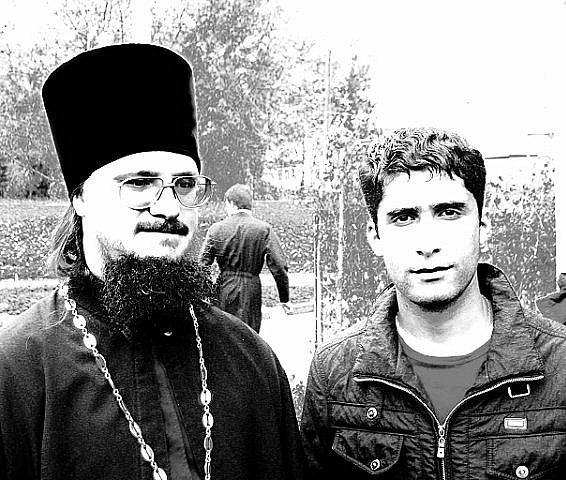
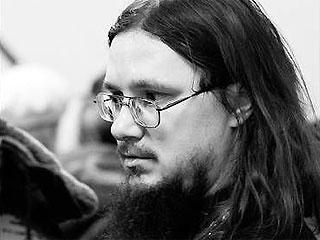
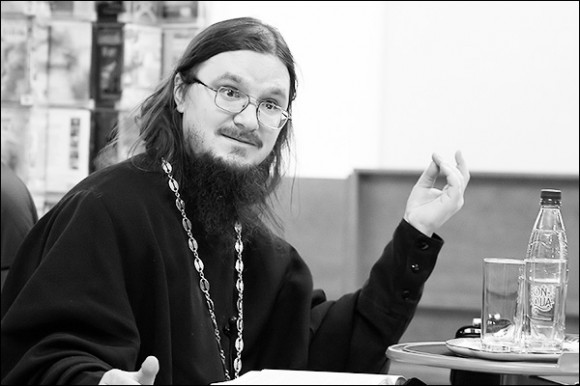
Fr. Daniel Sysoev: “To Make the Whole World Love Christ”


2009, on November 19, in the church of the Holy Apostle Thomas, north of Moscow, Priest Daniel Sysoev was killed. Below are Seraphim Maamdi’s memories of Father Daniel.

My acquaintance with Fr. Daniel was God’s mercy toward me.
When I watched his disputes with the Muslims and heard his sermons, there arose in me a great desire to get to know him. At that time I was unaware that he had a missionary school. Then I became acquainted with a student-missionary of his, who also spoke with Father about me. Fr. Daniel gladly agreed to make my acquaintance.
When I met him I was impressed by his burning faith and the brave spirit which he was able to share with those around him. I was also amazed by his knowledge of the fundamentals of the faith and his wondrous exgetical gift, by his knowledge of the Holy Scriptures and the interpretations of the Holy Fathers — all of this made an impression on me and inspired me to go by the same path.
Of course, I was also impressed by his love for the Lord, his zeal for His service. He very much loved to preach about Christ; and I can say for myself that the greatest commandment that I received from my preceptor is this: “The purpose of a missionary is to make the whole world love Christ.”
I remember that Father said to me, “Seraphim! There is a large Kurdish population in Saratov. Vladyka blessed us to go there. So — will you go?” I hedge a little and aid that I still wasn’t ready, that I was a bit intimidated. Of course, I was still not very knowledgeable about of luminous faith. At that time I truly wasn’t ready yet, but after his martyric end, my brother and I, with the blessing of Bishop Longin, made the first missionary journey to Saratov.
He called me to bravery and said many things that I will remember for my entire life, especially this: “If a man sets out on the path of missionary, there is no way back. The Lord will demand of such people the talent that they received and buried.” And this: “Prayer is the most important thing in the missionary life: unceasing prayer is first, last and central. It is an essential part of the life of the missionary. The study of the Holy Scriptures is one of three chief activities of the missionary. And, as you understand, all of this is in the liturgy. Therefore, the more you go to services, the more success awaits you in your mission.” And also: “We preach the Gospel for the sake of God, before Him, and for the salvation of people.”
I told him that our people are simply fed up with religious lies, that they are going to the torments of hell without murmuring. He strove by all means to help us in missionary work among the Kurds. First of all he gave us books of the New Testament in the Kurdish language. (By the way, I learned to read in Kurdish from that very book which Fr.Daniel gave me.) He told us to assemble the Kurds in order to read passages to them. He also applied his abilities to the task of translation. Such concern amazed and inspired me. I remember once we were discussing the possibility of a missionary journey to the Iraqi Kurds (who are in a center of Yazidism), so that there also the preaching of Christ might conquer the local Kurdish population. I said that I knew our laguage only poorly, and that moreover there is a different dialect there (Sorani), and that I was sure to receive a martyr’s crown there, since the radicalism of the Iraqis is known to the whole world.
Fr. Daniel told me to fear nothing, that the Muslims had threatened him personally fourteen times, saying that they would behead him — but should we hold back out of fear? The important thing, he said, is to firmly and bravely bear the Word of God, and to be witnesses of Christ, lest we forget that this is a great honor. (I believe that, by Fr. Daniel’s prayers, the time will come when the Word of God will be preached there.)
He often said spoke of martrydom, as if he knew that the Lord would glorify him in precisely this way. And behold, the Lord made him worthy of a martyr’s crown. The ancient Christians rejoiced in this situation, but we were saddened.
I remember that when I learned of his death I was very grieved and thought, “If only he could have had a few more years.” But later I acknowledged that the will of God is in all things. I humbled myself and glorified God, for now we have an intercessor in heaven, the hieromartyr Daniel, who prays for us and helps us in our missionary endeavors. I would even say that he is continuing his missionary work.
Not long before his death there was a striking event. One one of the Muslim forums, I found a photo of Fr. Daniel. The Muslisms, with the help of photoshop, had given him the clothing of a medieval crusader, and a sword, all against the background of a certain church. This made me laugh quite a bit, and I decided to show Fr. Daniel. We were very amused and Fr Daniel asked me to put it in a frame, so that I could remember him by it.
After his martyric end, when I was burdened with deep sorrow, remembering him, I looked at the photo from my personal archive. When I saw the photo, I was simply stunned. I became apparent that the church in front of which he was standing in the photograph was the same Church of the Apostles Peter and Paul in Yasenevo, where his funeral was held!
After his death, many people became interested in his labors, and gradually they came to Christ. I personally know many people who came to the Church through his books.
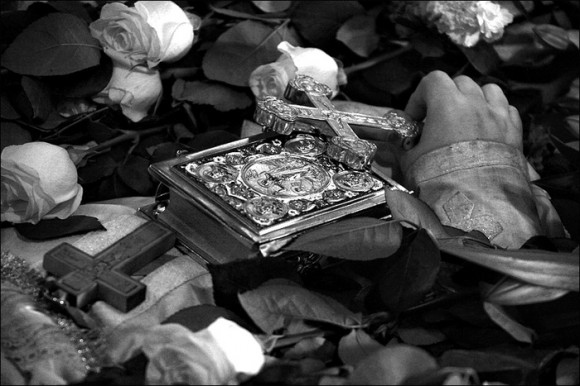
I remember when his honorable body was in the Church, a great number of people came to bid farewell to him, and many of them had a feeling as if a great holy thing had been brought. Peope with their children piously venerated the honorable relics of the saint. It was amazing, but that was how God disposed the people. Before long, Orthodox people from Serbia, Greece, the USA and other countries began to venerate Fr. Daniel as a hieromartyr. As the Lord says: “I will glorify them that glorify me.” (I Kings 2:30)

Everyone wondered at his love and fatherly concern. I remember our first missionary journey to Moscow. Father served a moleben, gave counsels and admonitions. We opened a map of Moscow and divided it up by regions. We got a very good education, so that we would be able to preach the Gospel and be ready to give answer about our hope with meekness and piety. (I Pet. 3:15)
Our last meeting was deeply moving. On the day before his martyric end, the lecture was led by Yuri Maksimov, who later became Deacon George. After the lecture we discussed many things, particularly the questions of Ouranopolitism and Nationalism. Father said that our citizenship is in heaven (Phil. 3:20), and that a Christian must not be attached to anything earthly. We are on the earth as if in a guest house, but our home is there, where Christ is at the right hand of the Father. His last lecture was about God the Father. He gave this lecture on the day before his death.
Just a few months before his death I asked Fr. Daniel’s blessing to establish two networking groups. One was about himself (in order to publish his lectures and articles), while the other was for doing missionary work among muslims. Amazingly, after his death the groups were filled with people, and many acknowledged that they started coming to the Church by reading hearing his lectures and reading his books.
I received three blessings from Fr. Daniel: for missionary work, for frequent Communion (every Sunday), and just a few days before his death I asked his blessing to write a book.
Yazidism has a very distorted view of Christianity, and Father counseled me to deal with this problem. I believe that he is praying for me and helping me to write apologetic works. I feel his help. It happens that a question arises, and you listen to his lectures and immediately find the answers to your questions.
I am truly thankful to the Lord that he vouchsafed me to study with the Hieromartyr Daniel. I finished his one-year missionary course. If I were now to forsake missionary activity, this would be very base and unjust toward him, since he gave his life for Christ, giving us an example of how serious he was, that he loved not his own life, even unto death (Rev. 12:11). As one of the great missionaries said, missionary work is a truly holy work, equal to that of the apostles. Blessed is the one whom the Lord choses and places in such service (St. Innocent of Moscow).
When he preached to non-Christians and the heterodox, he manifest an exalted love for them. What could be more important than the salvation of a human soul? Because of this love he was made worthy of a martyr’s crown. It is wondrous, but it happened just as the Lord said: “There will come a time when everyone who kills you will think that he is serving God.” (John 16:2)
As His Holiness Patriarch Tikhon of Moscow and All Russia said in his condolences on the death of Fr Daniel, “The Lord has called His faithful servant to himself, having given him the ability to become a confessor of the faith and a martyr of the Gospel.”
And Paul admonishes us: “Remember your preceptors, who preached the word of God to you and, looking to their end, imitate their faith.” (Hebrews 13:7)
He opened to the Holy Scriptures to me in the light of the Holy Fathers, made me wise in the faith of Christ, and also taught me to bear the Word of God. Now he is praying for us at the throne of God, so that we might painstakingly bear the Gospel of the Kingdom of God. Now is the acceptable time. We must gather all the children of God into unity of faith, for many have forgotten the chief commandment of the Gospel, to preach the Gospel to all creatures. (Mk. 16:15) In the person of the Apostles, the Lord commanded all Christians: “Go forth and teach all nations.” (Matt. 28:19) We must convince all people to come to the Truth, and we must bring them to Him. This is the will of God.
As St. John Chrysostom said: “It is a great virtue to boldly and openly preach Christ and to prefer this to everything else. It is so great and wondrous that the Only-Begotten Son of God confesses such a man before His Father, although this reward is not proportionate. You preach on the earth, and He preaches in the heavens; You before men, and He before His father and all the angels.”


source

Wednesday, March 11, 2015

A Prayer - Teach Me Your Love ( St. Nikolai Velimirovich )


Your birds awaken me in the morning, and the murmur of the lake lulls me to sleep in the evening. But it is not the birds that awaken me, nor the lake that lulls me to sleep, but You, 0 Lord, Master of the voice.

You lend Your voice to the birds and the midnight murmur to the lake. You have lent a voice to every throat, and have put a story into every creature. I am surrounded by Your heralds, as a student by many teachers, and I listen to them tirelessly from day until dusk.

O Lord, Master of the voice, speak more clearly through Your heralds!

The sun speaks to me about the radiance of Your countenance, and the stars about the harmony of Your being. The sun speaks in one language, and the stars speak in a different language, but all the languages flow out of the same vocal cords. The vocal cords belong to You, and You uttered the first sound that began to tremble in the deafness and formlessness of nothingness, and it broke into countless sounds and heralds, as a thundercloud breaks into rain drops.

O Lord, Master of the voice, speak more clearly through Your heralds!

One exclamation escaped the breast of the Bride of God when She saw Your Son––a voice filled with a love that could not be contained in silence. And that exclamation echoed in the heart of Her Son, and this echo––this response to the love of His Mother––the Holy Spirit has spread with His powerful arms throughout the entire universe. Therefore, all the universe is filled with Your heralds, O my Song and my Love.

O Lord, Master of the voice, speak more clearly through Your heralds!

For this reason You also spoke in parables, O Son of God, and You would explain things and events as stories about the Most High God. You cured the sick with words and raised the dead with words, for You recognized the mystery of love. And the mystery of love is a mystery of words. Through all creatures, as through piercing and blaring trumpets, words pour forth––and through words, the Love of Heaven.

O Lord, Master of the voice, teach me Your Love through all Your heralds.

From Prayers by the Lake by Bishop Nikolai Velimirovich 


http://agapienxristou.blogspot.ca/2013/04/a-prayer-teach-me-your-love.html

Friday, February 27, 2015

Love of Christ and Prayer ( St. Porphyrios )


 I said to the elder, "They are constantly saying prayers at the monastery. They are always saying the Jesus prayer. While at their various chores they recite supplications and salutations. They do this for whole hours at a time. After this they go to the Church for services.


"I cant stand it any more. My mind has become tired. I feel that I am about to burst. But Never the less I want to become a monk. What will I do? Help me."
The Elder said,


A young girl used to come here and confess her sins. She was in her second grade of Junior High School. She told me once, 'Father, I have fallen in love with a boy and I can't get him out of my mind. My mind is constantly on him, on Nick. One would think that Nick is here, (she pointed with her finger to her forehead). I begin to read and Hick is here. I go to eat and to sleep but nothing changes. Nick is here. What can I do father?'"


"My child," I told her, "you are still young. Be patient, finish school and then Nick will still be here. Now you must put effort into your lessons. A week passed and she came again."
"Dear Father, It's impossible for me to concentrate on my lessons. Constantly all day long my mind and my heart are on Nick. Nick has become an obsession with me and it won't go away."
(As he was saying these things, I was thinking, "What connection do these things have with me? Maybe he is telling me these things to give me a respite from my obsession.")


The elder continued, (while reading my thoughts) "you are now saying, why is he telling me these things?"
"But nevertheless, tell me, please."
"Did this girl sit on a stool? Did she force herself to focus her mind on Nick? No.
"This happened spontaneously. This was unforced love.


"This same happens with us. When we love Christ with divine love, without any coercion, pressure of worry, with love we will proclaim His holy name, 'Lord Jesus Christ.'
"And when the heart is flooded by this divine love, it does not require us to verbalize the whole prayer, 'Lord Jesus Christ, have mercy on me.'
Before he finishes the prayer the heart stops at that point of love and rejoicing.
Other times he proclaims only the "Lord..." and stops. He proclaims this mystically and without speaking."


In saying these things he gave me an answer to my first question that was not expressed verbally. I had only thought it without verbalizing it.
I was flabbergasted. I was totally amazed at his responses. A divine flame enveloped my inner being and I felt the desire to begin proclaiming within my heart the ineffable love I had for the name of our Christ.


From the Divine Flame: Elder Porphyrios Lit my Heart, by the monk Agapios, pp 25-26, Published by the Holy Convent of the Transfiguration of the savior, Athens 2005. 


http://agapienxristou.blogspot.ca/2012/10/love-of-christ-and-prayer.html

Monday, February 2, 2015

Love ( St. Nektarios )


It’s a popular topic; a word thrown around here and there. We love our mothers and fathers from birth; we love our siblings, our friends, and even co-workers. We “fall in love” and many times vow to love one person for the rest of our lives.

So what kind of loves are these: familial, “love of one’s own”? In what way do we love those around us naturally? I use “naturally” because I think we’d all agree that to a certain extent we are naturally inclined towards loving. But the nature of this love, the root, where is it to be found? What is the goal of this love? Why do we love: for what purpose, for what benefit? What makes this “natural” love of ours binding? What unites us to those that we love?

I suppose it’s easy to think that all or any kind of love is good and of God, but is this true?
I don’t propose to know the answers to the above questions. In fact, I don’t even plan on trying to answer them here. Each in its own right could be expounded upon in its own article. I simply would like to talk about the relationship love has with Christ and if indeed Christ is the binding element of love.

The Scriptures tell us “We can do nothing without Christ”, and, “Except the Lord build the house, in vain do they labour that build it.” So, this brings us to the heart of the matter: Can love that is not mediated by Christ be called, or be in essence, love?

Here is a small, but powerful excerpt from a letter St. Nektarios wrote to one of the nuns under his spiritual care: “Be careful in the development of the feeling of love. It is endangered when the heart is not supported by honest prayer, and can then become carnal, unnatural, and can darken and burn the heart. I hope that this doesn’t happen. Love each other like holy sisters and let only the common love you share for the Lord unite you.”

According to this great theologian and miracle-worker, loves exist that are not good, are not “natural”, are not of God and in the end will only harm us, “darken and burn the heart” even.
I do not know how to discern which love is “carnal” and which is not, which is “spiritual” and which is based solely on selfishness. The only thing I know is that the Scriptures seem to suggest, just as St. Nektarios’ letter does, that love is of a very particular nature and can only be shared, understood, felt, and given with Christ as our conscious mediator. Again I will quote a letter written by St. Nektarios to a nun who (I’m assuming unknowingly and unintentionally) allowed her love for him to turn into something other than that which is mediated through love of Christ:

“My soul has become cold towards Syncletici so much that I have become indifferent towards her because of her state of mind. I love all of you, my dear girls, not because you love me but because you love our Lord Jesus Christ. It is a common love that we have for the Lord and it is that love which makes my heart love you, and it is what binds us. When one of you takes the love in your heart away from the Lord and offers it to the vanity of the world and the passion of the soul, then my love towards you will diminish because you have taken Christ out of your heart and have thus broken the bond of love between us, because, of course, the link that binds us is the common love of Christ.”

I must admit when I first read this I felt guilty. Have I too taken the love in my heart away from the Lord? Am I guilty of offering the love in my heart to the “vanity of the world”? The saint’s words seemed so sharp they cut me like a knife; I can’t imagine how they made Sr. Syncletici feel. Despite how she initially felt on reading her elder’s letter, I think they most likely helped her see her error.

How often do we fall into the same or similar error with our friends, co-workers, classmates, siblings, and/or parents? Perhaps not in a way that can turn into lust, but in a way that is merely human and devoid of Christ.
Can there be ANY love without Christ? I don’t think so. I don’t know what this means about the world and the supposed love non-Christians have for one another. It seems to me that St. Nektarios is clear: we cannot even love without Christ.


St. Nektarios

Tuesday, January 20, 2015

People in pain ( St. Paisios )


Those who come close to people in pain, naturally draw near to God, because God is always by the side of His children who are in pain.

St. Paisios


Friday, December 19, 2014

Using Love to conquer ( St. Isaac the Syrian )


Conquer evil men by your gentle kindness and make zealous men wonder at your goodness. Put the lover of legality to shame by your compassion. With the afflicted in mind. Love all men, but keep distant from all men.

St. Isaac the Syrian

Thursday, December 18, 2014

Η αγάπη των πλασμάτων του Θεού - Love of God's creatures

Love Thy Neighbor...( St.Seraphim of Sarov )


One must behave affectionately toward one’s neighbors, not showing even a hint of offense. When we turn away from a person or offend him, it is as if a rock settles on our heart. One must try to cheer the spirit of an embarrassed or dejected person with words of love.

When you see a brother sinning, cover him, as counseled by St. Isaac the Syrian: "Stretch out your vestment over the sinner and cover him."

In our relations with our neighbors we must be equally pure towards everyone in word as well as in thought; otherwise we will make our life useless. We must love others no less than ourselves, in accordance with the law of the Lord: "Thou shalt love ... thy neighbour as thyself" (Lk. 10:27). But not so much that our love for others, by extending past the boundaries of moderation, diverts us from fulfilling the first and main law of love towards God, as our Lord Jesus Christ himself taught: "He that loveth father or mother more than me is not worthy of me: and he that loveth son or daughter more than me is not worthy of me" (Mt. 10:37).

St.Seraphim of Sarov

Sunday, December 14, 2014

Showing love and not anger ( St. John of Kronstadt )


As sins consist mostly of malice and pride, it is necessary to treat everyone who suffers from the malady of sin with kindness and love.


This is an important truth, which we often forget. Very often we act in the opposite manner, we add malice to malice by our anger, we oppose pride to pride.
 

Thus, evil grows within us, and does not decrease, it is not cured, rather it spreads....

St. John of Kronstadt

Friday, December 5, 2014

Love for Others - We are One ( Saint Porphyrios )

This message from Saint Symeon the New Theologian was hanging on the cell wall of Elder Porphyrios . He would hand out a copy of this to his guests. Elder Porphyrios consistently taught that we should love others as if we see them as ourselves .


We need to regard all the faithful as one and think that each one of them is Christ. We need to have such love for each individual that we are ready to sacrifice our very life for him. Because we ought never to say or think that any person is evil, but rather to regard all as good. And if you see a brother troubled by passions, do not hate him. Hate rather the passions that are assailing him. And if you see that he is being tormented by desires and habits from former sins, have even greater compassion on him, lest you also fall into temptation, since you are made of matter that easily turns from good to evil. Love for your brother prepares you to love God more. Accordingly, the secret of love for God is love for your brother. Because if you don’t love your brother whom you see, how can you possible love God whom you don’t see?


“He who does not love his brother whom he has seen, how can he love God whom he has not see?” (1 John 4:20) Words of Saint Symeon the New Theologian interspersed with Elder Porphyrios’s own words from One Hundred Theological and Practical Chapters, of Saint Symeon.


Reference: Wounded By Love, p 183 - 184

Wednesday, November 26, 2014

Love For God ( Saint Herman of Alaska )

Once the Elder was invited on board a frigate that had come from St. Petersburg. The captain of the frigate was a man quite learned, highly educated; he had been sent to America by Imperial command to inspect all the colonies. With the captain were some 25 officers, likewise educated men. In this company there sat a desert-dwelling monk of small stature, in an old garment, who by his wise conversation brought all his listeners to such a state that they did not know how to answer him. The captain himself related: "We were speechless fools before him!"


Father Herman gave them all one common question: "What do you, gentlemen, love above all, and what would each of you wish for his happiness?" Diverse answers followed. One desired wealth, one glory, one a beautiful wife, one a fine ship which he should command, and so on in this fashion. "Is it not true," said Father Herman at this, "that all your various desires can be reduced to one - that each of you desires that which, in his understanding, he considers best and most worthy of love?" "Yes, it is so," they all replied. "Well, then, tell me," he continued, "can there be anything better, higher above everything, more surpassing everything and in general more worthy of love, than our Lord Jesus Christ Himself, who created us, perfectly adorned us, gave life to all, supports all, nourishes and loves all, who Himself is love and more excellent than all men? Should not a person then love God high above all and desire and seek Him more than all else?" All began to say: "Well, yes! That is understood! That speaks for itself!"


"And do you love God?" the Elder then asked. All replied: "Of course, we love God. How can one not love God?" "And I, sinful one, for more than forty years have been striving to love God, and cannot say that I perfectly love Him," answered Father Herman; then he began to show how a person should love God. "If we love someone," he said, "we always think of him, strive to please him, day and night our heart is occupied with this subject. Is it thus that you, gentlemen, love God? Do you often turn to Him, do you always think of Him, do you always pray to Him, and fulfill His holy commandments?" It had to be acknowledged that they did not! "For our good, for our happiness," concluded the Elder, "at least let us make a promise to ourselves, that from this day, from this hour, from this very moment we shall strive to love God above all, and fulfill His holy will!"

Behold what an intelligent, superb conversation Father Herman conducted in society; without doubt this conversation must have imprinted itself on the hearts of his listeners for their whole life!
 

Saint Herman of Alaska 

http://agapienxristou.blogspot.ca/2012/10/saint-herman-of-alaska-on-love-for-god.html

Sunday, November 16, 2014

Are You In Love? ( Saint Porphyrios )


What is it like when you are in love? Nothing disturbs you. You only think about your lover and all else blurs into the background. This is true also with when we fall in love with Christ.

Saint Porphyrios says,

If you are in love, you can live amid the hustle and bustle of the city center and not be aware you are in the city center... Imagine the person you love is Christ, Christ is in your mind, Christ is in your heart, Christ is in your whole being, Christ is everywhere. This is our challenge. To love Christ is is to lift us above all our earthly concerns, to experience continual joy no matter how difficult a situation we face, no matter what turmoil is taking place around us. This is the way life was meant to be lived.

Saint Porphyrios says,

Whoever loves Christ and other people truly lives life. Life without Christ is death; it is hell, not life. Life is Christ. Love is the life of Christ. Either you will be in life or in death. It's up to you to decide. Isn't this the only answer to all the anxiety of our present world situation? When I live with Christ as my true lover, there is no room for anxiety. But when others take His position then I find myself filled with anxiety. Oh, how I yearn for the wisdom to live in this world with this other worldly love.
Lord have Mercy!

Quotes from Wounded By Love, p 97

Wednesday, November 5, 2014

Five Languages of Love ( Eldress Gabriela )


The First is a smile.

The Second is tears.

The Third is a gentle touch.

The Fourth is prayer.

The Fifth is love.

With these five languages you can travel the entire earth and the whole world will be yours.

http://agapienxristou.blogspot.ca/2013/05/five-languages-of-love-eldress-gabriela.html