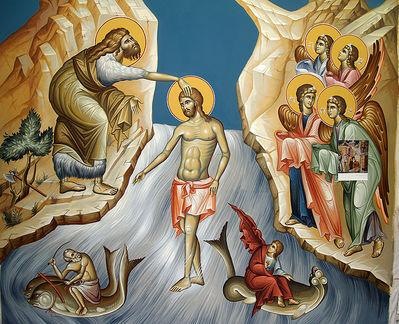
During this time many Orthodox Christian will take from the Church bottles of Holy water to be used throughout the year. It is common for the priest to come to the home during this period to bless the home with Water that has been consecrated on the day of Theophany. Here are some thoughts on the value of Holy Water by Saint John of San Francisco.
On Theophany, the Day of the Lord's Baptism, every year a great miracle is performed. The Holy Spirit, coming down upon the water, changes its natural properties. It becomes incorrupt, not spoiling, remaining transparent and fresh for many years. This Holy Water receives the grace to heal illnesses, to drive away demons and every evil power, to preserve people and their dwellings from every danger, to sanctify various objects whether for church or home use. Therefore, Orthodox Christians with reverence drink Holy Water — a great Agiasma (holy thing), as the Greeks call it.
One should always have at home enough Theophany water to last the whole year, and make use of it at every need: in cases of illness, leaving on a journey, whenever one is upset, students prior to examinations, etc. People who drink a little Holy Water daily, before eating any kind of food, do well. It strengthens the powers of our soul—if it is done with prayer and reverence, and one does not merely expect a mechanical result from it.
http://agapienxristou.blogspot.ca/2013/01/value-of-holy-water.html

On January 6th we celebrate the Theophany, the full manifestation of God, the Holy Trinity revealed to us. Too often we only think about this as the time when we get Holy Water from the Church or when the Priest comes to bless our homes, but the significance of this event is so much more.
We are fortunate to have commentary from the second century by St Hippolytus [a.d. 170–236.] who was the disciple of Irenæus. We often raise the question, "Why did Jesus have to be baptized if He was sinless?" He explains why John, who resisted baptizing Jesus because he felt unworthy and inferior to Him thinking that he should be baptized by Jesus, baptized Him who was God Himself.
Hyppolytus shows how Christ comforted John,
And what saith the Lord to him? “Suffer it to be so now, for thus it becometh us to fulfil all righteousness.” (Matt 3:15) “Suffer it to be so now,” John; thou art not wiser than I. Thou seest as man; I foreknow as God. It becomes me to do this first, and thus to teach. I engage in nothing unbecoming, for I am invested with honour. Dost thou marvel, O John, that I am not come in my dignity? The purple robe of kings suits not one in private station, but military splendour suits a king: am I come to a prince, and not to a friend? “Suffer it to be so now for thus it becometh us to fulfil all righteousness:” I am the Fulfiller of the law; I seek to leave nothing wanting to its whole fulfilment, that so after me Paul may exclaim, “Christ is the fulfilling of the law for righteousness to every one that believeth.” (Rom 10:4) “Suffer it to be so now, for thus it becometh us to fulfil all righteousness.” Saint Hyppolytus tells us why Jesus was baptized, speaking from viewpoint of Jesus,
Baptize me, John, in order that no one may despise baptism. I am baptized by thee, the servant, that no one among kings or dignitaries may scorn to be baptized by the hand of a poor priest. Suffer me to go down into the Jordan, in order that they may hear my Father’s testimony, and recognise the power of the Son. “Suffer it to be so now, for thus it becometh us to fulfil all righteousness.” Then at length John suffers Him. “And Jesus, when He was baptized, went up straightway out of the water: and the heavens were opened unto Him; and, lo, the Spirit of God descended like a dove, and rested upon Him. And a voice (came) from heaven, saying, This is my beloved Son, in whom I am well pleased.” (Matt 3:16-17) Jesus wanted to emphasize the role of the priest in baptizing those who chose to follow Him. He wanted all to hear the testimony of the Father so others would accept Him as His Son as this was the time He began His public ministry.
Saint Hyppolytus continues uplifting our sight even higher,
Do you see, beloved, how many and how great blessings we would have lost, if the Lord had yielded to the exhortation of John, and declined baptism? For the heavens were shut before this; the region above was inaccessible. We would in that case descend to the lower parts, but we would not ascend to the upper. But was it only that the Lord was baptized? He also renewed the old man, and committed to him again the sceptre of adoption. For straightway “the heavens were opened to Him.” A reconciliation took place of the visible with the invisible; the celestial orders were filled with joy; the diseases of earth were healed; secret things were made known; those at enmity were restored to amity. For you have heard the word of the evangelist, saying, “The heavens were opened to Him,” on account of three wonders. For when Christ the Bridegroom was baptized, it was meet that the bridal-chamber of heaven should open its brilliant gates. And in like manner also, when the Holy Spirit descended in the form of a dove, and the Father’s voice spread everywhere, it was meet that “the gates of heaven should be lifted up.” (Ps 24: 7) “And, lo, the heavens were opened to Him; and a voice was heard, saying, This is my beloved Son, in whom I am well pleased.”
Most significantly we see in this event that the heavens are opened for all mankind who follow Him and join with Him through Baptism to become His adopted children. Christ shows us that we begin our Journey with Him through baptism. This is a Holy Sacrament where heavens are opened and we join with The Holy Trinity to be transformed, born again, so we can become like Him and have eternal life in His kingdom as one of His children.
Christ’s baptism in the Jordan was A “theophany,” in that the world was granted a revelation of the Holy Trinity. The Father testified from on high to the divine Sonship of Jesus; the Son received His Father’s testimony; and the Spirit was seen in the form of a dove, descending from the Father and resting upon the Son.
In the hymn of the Feast we sing, “Christ has appeared and enlightened the world.” Thus, January 6 is also known as the Feast of Lights. The Church celebrates on this day the illumination of the world by the light of Christ.
Reference: Ante-Nicene Fathers, vol 5, Hyppolytus, Discourse on Holy Theophany
http://agapienxristou.blogspot.ca/2013/01/theophany-more-than-blessing-of-waters.html

Saint Gregory the Theologian refers to this great time of celebration in the Church as the "Day of Light."
He says,
For the Holy Day of Lights, to which we have come, and which we are celebrating today, has for it's origin the Baptism of my Christ, the True Light That lightens every man that comes into the world, and effects my purification, and assists that light which we received from the beginning from Him above, but which we darkened by sin. The image of Christ as one who brings light to the world can be a powerful one if we realize that without Him we are in darkness. It is His light that lights the path to His Kingdom, to union with God. Without it the path is impossible to find and we are left wandering in darkness seeking what we cannot find.
Saint Gregory says,
Therefore listen to the voice of God, which sounds so exceeding clearly to me, who am both disciple and master of these mysteries, as would to God it may sound to you; I am the Light Of The World. Therefore approach ye to Him and be enlightened, and let not your faces be ashamed, being signed with the true Light. It is a season of new birth, let us be born again. It is a time of reformation, let us receive again the first Adam. Let us not remain what we are, but let us become what we once were... See the grace of the day; see the power of this mystery... This event is the establishment of the Sacrament of Baptism where we begin our healing from the sinful natured we have inherited from the fall of Adam and Eve. It is an event celebrating our renewal through our baptism, the time we became Christians with the Holy Spirit within guiding us toward a life like Him, made evermore effect as we participate in the teachings, practices and sacraments of the Church.
Saint Gregory puts it this way,
We were turned into a den of all sorts of passions, which cruelly devour and consume the inner man; but there was this further evil, that man actually made gods the advocates of his passions, so that sin might be reckoned not only irresponsible, but even divine, taking refuge in the objects of his worship as apology. It is on this day that Jesus entered the waters of the Jordan and submitted to the baptism of John to renew and fulfill it as an act to join us to God, being absolved of all our sins through the grace of the Holy Spirit.
Saint Gregory says,
Jesus goes up out of the water ...for with Himself He carries up the world ... And sees the heaven opened which Adam had shut against himself and all his prosperity, as the gates of Paradise by the flaming sword. And the Spirit bears witness to His Godhead, for he descends upon One that is like Him, as does the Voice from Heaven..., and like a Dove, for He honors the Body... By being seen in a body form... On this day the divine nature of Christ is revealed as part of the Holy Trinity. He became fully flesh in the Incarnation to renew all of mankind. Today we celebrate the beginning of His actions to help us rejoin in union with Him.
Reference: On The Holy Lights by Saint Gregory the Theologian
Στις 6 Ιανουαρίου κλείνει ένα πλουσιότατο σε λατρευτικά δρώμενα, παραδοσιακά έθιμα και μακραίωνες συνήθειες Δωδεκαήμερο, που συνδέεται με κεντρικά στοιχεία του χριστιανικού Ευαγγελίου.
Tην κατά σάρκα γέννηση, την Περιτομή και τη Βάπτιση του Ιησού Χριστού, που είναι βασικοί σταθμοί της Ενανθρώπησης του Θεού στον κόσμο.
Παράλληλα, την 1η του έτους εορτάζεται και η μνήμη του μεγάλου Πατέρα της Εκκλησίας μας, Βασιλείου αρχιεπισκόπου Καισαρείας της Καππαδοκίας. Ο συνδυασμός όλων αυτών των στοιχείων κάνουν το διάστημα αυτό έναν πόλο εορταστικό και λατρευτικό στην καρδιά του χειμώνα, που συμπληρώνεται από τον αντίστοιχο εαρινό, δηλαδή εκείνον των πασχαλίων εορτών. Πώς προέκυψε όμως ιστορικά το εορταστικό αυτό σύμπλεγμα;
1. Η αρχή των Θεοφανείων
Για τις εορτές και τη λατρεία των πρώτων Χριστιανών οι πηγές μας είναι βέβαια τα βιβλία της Καινής Διαθήκης, κατόπιν οι λεγόμενοι Αποστολικοί Πατέρες, που υπήρξαν μαθητές και “ακουσταί” των Αποστόλων, όπως ο Ιγνάτιος Αντιοχείας, ο Κλήμης Ρώμης και άλλοι, και κατόπιν άλλοι χριστιανοί συγγραφείς του 2ου και 3ου αιώνα, καθώς και κείμενα κανόνων, προτροπών και διδαχών που γράφτηκαν τότε.
Σ’ αυτά ξεχωρίζουμε το Πάσχα και την κυριακάτικη Θ. Λειτουργία, τις καθημερινές προσευχές και το βάπτισμα των νέων Χριστιανών, που γινόταν ομαδικά το Μέγα Σάββατο το βράδυ. Για την περίοδο αυτή, του χειμώνα, η πρώτη μαρτυρία που έχουμε είναι του Κλήμεντος του Αλεξανδρέως στο δεύτερο μισό του 2ου αιώνα (δηλαδή 150-210), που μας πληροφορεί ότι οι οπαδοί του Βασιλείδη (που ήταν της αίρεσης των Γνωστικών) γιόρταζαν την ημέρα “του βαπτίσματος του Κυρίου” με αγρυπνίες και αναγνώσματα, χωρίς όμως να συμφωνούν όλοι για την ημερομηνία – άλλοι την τοποθετούσαν στις 6 κι άλλοι στις 10 Ιανουαρίου.
΄Οπως συμπεραίνουν νεώτεροι ειδικοί, από το διάστημα αυτό, ξεκινώντας ίσως από την Αλεξάνδρεια, μέχρι τα μέσα του 4ου αιώνα σ’ όλη την Ανατολή, την 6η Ιανουαρίου εορταζόταν μια τριπλή εορτή: η γέννηση του Χριστού, η προσκύνηση των μάγων και η βάπτισή Του. Η λέξη “Επιφάνεια” καλύπτει και τις τρεις εορτές, είναι η φανέρωση του Θεού ως βρέφους στους ανθρώπους γενικά και στους Μάγους ειδικά, η φανέρωση της Θεότητας στον Ιορδάνη με τη συμμαρτυρία του Πατρός και του Πνεύματος. Γιατί όμως στις 6 Ιανουαρίου;
Η προέλευση, πιθανότατα, είναι εξωβιβλική: είναι γνωστό, ότι αιγύπτιοι λάτρεις ενός μυστηριακού θρησκεύματος εόρταζαν την εμφάνιση του Χρόνου ή Κρόνου μέσα από τα νερά του Νείλου στις 6 Ιανουαρίου. Αυτή ήταν μια από τις πολλές ειδωλολατρικές “Επιφάνειες”. Είναι φανερό ότι οι Χριστιανοί ξεκίνησαν στην Αίγυπτο να δίνουν τη δική τους απάντηση για το ποια είναι η πραγματική “Επιφάνεια” του Θεού μέσα από τα νερά: αυτή του βαπτιζομένου Ιησού. Με το παράδειγμά Του και την εντολή Του αργότερα για βάπτιση των πιστευόντων όχι μόνο πλέον “εν ύδατι” (όπως στην θρησκευτική πρακτική πολλών ανατολικομεσογειακών θρησκειών, όπου το λιγοστό νερό θεωρείται πάντα θεόσταλτο καθαρτήριο), αλλά και “εν Πνεύματι”, ο Χριστός αναδείκνυε τη μοναδική ιστορική “Επιφάνεια” του Θεού σε μια ιστορία ευθύγραμμη, που δεν επαναλαμβάνεται. Αντίθετα, η “Επιφάνεια” των νερών ή του θεού-Ηλίου (solis invicti) στη Δύση, κατά το χειμερινό ηλιοστάσιο, ήταν η αποθέωση της κυκλικής φυσικής ροής του κόσμου.
2. Η ανάδειξη της ημέρας των Χριστουγέννων
Το βέβαιο είναι ότι μέχρι τα μέσα του 4ου αιώνα τα Θεοφάνεια ή “Φώτα” ή Επιφάνεια εμπεριείχαν και την εορτή των Χριστουγέννων, ένας συνδυασμός που απαντά ακόμη και σήμερα στο εορτολόγιο της Αρμενικής Εκκλησίας. Την εποχή του Μ. Βασιλείου (+ 379) και του Γρηγορίου του Θεολόγου μαρτυρούνται στη Μικρά Ασία οι πρώτες περιπτώσεις χωρισμού των δύο εορτών, όπου τα Χριστούγεννα άρχισαν να εορτάζονται στις 25 Δεκεμβρίου από επίδραση της Εκκλησίας της Ρώμης.
Στη Ρώμη είχε αρχίσει από τις πρώτες δεκαετίες του 4ου αιώνα (περί το 330-340) ο εορτασμός των Χριστουγέννων ως απάντηση στα ειδωλολατρικά Βρουμάλια ή Σατουρνάλια, που ήταν η λατρεία του αναγεννώμενου Ηλίου, όταν (περισσότερο εμφανώς στα βορειότερα κλίματα) άρχιζε να ξαναμεγαλώνει η μέρα, μετά το χειμερινό ηλιοστάσιο. Οι Χριστιανοί στη λατρεία του «ξαναγεννημένου Ήλιου» του φυσικού κύκλου, απαντούσαν με τη γέννηση του «νοητού Ηλίου της Δικαιοσύνης». Περί το 375 άρχισαν να εορτάζονται τα Χριστούγεννα και στη Συρία και το 386 ο Ιωάννης ο Χρυσόστομος, πρεσβύτερος στην Αντιόχεια, εξέφρασε στο Λόγο του “Εις την γενέθλιον ημέρα του Σωτήρος” τη χαρά του, που επιτέλους η 25η Δεκεμβρίου μπήκε επίσημα στο εορτολόγιο της πόλης. Μέχρι το 432 η εορτή είχε φθάσει και στην Αλεξάνδρεια.
Ενώ στη Δύση τα Επιφάνεια συνδέονται μέχρι σήμερα, κυρίως, με την προσκύνηση των Μάγων, στην Ανατολή εξακολούθησαν να εορτάζονται με μεγάλη λαμπρότητα: στα Ιεροσόλυμα την εποχή εκείνη, μας πληροφορεί το Οδοιπορικό της Αιθερίας (ταξιδιωτικός οδηγός μιας ευσεβούς Μαυριτανής κυρίας στα τέλη του 4ου αιώνα) ότι επί μία εβδομάδα μετά τις 6 Ιανουαρίου τελούνταν μία Λειτουργία κάθε μέρα σε συγκεκριμένους μεγάλους ναούς της πόλης από τον επίσκοπο ή μοναχούς.
Οι γνωστές σε όλους μας ευχές του Μεγάλου Αγιασμού έχουν σαφώς εξορκιστικό χαρακτήρα και καταδεικνύουν το θρίαμβο της νίκης του ενανθρωπήσαντος Υιού του Θεού (άρα, τελικά, του ανθρώπου, που ενώνεται με το Θεό) πάνω στον “γκρίζο” κόσμο πνευμάτων, κακοποιών στοιχείων, αοράτων “αρνητικών” δυνάμεων (όπως λέμε σήμερα) κλπ. Πολύ σωστά έχει, λοιπόν, συνδεθεί στη λαϊκή αντίληψη η έξωση των καλικαντζάρων ή “παγανών” με τον αγιασμό των υδάτων. Βαθμιαία, το διάστημα των 40 ημερών πριν τα Χριστούγεννα και των 40 ημερών μετά, μέχρι την Υπαπαντή, έγινε μια λαμπρή εορταστική αλυσίδα, που στις μέρες μας έχει, δυστυχώς, εκφυλιστεί σε άλλοθι καταναλωτισμού».
http://agapienxristou.blogspot.ca/2013/01/blog-post_6.html
 In Egypt, in whose ancient Christian past there had once been many grand monasteries, there once lived a monk who befriended an uneducated and simple peasant farmer. One day this peasant said to the monk, “I too respect God who created this world! Every evening I pour out a bowl of goat’s milk and leave it out under a palm tree. In the evening God comes and drinks up my milk! He is very fond of it! There’s never once been a time when even a drop of milk is left in the bowl.”
Hearing these words, the monk could not help smiling. He kindly and logically explained to his friend that God doesn’t need a bowl of goat’s milk. But the peasant so stubbornly insisted that he was right that the monk then suggested that the next night they secretly watch to see what happened after the bowl of milk was left under the palm tree.
No sooner said than done. When night fell, the monk and the peasant hid themselves some distance from the tree, and soon in the moonlight they saw how a little fox crept up to the bowl and lapped up all the milk till the bowl was empty.
“Indeed!” the peasant sighed disappointedly. “Now I can see that it wasn’t God!”
The monk tried to comfort the peasant and explained that God is a spirit, that God is something completely beyond our poor ability to comprehend in our world, and that people comprehend His presence each in their own unique way. But the peasant merely stood hanging his head sadly. Then he wept and went back home to his hovel.
The monk also went back to his cell, but when he got there he was amazed to see an angel blocking his path. Utterly terrified, the monk fell to his knees, but the angel said to him:
“That simple fellow had neither education nor wisdom nor book-learning enough to be able to comprehend God otherwise. Then you with your wisdom and book learning took away what little he had! You will say that doubtless you reasoned correctly. But there’s one thing that you don’t know, oh learned man: God, seeing the sincerity and true heart of this good peasant, every night sent the little fox to that palm tree to comfort him and accept his sacrifice.”
The Tale of the Prayer and the Little Fox- from the little prologue.
http://agapienxristou.blogspot.ca/2013/01/the-tale-of-prayer-and-little-fox.html
http://everyday-saints.com/fox.htm

What saves and makes for good children is the life of the parents in the home. The parents need to devote themselves to the love of God. They need to become saints in their relation to their children through their mildness, patience and love. They need to make a new start every day, with a fresh outlook, renewed enthusiasm and love for their children. And the joy that will come to them, the holiness that will visit them, will shower grace on their children. Generally the parents are to blame for the bad behaviour of the children. And their behaviour is not improved by reprimands, disciplining, or strictness. If the parents do not pursue a life of holiness and if they don't engage in spiritual struggle, they make great mistakes and transmit the faults they have within them. If the parents do not live a holy life and do not display love towards each other, the devil torments the parents with the reactions of the children. Love, harmony and understanding between the parents are what are required for the children. This provides a great sense of security and certainty.
The behaviour of the children is directly related to the state of the parents. When the children are hurt by the bad behaviour of the parents towards each other, they lose the strength and desire to progress in their lives. Their lives are constructed shoddily and the edifice of their soul is in constant danger of collapsing. Let me give you two examples.
Two sisters came to see me. One of them had gone through some very distressing experiences and they asked me what was the cause of these. I answered them:
'It's because of your home; it stems from your parents.' And as I looked at the girl I said:
'These are things you've inherited from your mother.'
'But,' she said,' my parents are such perfect people. They're Christians, they go to confession, they receive Holy Communion and we had a religious upbringing. Unless it is religion that is to blame...'
I said to them:
'I don't believe a word of all that you're telling me. I see one tiling only, and that is that your parents don't live with the joy of Christ.'
On hearing this, the other girl said:
'Listen, Maria, the Father's quite right. Our parents go to confession and receive Holy Communion, but did we ever have any peace at home. Our father was constantly complaining about our mother. And every day either the one refused to sit at the table or the other refused to go out somewhere together. So you see what the Father is saying is true.
'What's your father's name?' I asked her,
She told me.
'What's your mother's name?'
She told me.
'Well,' I said,' the feelings you've got inside you towards your mother are not at all good.'
You see, the moment she told me her father's name I saw his soul, and the moment she told me her mother's name, I saw her mother and I saw the way her daughter looked at her.
Another day a mother came to visit me with one of her daughters. She was very distressed and broke down in tears.
'What's the matter?' I asked.
'I'm in total despair over my older daughter. She threw her husband out the house and deceived us all with a pack of lies.'
'What kind of lies?' I inquired.
'She threw her husband out the house ages ago and she didn't tell us anything. We would ask on the phone, "How's Stelios doing?', and she would reply, "Oh, he's fine. He's just gone out to buy a newspaper." Each time she would think up some new excuse so that we wouldn't suspect anything. And this went on for two whole years. A few days ago we learned the truth from Stelios himself when we bumped into him by chance.'
So I said to her:
'The fault's your own. It's you that's to blame, you and your husband, but you most of all.'
'What do you mean!' she said indignantly. 'I loved my children to the point that I was never out of the kitchen. I had no life of my own at all. I took them to the church and I was always telling them the right thing to do. How can you say that I'm to blame?'
I turned to her other daughter who was with her and asked:
'What do you think about the matter?'
'The Father's right, Mum,' she said. 'We never ever enjoyed a single day when you weren't quarrelling with Dad.'
'Do you see then, how I'm right? It is you that are to blame. You traumatised the children. They are not to blame, but they are suffering the consequences.'
Wounded by Love: The Life and the Wisdom of Elder Porphyrios, trans. by John Raffan (Limni, Evia, Greece: Denise Harvey, 2005), 195-205.
Ο Αντίχριστος, επειδή είναι εχθρός του Θεού, επιθυμεί να χαθούμε όλοι και αυτός ο τύρανος θα χρησιμοποιήσει όλους τους τρόπους για να πάρουν όλοι τη σφραγίδα του θηρίου, μόλις θα έρθει για να παραπλανήσει όλο τον κόσμο.
Να προσέχετε αδελφοί μου, τους διάφορους πονηρούς τρόπους που θα χρησιμοποιήσει το θηρίο. Η αρχή γίνεται από την κοιλιά, ώστε όταν κανείς βρεθεί σε δύσκολη θέση, αφού δε θα έχει τροφές, θ' αναγκαστεί να πάρει το σφράγισμα του Αντίχριστου στο δεξί χέρι και στο μέτωπο, όχι τυχαία, αλλά για να μην μπορεί ο άνθρωπος να κάνει με το δεξί του χέρι το σημείο του Σταυρού, και να μην μπορεί να σημειώνει το Άγιο όνομα του Κυρίου στο μέτωπο.
Επειδή ξέρει ο πανάθλιος, ότι όταν ο άνθρωπος σφραγισθεί με το σημείο του Σταυρού, ελευθερώνεται ο άνθρωπος απ' τις δυνάμεις του διαβόλου.
Γι αυτό το λόγο σφραγίζει το δεξί χέρι του ανθρώπου"
Οσιος Εφραίμ ο Σύρος

Give to every man that asketh of thee. (Luke 6:30)
This is one of the first Christian commandments. The Lord and His holy Apostles often remind us of it, and in order that we may be the more earnest to act upon it, they encompass it with the most moving incentives and the most striking admonitions. There is no one who is not familiar with this commandment, and everyone should act in accordance with their conscience to help the needy as far as they are able. If we examine our actions more closely, however, we shall not find any other area of Christian duty which is so shamefully neglected. Certainly, we do a little here and there -- just enough to get rid of the tiresome suppliant; sometimes we refuse altogether -- which is, in fact, more often the case. Our conscience somehow remains calm; it is silent and does not reprimand us for not helping -- or for extending such meager help. Why is this? Our sinful soul has adopted a calculated understanding of poverty which comes to mind in situations calling for our help. It frustrates our good intentions to the extent that not only does our conscience remain silent at our refusal -- or feeble beneficence; we even convince ourselves that we do better in evading the petitioner.
What have we not thought up, in our selfishness and avarice, to justify our coldness and hardheartedness towards those in need! We attribute ulterior motives to the one asking for help; we suspect his needs are not genuine; we think of what we lack, of hard times and the need to store up for a rainy day…All of these thoughts wander through the minds of those who are careless towards their obligations as Christians; they even enter the minds of those who are mindful and often throw them off the right path of action. Do we want to give freedom and space to feelings of tenderhearted compassion, not to allow them to be darkened by falsehoods? Then let us tear away these prejudiced thoughts and restore a healthy Christian attitude towards the giving of alms. Planting this firmly in our mind and keeping it clearly before us, especially when our assistance is called upon, we shall perfect the carrying out of this duty. Then we shall be able to hear the words: “Thou good and faithful servant.” Let us do this now, so that once and for all, having rejected what is wrong, we shall settle upon what is right.
The moment we find ourselves called upon to give help, the thought strikes us: Is this person really in need? who knows him? Perhaps this is a routine practice and he isn’t needy at all. We believe these thoughts and - either we turn aside altogether, or we help only minimally. Is this right? It’s true; there are cases which support our skepticism. But are we sure that the person standing before us with his request is a case in point? If we do not know this for a fact, why do we jump to conclusions and, even worse, act upon our unfounded suspicions? In fact, this may be a mother who has hungry children at home, or a husband whose wife is ill and his children in rags; perhaps it is the eldest of several homeless and helpless orphans; of a similar unfortunate soul. In such cases, of course, we would be willing to give help We must regard everyone, who approaches us for the first time, in like manner, and not grieve them with our suspicions. What if the person, whose heart is already burdened, should read in our eyes such distrustful thoughts? This would only add to his misery, and instead of being consoled, he would walk away from us with an even greater burden.
Today there is a widespread attitude of suspicion towards the poor. We must react to this with the following resolve: to make certain about those who have no cause to ask for help, and not to give to such a person; but to deny help to everyone simply because there are those whose demands are unjustified -- this is a sin.
When faced with an opportunity to give, we sometimes ask ourselves: with what? We can barely make ends meet ourselves. When there’s nothing to give, how can we feel obligated? The Apostle says we are to give out of our abundance: “For if there be first a willing mind, it is accepted according to that a man hath, and not according to that he hath not. For I mean not that other men be eased, and ye burdened” (II Cor. 8:12). But is it really true that we have nothing left after our own needs are satisfied? And are we being honest in defining what it is we cannot do without? What we consider to be “essential” may easily be reduced or expended. If we eliminate those “needs” which arise out of habit, whim, vainglory, the empty demands of the world, our passions…how much we shall have left for the use of charity. Even if we have already cut down on nonessentials, where there is a desire to give, good will always find means to set aside something for Christ.
One also often hears the criticism: Why are they uselessly loafing about? They should work and earn their daily bread.” A reasonable demand. Even the Apostle enjoins us to work with our hands so that we might satisfy not only our own needs but also have something to give away (Eph. 4:28). With this rationale we can easily dissuade ourselves from offering charity. Are we so certain, however, that whoever asks for help is able to work, or can find work? He may work and still be unable to meet his needs, especially if he has many mouths to feed…
People give all sorts of reasons to excuse their lack of charity, their hardheartedness! Some say, “hard times.” But if the times are hard for those who have a sufficiency, how much harder are they for the poor?! This pretext alone should lead one to give all the more generously. Another says, “I have to save for a rainy day.” Even so, this must have its limits. Otherwise our projected future needs will never allow us to help the poor in their immediate and very real distress. Furthermore, does the future depend on our prudence or on God’s Providence? Of course, on Providence. Let us, then, draw upon ourselves God’s mercy through extending mercy towards those in need; thereby we shall have real security for the future…Yet another says, “Someone else will meet his needs,” and he sends away the suppliant. But will another meet his needs, or will he also say, “Someone else…” and a third, “Someone else…” and so on? This is to leave the poor to the mercy of fate. No. The Lord sent this needy person to you; it is you who should help him. Do not miss an opportunity which may never repeat itself…
You see how many cunning rationales the devil has devised to deter even well-meaning people from charitable deeds. We have to admit that we have all, to a greater or lesser degree, succumbed to them at times. Let us resolve in our hearts not to give in to them anymore… How will these weak excuses hold up before God’s righteous judgment? The Christian mind and the Christian heart should not look upon poverty and the poor in this way. A true Christian adopts the mind of Christ…and carries the law of God in his heart to guide him in his actions Such a one regards the poor as Christ’s “lesser” brethren, or as Christ Himself Who draws close to us through them and accepts what is offered to them as being given to Him…
Let us maintain a charitable disposition and chase away all unkind thoughts. Then our heart will not allow us to break God’s commandment, Give to every man that asks of thee, and it will always urge us to be gracious, to love our brothers, to be courteous (I Peter 3:8), to be filled with compassion and kindness (Col. 3:12), and zealous to be merciful, even as our heavenly Father is merciful.
http://agapienxristou.blogspot.ca/2013/01/st-theophan-recluse-on-charity.html
 -Γέροντα, μιὰ γυναίκα τὴν ἐγκατέλειψε ὁ ἄνδρας της, πῆρε καὶ τὸ παιδὶ, καὶ ἔχει σχέσεις μὲ δὺο ἄλλες γυναὶκες. Μὲ ρώτησε τί νὰ κάνη.
-Νὰ τῆς πῆς, ὅσο μπορεῖ, νὰ κάνη ὑπομονή, προσευχή, καὶ νὰ φέρεται μὲ καλοσύνη. Νὰ περιμένη· νὰ μὴ διαλύσει τὸν γάμο ἡ ἴδια. Κάποιος περιφρονοῦσε τὴν γυναίκα του, τὴν κακαμεταχειριζόταν, καὶ αὐτὴ τὰ ἀνατιμετώπιζε ὅλα μὲ ὑπομονὴ καὶ καλοσύνη, μέχρι ποὺ πέθανε σχετικὰ νέα. Ὅταν ἔκαναν τὴν ἐκταφή της, βγῆκε ἀπὸ τὸν τάφο μία εὐωδία.
Ἀπόρησαν ὅσοι βρίσκονταν ἐκεῖ.
Βλέπετε, αὐτὴ ἀντιμετώπιζε τὰ πάντα μὲ ὑπομονὴ σ’ αὐτὴν τὴν ζωή, γι’ αὐτὸ δικαιώθηκε στὴν ἄλλη ζωή.
Ἔχω ὑπ’ ὄψιν μου καὶ μιὰ ἄλλη περίπτωση. Ἕνα κοσμικὸ παιδὶ εἶχε συμπαθήσει μιὰ κοπέλα ποὺ ζοῦσε πνευματικά. Γιὰ νὰ τὸν συμπαθήση καὶ ἡ κοπέλα, προσπαθοῦσε νὰ ζῆ κι αὐτὸς πνευματικά, ἐκκλησιαζόταν κ.λπ. Τελικὰ παντρεύτηκαν. Μετὰ ὅμως ἀπὸ χρόνια ἐκεῖνος ἄρχισε πάλι τὴν κοσμικὴ ζωή.
Ἐνῶ εἶχαν καὶ μεγάλα παιδιὰ -ἕνα ἀγόρι στὸ πανεπιστήμιο καὶ δύο κοπέλες, μία στὸ λύκειο καὶ μία στὸ γυμνάσιο –αὐτὸς συνέχιζε νὰ ζῆ ἄσωτα. Εἶχε μιὰ μεγάλη ἐπιχείρηση καὶ ἔβγαζε πολλὰ χρήματα, ἀλλὰ τὰ περισσότερα τὰ ἐξόδευε μὲ τὴν ἄσωτη ζωή του.
Ἡ καημένη ἡ σύζυγός του κρατοῦσε τὸ σπίτι μὲ τὴν οἰκονομία ποὺ ἔκανε καὶ τὰ παιδιά της μὲ τὶς συμβουλές της. Δὲν κατηγοροῦσε τὸν πατέρα τους, γιὰ νὰ μὴν τὸν σιχαθοῦν καὶ τραυματισθοῦν, ἀλλὰ καὶ γιὰ νὰ μὴν παρασυρθοῦν.
Τὰ βράδια ποὺ γύριζε ἀργά, εὔκολα τὸν δικαιολογοῦσε, λέγοντας στὰ παιδιὰ ὅτι ἔχει δουλειὲς, ἀλλὰ τὸ μεσημέρι ποὺ πήγαινε στὸ σπίτι μὲ κάποια φιλαενάδα του, τί νὰ ἔλεγε; Γιατί, τί ἔκανε ὁ ἀθεόφοβος αὐτὸς ἄνθρωπος; -ἄν καὶ δὲν ἀξίζει νὰ τὸν λέη κανείς ἄνθρωπο, ἐπειδὴ δὲν εἶχε καθόλου ἀνθρωπιά.
Τηλεφωνοῦσε στὴν γυναίκα του νὰ τοῦ ἑτοιμάση τὰ φαγητὰ ποὺ ἐπιθυμοῦσε καὶ ἐρχόταν τὸ μεσημέρι μὲ κάποια ἀπὸ τὶς φιλενάδες του γιὰ φαγητὸ. Ἡ καημένη ἡ μάνα, γιὰ νὰ μὴν μποῦν σὲ ἄσχημους λογισμοὺς τὰ παιδιά της, τοὺς καλοδεχόταν.
Ἔδινε τὴν ἐντύπωση ὅτι εἶναι δική της φίλη καὶ πέρασε ὁ σύζυγος της ἀπὸ τὸ σπίτι της καὶ τὴν ἔφερε στὸ σπίτι τους, μὲ τὸ αὐτοκίνητό του. Ἔστελνε μὲ τρόπο τὰ παιδιὰ στὰ δωμάτιά τους, γιὰ νὰ διαβάσουν, γιατὶ φοβόταν μήπως δοῦν καμμιὰ ἄσχημη σκηνή, ἐπειδὴ δυστυχῶς αὐτὸς δὲν πρόσεχε, ἀλλὰ ἀσχημονοῦσε καὶ μέσα στὸ σπίτι. Αὐτὸ γινόταν κάθε μεσημέρι καὶ κάθε τόσο τῆς κουβαλοῦσε καὶ ἄλλο πρόσωπο.
Ἀφοῦ τὰ παιδιὰ ἔφθασαν νὰ λένε στὴν μητέρα τους: «Πόσες φίλες ἔχεις, μαμά;» . «Γνωριζόταμασταν ἀπὸ παλιά», τοὺς ἔλεγε ἐκείνη. Ἐν τῷ μεταξὺ αὐτὸς τὴν εἶχε τὴν καημένη χειρότερα καὶ ἀπὸ ὑπηρέτρια, διότι τῆς φερόταν μὲ πολλή βαρβαρότητα.
Σκεφθῆτε τώρα, αὐτὴ ἡ μάνα κάθε μέρα νὰ ὑπηρετῆ δύο κτήνη, ποὺ ἀτίμαζαν τὸ σπίτι, καὶ νὰ βάζη συνέχεια καλοὺς λογισμοὺς στὰ παιδιά της. Καὶ δὲν εἶναι ὅτι ἤξερε πὼς τὸ θέμα αὐτὸ θὰ λήξη ἔπειτα ἀπὸ ἕνα διάστημα, ὥστε νὰ πῆ: «θὰ κάνω ὑπομονὴ» καὶ νὰ ἔχη καὶ λίγη παρηγοριά.
Αὐτὴ ἡ κατάσταση συνεχίστηκε ἀρκετὰ χρόνια. Ἐπειδὴ ὅμως εἶχε δώσει ὁ ταλαίπωρος πολλὰ δικαιώματα στὸν διάβολο, ἑπόμενο ἦταν νὰ δέχεται φοβερὲς δαιμονικὲς ἐπιδράσεις. Ἦταν σὰν τρελλός, δὲν ἤλεγχε τὸν ἑαυτό του, ὅλα τοῦ ἔφταιγαν.
Μιὰ μέρα λοιπὸν, ὅπως ἔτρεχε μὲ τὸ αὐτοκίνητό του, καθὼς ἦταν μεθυσμένος ἀπὸ τὴν σαρκικὴ μέθη, ξέφυγε ἀπὸ τό δρόμο καὶ ἔπεσε στὸ γκρεμό. Τὸ αὐτοκίνητο διαλύθηκε καὶ αὐτός τραυματίστηκε σοβαρά. Τὸν μετέφεραν στὸ νοσοκομεῖο καὶ ὕστερα ἀπὸ μιὰ σχετικὴ νοσηλεία τὸν πῆγαν στὸ σπίτι σακατεμένο.
Καμμιὰ φιλενάδα του δὲν τὸν πλησίασε, γιατὶ δὲν εἶχε πιὰ οὔτε πολλὰ χρήματα, ἀλλὰ καὶ τὸ πρόσωπό του ἦταν παραμορφωμένο. Ἡ καλὴ σύζυγος ὅμως καὶ καλὴ μάνα τὸν περιποιόταν μὲ πολλὴ καλωσύνη, χωρίς νὰ τοῦ θυμίζη τίποτε ἀπὸ τὴν ἄσωτη ζωή του.
Αὐτὸ τὸν συγκλόνισε καὶ τὸν ἀλλοίωσε πνευματικὰ. Μετανόησε εἰλικρινὰ, ζήτησε καὶ ἐξομολογήθηκε, ἔζησε λίγα χρόνια χριστιανικά, μὲ ἐσωτερική εἰρήνη, καὶ ἀναπαύθηκε ἐν Κυρίῳ. Μετὰ τὸν θάνατο του τὸ ἀγόρι ἀνέλαβε τὴν δουλειά του καὶ συντηροῦσε τὴν οἰκογένεια.
Ζοῦσαν ἀγαπημένα τὰ παιδιὰ, γιατὶ εἶχαν πάρει καλὲς ἀρχὲς ἀπὸ τὴν καλὴ μάνα. Αὐτὴ ἡ μάνα ἦταν ἡρωίδα.
Ἤπιε ὅλα τὰ φαρμάκια, γιὰ νὰ μὴ διαλυθῆ ἡ οἰκογένειά της καὶ πικραθοῦν τὰ παιδιὰ της, κράτησε τὴν οἰκογένεια σωστά, ἔσωσε καὶ τὸν ἄνδρα της, ἀποταμίευσε καὶ αὐτὴ οὐράνιο μισθό. Ὁ Θεὸς αὐτὴν τὴν γυναίκα θὰ τὴν βάλη στὴν καλύτερη θέση στὸν Παράδεισο. Γεροντας Παϊσιος
http://agapienxristou.blogspot.ca/2013/01/superwoman.html

Κάποτε πού ήταν στην Αιδηψό καί έκανε μπάνια, ξυπνούσε άπό τίς 3 τά χαράματα καί προσευχόταν. Ενα πρωί διηγήθηκε ότι τήν προηγούμενη βραδιά τόνεπισκέφθηκαν γνωστοί κεκοιμημενοι, οί όποιοι τού έδωσαν τά ονόματα τους, γιά νά προσευχηθεί.
Ενας άπό αυτούς κάθισε δίπλα του στό κρεβάτι καί ήταν τόσο παγωμένος, πού μετά έκανε 5 ώρες νά συνέλθει άπό τό ψύχος.
" Ήταν, λές καί τόν είχαν βάλει στην κατάψυξη..."
Άπό τότε έλεγε ότι θά προσευχηθεί στον Θεό, γιά νά του δείξει πώς ζουν οί δίκαιοι καί πώς ζουν οί άνθρωποι οί οποίοι πάνε στην Κόλαση, δηλαδή εκείνοιπού σώζονται καί εκείνοι πού βρίσκονται μακριά άπό τή Χάρη του Θεού.
Έπειτα άπό ένα χρόνο δυνατής προσευχής, ό Θεός του έδωσε αυτή τή δυνατότητα. Σε μία άπό τις συναντήσεις μέ πνευματικά του παιδιά στή Μονή Δαδίου(27.7.2002), ρώτησε μετά τή θεία Λειτουργία του Αγίου ενδόξου Μεγαλομάρτυρος Παντελεήμονος αν γνωρίζουν τί είναι Κόλαση. Κάποιος τού απάντησε:
-Γέροντα, γνωρίζουμε ότι ή Κόλαση, όπως διηγείται τό Ευαγγέλιο, είναι ό χώρος όπου πηγαίνουν οί άνθρωποι πού δέν αγάπησαν τόν Θεό καί δέν τήρησαντις εντολές Του. Καί έχουμε αυτή τήν πληροφορία επίσης άπό τους Πατέρες.
-Ναί, άλλα αυτά είναι θεωρητικά, απάντησε. Έγώ θά σας πώ τήν εμπειρία πού είχα, όταν πρίν άπό λίγο καιρό μέ οδήγησε ό Άγγελος μου στις πύλες τηςΚολάσεως καί είδα έκεί τούς κολασμένους πώς ζουν. Καί εις άπόδειξιν αύτού, σας δείχνω τό σημάδι στό χέρι μου. Αυτό τό σημάδι τό έπαθα, όταν βρέθηκαστίς πύλες της κολάσεως.
Σάν νά έφυγε ή φωτιά άπό τόν πύρινο ποταμό καί μου δημιούργησε ένα μικρό έγκαυμα, γιά νά καταλάβω ότι αυτό τό οποίο μού συμβαίνει δέν είναι ψέματα, ούτε όραμα, ούτε ψευδαίσθηση, άλλα μιά πραγματικότητα, τήν οποία μέ βοήθησε ό Άγιος Άγγελος μου νά τή δεχτώ, νά τήν κατανοήσω καλύτερα, νά τήνπιστέψω περισσότερο, καί νά σας τή διηγηθώ...
Καί τους αφηγήθηκε πώς είδε τους ανθρώπους πού βρίσκονται στην Κόλαση, νά κολυμπούν μέσα σ' έναν πύρινο ποταμό, ενώ τό σημάδι πού απέκτησε, σάνμιά ουλή, ήταν λίγο πιό πάνω άπό τόν καρπό του.
Στή συζήτηση επάνω, είπε καί τά έξης:
- Ό κάθε άνθρωπος άπό εσάς έχει έναν Άγγελο πού τόν συνοδεύει. Αλλά προσέξτε, παιδιά, Άγγελο έχουν μόνο οί βαπτισμένοι. Οί άβάπτιστοι δέν έχουνΆγγελο φύλακα.
Τόν φύλακα Άγγελο τόν παίρνουμε τή μέρα της βαπτίσεώς μας. Άν προσευχηθείς σ' αυτόν, θά σου φανερωθεί. Αλλά έχεις καί δαίμονες δίπλα σου, ν
Γέροντας Αμβρόσιος της Μονής Δαδίου
http://agapienxristou.blogspot.ca/2013/01/blog-post.html