
Sunday, February 22, 2015

When People Don’t Forgive
 There are people who insist on holding on to resentment, often inventing situations in their minds that never happened, justifying their bad behavior, and putting the blame on others. They see themselves as the abused party, always quick to take offense. Rarely are they able to have healthy relationships, for they are in reality, the abusers. Their world centers around them, and any attempt by others to appease them, only contributes to the anti-social behavior.
 Such behavior betrays a deep spiritual and psychological illness, one that is not easily healed. Such people feel empowered by making other people uncomfortable, and normal attempts at rapprochement often end in failure, for such people are always looking for ways to continue their control over others. Their illness is difficult to heal, for their pride and deep seated sense of superiority makes repentance difficult, for they simply don’t see themselves as having a problem.
The cure for the illness of the soul is to be found in the life of the Church, where Her sacred mysteries (the sacraments), Her scriptures, and Her divine services, are the source for the healing that the heart so craves. Forgiveness Sunday Vespers is but one of the sources that can begin the process of healing, for it is during this service that the faithful, one by one, speak the words, “Please forgive me for any hurt or offense I have cause you in any way”.
The response, “God forgives. Please forgive me for any hurt or offense I have cause you in any way”, exemplifies the Church’s teaching that we can only forgive others if we have Christ in us, for it is Christ Who gives us the power to forgive. Since God forgives us, we, too, can forgive.
One of the Desert Fathers tells us of a young monk who came to his elder, complaining that he’d been wronged by one of his brothers, and following the holy tradition of the desert, had gone to the one who had wronged him, asking for forgiveness. The erring brother refused, so the wronged brother wanted to know what he should do in response. The elder told the young monk that he had walked away justified in the eyes of God, and that there was nothing left for him to do, except to pray for his erring brother.
This true story from the Desert Fathers makes clear that we must always be quick to forgive others, even if they were at fault, not remembering the wrong done to us, nor depend on the other cooperating in the reconciliation. Their repentance is not required, for we will be held accountable only for our own response. Before God, we will be justified.
When another person refuses to accept our heartfelt apology, we must be willing to let it be, and walk away, knowing that we’ve done our part. Abusive people such as these, can, if we let them, prevent us from living our own life in Christ, for they keep our focus away from the forgiveness that comes from Christ. When we walk away from such negative people, we walk away having forgiven them, and we commit ourselves to praying for their repentance. There is nothing more we can do.
Keeping our focus on Christ, we do not react, do not resent, and do not lose our inner peace. The sickness that is at the basis of controlling, abusive people, must not be allowed to take away from the inner joy and peace that comes from our personal relationship with Christ.
For your own soul’s sake, and for the soul of the abuser, continue to pray for them, but go your own way, “And the peace of God, which passeth all understanding, shall keep your hearts and minds through Christ Jesus (Philippians 4:7).” By Fr. Tryphon, Abbot of All-Merciful Savior Monastery This article originally appeared in The Morning Offering on February 28, 2012 and was posted here with permission.
http://pemptousia.com/2012/07/when-people-dont-forgive/


Forgiveness – Do We Know What We’re Doing?
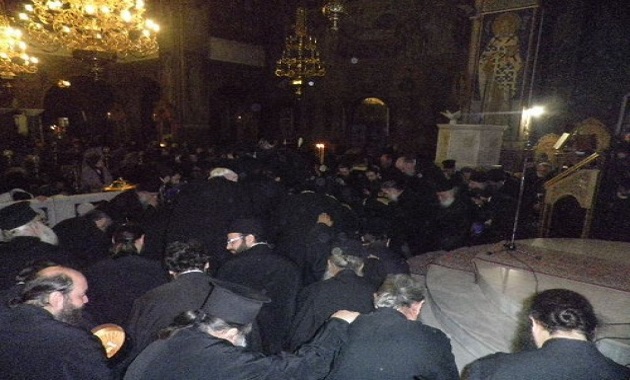 The first service of Great Lent in the Orthodox Church is “Forgiveness Vespers,” served on the eve of Monday of the First Week. There is nothing unusual about the service itself – other than the “rite of forgiveness” appended to it. In this, the priest and the faithful ask forgiveness of one another. Often this is done with mutual prostrations. Each asks the forgiveness of the other. The rite can take time, depending on the number in attendance. When it is complete, the long labors of Lent can begin. Fasting without forgiveness would be a hollow activity. This is a meditation I shared with my parish this week as the Sunday of Forgiveness approaches:
 Perhaps the most generous words spoken by Christ are those we hear from the Cross: “Father, forgive them, for they do not know what they are doing.” Taken at face value, the words make little sense. Surely, those who crucified Christ knew that they were killing a man. Surely they were even aware that his execution was largely political and unjust. The centurion in charge of the crucifixion is said to have stated, “Surely this man was the Son of God.” So how could Christ say, “They do not know what they are doing?”
I believe this goes to the very heart of our lives and actions. We almost never know what we are doing. The greater context, the meaning of anything, is hidden from us. We have children, work at a job, and live our lives, hoping that these have been worthwhile actions. We know that much, even most of what we have done has been tainted with bad intentions and other less-than-worthy motivations. But we never actually grasp the full scope of our actions. Even those good things that we do have a hidden aspect. Did that kind word spoken earlier make a difference? Did that act of charity actually change anything?
This hidden aspect of our lives is an inherent part of the human condition. We simply don’t know what we’re doing. This makes it very hard for us to judge our actions or to weigh them for their value.
Christ’s words are addressed to the Father on behalf of all of humanity. For it is not just the small number of people in Jerusalem who were consenting to His death. His death is “on behalf of all and for all.”
And this brings us to Forgiveness Sunday. “Why do I need to ask forgiveness of others if I have done them no wrong?”
The simple answer is: You don’t know what you have or have not done. But it is commonly understood in Orthodoxy that “each person is responsible for the sins of the whole world.” Our lives are deeply connected—we are never uninvolved in the lives of others. What I have done and what I have not done both effect the lives of the whole world. A child dies on the other side of the world. I may have had no direct hand in the death, and yet I cannot excuse myself as if I have no share in what happens everywhere. The world is as we make it.
I once heard a monk say, “The person of prayer does not need to go any further than his own heart to find the source of all violence in the world.”
But none of this is to call us to a morbid guilt. It calls us to Christ and calls us to hear His words. On Forgiveness Sunday each of us asks forgiveness of the others around us. It is both a personal matter and collective. I have failed and need forgiveness. We have failed and need forgiveness. And perhaps the even greater call comes to us to join ourselves with Christ who says: “Father, forgive them!”
“Forgive me,” we say. “God forgives us all,” comes the response. It sometimes feels awkward, even embarrassing. Some people begin to weep. Others begin to giggle. Both are part of the human condition within our shame. But the actions of Forgiveness Sunday unite us necessarily to the actions of Christ. By submitting Himself to crucifixion, Christ put Himself in the place of the sinner, the one needing forgiveness. He was displayed naked, nailed on high for all the world to see (“on His shoulders He bore our shame,” Isaiah prophesied).
In the mild social embarrassment of saying, “Forgive me,” to another human being, we unite ourselves to the deep, profound healing shame of Christ. And with brazen boldness we confess, “God forgives us all!” uniting ourselves with the priestly cry of Christ Himself, “Father, forgive them!”
And having read this, and done all that, we still will not know what we have done. But we are not saved by knowing what we do. We are saved by doing what He does.
Forgive me.
Fr Stephen Freeman
Source: glory2godforallthings.com/

Saturday, February 21, 2015
No terror on earth can be compared with that horror that I experienced in the life after death ( Nun Tatiana )

Following the early morning service, at 5:00 a.m., I had scarcely stretched out to rest, when an unusual vision began. I saw myself in St. Petersburg, on Vasiliev Island. I was going to Divine Liturgy at the Cathedral of St. Nicholas. I was wearing my monastic Schema and sitting in a small carriage.
Suddenly I found myself in a dark square. Frightened and overcome by trembling, I ran in different directions, looking for a way out of this terrible situation. Suddenly, I saw hundreds of people coming. They were all laypeople. Their faces were dark, smitten with an everlasting sadness, with faces just like my own face.
“Who are you?” I asked them.
They answered: “ We have suddenly passed over to Eternity, just as you have.”
What I felt at that moment defies description! Fear and trembling permeated my entire being. Just then, a radiant man, whose countenance was veiled by the light he was emitting, came to me and said, “Follow me.” And he took me to the place where the souls of the dead are judged.
He took me past forests, steppes, and buildings. The steppes were endless, and I understood that I had left behind my life on earth and that I had entered into life beyond the grave, but unprepared and unexpectedly.
He then led me into a chamber, where a multitude of laypeople – men and women, adults and children – were assembled. They were all possessed by a perpetual grief. There was a lady sitting at an enormous table in the middle of the chamber, and she said to me: “This place is prepared for you until the Second Coming of the Lord.”
I looked at all of the people there and asked: “What do you do here? Do you pray to God in this place?”
They replied sorrowfully: “In Eternity the Lord will not listen to us, because we have behaved carelessly during our life on earth. We will never have the boldness to call upon the Name of the Lord. When we were living on earth, we were given the task of suffering after ourselves and of praying for our souls. The command of Christ, ‘Pray without ceasing’ (Thessalonians 5:17), was our duty. Although we should have said the Jesus Prayer throughout our lives, with our every breath, we paid no attention to the state of our hearts. But just as one cannot live without air, so also the soul dies without unceasing prayer. We were individuals who conducted ourselves properly; we fulfilled all of our duties – but not the most important one, that of prayer.”
When I heard this, I began to pray and make the sign of the Cross. And what happened? To my horror, I realized that even the sound of my voice was coming back to me! I looked about me and saw a metal ceiling, walls, and a painted wooden floor. I then began to shake with fear from the awareness that I could not run away from that unpleasant situation.
The people around me said: “In Eternity, the Lord will not listen to us. Only those who are alive on earth can remember us before Him.”
And then the lady began speaking to me: “These people were good Christians. They loved the Lord and performed good deeds for their neighbor, but they did not acquire the Lord in their souls. They ended up here, like you, because of their negligent lives, since they thought that everyone lived the same way.”
“Oh!” I said. “Oh, how I am tormented and suffer! It is as if fire is burning me!” I fell down, with the sensation that my body was being separated from my bones.
“What kind of life did you desire?” the lady asked me. I replied, shaking: “I would have liked the kind of life such that, when I died, I would see earthly and heavenly things, the Lord and the Mother of God.”
At this point, the lady smiled and said: “Only the Saints enter Eternity in this way – those who, through the Jesus Prayer, acquired the Lord in their hearts while they were alive. But you are a nun, and yet you did not teach yourself this! By means of this prayer, the Grace of God comes to dwell in you, and when the soul is parted from the body, it is with Christ and does not feel this trembling that you are now experiencing. Paradise is in a man’s soul; where the Lord is present, there Paradise is also. You should speak about your vision to all monastics and to all Christians who live on earth and are going to perdition on account of their negligence. Only do not speak of it to unbelievers and those whose faith is weak. The Almighty is able to raise up a man who has been dead for a hundred years, in order to prove that there is life after death; but a person so raised would not be believed, and they would kill him.”
While the lady was uttering these words, I suddenly felt some hope that I would be returning to earth! All of those who were in the metal chamber pierced me with their glares, saying: “Well, then, do you intend for her to leave this fearful torture chamber?”
The lady continued: “If someone dies while saying the Jesus Prayer, his soul stands in the presence of the Lord, and he will be inseparable from Him for eternity. Likewise, if a man dies while uttering the prayer, ‘Most Holy Theotokos, save me, a sinner,’ then he will be inseparable from the Mother of God. If someone is not able to utter even a single word, then, if he struggled to attain this prayer during his life on earth, his soul will say it for him on his deathbed. The state in which the soul leaves the body is the state in which it abides forever. There will be no change for the better. Only if one is commemorated (on earth) can he alter the state of his soul.”
Then she said: “O monastics, monastics! You call yourselves monks and nuns, saying that you have abandoned worldly things. But just how do you live? You do not entrust all your problems to God and the Mother of God, but you think: ‘I need to have this and that; I cannot live without this thing or the other thing.’ The Mother of God does not look after such monastics, either in this life or in the next. She only looks after those who entrust all of their problems to her, who withstand afflictions, poverty, and illness in the name of the Mother of God and say: ‘These things must be pleasing to the Queen of Heaven; they have all come upon me in accordance with the will of the Most High.”
“Do you want me to show you the negligent monastics?” the lady continued. “Look.”
And I saw nuns coming towards me – those who served in the Altar and stole money, forever holding in their hands the pieces of paper on which were recorded the people whom the money belonged.
There also came others, who failed to preserve their chastity. Among them were chanters, whose faces were grief-stricken, like my own, wounded by an everlasting sorrow.
“Chant a hymn to the Mother of God; I want to hear one!” I said.
And they responded: “We no longer have such boldness, for when we were living in the monastery, we did not serve her with a pure heart.”
I wept bitterly, for on account of our inattentiveness we were deprived of this blessing of chanting hymns to the Lord and His All-Holy Mother.
* * *
After all of these things that I saw and heard, the man who had taken me into the judgment chambers came and told me: “We will now go to the place where your soul is separated from your body.”
I suddenly awoke on my bed. I was afraid to move. I looked all around my cell, tidied it up, made the sign of the Cross, and uttered a prayer: ‘Glory to God, it was only a dream!’ I had barely managed to say these words, when I suddenly found myself back in the next life, and the man who had been guiding me said to me: “Do not think that you were dreaming. You really were in the life beyond the grave!”
I suddenly awoke on my bed. I was afraid to move. I looked all around my cell, tidied it up, made the sign of the Cross, and uttered a prayer: ‘Glory to God, it was only a dream!’ I had barely managed to say these words, when I suddenly found myself back in the next life, and the man who had been guiding me said to me: “Do not think that you were dreaming. You really were in the life beyond the grave!”
I fell on my knees before him: “Woe is me! How miserable I am! I am back here again. Why was I only concerned about the things in my cell and not about running to get away?”
“Follow me,” he told me. “We will visit many places for twenty days, and afterwards we will return to the place that has been prepared for you to abide in until the Second Coming of the Lord.”
I wept and was unable to walk. He turned his face and looked at me with compassion. I asked him: “Are you my Guardian Angel?”
“Yes,” he replied.
I began to implore him: “Pray to the Most High and return my soul, so that I may repent.”
Then my Guardian Angel said; “I will take you back, but under one condition: that you tell of all that you saw and heard here.”
“Follow me,” he told me. “We will visit many places for twenty days, and afterwards we will return to the place that has been prepared for you to abide in until the Second Coming of the Lord.”
I wept and was unable to walk. He turned his face and looked at me with compassion. I asked him: “Are you my Guardian Angel?”
“Yes,” he replied.
I began to implore him: “Pray to the Most High and return my soul, so that I may repent.”
Then my Guardian Angel said; “I will take you back, but under one condition: that you tell of all that you saw and heard here.”
I fell on my knees and promised that I would do all of this. And suddenly, at that very moment, I felt joy in my soul. The Angel said to me: “The Lord is not in your heart, but you have promised to acquire Him. If you are overcome by foolish embarrassment and do not fulfill your promise, then you will return here to your previous place. I will be with you and I will observe how you do all of these things.”
At once I was back on my bed. I sprang up, seeing the man standing beside my bed. I ran to my cell-attendant, saying: “I was in the life after death!” After that, I ran from there to the door, to tell all of the Sisters. The man was still standing on the same spot. I was afraid that something was going to happen to me. I opened the door to tell the Sisters everything, with out embarrassment and without concealing anything. Then I saw that the man had disappeared through the wall. I went again into the corridor in a state of rapture; I summoned the Sisters.
They hastened to surround me and were astonished at the extraordinary change that they saw in me, which had come over me in such a short span of time. They had seen me totally calm twenty minutes earlier at our regular service. I fell on my knees before them and told them that from this moment on I would change completely.
No terror on earth can be compared with that horror that I experienced in the life after death. And to this day, I constantly speak with everyone about what I saw, without any hesitation. Amen!
From the Greek translation, by the Holy Monastery of Ss. Cyprian and Justina in Fili, Greece, of the Russian book, “Orthodox Miracles in the Twentieth Century”, pp. 305-311.
No terror on earth can be compared with that horror that I experienced in the life after death. And to this day, I constantly speak with everyone about what I saw, without any hesitation. Amen!
From the Greek translation, by the Holy Monastery of Ss. Cyprian and Justina in Fili, Greece, of the Russian book, “Orthodox Miracles in the Twentieth Century”, pp. 305-311.
ΑΓΑΠΑ ΚΑΙ ΚΑΝΕ ΟΤΙ ΘΕΣ ( Γερόντισσα Γαβριηλία )

- Ο προορισμός του Ανθρώπου;…. «Εντολήν καινήν δίδωμι υμίν ίνα αγαπάτε αλλήλους». Ο προορισμός πάλι είναι η Αγάπη. Τίποτε άλλο. Μην κάνεις τίποτε άλλο… Αλλά τι θα πει Αγάπη; Όταν βλέπεις έναν άνθρωπο, να παύεις να υπάρχεις εσύ, πραγματικά, ως οντότητα, και να μπεις μεσ’ την ψυχή του. Μα είναι κακοποιός… Μα είναι κάτι που δεν το καταλαβαίνεις… Θα μπεις! Γιατί έχει κι αυτός μέσα του την Πνοή του Θεού, τον Σπινθήρα του Χριστού. Και έχει μια καρδιά που χτυπά σαν τη δική σου. Μ’ άλλα λόγια, εσύ ο ίδιος αντικατοπτρίζεσαι μέσα του. Αν δεν το κάνεις αυτό, δεν μπορείς να βοηθήσεις τον άλλο. Και τι ωφελεί να αγαπούμε μόνο τον Θεό με τα χέρια ψηλά προς τον Κύριο, καθέτως, και να μην τ’ ανοίξουμε και οριζοντίως, να πάρουμε όλη την Ανθρωπότητα, εάν είναι δυνατόν, και να γίνει έτσι το σώμα μας το σημείο του Σταυρού;
- …Το σημείο του Σταυρού… Πιάνει τα τέσσερα σημεία του ορίζοντα και μέσα σ’ αυτά, κλείνει όλο τον κόσμο. - Και ξέρετε μαζί μ’ αυτά τι κλείνει; Τη μεγαλύτερη ευδαιμονία, γαλήνη, ειρήνη, πραότητα. Έλεος και Αγάπη Θεού μεσ’ την καρδιά μας. - Δηλαδή, η δική σας αρχή ποια είναι; - Δεν είναι δική μου. Είναι αυτό που είπε ο Άγιος Αυγουστίνος: «Αγάπα και κάνε ό,τι θέλεις» γιατί άμα αγαπάς, δεν μπορείς να κάνεις κακό!
Γερόντισσα Γαβριηλία, Η ασκητική της αγάπης, εκδ. Τάλαντο, σ. 66
Should Jesus scare us? ( Saint Porphyrios )

“There is no fear in love, but perfect love casts out fear. For fear has to do with punishment, and whoever fears has not been perfected in love” (A John, 4, 18)
When you love Jesus, despite your many weaknesses and your awareness of them, you rest assured that you have overcome death because you are in communion with Jesus’ love.
We ought to feel that Jesus is our friend. He is our friend. He confirms it Himself when He says: ‘You are my friends…” (John 15, 14).We ought to look up to Him and approach Him as our friend. If we fall, if we commit an offence, we ought to approach Him with love and courage and be filled with trust bestowed to us by our mutual friendship without fearing His punishment. We ought to tell Him: ‘Yes, Lord I have done this, I have fallen, forgive me”. At the same time we ought to feel that He loves us, that He receives us with tenderness and love and that He forgives us. Let our trespasses not separate us from Jesus. If we believe that He loves us and that we love Him, we will not feel strangers, neither we will feel separated from Him, not even when we commit a sin. We have secured His love and no matter what we do, we know that He loves us.
The Gospel, speaking allegorically, warns that the unjust will be taken to the place where there will be “weeping and gnashing of teeth” (Matthew 25, 30); indeed this is how it is going to be for someone who lives away from the Lord. Several of the Niptic fathers also speak about the fear of death and of Hell. They say: ‘You must always remember death’. Such words, if examined deeply, cause the fear for Hell. Someone who is trying to avoid committing a sin nurtures such thoughts, so that his soul is overcome by the fear of death, of Hell and of the devil.
Everything has its own importance at the appropriate time and the right circumstances. The fear of death is appropriate at the early stages of spiritual struggle. It is right for the novices, for those whose old-self is still active. The novice, who has not yet had the chance to be ‘sensitized’, is kept from sinning by this fear. Fear is necessary since we have a physical nature prone to wickedness. However, this is an elementary stage, an early level of relating to the divine. At this level the relationship with the Lord becomes a transaction: to gain Paradise and to avoid Hell. If we examine this properly we will see that it reeks from some kind of selfishness and self-interest.
I do not like this route. As soon as one progresses and enters the love of the Lord, why does he need fear? Whatever he does, he does it out of love and this is more important. It is not worth that much if someone becomes good because he fears the Lord and not because he loves Him.
Whoever would like to become a Christian ought to become a poet first. Once the soul is knocked about it becomes undeserving of Jesus’ love; Jesus interrupts the relationship since He does not want ‘thick’ souls with Him.
When you are worshiping the divine make sure that no one sees you nor recognizes what you are doing. You ought to do all these in secret, like the ascetics. Remember when I mentioned the nightingale? It sings in the forest, when there is silence, so that no one hears it neither praises it. What a magnificent singing in the desert! Did you notice how its throat swells? The same thing happens to the person who loves the Lord. As soon as he experiences this love, his ‘throat and his tongue swell”. He runs in the wild, in the desert and communicates with the Lord in secret, “with inexpressible sighs”.
You ought to ignore your passions; do not preoccupy yourselves with the devil. Turn towards Jesus instead. Divine grace teaches us our duties. We must employ love and longing in order to draw divine grace. The grace of the Lord needs divine Eros.
Once we have acquired love, then we are ready to pray. The Lord comes to such a soul by Himself as soon as He finds some pleasing things: a good intention, humility and love. Without these we are not able to say: ‘Lord, Jesus Christ, have mercy on me”.
The slightest criticism against someone else, affects our souls and we become unable to pray. The Holy Spirit does not dare approach such a soul.
We ought to let the Lord do what He wants with us; this is more beneficial and more appropriate for ourselves and for those whom we are praying for. Jesus will hand over all things in abundance. However, with the slightest selfishness, nothing can happen. The Lord has His own reasons for not giving us whatever we ask of Him. He has His own ‘secrets’.
Unless you obey your spiritual father and show humility, Jesus’ prayer (Lord, Jesus Christ, have mercy on me) will not work and you risk being deluded as well. Do not recite this prayer as a chore. If you apply pressure you may be harmed. Several people have fallen ill because they were reciting Jesus’ prayer under pressure. It can be done, of course, but it is not a healthy way to pray.
You do not have to concentrate excessively in order to recite Jesus’ prayer. You do not need special effort when you have divine Eros. Any place is appropriate for this prayer: sitting on a low chair, on an armchair, in the car, while on the road, at school, at the office, anywhere. Just say ‘Lord, Jesus Christ, have mercy on me’ gently, without pressure or feeling any tightness.
Intensity and not duration is more important in prayer. Pray even for five minutes, but your prayer ought to be offered to the Lord lovingly and with longing. This five-minute prayer may be more valuable than prayer which lasts all night. This is, certainly a mystery, but it happens.
Saint Porphyrios
When you love Jesus, despite your many weaknesses and your awareness of them, you rest assured that you have overcome death because you are in communion with Jesus’ love.
We ought to feel that Jesus is our friend. He is our friend. He confirms it Himself when He says: ‘You are my friends…” (John 15, 14).We ought to look up to Him and approach Him as our friend. If we fall, if we commit an offence, we ought to approach Him with love and courage and be filled with trust bestowed to us by our mutual friendship without fearing His punishment. We ought to tell Him: ‘Yes, Lord I have done this, I have fallen, forgive me”. At the same time we ought to feel that He loves us, that He receives us with tenderness and love and that He forgives us. Let our trespasses not separate us from Jesus. If we believe that He loves us and that we love Him, we will not feel strangers, neither we will feel separated from Him, not even when we commit a sin. We have secured His love and no matter what we do, we know that He loves us.
The Gospel, speaking allegorically, warns that the unjust will be taken to the place where there will be “weeping and gnashing of teeth” (Matthew 25, 30); indeed this is how it is going to be for someone who lives away from the Lord. Several of the Niptic fathers also speak about the fear of death and of Hell. They say: ‘You must always remember death’. Such words, if examined deeply, cause the fear for Hell. Someone who is trying to avoid committing a sin nurtures such thoughts, so that his soul is overcome by the fear of death, of Hell and of the devil.
Everything has its own importance at the appropriate time and the right circumstances. The fear of death is appropriate at the early stages of spiritual struggle. It is right for the novices, for those whose old-self is still active. The novice, who has not yet had the chance to be ‘sensitized’, is kept from sinning by this fear. Fear is necessary since we have a physical nature prone to wickedness. However, this is an elementary stage, an early level of relating to the divine. At this level the relationship with the Lord becomes a transaction: to gain Paradise and to avoid Hell. If we examine this properly we will see that it reeks from some kind of selfishness and self-interest.
I do not like this route. As soon as one progresses and enters the love of the Lord, why does he need fear? Whatever he does, he does it out of love and this is more important. It is not worth that much if someone becomes good because he fears the Lord and not because he loves Him.
Whoever would like to become a Christian ought to become a poet first. Once the soul is knocked about it becomes undeserving of Jesus’ love; Jesus interrupts the relationship since He does not want ‘thick’ souls with Him.
When you are worshiping the divine make sure that no one sees you nor recognizes what you are doing. You ought to do all these in secret, like the ascetics. Remember when I mentioned the nightingale? It sings in the forest, when there is silence, so that no one hears it neither praises it. What a magnificent singing in the desert! Did you notice how its throat swells? The same thing happens to the person who loves the Lord. As soon as he experiences this love, his ‘throat and his tongue swell”. He runs in the wild, in the desert and communicates with the Lord in secret, “with inexpressible sighs”.
You ought to ignore your passions; do not preoccupy yourselves with the devil. Turn towards Jesus instead. Divine grace teaches us our duties. We must employ love and longing in order to draw divine grace. The grace of the Lord needs divine Eros.
Once we have acquired love, then we are ready to pray. The Lord comes to such a soul by Himself as soon as He finds some pleasing things: a good intention, humility and love. Without these we are not able to say: ‘Lord, Jesus Christ, have mercy on me”.
The slightest criticism against someone else, affects our souls and we become unable to pray. The Holy Spirit does not dare approach such a soul.
We ought to let the Lord do what He wants with us; this is more beneficial and more appropriate for ourselves and for those whom we are praying for. Jesus will hand over all things in abundance. However, with the slightest selfishness, nothing can happen. The Lord has His own reasons for not giving us whatever we ask of Him. He has His own ‘secrets’.
Unless you obey your spiritual father and show humility, Jesus’ prayer (Lord, Jesus Christ, have mercy on me) will not work and you risk being deluded as well. Do not recite this prayer as a chore. If you apply pressure you may be harmed. Several people have fallen ill because they were reciting Jesus’ prayer under pressure. It can be done, of course, but it is not a healthy way to pray.
You do not have to concentrate excessively in order to recite Jesus’ prayer. You do not need special effort when you have divine Eros. Any place is appropriate for this prayer: sitting on a low chair, on an armchair, in the car, while on the road, at school, at the office, anywhere. Just say ‘Lord, Jesus Christ, have mercy on me’ gently, without pressure or feeling any tightness.
Intensity and not duration is more important in prayer. Pray even for five minutes, but your prayer ought to be offered to the Lord lovingly and with longing. This five-minute prayer may be more valuable than prayer which lasts all night. This is, certainly a mystery, but it happens.
Saint Porphyrios
http://agapienxristou.blogspot.ca/2013/03/should-jesus-scare-us.html
Subscribe to:
Posts (Atom)