St. Basil the Great
Translate
Friday, July 2, 2021
Saying thank you to God... ( St. Basil the Great )
St. Basil the Great
Saturday, June 5, 2021
The Holy Scriptures , about false miracles
"Let no one be found among you who sacrifices his son or daughter in the fire, who practices divination or sorcery, interprets omens, engages in witchcraft, or casts spells, or who is a medium or spiritist or who consults the dead. Anyone who does these things is detestable to the Lord , and because of these detestable practices the Lord your God will drive out those nations before you" (Deuteronomy 18:10-13).
"When men tell you to consult mediums and spiritists, who whisper and mutter, should not a people inquire of their God? Why consult the dead on behalf of the living? To the law and to the testimony! If they do not speak according to this word, they have no light of dawn" (Isaiah 8:19-20).
"All the counsel you have received has only worn you out! Let your astrologers come forward, those stargazers who make predictions month by month, let them save you from what is coming upon you. Surely they are like stubble; the fire will burn them up. They cannot even save themselves from the power of the flame. Here are no coals to warm anyone; here is no fire to sit by" (Isaiah 47:13-14).
"So do not listen to your prophets, your diviners, your interpreters of dreams, your mediums or your sorcerers who tell you, 'You will not serve the king of Babylon.' They prophesy lies to you that will only serve to remove you far from your lands; I will banish you and you will perish" (Jeremiah 27:9-10).
"The days of punishment are coming, the days of reckoning are at hand. Let Israel know this. Because your sins are so many and your hostility so great, the prophet is considered a fool, the inspired man a maniac" (Hosea 9:7).
"Thus, by their fruit you will recognize them. … Many will say to me on that day, 'Lord, Lord, did we not prophesy in your name, and in your name drive out demons and perform many miracles?' Then I will tell them plainly, 'I never knew you. Away from me, you evildoers!" (Matthew 7:20-23).
"He who is not with me is against me, and he who does not gather with me scatters" (Matthew 12:30).
The prophecy of the Savior about the last times:
"For false Christs and false prophets will appear and perform great signs and miracles to deceive even the elect--if that were possible. See, I have told you ahead of time. " (Matthew. 24:24-25).
Apostle John the Theologian:
"Dear friends, do not believe every spirit, but test the spirits to see whether they are from God, because many false prophets have gone out into the world" (1 John 4:1).
Apostle Paul:
"Jews demand miraculous signs and Greeks look for wisdom, but we preach Christ crucified: a stumbling block to Jews and foolishness to Gentiles, but to those whom God has called, both Jews and Greeks, Christ the power of God and the wisdom of God" (1 Corinthians 1:22-24).
"The Spirit clearly says that in later times some will abandon the faith and follow deceiving spirits and things taught by demons. Such teachings come through hypocritical liars, whose consciences have been seared as with a hot iron" (1 Timothy 4:1-2).
About the antichrist:
"And then the lawless one will be revealed, whom the Lord Jesus will overthrow with the breath of his mouth and destroy by the splendor of his coming. The coming of the lawless one will be in accordance with the work of Satan displayed in all kinds of counterfeit miracles, signs and wonders, and in every sort of evil that deceives those who are perishing. They perish because they refused to love the truth and so be saved" (2 Thessalonians 2:8-10).
"He exercised all the authority of the first beast on his behalf, and made the earth and its inhabitants worship the first beast, whose fatal wound had been healed. And he performed great and miraculous signs, even causing fire to come down from heaven to earth in full view of men. Because of the signs he was given power to do on behalf of the first beast, he deceived the inhabitants of the earth. He ordered them to set up an image in honor of the beast who was wounded by the sword and yet lived. He was given power to give breath to the image of the first beast, so that it could speak and cause all who refused to worship the image to be killed" (Revelation. 13:12-15). "But the beast was captured, and with him the false prophet who had performed the miraculous signs on his behalf. With these signs he had deluded those who had received the mark of the beast and worshiped his image. The two of them were thrown alive into the fiery lake of burning sulfur" (Revelation. 19:20).
About the future capital of the world state (Babylon):
"The light of a lamp will never shine in you again. The voice of bridegroom and bride
will never be heard in you again. Your merchants were the world's great men. By your magic spell all the nations were led astray. " (Revelation. 18:23).
Saturday, April 24, 2021
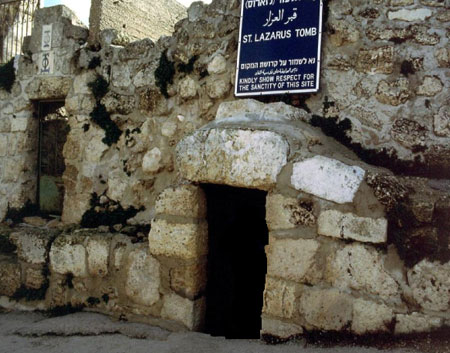
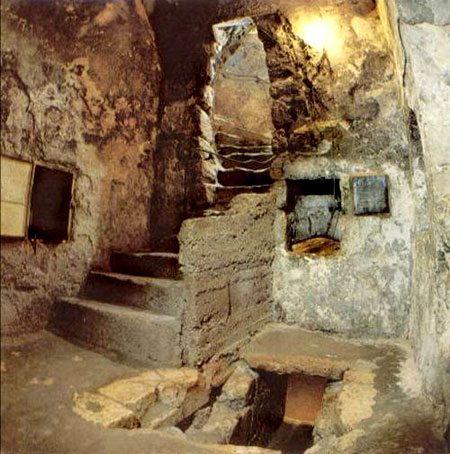
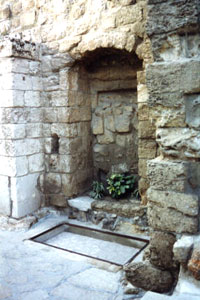
In the Tomb of Lazarus


One of the hymns of the Vigil of Lazarus Saturday says that Christ ”stole him from among the dead.” I rather like the phrase. Next weekend there will be no stealing, but a blasting of the gates of hell itself. What he does for Lazarus he will do for all.
Lazarus, of course, is different from those previously raised from the dead by Christ (such as the daughter of Jairus). Lazarus had been four days day and corruption of the body had already set in. ”My Lord, he stinks!” one of his sisters explained when Christ requested to be shown to the tomb.
I sat in that tomb last September, as I mentioned in my last post. It is not particularly notable as a shrine. It is today, in the possession of a private, Muslim family. You pay to get in. Several of our pilgrims did not want to pay to go in. I could not stop myself.
Lazarus is an important character in 19th century Russian literature. Raskolnikov, in Crime and Punishment, finds the beginning of his repentance of the crime of murder, by listening to a reading of the story of Lazarus. It is, for many, and properly so, a reminder of the universal resurrection. What Christ has done for Lazarus He will do for all.
For me, he is also a sign of the universal entombment.
That even before we die, we have frequently begun to inhabit our tombs. We live our life with the doors closed (and we stink). Our hearts are often places of corruption and not the habitation of the good God. Or, at best, we ask Him to visit us as He visited Lazarus.
That visit brought tears to the eyes of Christ. The state of our corruption makes Him weep. It is such a contradiction to the will of God. We were not created for the tomb.
I also note that in the story of Lazarus – even in his being raised from the dead – he rises in weakness.
He remains bound by his grave clothes. Someone must ”unbind” him. We ourselves, having been plunged into the waters of Baptism and robed with the righteousness of Christ, too often exchange those glorious robes for grave clothes.
Christ has made us alive, be we remain bound like dead men.
I sat in the tomb of Lazarus because it seemed so familiar.
Saturday, April 10, 2021
Why our intention to correct ourselves and lead a holy life remains without result ...
A certain sinner, for example, says to himself: “It’s high time for me to stop sinning, time to mend my ways! I repent! I’ll stop sinning!” The intention is quite indefinite. And because of this, although it might be sincere, it is unreliable and may not achieve the desired correction.
He who has a sincere desire to amend himself must first of all determine exactly what it is that must be corrected. He must determine what his greatest sin is and what means he must use against it, and what dangers he must avoid so as not to fall into it again, since it has become a habit, a part of his life. All this thought and self-examination must come first and only then should a resolve be made, and that resolve should be specific as, for example: “Enough is enough! With God’s help I am no longer going to fall into such-and-such a sin; I’m going to break this bad habit; I’m no longer going to associate with those particular people who encourage me in this habit; I’m going to break off that unhealthy relationship; I’m going to use such-and-such means against this sin; I’m going to arm myself and muster all my forces against it when it begins again to tempt me.”
The same thing must also be said about the resolution to lead a righteous life. By no means is it enough to content oneself simply by stating the following resolve: “From this time forth I’m going to lead a God-pleasing life.” Such a resolution is not definite enough, and although it may have come from the heart, it is doubtful whether it will have any effect.
He who desires to abandon a life of sin and live a righteous life must first of all examine which obligations he has most difficulty in fulfilling and does not like to fulfill; what exactly hinders their fulfillment; what he must do, what means he must employ to fulfill them more readily. Having done this, he must make a specific resolve, as for example: “Now, with God’s help I will try hard to fulfill this obligation which until now I have done so poorly; I will apply myself to using such-and-such means towards its fulfillment.
In general, the more definite one’s intention to change one’s sinful life and live righteously, the more it will suit the particular circumstances, the state of one’s soul, one’s relationship with others, etc., and the more hope there is of its bringing it into reality. When something is so definite one can more easily direct one’s thoughts and one’s strength to one subject and thus, of course, more easily achieve the desired goal.
Another reason why our good intentions fail, is because we do not hold firmly enough to our resolve. Scarcely two or three days pass by after our having made our resolution and we, in our normal daily routine of life amidst our worldly cares and pursuits, have already forgotten our intention, although at the time it was made with proper firmness of purpose. For this reason, if we truly wish our good intention to be realized, then each of us, every morning after our morning prayers, must immediately bring to mind and renew our resolution, saying in our hearts: “I promised God to turn away from this particular sin; I really wanted to fulfill this obligation; I must keep my promise!” Having renewed in this way our good intention, we must diligently pray to God that He would grant us the necessary strength to carry it out.
Likewise, our intention must be renewed in this way throughout the course of the day. And when evening comes, we should never go to sleep without having first examined our hearts to see how we have spent the day: did we keep our promise to God? And if it happens that we went against our resolve, against our promise, then we must immediately ask God’s forgiveness, and once again renew our resolve and carefully watch over ourselves. This is the way in which those people act who are concerned for the salvation of their souls, and in this way they attain salvation!
The third reason we fail in our intention to lead a better life, is our excessive fear of the difficulties connected with such an undertaking. A holy life is not attained without work, without sufferings and difficulties; it often takes a prolonged and fierce battle. We must withdraw from occasions to sin, of which there are so many. We must sacrifice various enjoyments which are so pleasant, abandon many worldly pursuits which make life interesting, and endure many unpleasant things which because of our self-love are often so difficult to bear.
For example, let us suppose that we resolved to withdraw from our natural inclination to become angry. In order to turn away from anger we must quietly endure a lot of what is to us almost unbearable, and to which our usual response would have been a stream of crude words; sometimes we must not justify ourselves even when we are in the right; often we must be silent when we feel the urge to speak; often we must give in to others even when the occasion does not demand it; we must often bear the offenses of others and not reveal our irritation; often force ourselves to patiently endure when we are slandered or laughed at like fools and cowards.
We must remember the millions of righteous ones, who have gone before us and their self-denial, patience and endurance which they left as an example for us and for the whole world. We must remember that, above all, God desires our correction, and because of this, knowing our weakness and our needs, He will unfailingly come to our aid if only we turn to Him with fervent prayer and make use of the means and the power which He has given to us.
We must remember that the difficulties which invariably accompany any important undertaking are intimidating only to the lazy and faint-hearted; that only the first steps along the path of correction are unpleasant and difficult; that the farther one goes along such a path the easier and less painful it becomes; that any victory which we gain over our enemy makes us much stronger and better able to endure any further onslaughts. We must more often remind ourselves of the feeling of peace and satisfaction we shall experience when in the last days and hours of our life we look back at our past, at the difficulties we have heroically overcome, at the many sufferings borne with Christian patience, at the countless temptations conquered by our love for God, at all the noble deeds which we performed in secret before God’s eyes alone, at all the favors which we showed our fellow man, at the faithfulness with which we fulfilled our obligations, often forcing ourselves to the utmost to do this.
Finally, we must more often remind ourselves that for all this we will be rewarded by so much in the life of the age to come that all the difficulties which we overcome here in this life, all the sufferings which we endure in this age for the sake of a righteous life, will appear to us much smaller; in fact, they will appear insignificant, in comparison with the heavenly rewards.
O, Almighty God! Now we count each minute of trial and suffering and we rarely consider the blessed eternity which delights the souls of Thy righteous and faithful servants. Brother! In your striving towards a God-pleasing life, when you weigh your earthly difficulties and grief, place more often on the scale this eternity! It will outweigh all your trials, all the pleasures of worldly pursuits, pleasures and enjoyments.
The fourth reason that our resolution to lead a better life often fails, lies in the fact that we want immediately to become saints. Many people, when they once feel an aversion to their sinful behavior, make a firm resolve to change their ways and place a good beginning towards this reform; but because this doesn’t happen as quickly as they would like, and whether by habit or rashness they often fall into their old sins, they lose heart and come to the conclusion that it’s impossible for them to change their ways.
Brother! Sister! People don’t become saints overnight. Our old man does not easily yield to being transformed into the new man. A big tree is not felled by a single stroke of the ax. So it is with each evil passion which’ is so firmly rooted in us. The way to perfection or to spiritual maturity is almost always unnoticeable, just as are so many things in nature.
A spiritual man passes through various stages of growth, just like the physical man. Much time is spent in childhood before reaching the fullness and strength of manhood. There is a long period of weakness, and only then does one become stronger and stronger, until finally one becomes a man. Only at this age is one capable of doing what is proper to a man. Likewise, a ripened ear of corn is at first only a seed, then a small blade of grass, then a stalk, and finally an ear of corn; but even this ear is not ripe all at once, but grows, then flowers, then it tassels and only then does it become ripe. The same is true of a righteous, life! Even the best man in the world does not suddenly become a saint. His perfection for the most part develops slowly and only little by little. Good earth which accepts into itself a good seed brings forth fruit, says the Lord, in patience. (Lk 8:15).
To fall, of course, is not good, and it were better not to; but he who falls and then quickly gets up, becomes wiser and more careful, renews his good intention, fervently prays to God for new strength to attain a righteous life. Falls are not such a hindrance for such a man on the path to perfection. At the time of his fall, when he falleth, he shall find a stay, i.e., strength (Sir 3:31) and like the Apostle Paul, strikes ahead towards the mark of the prize of the high calling, forgetting those things which are behind. (Phil 3:13).
The above, then, are some of the reasons why our good intentions to turn away from sin and lead a better life are often unfulfilled. Let us avoid these pitfalls; let us try to make our resolution as definite as possible; let us remember more often and continually to renew our decision, and let us not become faint-hearted if we do not at once reach perfection, but let us courageously surmount the difficulties we meet along the way in firm hope of God’s help.
From “The Conversations of Metropolitan Gregory of Novgorod,” translated from the monthly periodical of St. Panteleimon’s Monastery on Mt. Athos, January 1899, pp. 15-19.
Saturday, March 27, 2021
The essence of Orthodoxy - St. Justin Popovich

- St. Justin Popovich
Friday, March 12, 2021
Judgment Sunday Teaches us that God is a Just Judge

parables of "the Publican and the Pharisee" and especially "the Prodigal Son" were used to emphasize God's infinite compassion and goodness. However, realizing that this could possibly prompt people to incorrectly and falsely hope in God's forgiveness alone, while foolishly ignoring His commandments, living with indifference, persisting in sin, and squandering the time that has been given
to them to acquire salvation, the holy Fathers appointed that we commemorate and bring to mind the Second Coming of Christ on this day in order to underline and remind us that God is not only a compassionate Lord, but also a righteous
Judge Who renders to each man according to his works.
Last Sunday through the parable of the prodigal who was saved, the Church commemorated God’s incomparable love for mankind. This Sunday it teaches us about His terrifying Judgment to come, following the right order and in accordance with the prophetic sayings: “I will sing of mercy and of judgment” (Ps. 101:1), and, “God hath spoken once: twice have I heard this; that power belongeth unto God. Also unto thee, O Lord, belongeth mercy: for thou renderest to every man according to his works” (Ps.62:11-12).
When You come, O God, to the earth in glory, the entire universe will tremble [with fear]. A river of fire will flow forth from Thy judgment seat. Books will be opened, and the secret [deeds of men] will be publicized. At that time, deliver me from the inextinguishable [eternal] fire, and deem me worthy of standing on Your right, O most-righteous Judge.
Wednesday, February 24, 2021
Treating an addict ( Elder Thaddeus of Vitovnica )

The official statistic then in Serbia say that one in a thousand patients could get away from drugs.
When they started to come from Belgrade , father, mother and son , for a long time, they were quarreling in the car . Fortunately for the young mother she kept her composure .
At that time , their son was able to sleep twenty-four hours and the other twenty-four hours he could not sleep because his nervous system was completely upside down .
With the help of God, they arrived at the monastery and the elder immediately spoke with them .
At first , father and son , voiced complaints that they had from each other but then they calmed down . After the son was left alone with the elder . Father Thaddeus spoke with him with patience and great love and recited prayers for his health. All throughout the course of the prayer, Father Thaddeus caressed the head of the young man in the same way that a mother caresses her child.
After that, they all went into the car and were on their way back. The young man fell asleep during their return to Belgrade . His mother immediately sensed that something good was happening to her son because her son before wasn't able to sleep at all.
Twenty-five years later, the former drug addict got married and has two children . He never returned to the bad drug habit .
Elder Thaddeus of Vitovnica
Wednesday, February 10, 2021
God is everywhere. ( St. Joseph the Hesychast )
We breathe God, we eat God, we clothe ourselves with God. Everything praises and blesses God. All of creation shouts His praise. Everything animate and inanimate speaks wondrously and glorifies the Creator. Let every breath praise the Lord!”
St. Joseph the Hesychast
Sunday, January 31, 2021
A MIRACLE OF THE ARCHANGEL MICHAEL WITH SUDAN AIR...

The captain checked the instruments one last time and then announced to the control tower that everything was ready for takeoff. The control tower gave the pilot the latest meteorological forecast for the trip. All indications showed that the weather was good for the planned trip and the tower wished the captain a good flight. Within a short period of time the airplane was racing down the runway and lifting up into the morning sky like a huge bird on its way to its destination which was 500 miles away. The plane had covered about 100 miles and everything appeared that they would have a great flight with blue skies in every direction. The young passengers were enjoying the great views of the ground below. The topography below them appeared like a huge live map with villages, rivers and verdant plains. The airplane hostess continuously pointed out to the students what they were seeing below.
The airplane was being bounced around like a toy in the fearful arms of the storm. The plane was creaking and the altimeter was now at 12,000 feet. The captain calmly began a descend. He kept moving down to 8,000 feet, then to 6,000, then 5,000, 4,000, 3,000, and then 2,000 feet and the conditions were the same. At this altitude the pilot was now afraid that he might hit a mountain top and so he began to climb again. He ascended up to 8,000 feet and then attempted to contact the control tower with his wireless radio to report his situation, his location and to report the weather conditions. Instead of receiving a weather report, he found that the wireless was dead. He then immediately turned on the plane radio and that too was silent. He felt a cold hand squeeze his heart. He looked at a map and attempted to find his exact location but this was also useless. In his attempt to avoid the terrible storm, he had lost all sense of direction. He also could see that the co-pilot was in a state of total panic. Seeing the panic in the eyes of his co-pilot, the captain again tried to communicate with the tower with his wireless radio.
Time was passing and the plane was scheduled to land at its destination in two and a half hours. The fuel supply was getting critically low. There was no help and no light at the end of the tunnel. The passengers knowing how long the flight should have taken began to cry. Even the stewardess lost control of her emotions and she could no longer offer any help to the passengers.
He was of Greek ancestry and his mother hailed from the village Sikamnia, Mytilene. He remembered that as a small boy, he visited his mother’s village, Sikamnia in order to visit his grandmother and his relatives. He even remembered that his pious mother would often speak to him about the miracle working icon of the Archangel Michael in Mandamadou. He remembered that he had visited Mandamadou as a young boy in order to venerate the miracle working icon of the Archangel. He also remembered that he felt a chill go through his body when he first saw the bas-relief of the Archangel Michael. He was now hearing clearly the words of the elders who said to him about the icon: “The Arab, my child, when you call upon him with faith he will always be with you, willing to help you. We have witnessed many miracles first hand during the wars.” Remembering this pilgrimage from his youth, the captain regained hope and truly believed in the power of the Archangel Michael. He lifted up his hands and shouted with a load voice: “My Archangel, my Arab, save us, save us, and I promise to light a candle in your honor as tall as I am and I will also offer you a gold image of our plane. These I will place before your image. “
As the captain was relating this story to a priest of the Church in Mandamadou, Greece, Nicholas Hatzoglou, the captain of the airplane stood up trembling, turned yellow, and made the sign of the Cross. He was still living those unusual circumstances of his life and he continued to tell me the rest of the story with difficulty: “At that moment, the very black clouds opened up below us and the blue sky reappeared. It was like a curtain opening up for a theatrical performance. There below us was the airport of our destination, bathed in sunshine. I thankfully took control of the plane and in a short time we were landing at the airport. Upon landing, I looked at the fuel gage and noticed that we had only five minutes of fuel left. When the opportunity first became available to me, I took leave of my job and came here today, my dear Reverend Father, in order to thank my Saint and my savior. I offer him my thanksgiving and my reverence. I also offer him the two items that I had promised him.”
Sunday, January 17, 2021
Blessed immortality is the lot of the holy soul when it is good, and death eternal meets it when it is evil. ( St. Anthony the Great )

Monday, January 4, 2021
Christianity is a religion of revelation. ( St. Nektarios of Aegina )
St. Nektarios of Aegina
Thursday, December 17, 2020
The Ninth Beatitude- Blessed are ye when men shall revile you, and persecute you, and shall say all manner of evil against you falsely, for my sake. Rejoice, and be exceeding glad, for great is your reward in Heaven.

The courage of Christian martyrs must be distinguished from fanaticism, which is irrational zeal not according to reason. Christian courage must also be distinguished from the lack of feeling brought on by despair or pretended indifference, with which some criminals because of their incorrigible hardness and pride, serve out their sentences and go to execution.
Christian courage is based on the highest of Christian virtues, on faith in God, on hope in God, on love for God and neighbor, on complete obedience and unshaken faith in the Lord God.
The highest form of martyrdom was suffered by Jesus Christ Himself, and in like manner, the Apostles and an innumerable multitude of Christians, who with joy went to martyrdom for the name of Christ.
Wherefore seeing we also are compassed about with so great a cloud of witnesses, let us lay aside every weight and the sin which doth so easily beset us, and let us run with patience the race that is set before us, and looking unto Jesus the Author and Finisher of our faith, Who for the joy that was set before Him endured the cross, despising the shame, and is set down at the right hand of the throne of God. For consider Him that endured such contradiction of sinners against Himself, lest ye be weaned and faint in your minds (Heb. 12:1-3).
For the spiritual feat of martyrdom, the Lord promises a reward in Heaven. But here on earth the Lord glorifies many martyrs for their firm confession of faith with incorruptible bodies and miracles.
Numberless Christians martyrs rejoiced during unspeakable torture, accounts of which are preserved in factual accounts of lives of the Saints. Note: In Roman courts, special scribes were obligated to write protocols (official records) of judicial procedures and legal decisions. Such protocols of interrogations, made in Roman courts during the legal process of Christian martyrs, after the period of persecutions were carefully preserved by the Church. The protocols came to be trustworthy accounts of the feats of martyrdom of the Christians.
Wednesday, November 25, 2020
Keep saying the Jesus Prayer... ( St.Joseph the Hesychast )

Tuesday, November 17, 2020
The hand of a priest ( Protopresbyter Stephanos K. Anagnostopoulos )
Taken from Experiences During the Divine Liturgy, Protopresbyter Stephanos K. Anagnostopoulos
[While the Cherubic hymn is being sung during liturgy the priest reads the prayer which begins with the words, -ed]…”No one who is bound with the desires and pleasures of the flesh is worthy to approach…”
None of the priests ever approaches the Holy Altar, in order to serve the Divine Liturgy, trusting in his holiness. If he is ever fooled and believes that he is holy, he must not perform the Liturgy; in which case we have delusion and heresy. But at this point, we should not say much, for the more we say, the worse it is for us. Here, we do the sign of the Cross, are silent, and we priests ask for God’s mercy.
In order to comprehend what man is worth, for which God’s love can do anything, we ought to give some thought to the high ministry of the Priesthood. The priest, as a human being might not be wealthy, strong, wise and a scholar, but may be humble and insignificant. From the moment, however, he received the gift of the Priesthood and puts on “the grace of priesthood”, from that moment on the Priest receives spiritual power, which surpasses all secular power.
Saint Cosmas Aitolos used to say: “If I ever encounter the emperor of Byzantine. or the king and a poor priest on the street, I will first hasten to kiss the priest’s hand then greet the Emperor. And if I ever encounter an Angel or an Archangel or a Cherubim walking together with a priest on the same road, I will first hasten to kiss the hand of the Priest and then the hand of the Angel.”
The priest’s blessing is Christ’s blessing. It is Christ’s Grace. Whether the priest is young, or elderly, worthy, or unworthy, he bears Christ’s Priesthood, he possesses his Grace and imparts His divine Blessing.
Monday, October 19, 2020
The Five Miracles of Saint Gerasimos of Kefallonia
1. A Young Atheist Woman From Australia Converts To Orthodoxy and Becomes A Nun After Seeing the Incorrupt Relics of Saint Gerasimos
The powerful effect the incorrupt relics of Saint Gerasimos the New had a particular effect on a young Australian nun, Anna, who lives at St. Stephen's Monastery on Meteora. She related the following:
I came to Greece in 1988, hoping to get work as an English teacher. I wasn't of Greek parentage, nor did I have any particular interest in classical culture or the arts, but came because Greece sounded interesting. I had not been raised with any religion nor was I looking for one, but soon after I arrived I met some people who were planning to go to Kefallonia, to St. Gerasimos, and invited me along. It seemed a good way to begin seeing the country, and I agreed. When I entered the church and stood before the saint's coffin, I was stunned by what I saw - the incorrupt relics were so obviously a miracle that I knew in myself that there must be a God, and that Orthodoxy was how you worshipped Him. I was baptized and a year later I came to the monastery.
2. The Cave of Saint Gerasimos and Unbelievers
The older church containing the relics of St. Gerasimos is built directly over his cave and pilgrims are welcome to descend the ladder and squeeze through the tiny floor-level entrance that leads into the cave. Local Christians say that only believers can wriggle through the narrow passageway. The wife of an Argostoli priest has informed that, wanting a blessing for her unborn child, she had squeezed through with no trouble when she was fully nine months pregnant, but the thin, lithe young woman whom she brought with her - an unbeliever - couldn't do so.
3. The Epidemic of Cholera in 1760
In 1760, when an epidemic of cholera struck the island, a nun named Akakia had a vision of the saint, praying in front of an icon of the Mother of God, beseeching her to halt the epidemic. The Mother of God spoke from the icon and said, "I have asked my Son, and He will grant you this." Then the saint caught hold of a roll of a cotton-like material wrapped around his staff, and began plucking off many small pieces, scattering them into the air. That night he also appeared to another woman on the island, telling her to go quickly to her father's house - that the infection would not spread to the countryside.
The stories of these visions quickly made the rounds of the villages. One local woman, however, refused to believe the accounts, and scoffed at them saying, "These are stories for children." That night the saint appeared to her in a dream and struck her with his staff, saying, "By this children's story, through the blessing of Panagia, I dispel the sickness from this island." The next morning the woman went straight to the monastery to venerate the saint's relics, telling the nuns of her dream and showing them the bruise on her side where the saint had struck her. They all gave thanks to God.
4. Healing of a Mentally Ill Woman in 1785
In 1785, a mentally ill woman named Susannah came to the monastery and lived there for many months. She never spoke to anyone and ate only if she was given food; otherwise, she went hungry.
One day, after she had been there almost a year she began shrieking loudly during Vespers. The priest came out of the altar and tried to calm her but she screamed all the more until the unnerved cleric finally slapped her, and she was forcibly carried out of church.
That night the priest had a dream that the saint's larnaca (coffin) opened by itself and that St. Gerasimos climbed out. He was holding a book in his hands and motioned the priest over. When the priest came up to him, he hit him hard over the head with the book and asked him, "Did that hurt?" The priest said, "Yes," and the saint responded, "And that hurt me tonight when you slapped that poor woman. Get up now, it's time to go to Matins, and don't ever do it again."
The priest awoke terrified, and ran to the church where he begged the saint's forgiveness. That morning, Susannah was again in church, but this time, she suddenly called out coherently, "Let the priest who hit me yesterday, come and give me something to eat." To the amazement of everyone who knew her, she had been healed.
5. Saint Gerasimos Saves Sailors At Sea From Death
In November 1807, a shipping merchant by the name of Manuel was passing the island on his way to the Peloponnese. When he was in sight of Kefallonia a huge storm blew up. The sailors did all they could to keep the ship afloat, but the intensity of the storm continued to build until they were near despair. On board was a Kefallonian sailor named Ioannis, who had a small icon of St. Gerasimos with him. Shouting to the crew, "St. Gerasimos will save us!" he threw the icon into the sea. When the icon touched the surface of the sea the waves were immediately calmed. The grateful captain ordered the crew to dock in Kefallonia, to pay homage to the saint.
Apolytikion in the First Tone
O believers, let us praise the protector of the Orthodox, the God-bearing miracle-worker lately appearing to us, the incarnate angel, divine Gerasimos. For he has rightly received from God the ever-flowing grace of performing healing. He strengthens those with diseases and he heals those with demons. And therefore he pours out healings to those who honor him.
Saint Gerasimos of Kefallonia
Wednesday, October 7, 2020
Happiness is found within ourselves, and blessed is the man who has understood this. ( St. Nektarios of Aegina )

Thursday, October 1, 2020
Never correct someone with anger, but only with humility and sincere love. ( St. Joseph the Hesychast )

An angry and irritable man is not accepted into the Kingdom of God even if he raises the dead.
Therefore, suppress anger with all of your might, and you will find it weaker the next time.
St. Joseph the Hesychast
Sunday, September 20, 2020
The Holy Scriptural Orthodox Tradition of “Sarandismos”

The very first thing that we must point out is that these Orthodox Traditions are not "man-made" or "human teachings" as heretics accuse us. Holy Scripture commands us to "stand fast, and hold the traditions which you have been taught, whether by word or letter." (2Thess. 2, 15) These are sacred traditions initially practiced by very sacred people under divine inspiration. "Holy men of God spoke just as they were moved by the Holy Spirit." (2 Peter 1, 21) It is God the Holy Spirit that guides the Church to all Truth (John 16, 13) These sanctified persons found great favour by God, received holy information and confirmed that it is in fact pleasing to God.
It is therefore a very daring and anti-Christian stance to oppose these traditions, to attack believers and degrade their faith and adherence. It is far better, fairer and safer for someone to say: "Since it is recorded in the history of the First Apostolic Church, I do accept it, but I myself cannot practice this" or "I don't have the strength, the capacity, the ability or the intention to follow such thing" instead of cunningly devising evil excuses saying that it is supposedly "not Scriptural or not important for God or man-made". The truth is that Holy Scripture abundantly denotes the importance of motherhood, childbirth (and the sacred traditions surrounding it) are heavily important not only for her spiritual growth, but her very salvation: “A woman will be saved through bearing children, if she continues in faith and love and holiness, with modesty”. (1 Tim. 2, 15) Sarandismos is a gracious part and extension of these saving virtues.
During the 40 day period of Sarandismos, the mother remains enclosed in her home with special dedication and focus on her child as well as on God Who gifted her that child. No visiting by family, relatives or friends is allowed and the mother is not blessed to exit her home at all, unless there is a serious medical issue or a life-threatening need. All other contemporary forms of communication are not forbidden, such as telephone calls, emails etc, as long as they are done within the need of human support and comfort, not chit-chatting, gossiping and trivial spreading of rumours, scandals and slander.
The mother devotes to prayer and chants joyful Orthodox Psalms with her infant in her arms and tries to follow the fasting, (on the normal fasting days Wednesdays & Fridays) only with the blessing of her spiritual father, as she must be assured that fasting does not affect breast-feeding in any way as there are many non-dairy foods which highly assist in breast-feeding (the mother is very highly recommended if possible to keep breast-feeding for as long as she can –even if it is for one year- and not rush to replace it with formula milk if there is no need). She also takes the chance to read various spiritual books (especially Christian Orthodox material) on how to raise children with the fear of God and how both parents can come closer to Christ & His Church. There is no such thing as Half Sarandismos, (20 days) but only the full 40 day period.
Sarandismos is entirely an issue of Faith and forms a special aspect of Spiritual Life. Although it is evidently God’s will, our Mother Church does not strictly or forcefully impose this. Our Holy Orthodox Church leaves this to the good will, the level of faith and strength of determination of each individual mother. Rest assured that any woman who willingly and gladly follows this, has immense special blessings to gain for herself, her infant and her husband too. Therefore our criteria of wanting to follow such practice are critically important as there should be no trivial or just customary purposes behind this very important implementation. Also, there should be no intentions of wanting "to show off our spirituality" or promote one’s self as a “good Christian” or keeper of traditions. A spirit of humbleness and a pure love for God are the only blessed, praiseworthy and exemplary motives.
The Actual Service of the “First Church Attendance”= “Protos Ecclisiasmos” in the “Efholoyion” (Book of Priest’s Prayers & Services) states that the Mother (always accompanied by her husband of course) attends Church for the first time “to be cleansed from every sin and every defilement of the servant of God” (Leviticus 15, 22-33) where she brings the infant to Church for the first time and dedicates it to the Holy Temple of God for the glory of God, as a sacrifice that is pleasing to God. It is important and proper that both parents specifically attend this service and not just the mother alone, as wrongly practiced today. There, the mother obtains the blessing to receive Holy Communion once again, but only her, not the child yet. The infant can only receive Holy Communion once it is Baptised and Baptism is strongly urged by our Holy Fathers to take place, no longer than 6 months, but as soon as possible immediately after the Baptism (we do not “Christen”, the term “Christening” is a Western Papal erroneous term. We Orthodox exclusively use the term “Baptism” which is an Early Christian Scriptural term maintained by Christ and The Apostles, from the Greek verb “vaptizo” which means “to fully immerse someone in water”)
The very first question, in all good intention, that may naturally arise, is “why and how can the woman be considered “unclean” since the menstrual flow and childbirth are a natural process by God’s will”?
Although the question is logical and the mindset valid, it is deeply sad to hear this when it sometimes unfortunately comes from some ‘academic’ theologians, uneducated priests or Ecumenist Modern Bishops or Archbishops, especially when they make unacceptable inaccuracies by public statements that “any prayers and references to a woman being ‘unclean’ should be totally removed from our Church books and services” and other disturbing statements such as “our Liturgical Texts and Sacraments should be “corrected”... How profoundly deplorable...
We must clarify and underline in advance that we are not promoting any disrespect to our highly respectful Clergy and consciously avoid falling in to the cursed sin of “ierokatigoria” = speaking against priests. The above references to Bishops are only made because these statements were made in public, at very large scale. It is imperative that we must be very discerning in what we sometimes hear and always get an opinion from an experienced Holy Elder, just as the “Yerontikon” sternly recommends us. Leaders themselves must be very cautious when making such public statements, because the scandal could be so great that it becomes extremely difficult to restore and re-gather those confused souls that are later “snatched” by heretical wolves at the first given chance. Our responsibility is immense with devastating consequences. Orthodoxy is not a system of false, fabricated traditions nor is our Faith subject to the pseudo-piety and barren ethics of any (rare) Ecclesiastical Leaders.
Now to the answer:
This “uncleanness” or “contamination” is not of an ethical or sinful nature. God and His Church are not considering the woman sinful or shameful, therefore she should feel no guilt about it at all. Saint John Chrysostom precisely exclaims: “There is nothing unclean within any natural process!” In his Hermeneutic Commentaries on Leviticus, he strongly opposes the notion of ethical uncleanness in a very apologetic way and not only underlines the preventing aspects of infections but also implies and condemns the defilement of adultery which was often committed under the pretext of men supposedly wanting to refrain from any contagiousness and cunningly resorting to sin.
Our Holy Orthodox Faith is a living revelation of Truth and Exposition of Sacred Tradition that is feasible and fair. According to the Old Testament (Gen. 3, 16, Leviticus 15, 22-33) which was not cancelled but completed and is still the Word of God and valid Part of Holy Scripture, and according to the All-Wise Holy Fathers, God allowed the menstrual flow as well as the birth-pains to take place after the fall of man, as a consequence of their disobedience towards their Creator, along with many other serious distortions of nature that tragically eventuated as a spiritual chastisement. After childbirth, the woman’s body experiences some unpleasant changes, human nature undergoes some form of corruption, defilement and distortion, especially with all the excessive blood flow, internal and external, liquids, infections, chemicals and pharmaceuticals used etc.. Her mental and psychological state also endures some radical changes and both parents, both “Syzigi” (an ancient Greek Biblical Greek term which means “co-bearers” of the same load and “Syzigia” to carry a burden together) share the load of these life-changing occurrences as well as the load of various other good and bad experiences during and after birth. Not only the Holy Fathers, but even doctors themselves globally testify that a woman is not yet clean straight after child-birth, that is why they even suggest that the couple refrains from coming together at least for a couple of weeks in order for genital sterilisation to be completed.
The Pioneering Book called “The Holy Rudder” = “To Ieron Pedalion” (a Complete Collection of all Decisions by All Ecumenical and Local Councils) is of paramount importance and vast validity for the Orthodox Church. There, Saint Nicodemus of Holy Mountain mentions these truths, and in rhetoric form asks the same question himself: “Why does God call a woman in her monthly, ‘unclean’? It seems that the blood flow itself, being a natural procedure, is not really a sin or (ethical) uncleanness”. It is an educational, biological and physical uncleanness to avoid contamination and prevent any possible infection. Saint Isidoros Pilusiotis makes special interpretation of these spiritual measures and restrictions, and clearly defines them as “educational measures of catharsis and sanctification”. Also in a very Early Christian Book of the 1st Century, “The Apostolic Orders” we find: “Not even the lawful marital relationships or the Wed-Bed nor the ‘flowing of blood’ can defile human nature and separate man from the Holy Spirit apart from evil, sin, impiety and ungodliness”. Yet, no Saint, Holy Father or Ecclesiastical Write ever opposed the order of Sarandismos, but they all firmly urged the faithful to safe keep it and thus it has been preserved till today. Other Great Saints such as St Dionysios Archbishop of Alexandria-the Confessor (Canon B’ 260AD), St John the Nisteftis, St Timotheos Archbishop of Alexandria, even the recent great Saints such as Saint Kosmas the Aitolean, St Nektarios, the Holy Elders St Porphyrios, St Paisios, along with all the Great Ascetic Women Saints of our times, all gave the same non-conflicting, harmonious sacred guidelines to women that sought their valuable advice and most valuable blessing.
I was very moved and taken by awe to personally witness a lady who once asked the former Holy Bishop of Florina, Augoustinos Kantiotis, if she was allowed to enter the Church whilst on her monthly, and he replied in his characteristic loving austerity: “My child, you are not even allowed to kiss my hand, not that I am anything special, we are unworthy servants but it’s the Priesthood that we have, you understand? Not only you cannot light a candle, kiss an icon or receive the ‘Antidoron”, but strictly speaking, you are not allowed to even come to the temple. We don’t say these things to degrade you women or throw you in despair, this ‘uncleanness’ is of a legal, educational nature, not ethical, you understand?”
The whole 40 day process of Sarandismos is an extended “askisis”= an extremely beneficial spiritual exercise of ascetic silence and rejuvenating stillness, a good form of experiencing “monastic” isolation, a very blessed chance of remoteness, a trial of patience, a test of ego and an assessment of obedience. It is not an easy thing, but not impossible. For those who truly believe, “with God's help everything is possible” (Mark 10, 27). Sarandismos is a pure test of faith. We eagerly submit and happily obey God’s will in order to oppose and “correct” the former disobedience by Eve. We accept this “penance” without evil objection or worldly suspicion, trusting in God’s wisdom and with steadfast hope in His great mercy. After the 40 day period of preparation, the mother re-enters the Church and restores that distortion, approaching the Sacramental Communion of the Church of God in all blessing and readiness.
Our very own Orthodox grandmothers and ancestors (which some modern theologians are very sarcastic of) have never had any issue with observing these matters and would never take any offense to these “prohibitions”. Although they were illiterate and had no theological knowledge, yet, throughout the ages, they would very humbly, remarkably and impressively express that “we really like to keep our sacred traditions, we just love to do the right thing by God! We have never thought or imagined or even intended to ever change the Gospel of Christ! That’s why we see no insult to be excluded from priesthood. We are already ‘priestesses’ and ‘Deaconesses’ in act, in sacrifice, within our blessed Home-Church, the ‘Kat’ Oikon Ecclesia!”
I think this is a very good powerful lesson for all of us, including males, monks, priests and Bishops. Rejoice. Hairete.
Monk Nicodemus
July 8, 2011
Sunday, September 13, 2020
Spiritual Deception - Do Demons exist?

The consequences of this deception are important. When we deny their existence we deny the spiritual struggle we must engage in, or the spiritual war that Saint Paul says Christians are engaged in. If there is no war, no struggle, then all that is necessary to be Christian is to mentally embrace Christ by saying, “I believe,” attend church on Sunday, be nice to others, and support social activities of the church and community. There is no need for ascetic practices to overcome forces that lead us astray. No need for prayer and fasting.
This view that denies the existence of demons is one that is promoted by the Devil himself. It is his greatest deception, making us believe that he does not exist. It makes us passive in our spiritual life. Here is what St. Irenaeus of Lyons of the second century says of the work of the devil, “He had indeed been already accustomed to lie against God, for the purpose of leading men astray.” (Against Heresies, 5.23.1) “To lead men astray,” he says! This is the danger.
Scripture very clearly teaches that demons are real (In the Gospels alone, the word “demon” is used thirty-two times, “devil” and “Satan” both appear fourteen times, and the phrase “the evil one” appears five times.).* Also, in the sacrament of Baptism, from the early days of the Church, we have the prayers of exorcism which are read to this day. After these prayers are read the Priest asks the Catechumen, “Do you renounce Satan, and all his works, and all his worship, and all his angels, and all his pomp?” Also in the conclusion of the Lord’s Prayer, we pray for God to protect us, “Lead us not into temptation but deliver us from the evil one.” The Apostle Peter calls to each Christian: "Be sober, be vigilant; because your adversary the devil walketh about as a roaring lion, seeking whom he may devour" (1 Peter 5:8).
If the Gospel writers did not believe that demons exist, why would they use the term "demon" so often! There are excellent Greek words for disease and madness (which appear in the New Testament). Without any doubt we find a clear reference to demons throughout the Scripture. It was not written there by mistake or to allude to some kind of physical illness. The facts of the gospel records clearly show that Jesus believed in personal demons. He addressed them and they addressed Him. Today, we can find people who can recount similar personal encounters with demons. Even though they are invisible beings, they are no less real than any other person to whom our Lord Jesus Christ spoke.
To avoid spiritual deception we need to develop a keen awareness of these demonic forces, because they are our enemy on our spiritual path. If we are to follow Christ, we, like Him, have to recognize the power of the evil forces we face. We of necessity need to properly prepare ourselves to fight against them, knowing they are actively attacking us. Without such a recognition, our efforts will be weak and ineffective. This is the nature of the authentic Christian struggle.
There was a time not so long ago that I used to worry about what others would say of me if I began to talk about the demons who attack me? I feared the possibility of ridicule and being rejected as some kind of religious kook, a Neanderthal thinker. I worried that they would say I am naive, old fashioned, ignorant of modern scientific views, one babbling superstitious and archaic views. This is the challenge we face in today's world. Generally, a minority (34% for Orthodox and 40% for all Americans according to PEW Survey of Religious Landscape) of the population believes in demons with certainty.
Monday, September 7, 2020
St. Paisios on the Prayer Rope

St. Paisios preaching to people outside his cell on the Holy Mountain
Q-Elder, what meaning does the prayer rope (komboschoini) have?
A-The prayer rope is an inheritance, a blessing, which was left to us by the Holy Fathers. And for this alone, it has great worth. You see, when someone's grandfather leaves him a meaningless object as an inheritance, he keeps it like a talisman, how much more should we keep the prayer rope as an inheritance of the Holy Fathers!
In olden times, when there were no clocks, monks counted the time with prayer with the prayer rope, but the knots of the prayer rope were simple. Once, an ascetic was doing great struggles, many prostrations, etc. and the devil went and broke the knots of his prayer rope. The poor man then did prostrations after prostrations, because he couldn't count them, as the devil broke his prayer rope to further continue his struggle. Then, an Angel of the Lord appeared to him and taught him how to weave the knots, so that each knot might contain nine crosses. The devil afterwards, who trembles at the cross, could not break them. Thus the knots of the prayer rope have nine crosses, which symbolize the nine ranks of the Angels.
Q-Elder, what do the 33, 50, 100 and 300 knots mean on prayer ropes?
A-Only the number 33 is symbolic, for it symbolizes the 33 years that Christ lived upon the earth. The other numbers simply help us count the prostrations that we do or how many times we say the prayer.
Some machines have a rope with a grip in its side so that if you want it to go forward, you pull the rope strongly, until it warms it up with oil. Thus, the prayer rope is the rope which we pull one, two, five, ten times to warm up with spiritual oil and to move the spiritual machine forward of unceasing prayer, which afterwards, functions on its own. However, when the heart is going forward with the prayer, we still should not remove the prayer rope, so that others might not remove it, whose hearts have not moved forward with prayer.
Q-Elder, when I hold my prayer rope, and say the prayer mechanically, is there a danger of vainglory [ανθρωπαρέσκειας]?
A-If you use the prayer rope externally, out of vainglory, even though your hands start to peel, it does not benefit you at all. It will only bring you fatigue, and the illusion that you are supposedly pursuing noetic prayer.
Q-Elder, I'm not used to carrying the prayer rope.
A-You should carry the prayer rope, so that you might not forget the prayer, which should work internally, within the heart. When of course you exit your cell, you should remember that the enemy is ready to fight you. Thus, imitate the good soldier, who exits the barracks always with his automatic weapon “at hand”. The prayer rope has a great power, and is the weapon of the monk, and its knots are bullets, which [when fired at the feet of the demons] make their sandals dance.