Translate

Showing posts with label Prayer. Show all posts

Monday, April 2, 2018

A Prayer written by Elder Joseph the Hesychast


O Master, our sweetest Lord Jesus Christ,
send forth Your grace and free me from the bonds
of sin. Enlighten the darkness of my soul, so that
I may apprehend Your infinite mercy, and so that
I may love and thank You worthily, my sweetest
Savior, Who is worthy of all love and thanks.
Yes, my good Benefactor and most merciful
Lord; do not withdraw Your mercy from me, but
have compassion upon Your creature.

I realize, o Lord, the weight of my
transgressions, but I am also aware of Your
inexhaustible mercy. I behold the darkness of my
insensitive soul, but I have good hope and await
for Your divine illumination and the deliverance
from my evil deeds and destructive passions,
through the intercession of Your sweetest Mother,
our Lady the Theotokos and Ever-Virgin Mary,
and of all the Saints. Amen.

Elder Joseph the Hesychast
http://www.stnektariosmonastery.org/en/index.php

Sunday, June 18, 2017

12 steps on how to prepare for prayer ( St. Porphyrios )

To pray, you need to create for yourself the proper “climate”. Then the Lord himself will teach us how to pray. An Elder used to say that in order to have light in your house, you need to install in your house the right hardware, switches, etc. Therefore, there are certain prerequisites to praying. These are:
 1) some preparatory prayers, 
2) to ask the Lord to have tears, 
3) burning incenses,
 4) lighting of a candle, 
5) silence, 
6) no worrying, 
7) some prior study (i.e. lives of Saints),
 8) removal of yourself from everybody and everything, 
9) burning oil lamp, 
10) desire to be happy, 
11) complete dependence from God, and
 12) complete let go of yourself for God.

St. Porphyrios

Thursday, December 10, 2015

Crossing the great abyss with prayer ( Fr. Dimitru Staniloae )


The virtue of prayer brings about the mystery of our union with God, because prayer is the tie of rational creatures with the Creator. - Saint Gregory Palamas

Pure Prayer is the bridge we seek to union with God and to be participants in His divine light. It is prayer that enables us to cross the great abyss when realize God is beyond all mental concepts and involves a higher knowledge. It is a step that is beyond apophaticism or negative theology.


Fr. Dimitru Staniloae writes,
Pure prayer is an ecstasy of interior quietness, a total cessation of thought in the face of divine mystery, before the divine light descends to the mind thus stopped by astonishment.
This pure prayer is only given to us once we have mastered our passions.


Fr. Dimitru says,
Pure prayer is made only after the mind has been raised from the contemplation of visible nature and from the world of concepts, when the mind doesn't have any image or form or concept.
It is called pure because it does not have and object and does not involve any words. This is also called by the Church Fathers as the Prayer of the mind, or noetic prayer, where the mind is free and we are face to face with God.


Fr. Dimitru gives us a couple of conditions for reaching this level of prayer:
1. The mind must withdraw from things outside and focus on what is within, to its heart. It is in this place called the heart, the center of our soul where we find God.
2. One should use only a few words addressed to Jesus to assure a remembrance of Him and to focus the mind on its goal. He says, "even the most pure prayer must keep the thought of the presence of Jesus." He advises us that the common prayer of this nature is the Jesus Prayer :Lord Jesus Christ, Son of God, have mercy on me a sinner."


With the mind focused on the heart we will find that the mind no longer looks for external things. With its focus on the name of Jesus it is guarded by any sinful thoughts. But there is a struggle involved against evil forces.


Fr. Dimitru says,
It must struggle much with the thoughts around it, to make its way toward it (the heart) and to open it... The mind with difficulty regains the habit of looking toward God... Then it lives His presence directly, or feels itself in His presence.
This state of prayer involves the opening of the heart. We feel the pleasure of constantly remembering His name and being within with His love.


St. Diadochos writes,
Grace itself then thinks together with the soul and cries or together with it: "Lord Jesus Christ." [Because immediately]... we need His help to unite and gladden all our thoughts with His ineffable Sweetness, that we might be moved with all our heart to the remembrance and love of our God and Father.

Fr. Dimitru Staniloae

Sunday, December 6, 2015

A prayer Elder Joseph the Hesychast would recite before beginning to pray


Lord Jesus Christ, sweetest Father, God and
Lord of mercy, and Creator of the entire universe: Look upon my humility and forgive all my sins
which I have committed all the years of my life up to this very day and hour. Send forth Thine All-
Holy Spirit, the Comforter, so that He may teach, illuminate, and safeguard me so that I no longer
sin, so that with a pure soul and heart I may adore, worship, glorify, thank, and love Thee with all my
soul and heart, my sweetest Savior, Benefactor, and God, Who is worthy of all love and worship.


Yes, good eternal Father, co-eternal Son, and All-Holy Spirit, count me worthy of enlightenment and divine spiritual knowledge, so that by beholding Thy sweet grace I may bear the burden of this vigil tonight, and render unto Thee my prayers and thanksgiving, through the intercessions of the Most Holy Theotokos and all the Saints. Amen.

Elder Joseph the Hesychast

Monday, November 16, 2015

Pray Fervently , not Hurridly ( St John of Kronstadt )


“When praying, keep to the rule that it is better to say five words from the depth of your heart that ten thousand words with your tongue only.

When you observe that your heart is cold and prays unwillingly, stop praying and warm your heart by vividly representing to yourself either your own wickedness, your spiritual poverty, misery, and blindness, or the great benefits which God bestows every moment upon you and all mankind, especially upon Christians, and then pray slowly and fervently.

If you have not the time to say all the prayers, it does not matter, and you will receive incomparably greater benefit from praying fervently and not hurriedly than if you had said all your prayers hurriedly and without feeling: ‘I had rather speak five words with my understanding that ten thousand in an unknown tongue.’

But it would, of course, have been very well had we been able to say those ten thousand words in prayer with due understanding and feeling.”

St John of Kronstadt

Monday, November 2, 2015

A prayer to St. Ephraim of Nea Makri for those suffering from drug or alcohol addition (or other needs)...


A Special Prayer of Intercession to St. Ephraim of Nea Makri, the Newly-revealed Hieromartyr and Wonderworker
 

 O Holy Martyr Ephraim, look with compassion upon my distress and, as thou didst deliver the young man from his cruel addiction, so also pray for me that our Lord and Saviour, for Whom thou didst witness unto death, may deliver my soul from captivity to Satan. For I am in cruel bondage and suffering because of my weakness and sinfulness. Beseech our merciful Lord that, as He didst lead the Hebrews forth from slavery in Egypt and called His people out of Babylon, as He delivered the youth from the demon, and freed the daughter of the Canaanite woman, and healed the woman taken in adultery and restored the Samaritan woman, that He may also set me free and deliver me from the demon of addiction***. I confess that I have fallen into this evil through my own slothfulness and weakness, but have mercy and pray for me, 0 saint and martyr of God.


A short prayer to be said continually by one who is struggling with addiction to drugs or alcohol***:
O Lord, Jesus Christ, through the prayers of Thy Holy Martyr Ephraim, have mercy on me and deliver me from this cruel bondage.
(

***Note: that this could potentially be changed based on whatever one's specific need might be, e.g. depression, disease, passion, etc.

http://full-of-grace-and-truth.blogspot.ca/search/label/Alcohol%20abuse

Wednesday, September 30, 2015

Daily Prayer Basics - How to Pray


Daily prayer is essential to a healthy Orthodox Christian life. It is not an option. Why do we pray, How do we pray, When do we pray and Where do we pray are questions we address below.

Why do we Pray?
• Christ asks us to pray. He tells us in the Gospel of Luke, How much more will
the heavenly Father give the Holy Spirit to those who ask him (Luke 11:13).
We pray so that God can help us to become more like Him in our actions.
• For renewal and the growth of our soul.
• To give thanks to God for all he provides for us.
• To seek forgiveness for our sinfulness as humility is a prerequisite for prayer.

We can also pray to seek help for others as well as ourselves. But we must not forget to pray for His help in our own spiritual growth. This is not selfish, but essential for us to better love and serve others and carry out God’s commandments. We can ask also for His help in supporting us in the various ascetic practices we choose to undertake.

Make your life a continuous prayer
We are asked to pray without ceasing. Here are the Scripture references to this idea.
Pray without ceasing (1Thess 5:17)
Praying always with all prayer and supplication in the Spirit (Eph 6:158)
He spoke a parable to them, that men always ought to pray and not lose heart.
(Luke 18:1)

God intends our life to become one of a constant prayer where we are continually in a relationship with Him. This is our main task, to draw nearer to God. How do we do this? Saint Isaac of Syria reminds us that it is impossible to draw near to God by any means other than unceasing prayer.

When Do We Pray?
A Regular Time for Prayer
First, you need to establish a regular time to pray. You should have as a minimum a specific time in the morning and in the evening set aside for prayer. With our busy lives this means you will have to make some conscious changes to make time for prayer. Pick a time that you know you can keep no matter what. Strict discipline in this is important. The length of time is something that only you can determine in consultation with your spiritual father. You prayer time should not be less than ten minutes in the morning and then again in the evening. Your time in prayer will grow as your relationship with God grows. At first you will find it a struggle to maintain what seem like a simple discipline as there are negative forces that will try and keep you from regular prayer. But, there will come a time when you can’t wait for the time to pray. Expect a struggle in the beginning to maintain a strict schedule. As the popular saying goes, “Just do it!” Think of all the other things in your life that you do routinely like getting to work of school on time, or personal hygiene acts like brushing your teeth. Surely you can also make prayer a fixed routine..

Where Do We Pray?

A Quiet Private Place For Prayer
 
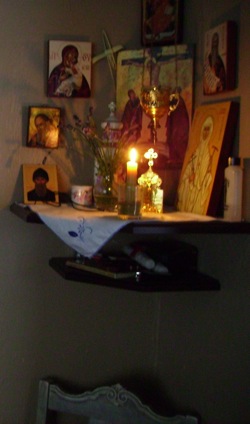
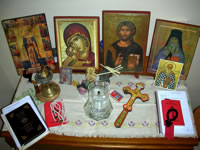
Next, you need to find a quiet private place where you will not be disturbed for your daily prayer. This may be a corner in the bedroom (a room divider can help make a special place), space in a walk-in closet, or, if you are fortunate to have an extra room, a special room that is only for prayer. It needs to be a place where you can be undisturbed and alone. Once you choose the place, you should set up a small home icon stand. On it place an icon of Christ, Theotokos, and your patron saint. Have an oil lamp or candle that you can light while you pray. Also an incense burner, a cross and a prayer book and Bible...

How Do We Pray?
"Prayer needs no teacher. It requires diligence, effort and personal ardor, and then God will be its teacher." St. Meletius the Confessor


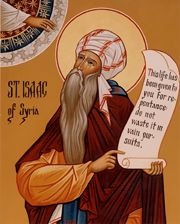
St Isaac the Syrian says we should:
• Pray with attention – so that we can have a true
encounter with God
• Pray with humility – because this sort of prayer goes straight to God’s ear
• Pray with affection and tears – with joy and
thanksgiving, but also with true repentance and purity.
• Pray with patience and ardor – ‘to deny oneself’ is courageously to persevere in prayer.
• Pray from the depths of the heart – even if we pray using ‘the words of another’ they should be uttered as if they are our own. St. Isaac says this is especially true of the Psalms.


• Pray with faith and absolute trust in God – because He knows our life.

Preparing to Pray
With a regular time and a special place, you are ready to begin. You begin praying by focusing your consciousness in your heart and forcibly gathering there all the powers of the soul and body. Take the time at the beginning of your prayer time to quiet your body and to concentrate your energies in your heart. Christ says, “Enter into thy closet and ... shut thy door” (Matt 6:6). Remove all activities that could disrupt your inner descent. Set aside, to the best of your ability, all of your problems of the day and your worries for tomorrow. This is not a time for thinking or worrying. When you are preparing to pray, stand, sit or walk a few minutes and steady your mind to concentrate on God.

Reflect on who it is that you will be addressing. Remember, it is God Himself who you are about to talk with. Try to bring about a feeling of humility and reverent awe. Make some prostrations before you begin....

Note: When we pray we should face East.

Follow a Prayer Rule and use written prayers in the beginning

You should have a specific rule for both morning and evening. Don’t try and wing it. You are developing a discipline that is beyond what you will feel like doing. This is not a relaxation exercise but a path to be in communion with your God. You will need to have a specific set of guidelines that you follow each time with no excuses for shortcutting them. In your rule, incorporate standing, prostrations, kneeling, making the sign of the cross, reading, and at times singing. Use prayer books and written prayers. The Orthodox prayer books are filled with prayers that have been well tested and used for hundreds of years. Prayer does not have to be a creative activity. You must be sincere. Keep your awareness in your heart and concentrate on the words of the prayer. Once you establish a rule, always keep it. Be sure to work with your spiritual Father on this....

Focus on each word - Don't rush your prayer
As you begin to pray enter into every word of the prayer. Bring the meaning of the words down into your heart. Do not rush through the prayers like you are in a hurry to get them over with. Let them slowly drop into the depths of your heart with humility and awe of God. Its like in driving a car. When you are going 90 miles per hour down the highway you may feel powerful and in control. But at high speeds things can go wrong fast. When driving at a speed of twenty-five miles per hour the car handles easy and if someone makes a dangerous maneuver you can easily avoid it. Well, the mind works the same way. We want to train it to slow down so we can become aware of God’s presence within us. So, in prayer we say the words slowly so we can gain the meaning of them and allow them to penetrate our consciousness and to bring to our heart feelings of love and reverence for our God. Let the words drop individually into your heart like pebbles dropping into a pond. You will eventually find the right pace for yourself. Beware of the tendency to rush to complete them hurriedly. When this tendency is present you have turned your prayer into an obligation and it is no longer true prayer. Don’t worry if you catch yourself doing this. It is normal at first. Just stop and slow down and proceed asking God’s forgiveness and help. Also, study the prayers before you use them so you know the meaning of each word. Eventually you will want to memorize them...

Concentrate 
 After you begin to recite your prayers you will find that your mind will want to wander. While you are reciting the words of the pray your mind can jump to something entirely different. Don’t be concerned about this as this is natural due to the forces that do not want us to pray to God. Work to learn to concentrate your attention. Recognize that when this happens you are no longer praying. When you mind does wander, be gentle with yourself and go back and recite again what you said while your mind was elsewhere. Make a concerted effort to bring yourself to concentrate on the words of the prayer. Sometimes it helps to say them out loud for a while. The mind is quite adept at doing more than one thing at a time. You need to bring yourself to a single focus on God. When you are talking to your best friend you don't think of other things when talking with them. When you go into the boss for a discussion you concentrate. God deserves better attention than anyone, so you must learn to concentrate, to focus on the words of the prayer. These wanderings of the mind show you the impact of your busy life that you need to find ways to make quieter so you can be always mindful of God no matter what you are doing. Prayer is not time to be distracted by these worldly activities, because this will only further distract you from prayer. Work to concentrate your attention more and more. Each day you will gain in your attentiveness during prayer. Learn how to lift you mind to be attentive to heavenly things...

Don't rush into other activities when finished with Prayer
When you finish your prayers, stand for a few moments. Consider to what your prayer life commits you. Try to hold in your heart what has been given to you. Treasure it for a few moments.

Pray EVERY Morning and Evening at a minimum
Remember to make your prayer life one that is a firm rule and not something that is done occasionally or sporadically. It must be done each day morning and evening at a minimum. You need to have specific prayers that are part of your prayer rule. You need to commit to doing you rule each and every day. Think about certain personal hygiene tasks such as brushing your teeth that you do each day out of habit. You don’t forget to do them each day. Your prayer rule needs o become a habit as strong as these. Prayer must become a daily habit that you never forget. Prayer is essential for the health of our soul Just like the hygiene activities that we do for the health of our body.

Sunday, September 20, 2015

A Prayer to Archangel Michael


O Lord God, Great and Eternal King! Send, O Lord, Thy Archangel
Michael to help Thy servant (name), and to deliver me from all my enemies, visible and invisible.
O Archangel Michael, angel of the Lord and vanquisher of demons! Suppress all my combatants, make them meek as sheep, and disperse them like dust before the wind.


O great Michael, Archangel of the Lord, six-winged high prince, leader of the heavenly host, the Cherubim and the Seraphim! O kind Archangel Michael, be my helper in all offenses, sorrows and woes, in the desert, at the crossroads, be a safe haven on rivers and seas. Deliver me, O great Archangel Michael, from all the temptations of the demons, when they hear me, thy sinful servant (name), praying to thee, and calling upon thee, and entreating thy holy name: hasten to assist me and heed my prayer.
O great Archangel Michael! Vanquish all my opponents by the power of the Holy and Life-giving Heavenly Cross of the Lord, by the prayers of the Most-holy Theotokos and the holy apostles, the holy prophet of God Elias, Saint Nicholas the wonder worker, Saint Andrew the fool-for-Christ, the holy great martyrs Nikitas and Eustace, the venerable fathers and holy hierarchs, martyrs, and all the heavenly host. Amen.

Whosoever reads this ancient prayer – on that day will he be touched neither by the devil, nor by any evil man, nor will any temptation seduce his heart. If he should pass from this life – hell will not take in his soul.

Tuesday, September 8, 2015

Why prayer is important for the family ( St. Paisios )


Geronta, should the entire family do compline together at night?


The older family members should motivate the youngsters with their solemnity. They should do compline and say to the small children: “If you want, stay a little while.” When the children are somewhat bigger they can have a rule—for example, fifteen minutes for the older ones, and two to five minutes for the small children—then after their rule, as much as they want. If the parents make them stay for all of compline they’ll resent it. Parents shouldn’t pressure their children because they don’t yet understand the power and value of prayer.

Parents, you could say, are able to eat beans and meat: hearty food. But when a little child is still only drinking milk, should they tell him to eat meat because it is strengthening? Maybe it is more strengthening, but the poor thing can’t even digest it. That’s why starting out they should give him little pieces of meat and broth, so that he’ll want more.


Geronta, sometimes even the adults are so tired in the evening that they aren’t able to do compline.


When adults are very tired or sick they should say half of compline or at least one “Our Father.” They should not completely bypass prayer. In wartime if you end up on a hill in the evening, surrounded by enemies, you let out a few shots to frighten the enemy, so they will not attack. Adults should also let out a few shots so as to scare the little demons away.

Prayer has great power within the family. I know two siblings who not only kept their parents—who had a big problem between them—from separating, but even caused them to be more in love. With us my father said: “You don’t know what you’re going to do; two times a day you must entrust the future to God, so as to know where you’ll end up.”

Each morning and evening we would all pray together before the icons, father, mother and the children, ending with a prostration before the icon of Christ. When a problem arose in the family we would pray and it would clear up.

I remember once, when our youngest brother got sick and my father said: “Come, let’s beg God to make him well or to take him, so that he won’t suffer anymore.” We all prayed together and he recovered.Even at the table, we all sat together.

First we prayed and then we would begin eating. If someone started to eat before the food was blessed we would say “he fornicated.” We considered a failure to remain temperate fornication. It destroys a family if each person comes home, at whatever hour he wants, and eats alone without reason.


St. Paisios

Sunday, July 19, 2015

The Cross of the Prayer


A pilgrim of the Holy Mountain visited a hermitic skete and stayed in the hut of a known elder. He had the idea that prayer is easy work and that monks do not toil a lot for it .
 
Then the elderly ascetic told the pilgrim to be obedient and to stay awake one night- according to the typikon of prayer of the hesychasts- and to do prostrations and prayer with the prayer rope for a certain number of hours.

That man really stayed awake and tried to pray as the elder had instructed him.
When dawn finally came, he asked him : '' How did it go, brother? ''
''What can I tell you, Father, forgive me . I couldn't wait for daybreak.
I feel so tired from the vigil and from the attacks of the evil spirits that I would have preferred
to dig in a garden all day with the hoe. ''

'' Brother, the work of prayer, especially of pure prayer, is toilsome. That is why it has so many fruits and gifts. ''

Themes from the Philokalia pg. 66

Wednesday, June 24, 2015

Prayer to the Theotokos ( St. Seraphim of Sarov )


Ο my All-Merciful, Sovereign Lady! All-Holy Lady, Most Pure Virgin, Theotokos Mary, Mother of God, My undoubting and my only Hope: Disdain me not, reject me not, forsake me not, Help me, intercede, hear and behold me. Ο Lady, help me, forgive me, forgive me, Ο Pure One!

St. Seraphim of Sarov

Monday, May 25, 2015

Rukous avaa tien ( Prayer opens the way )


Rukous on kaikki kaikessa. Joku sanoo, että se on minun puhettani Jumalalle, toinen että rukouksen kautta Jumala puhuu meille. Tärkeintä on, että meillä on säännöllinen rukouselämä.


Rukoukseen on kiteytynyt kirkkomme vuosisatainen tai tuhantinen kilvoitteluperinteemme. Sen kautta me liitämme itsemme kirkkomme opetukseen ja se on verraton tapa oppia tuntemaan Jumalan tahto. Evagrios Pontoslainen totesi, että se joka rukoilee, on teologi ja se joka on teologi, rukoilee.


Eräs huipentuma tästä rikkaasta rukousperinteestämme on meditatiivinen Jeesuksen rukous Herra Jeesus Kristus, Jumalan poika, armahda minua syntistä!


Rukous alkaa huuliltamme ääneen lukien, josta se siirtyy mieleemme sanattomaksi hiljentymiseksi ja nousee tai laskee lopulta sydämeemme, jolloin siitä tulee alati jatkuvaa rukousta. Tämä on rukousta aidoimmillaan, hesykhiaa, mielen hiljaisuutta. Se kirkastaa ja jalostaa ajatuksemme sanamme ja tekomme.


Jeesuksen rukous on vastalause monisanaisiin rukouksiimme ja pyyntöihin, joihin ajatuksemme tuntuvat joskus hukkuvan. Jeesuksen rukous on puhdasta yksinkertaisuutta, jossa keskitymme vain kahteen asiaan, Jeesukseen Kristukseen ja armahtamiseen. Se tyhjentää mielen ja nostaa eteemme kirkkaimmaksi timantiksi Jeesuksen nimen ja siihen turvautumisen.

Pyydä Jumalalta rukouksen armolahjaa, niin huomaat, että jaksat rukoilla yhä useammin, enemmän, keskittyneemmin ja suuremmalla antaumuksella. Siitä kasvaa sisäinen ilo, jota kaipaat yhä enemmän elämässäsi. Pyydä Häneltä vapautusta vihasta ja hädästä, niin pian huomaat, että tyyneys valtaa alaa mielessäsi.


Rukouksen tiessä on jotain erikoista. Me tulemme pyhiksi vasta silloin, kun huomaamme oman syntisyytemme ja nojaamme Jumalan armoon. Vasta kun kykenemme samaistamaan Autuuden lauseet elämäämme, me olemme lähellä. Kun me olemme hengessä köyhiä, nälkäisiä, vainottuja, armahtavia ja sävyisiä. Meitä ei pelasta se, että me olemme valmiita, vaan se vie meidät tuhoon. Meidät pelastaa kaipaus pyhyyteen ja sen ymmärtäminen, ettemme kykene yksin pelastumaan.


Entä jos huomaammekin rukoillessamme, ettei meillä olekaan mitään tunnustettava tai kaduttavaa? Se merkitsee sielumme väsymistä ja kylmenemistä. Moni meistä törmää tähän tilanteeseen aika ajoin, mutta siitä voi päästä eteenpäin kun muistaa muutaman asian. Jokaiseen rukoushetken pitää keskittyä erityisen huolellisesti. Jos luet hajamielisesti iltarukouksia, eivätkä ne saa sijaa sinussa, aamurukoukset tulevat olemaan entistä vaikeampia. Seuraavat rukoushetket voivat olla hyvin vaativia.


Itse luen entistä enemmän rukouksia, jos tunnen sydämeni kylmenevän rukoukselle. Silloin olen usein huomannut, että sydän alkaa pehmetä ja heltyä ja nöyryys palaa mieleen. Toinen vaihtoehto on lukea rukoukset entistä hitaammin ja suuremmalla ajatuksella. Joskus mieltä on rasitettava ihan todella ja todellinen hartaus syntyy vasta selkeän työntekemisen jälkeen.


Itse pyrin ajattelemaan, että kyse on kuuliaisuudessaan ja itsekurista. Laiskuudelle ja velttoudelle on helppo antaa periksi ja meidän pitää nähdä vaivaa rukouksemme eteen. Kun rukous on vaikeaa, uskon, että paremmat ajat on koittamassa, jos vain jatkan. Jos lopetan nyt, niin silloin parempia aikoja ei koskaan voi silloin tulla.

Kun me rukoilemme säännöllisesti, meidän hengellinen herkkyytemme kasvaa. Me huomaamme yhä selvemmin kaikkia synnillisiä asioita, joita sanomme ja mietimme. Me löydämme itsestämme paljon piileviä asenteita ja tuomitsemista. Huomaamme miten kaukana me olemmekaan kaikesta siitä hyvästä, johon meidät luotiin.


Saatamme myös hyvin usein kieltäytyä pitämästä tehtyä syntiä syntinä, ja selvitämme sen tekemisen jopa välttämättömäksi. Selittelemme ja puolustelemme tekojamme. Siirrämme vastuun toiselle, kuten Aadam ja Eeva paratiisissa. Saatammepa myös oikeuttaa syntimme ja tehdä sen tekemisen välttämättömäksi.


Rukouksen lahja


Keskity ja hiljenny, hengitä syvään ja sulje kaikki huolet mielestäsi. Toista mielessäsi rukouslauselmaa, Jumala puhdista minua syntistä ja armahda minua!


Kuvittele itsellesi ne asiat, joissa rukouksessa puhutaan ja erityisesti ne puutteet, joista siellä puhutaan. Kun rukouksessa sanotaan, että puhdista minut synneistäni, ymmärrä, että sinä olet tahrannut itsesi synnillä. Jos pyydät puhdistusta synneillesi, sinun on tunnettava itsesi synnin tahraamaksi, jotta voisit saada puhdistuksen armon sielullesi. Kautta aikojen kirkkomme isät ovat sanoneet, ettei synnin sairautta ei voida sielustamme puhdistaa, ellemme näytä haavoja lääkärillemme. Jos kiellämme koko sairauden olemassaolon, emme voi saavuttaa parannusta.


Tunnetko rukouksessa mainitut puutteet omaksesi? Tunnetko itsessäsi ne samat puutteet, jotka Kristuksellakin oli? Hän oli nälkäinen, koditon, hengessään köyhä, tässä maailmassa sureva ja rauhaa rakentava. Aivan kuten Autuuden lauseissa sanotaan. Oletko poistanut näitä puutteita lähimmäiseltäsi vai lisännyt hänen taakkansa.

Itse koen erityisesti pappina, että esirukoukset toisten puolesta ovat hyvin tärkeitä. Melkein yhtä tärkeää on kuitenkin löytää myös henkilökohtaisten rukousten kautta oma syyllisyys ja vieraantuneisuus Jumalan edessä. Samalla ne herättävät voimakkaan tunteen myös siitä, että taivaalliset esirukoilijat auttavat minua kilvoittelussani. Noiden rukoukseen kautta minä liityn siihen samaan rukoilijoiden joukkoon, jotka vuosisatojen ajan ovat hiljentyneet ikonin edessä.


Joskus me saatamme odottaa jotakin muuta itsellemme palkkioksi uurastuksestamme ja se voi olla kova paikka meille. Olemme tottuneet usein siihen maailmassa, että meidät palkitaan työstämme ja uhrauksemme korvataan. Me rukoilemme ja pyydämme jotain erityistä, riippumatta siitä, onko siitä meille edes hyötyä. Tätä sanotaan palkaksi mutta kristittyinä meidät on kutsuttu uhrautumaan. Meidän pelastuksemme ei ole Jumala antama palkka vaan pelastuksemme perustuu armoon. Siksi meidänkin pitää armahtaa, olettamatta palkkiota siitä. Ja mihin meidän palkkiomme edes riittäisi jos vertaamme sitä synteihin, joihin me olemme langenneet?


Vain rukouksen kautta me voimme nähdä oman keskeneräisyytemme ja tästä syntyy tilaa Luojallemme. Hän toivoo, että me kadumme, jotta hän voisi koota meidät uudelleen. Tästä syntyy todellinen paasto ja se avaa tiemme kohti rakastavaa Isää.

Friday, May 15, 2015

Prayer vs sight ( Evagrios the Solitary )


As sight is superior to all the other senses,
so prayer is more divine than all the other virtues....

Evagrios the Solitary

Thursday, May 7, 2015

Prayer - St. Isaac the Syrian


How Do We Pray?


"Prayer needs no teacher. It requires diligence, effort and personal ardor, and then God will be its teacher." St. Meletius the Confessor

St Isaac the Syrian says we should:
• Pray with attention – so that we can have a true
encounter with God
• Pray with humility – because this sort of prayer goes straight to God’s ear
• Pray with affection and tears – with joy and
thanksgiving, but also with true repentance and purity.
• Pray with patience and ardor – ‘to deny oneself’ is courageously to persevere in prayer.
• Pray from the depths of the heart – even if we pray using ‘the words of another’ they should be uttered as if they are our own. St. Isaac says this is especially true of the Psalms.
• Pray with faith and absolute trust in God – because He knows our life.


St. Isaac the Syrian


http://agapienxristou.blogspot.ca/2013/05/prayer.html

Wednesday, April 22, 2015

Can Prayer Help relieve Headaches


While there is no research on the use of the Jesus Prayer and relief from headaches there is some research from those who meditate.

Meditation has been shown to help offset the symptoms of chronic pain, including headaches. One study showed that 72 percent of patients with chronic pain who underwent meditation training, reported significant reductions in their level of pain. In another study, patients who practiced meditation experienced fewer migraine headaches, enhanced their pain tolerance, and reported a greater sense of well-being.The Jesus Prayer is quite different than meditation as it is an prayer in communication with God. But there are many similarities to the regular practice of this prayer that are similar to meditation. The Jesus prayer should be much more effective than meditation as it does call on God for His mercy.


The regular practice of the Jesus prayer requires at least 15 minutes per day where you can set aside all daily cares and quietly in your mind repeat the prayer, "Lord Jesus Christ, Son of God, Have mercy on me." One will find that this is not an easy task as our minds are very active and we will observe many distracting thoughts while we try to pray in this way. Gradually as we keep up a daily practice we will gain in our ability to concentrate on the words of the prayer. As we gain in this way, our mind becomes quiet, our body relaxes, and our heart opens to God. This opening then allow His grace to flow through us bringing any healing power as God wills for us.


With the practice, when we feel a headache coming on, we can stop for a few minutes and repeat this prayer until the pain subsides. We don't have to wait for the actual headache to intervene with a prayer. Here are some symptoms that are known to be precursors to and headache: Fatigue, mood changes, food cravings, loss of appetite, yawning, increased urination, and muscle stiffness. We can observe our own situation and learn to recognize these warning signs. There are also some common triggers that can be avoided. They are: Caffeine, chocolate, aged cheese, red wine, hormonal changes, stress, and too much or to little sleep.


The power in this prayer comes from the name, "Jesus". Its practice requires humility realizing that we cannot control everything in this world, including our aches and pains. Its practice is both a worship of God and a discipline with similarities to many meditation techniques. It is not an easy practice and takes patience and endurance. Research has shown that it actually causes a change in neurological networks of our brain. One must first have faith in Jesus Christ as our Lord and Savior.

Tuesday, April 14, 2015

The Work of Prayer ( Saint Seraphim of Sarov )


Daily prayer is the foundation of a spiritual life in Christ. We pray in the morning and the evening and throughout the day, with an aim for our entire life to be one of prayer. Saint Seraphim places the emphasis on saying the Jesus Prayer.


Saint Seraphim says,
Those who have truly decided to serve the Lord God should practice the remembrance of God and uninterrupted prayer to Jesus Christ, mentally saying: Lord Jesus Christ, Son of God, have mercy on me a sinner... By such exercises in preserving oneself from dispersion and keeping peace of conscience one may draw near to God and be united to Him. The daily practice of the Jesus Prayer involves numerous disciplined repetitions of this short but all powerful prayer. As we practice it, our mind is reshaped, our thoughts are tamed, our soul's orientation is pointed towards God, and prayer is always on our lips.


Saint John Chrysostom says,
"Prayer is a great weapon, a rich treasure, a wealth that is never exhausted, an undisturbed refuge, a cause of tranquility, the root of a multitude of blessings and their source and mother"
In prayer we lift ourselves above our thoughts. It is our thoughts that destroy prayer. The main struggle in prayer is not to allow our thoughts to take away our prayer.


Saint Seraphim says,
One must always strive to give oneself up to dispersion of thoughts: for through this the soul turns away from remembrance of God and love of Him...
This is how we get the benefit from prayer, by controlling our thoughts. And it is by regular prayer where we learn to concentrate on God that we learn to control our thoughts.


Saint Seraphim says,
When the mind and the heart are united in prayer and the soul's thoughts are not dispersed, the heart is warmed by spiritual warmth in which the light of Christ shines, making the whole inner man peaceful. This is our aim, to be united with God. 


http://agapienxristou.blogspot.ca/2013/05/the-work-of-prayer.html

Wednesday, April 1, 2015

Blessed is the man who is wide awake and praying ( Elder Joseph Vatopaidinos )


"Everything  is put in order with endurance and patience.
To the degree that people forget the idea of the Cross, so evil grows and spreads, with the different pressures which occur both naturally and artificially.
Blessed is the man who is wide awake and praying."


http://agapienxristou.blogspot.ca/2013/04/elder-joseph-vatopaidinos.html

Wednesday, March 25, 2015

Prayer For Those Who Commit Suicide and For the Departed Non-Orthodox ( Optina Elder Leonid )


The Optina Elder Leonid told of one of his disciples whose father committed suicide. In his overwhelming grief the son turned to the Elder for consolation. The Elder replied, "Entrust both yourself and the lot of your father to the all-wise, omnipotent will of the Lord. Do not seek miracles of the Most High. Strive by humble-mindedness to strengthen yourself within the bounds of tempered sorrow. Pray to the Most-good Creator, thus fulfilling the duty of love and the obligation of a son. You ought not to sorrow beyond measure. God loved and loves him incomparably more than you. And so it remains for you to entrust the eternal lot of your father to the goodness and compassion of God, Who if He is well-pleased to show mercy, then who can oppose Him?"

The following is a model of a private prayer which might be said for a non-Orthodox person as suggested by the Elder Leonid, one who was experienced in the spiritual life:

Have mercy, O Lord, if it is possible, on the soul of Thy servant (name), departed to eternal life in separation from Thy Holy Orthodox Church! Unsearchable are Thy judgments. Account not this my prayer as sin. But may Thy holy will be done!

Optina Elder Leonid 

http://agapienxristou.blogspot.ca/2013/06/prayer-for-those-who-commit-suicide-and.html

Monday, March 16, 2015

Work vs. Prayer


There is no tradeoff between work and prayer. Both are essential to a healthy physical and spiritual life according to Saint Basil. It is wrong to deny prayer because of work and it is wrong to deny work because of prayer. We can learn to make our work a prayer. The Jesus Prayer and other remembrances of God during the day are a great help in this task. At the foundation a God centered work life is attentiveness based on a quiet mind as Basil explained in earlier posts..
Here is what Basil has to say to us:

As daily sustenance is necessary for everyone, so labor in proportion to one's strength is also essential. Not vainly has Solomon written in praise: “she watches over the ways of her household, and does not eat the bread of idleness” (Prov 31:27). And again, the Apostle says of himself: “nor did we eat anyone’s bread free of charge, but worked with labor and toil night and day” (2 Thess 3:8); yet, since he was preaching the Gospel, he was entitled to receive his livelihood from the Gospel. The Lord couples sloth with wickedness, saying: '‘You wicked and lazy servant" (Matt 25:26). Wise Solomon, also, praises the laborer not only in the words already quoted, but also, in rebuking the sluggard, associating him by contrast with the tiniest of insects: “Go to the ant, you sluggard!" (Prov 6:6). We have reason to fear, therefore, lest, perchance, on the day of judgment this fault also may be alleged against us, since He who has endowed us with the ability to work demands that our labor be proportioned to our capacity; for He says: “to whom much is given, from him much will be required" (Luke 12:48). Moreover, because some use prayer and psalmody as an excuse for neglecting their work, it is necessary to bear in mind that for certain other tasks a particular time is allotted, according to the words of Ecclesiastes: “To everything there is a season" (Eccl 3:1). For prayer and psalmody, however, as also, indeed, for some other duties, every hour is suitable, that, while our hands are busy at their tasks, we may praise God sometimes with the tongue (when this is possible or, rather, when it is conducive to edification); or, if not, with the heart, at least, in psalms, hymns and spiritual canticles, as it is written (Col 3:16). Thus, in the midst of our work can we fulfill the duty of prayer, giving thanks to Him who has granted strength to our hands for performing our tasks and cleverness to our minds for acquiring knowledge, and for having provided the materials, both that which is in the instruments we use and that which forms the matter of the arts in which we may be engaged, praying that the work of our hands may be directed toward its goal, the good pleasure of God.

Thus we acquire a recollected spirit-when in every action we beg from God the success of our labors and satisfy our debt of gratitude to Him who gave us the power to do the work, and when, as has been said, we keep before our minds the aim of pleasing Him.

From Church Fathers: The Long Rule pp 306-311


From a letter
Prayer is to be commended, for it engenders in the soul a distinct conception of God. And the indwelling of God is this – to have God set firm within oneself through the process of memory. We thus become a temple of God whenever earthly cares cease to interrupt the continuity of our memory of him.


The Heart of Basilian Spirituality p 120 Letter 2

Wednesday, March 11, 2015

A Prayer - Teach Me Your Love ( St. Nikolai Velimirovich )


Your birds awaken me in the morning, and the murmur of the lake lulls me to sleep in the evening. But it is not the birds that awaken me, nor the lake that lulls me to sleep, but You, 0 Lord, Master of the voice.

You lend Your voice to the birds and the midnight murmur to the lake. You have lent a voice to every throat, and have put a story into every creature. I am surrounded by Your heralds, as a student by many teachers, and I listen to them tirelessly from day until dusk.

O Lord, Master of the voice, speak more clearly through Your heralds!

The sun speaks to me about the radiance of Your countenance, and the stars about the harmony of Your being. The sun speaks in one language, and the stars speak in a different language, but all the languages flow out of the same vocal cords. The vocal cords belong to You, and You uttered the first sound that began to tremble in the deafness and formlessness of nothingness, and it broke into countless sounds and heralds, as a thundercloud breaks into rain drops.

O Lord, Master of the voice, speak more clearly through Your heralds!

One exclamation escaped the breast of the Bride of God when She saw Your Son––a voice filled with a love that could not be contained in silence. And that exclamation echoed in the heart of Her Son, and this echo––this response to the love of His Mother––the Holy Spirit has spread with His powerful arms throughout the entire universe. Therefore, all the universe is filled with Your heralds, O my Song and my Love.

O Lord, Master of the voice, speak more clearly through Your heralds!

For this reason You also spoke in parables, O Son of God, and You would explain things and events as stories about the Most High God. You cured the sick with words and raised the dead with words, for You recognized the mystery of love. And the mystery of love is a mystery of words. Through all creatures, as through piercing and blaring trumpets, words pour forth––and through words, the Love of Heaven.

O Lord, Master of the voice, teach me Your Love through all Your heralds.

From Prayers by the Lake by Bishop Nikolai Velimirovich 


http://agapienxristou.blogspot.ca/2013/04/a-prayer-teach-me-your-love.html