Translate

Showing posts with label St. John Chrysostom. Show all posts

Friday, June 1, 2018

Those Who Find Fault With The Body ( St. John Chrysostom )


In as much, then, as you have now shaken off despondency, we are desirous to recall you to the recollection of former matters; so that our discourse may be rendered the clearer to you. For what we said of the creation, that God not only made it beautiful, and wonderful, and vast, but also weak and corruptible; and moreover that He has established various proofs of this; ordering both these circumstances for our advantage; leading us on by its beauty to admiration of Him who framed it: and by its weakness leading us away from the worship of the creature; this we may see, take place also in the case of the body. For with respect to this too there are many among the enemies to the truth, as well as among those who belong to our own ranks, who make it a subject of enquiry, why it was created corruptible and frail? Many also of the Greeks and heretics affirm, that it was not even created by God. For they declare it to be unworthy of God's creative art, and enlarge upon its impurities, its sweat, its tears, its labours, and sufferings, and all the other incidents of the body. But, for my part, when such things are talked of, I would first make this reply. Tell me not of man, fallen, degraded and condemned. But if you would learn what manner of body God formed us with at the first, let us go to Paradise, and survey the Man that was created at the beginning. For that body was not thus corruptible and mortal; but like as some statue of gold just brought from the furnace, that shines splendidly, so that frame was free from all corruption. Labour did not trouble it, nor sweat deface it. Cares did not conspire against it; nor sorrows besiege it; nor was there any other affection of that kind to distress it. But when man did not bear his felicity with moderation, but threw contempt upon his Benefactor, and thought a deceiving demon more worthy of credit than God who cared for him, and who had raised him to honour, and when he expected to become himself a god, and conceived thoughts above his proper dignity, then—then indeed it was that God, to humble him by decisive acts, made him mortal, as well as corruptible; and fettered him with such varied necessities; not from hatred or aversion, but in care for him, and to repress at the very outset that evil and destructive pride; and instead of permitting it to proceed any further, He admonished Him by actual experience, that he was mortal and corruptible; thus to convince him that he must never again think or dream of such things as he had done. For the devil's suggestion, was, "You shall be as gods" (Genesis 3:5). Desiring then utterly to eradicate this idea, God made the body subject to much suffering and disease; to instruct him by its very nature that he must never again entertain such a thought. And that this is true, is really most evident from what befell him; for after such an expectation, he was condemned to this punishment. Consider also with me the wisdom of God in this matter. He did not allow him to be the first to die, but permitted his Son to suffer this death; in order that seeing before his eyes the body corrupting and decaying, he might receive a striking lesson of wisdom from that spectacle; and learn what had come to pass, and be duly chastened before he departed hence.

But why do you marvel if this has happened in respect to the body, when even with respect to the soul it is plain, that a similar thing has taken place. For God made it not mortal, but permitted it to be immortal; He constituted it however subject to forgetfulness, to ignorance, to sadness, and to care; and this, lest regarding its own nobility of birth, it might take up a conceit too high for its proper dignity. For if, even while the case stands thus, some have dared to aver, that it is of the Divine essence; to what a pitch of frenzy would they not have reached, if it had been devoid of these imperfections? What, however, I affirmed respecting the creation, I affirm also respecting the body, that both these things alike excite my admiration of God; that He has made it corruptible; and that in its very corruptibility, He has manifested His own power and wisdom. For that He could have made it of some better material, He has evidenced from the celestial and the solar substance. For He that made those such as they are, could have made this also like them, had He thought proper to do so. But the cause of its imperfection is what I before adverted to. This circumstance by no means lowers the admiration due to the Creator's workmanship, but rather increases it; for the meanness of the substance, manifests the resource and adaptiveness of His art; since He has introduced such a harmony of parts in clay and ashes, and senses so various and manifold and capable of such spiritual wisdom.

In proportion, therefore, as you find fault with the meanness of the substance, be so much the more astonished at the greatness of the art displayed. For this reason also, I do not so much admire the statuary who forms a beautiful figure out of gold, as him who, by the resources of art, is able, even in crumbling clay, to exhibit a marvellous and inimitable mould of beauty. In the former case, the material gives some aid to the artist, but in the latter, there is a naked display of his art. Would you learn then, how great the wisdom of the Creator is, consider what it is that is made out of clay? What else is there but brick and tile? Nevertheless, God, the Supreme Artist, from the same material of which only the brick and tile is formed, has been able to make an eye so beautiful, as to astonish all who behold it, and to implant in it such power, that it can at once survey the high aerial expanse, and by the aid of a small pupil embrace the mountains, forests, hills, the ocean, yea, the heaven, by so small a thing! Tell me not then of tears and rheums, for these things are the fruit of your sin; but consider its beauty, and visual power; and how it is that while it ranges over such an expanse of air, it experiences no weariness or distress! The feet indeed become tired and weakened even after going but a small distance; but the eye, in traversing a space so lofty and so wide, is not sensible of any infirmity. For since this is the most necessary to us of all our members, He has not suffered it to be oppressed with fatigue; in order that the service it renders us might be free and unfettered.

But rather, I should say, what language is fully adequate to set forth the whole excellency of this member? And why do I speak of the pupil and the visual faculty? For if you were to investigate that which seems the meanest of all the members, I mean the eyelashes, you would behold even in these the manifold wisdom of God the Creator! For as it is with respect to the ears of grain; the beards, standing forth as a sort of spears, repel the birds, and do not suffer them to settle upon the fruits, and to break the stalk, which is too tender to bear them; so also is it with regard to the eyes. The hairs of the eyelids are ranged in front, and answer the purpose of beards and spears; keeping dust and light substances at a distance from the eyes, and any thing that might incommode the sight; and not permitting the eyelids to be annoyed. Another instance of wisdom, no less remarkable, is to be observed in eyebrows. Who can help being struck by their position? For they do not project to an immoderate degree, so as to obscure the sight; nor do they retire farther back than is fitting; but in the same manner as the eaves of a house, they stand out above, receiving the perspiration as it descends from the forehead, and not permitting it to annoy the eyes. For this purpose too there is a growth of hair upon them, which serves by its roughness to stay what descends from above, and affords the exact protection that is needed, and contributes also much appearance of beauty to the eyes. Nor is this the only matter of wonder! There is another thing also which is equally so. How is it, I ask, that the hairs of the head increase, and are cut off; but those of the eyebrows, not so? For not even this has happened undesignedly, or by chance, but in order that they might not darken the sight too much by becoming very long; an inconvenience from which those suffer who have arrived at extreme old age.

And who could possibly trace out all the wisdom which is manifested by means of the brain! For, in the first place, He made it soft, since it serves as a fountain to all the senses. Next, in order that it might not suffer injury owing to its peculiar nature, He fortified it on every side with bones. Further; that it might not suffer from friction, by the hardness of the bones, He interposed a middle membrane: and not only a single one, but also a second; the former being spread out on the under side of the skull, but the latter enveloping the upper substance of the brain, and the first being the harder of the two. And this was done, both for the cause that has been mentioned, and in order that the brain might not be the first to receive the blows inflicted upon the head; but that these membranes first encountering them, might free it from all injury, and preserve it unwounded. Moreover, that the bone which covers the brain is not a single and continuous one, but has many sutures on every side, is a circumstance which contributes much to its security. For a ventilation of the vapours that surround it may easily take place outward through these sutures, so as to prevent it from being suffocated; and if a blow should be inflicted upon it, on any particular point, the damage does not extend to the whole. For if the bone had been one and continuous, the stroke even when it fell upon one part, only, would have injured the whole; but now, by its being divided into many parts, this can never happen. For if one part should chance to be wounded, only the bone that is situated near that part receives injury, but all the rest remain unhurt; the continuity of the stroke being intercepted by the division of the bones, and being unable to extend itself to the adjacent parts. By reason of this God has constructed a covering for the brain of many bones; and just as when one builds a house, he lays on a roof, and tiles upon the upper part, so God has placed these bones above upon the head, and has provided that the hairs should shoot forth, and serve as a kind of cap for it.

The very same thing also He has done with regard to the heart. For inasmuch as the heart has preeminence over all the members in our body, and that the supreme power over our whole life is entrusted to it, and death happens when it receives but a slight blow; He has fenced it about on every side with stiff and hard bones, surrounding it by the protection of the breast-bone before, and the blade-bones behind. And what He did with respect to the membranes of the brain, He has done in this instance also. For in order that it might not be rubbed and pained in striking against the hard bones which encompass it, in the throbbing and quick pulsation to which it is subject in anger and similar affections, He both interposed many membranes there, and placed the lungs by the side of it to act the part of a soft bed to these pulsations, so that the heart may break its force on these without sustaining injury or distress.

But why do I speak of the heart, and of the brain, when if any one will investigate even the very nails, he will see the manifold wisdom of God displayed in these; as well by their form, as by their substance and position. I might also have mentioned why our fingers are not all equal, and many other particulars besides; but to those who are inclined to attend, the wisdom of God Who created us, will be sufficiently clear from what has been said. Wherefore, leaving this department to be investigated with diligence by those who are desirous of the task, I shall turn myself to another objection.


St. John Chrysostom

From Homily 11 of On the Statues.

Monday, February 19, 2018

Great Lent begins...( St. John Chrysostom )

The value of fasting consists not in abstinence only from food, but in a relinquishment of sinful practices, since he who limits his fasting only to an abstinence from meat is he who especially disparages it.


The change in our way of life during these blessed days will help us to gain holiness.

Therefore, we should let our soul rejoice during the fast.


St. John Chrysostom

Saturday, August 8, 2015

Almsgiving gives rise to many blessings - St. John Chrysostom


Build palaces and mansions in Heaven without the help of engineers and contractors.
Buildings are erected in Heaven by the poor whom you help here on earth. These structures never
deteriorate or collapse.


Furthermore, they also help you to win God’s favor, and they purify you from sins—sometimes they can even deliver you from death!
Do not be surprised with what I say.


Everyone, of course, is powerless before death;
almsgiving, none the less, can conquer even death itself. This is confirmed by the account of Tabitha.
Tabitha was a Christian who lived in Jope during the time of the Apostles. As described in the
Holy Scriptures, she performed many good works and continuously gave alms.

At some point she became ill and died. At that time the Apostle Peter happened to be in a
neighboring city named Lydda, which was not far from Joppa. Two Christians from Jope went to
find the Apostle and informed him that this compassionate and charitable woman had just died. Upon hearing this, the Apostle immediately followed them.


When he arrived in Joppa, he proceeded to the second story of the house where they had placed the body of the deceased. There, he was encircled
by many widows; all of them were crying and showing him the clothes and garments that Tabitha had bought for them while she was still alive.


What did the Apostle Peter do then? He kneeled and prayed. Next he turned to the corpse and said, “Tabitha, arise!” That very same moment the dead woman opened her eyes, and, when she saw the Apostle, she got up. The Apostle Paul grabbed her hand and pulled her to her feet.


Then he called all the Christians and the widows
who were gathered there and presented her to them (Acts 9:36-41). Do you see how she was rewarded for the alms and help she gave to those poor and needy widows? The blessing she received was incomparably greater than the alms she gave, even if she had given all the money in the world.


St. John Chrysostom

Tuesday, July 14, 2015

If we repent, God will forgive us ( St. John Chrysostom )


Are you a sinner? Do not despair. Come to church with repentance.
Have you sinned? Say to God: “I have sinned.” You find it so difficult to confess your sin? But if you do not accuse yourself first, the devil will
eventually accuse you. Therefore, before he has a chance to do so, strip him of his power; because, truly, his role is to accuse us. 


Erase your sin before he has a chance to blame you. For you have an accuser who will not remain silent. Have you sinned? I ask nothing else from you except this: enter the church and say to God with repentance, “I have sinned.” Because it is
written: “confess your sins first, so that you may be justified” (Isa. 43:26).


Confess your sin so that you may erase it. This does not require any effort, or many words, or large sums of money, or any other such thing. It only takes three words: “I have sinned.”
Have you sinned? Come to Church and erase your sin. Every time you fall while walking you get up. Similarly, every time you sin, repent. Do not despair; do not become indifferent, so that you do not lose hope in the heavenly riches that are in store for us. Even if you sin late in life when you
have grown old, repent and come to Church. 


The Church is a hospital not a court. It bestows forgiveness; it does not demand accountability for the sin. Say to God: “Against Thee only have I sinned and done this evil before Thee” (Ps. 50:6), and He will forgive you. Show Him that you repent, and He will have mercy on you. If we do our part, God will do His part.


Since the almighty Lord is so loving and merciful, let us not remain indifferent for our salvation. Waiting for us are the Kingdom of Heaven,
Paradise, and goods that no human eye has seen, that no human ear has heard, and which no human mind can conceive. Shouldn’t we do whatever
we can in order not to lose these things? Shouldn’t we give something trivial in order to acquire these great and invaluable things? 


Therefore, let us repent, let our hands become accustomed to giving to others, let us humble ourselves, let us mourn and cry for our sins. All these things are small. But great and beyond our strength are the things that will be given to us by God; that is, Paradise, and the Kingdom of Heaven. May we all be worthy of entering it, through His grace.
 

St. John Chrysostom

Wednesday, December 24, 2014

If we repent, God will forgive us ( St. John Chrysostom )


Are you a sinner? Do not despair. Come to church with repentance.
Have you sinned? Say to God: “I have sinned.” You find it so difficult to confess your sin? But if you do not accuse yourself first, the devil will
eventually accuse you. Therefore, before he has a chance to do so, strip him of his power; because, truly, his role is to accuse us. Erase your sin
before he has a chance to blame you. For you have an accuser who will not remain silent.


Have you sinned? I ask nothing else from you except this: enter the church and say to God with repentance, “I have sinned.” Because it is written: “confess your sins first, so that you may be justified” (Isa. 43:26).
Confess your sin so that you may erase it. This does not require any effort,or many words, or large sums of money, or any other such thing. It only
takes three words: “I have sinned.”


Have you sinned? Come to Church and erase your sin. Every time you fall while walking you get up. Similarly, every time you sin, repent. Do not despair; do not become indifferent, so that you do not lose hope in the heavenly riches that are in store for us. Even if you sin late in life when you
have grown old, repent and come to Church. The Church is a hospital not a court. It bestows forgiveness; it does not demand accountability for the sin. Say to God: “Against Thee only have I sinned and done this evil before Thee” (Ps. 50:6), and He will forgive you. Show Him that you repent, and He will have mercy on you. If we do our part, God will do His part.


Since the almighty Lord is so loving and merciful, let us not remain indifferent for our salvation. Waiting for us are the Kingdom of Heaven,
Paradise, and goods that no human eye has seen, that no human ear has heard, and which no human mind can conceive. Shouldn’t we do whatever we can in order not to lose these things? Shouldn’t we give something trivial in order to acquire these great and invaluable things? Therefore, let us repent, let our hands become accustomed to giving to others, let us humble ourselves, let us mourn and cry for our sins. All these things are small. But great and beyond our strength are the things that will be given to us by God; that is, Paradise, and the Kingdom of Heaven. May we all be worthy of entering it, through His grace.

St. John Chrysostom

Tuesday, November 25, 2014

Reason for battle against the devil ( St. John Chrysostom )


For what reason do we fight against them?
It is because we have a mighty ally, the Grace of the Holy Spirit ! Thus, we have been taught the techniques so that we will be able to do battle, not against men, but against the demons.


St. John Chrysostom, the Devil and Magic pg. 94

Monday, November 17, 2014

“As I find you, so will I judge you” ( St. Basil the Great )


St. Basil the Great and St. John Chrysostom commented on the following saying of our Lord, “As I find you, so will I judge you,” (Ezekiel 33:20) saying that forgetting to practice the smallest of the Commandments of our Lord is all that is sufficient to send one to Gehenna and exclude us from the kingdom of heaven.


Think about this for a moment. How many of us are ignoring the reality of our sinfulness? How many blame others for our shortcomings? How much time to spend complaining about what others do? Do we spend the same amount of time thinking about our own actions?

Saint Basil of Poiana Marului says the following,
Yes, we sin every day, at times unconsciously or out of forgetfulness, without intending to or involuntarily, or because of weakness we sin every day willingly and unwillingly. Because of our human nature and weakness we sin every day willingly and unwillingly. Is this not what the apostle Paul refers to when he says, “I do what I do not want and what I do not want is what I do” (Romans 7:15)? All of us commit excusable sins without asking to be excused. Or rather, we fall into sins that can be forgiven and yet we feel no contrition and thus become guilty of God's judgment and bring God's wrath upon ourselves. In the words of an ancient saying, “we have made a habit of sitting with her own free will”–– that is, we are consciously aware of committing sins and have developed the habit of sitting with our own free will. The recognition of the reality of our sinfulness, the fact that we do sin many times each and every day, is the starting point for our salvation. It is important for us to recognize that we must continually ask the Lord for forgiveness as well as those whom we transgress. Saaint Basil tells us that “we should ask forgiveness of our fellow man face-to-face and beg forgiveness of God with the intellect and secret.”

We all have particular passions that we have grown up with, that have given us great pleasures, that we have continued to nurture and develop habitually. This passion will be different for each individual. For one person it may be an insatiable appetite for food, for another love of money, anger, self-esteem, arrogance or others. All of these increase over time through habit. St. Hesychios reminds us what the great lawgiver Moses teaches when he says, “Pay attention to yourself so that you have no secret thoughts in your heart” (Deuteronomy 15:9). Needless to say, it is imperative that we learn to closely examine ourselves each and every day. It is a matter of recognizing that we have weaknesses and that we need to pray to God continually with a broken heart and the contrite spirit. We must avoid accusing others but instead forgive others as this is what is pleasing to God. With our forgiveness of others and our recognition of our own weaknesses God will forgive us through his great mercy.

Our challenge in the spiritual life is to live the Commandments that Christ has given to us; all of them all of the time. We need to work at this with the best of our ability, recognizing that we are not fully capable of doing this. Because of this imperfect condition, we need to always be repentant and seeking forgiveness from others and our Lord.

This is an issue of obedience. We must learn to become obedient to God's commandments not to our own self-gratification. Saint Basil points out that in these times there is a widespread practice of being obedient for human reasons. This is where we use our obedience to get a promotion or earn a favor of any kind. This is how we learn to survive in the modern workplace. We become obedient to the organizations rules and norms and learn to do what we are asked for the benefit of those who are paying us. We know about obedience and have the ability for it. Our challenge is to transfer this skill we have learned to use for our own benefit, to follow God's commandments in the same way.

Saint Basil points out,
“one who forces himself in obedience for Christ alone and submits themselves to his precepts will find relief from his passions. The one who forces himself for the things of the world hoping to obtain prestige and riches along with physical pleasures is unaware of his burden. This is why the fathers rightly say that there is obedience for God's sake and obedience for the devil's sake.... As for us, let us force ourselves to demonstrate the power of obedience for the sake of God." He also shows us that the most powerful way to deal with this weakness is the practice of what we know as the Jesus Prayer. He says, if we turn to God saying with our mind,
"'Lord Jesus Christ, Son of God, have mercy on me a sinner,' beyond all doubt this will obtain forgiveness of sins for him, and with this prayer also he will fulfill his entire rule, following the example of that widow of the Gospel who used to cry out to the judge day and night claiming her do (Luke 18:1–8 ). The Jesus Prayer had its beginnings in the days of the apostles. It has been practiced by the Saints since that time. Many of them have written much about this practice. It is a common practice within the Orthodox Tradition.

The practice of the Jesus prayer, does not come without effort. We have to commit ourselves to a daily prayer rule were we repeat this prayer over and over and over each and every day. By doing this this, prayer becomes ingrained, etched, programed in our physical brain, so that when it's needed, it is instantly available to us. Living a life with this prayer at the tip of our tongue is the easiest way to constantly be reconciled to our God.

The first step that we must make is to recognize of our nature. We must acknowledge that we are continually, both willfully and unknowably, using our free will to act against the Commandments of our Lord. We also must recognize that our Lord is most merciful and wants to give us help. The only way that we will receive this help is through a life of continual repentance. He has given to us the Jesus Prayer as a powerful way for us to learn to practice obedience to his commands.

Friday, November 7, 2014

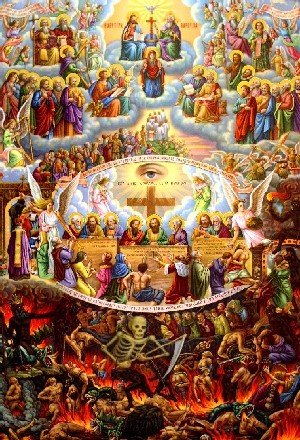
Rewards and retributions await us in the next life ( St. John Chrysostom )


Do not be surprised or upset when you witness evil and unjust people enjoying the comforts and pleasures of this present life. Realize that rewards
and retribution for good and evil deeds do not take place here on the earth.


Even when there is certain recompense, from time to time, it is not complete, but serves only as a small sample of the perfect payback that will take place in the next life. This occurs so that all they
who do not believe in the Resurrection of the dead and in the Final Judgment may at least receive a lesson and be kept in line when they are disciplined here on the earth.


Do you see an evil person becoming rich? Do not be discouraged. Conversely, do you see a good person suffering? Do not be surprised. Rewards and punishments are in store for the next life. A bad person does not only do bad things. It is quite possible that such a person has also done some good things during his lifetime. Similarly, it is not possible for any good person to be completely flawless. Even the best person will have committed a number of sins for which he is accountable. 

Thus, the evil person enjoys a short-lived earthly prosperity as a reward for the few good deeds he has done; however, he will be harshly punished in the next life in totality for all his wickedness. The good person, on the other hand, suffers during this present life in order to be cleansed of his sins, and
subsequently enjoy eternal bliss in the Kingdom of Heaven.


Desiring to demonstrate these very things to us, the Apostle Paul says, “For this reason many are weak and sick among you, and many pass away” (1 Cor. 11:30). He also wrote the following to a group of people concerning a certain Christian in
Corinth who had sinned:
 

“Deliver such a one to Satan for the destruction of the flesh, that his spirit may be saved in the day of the Lord Jesus” (1 Cor. 5:5).Even in the Old Testament, the prophet Isaiah says the following concerning Jerusalem: “For her sin is pardoned; for she received from the Lord’s hand double for her sins” (Isa. 40:2).
 

Additionally, the prophet David prays
to the Lord, “Look upon my humiliation and my pain, and forgive all my sins” (Ps. 24:18).
From the above, we can conclude that good
people are disciplined for their sins here on the earth. 


St. John Chrysostom