Translate

Showing posts with label Miracles. Show all posts

Sunday, January 31, 2021

A MIRACLE OF THE ARCHANGEL MICHAEL WITH SUDAN AIR...


It was a beautiful spring morning in the far away country of Sudan. There was unusual activity at the international airport of the capital of Sudan. In addition to the regular flights that were taking off there were an unusual number young people present filling the waiting rooms of the terminal. An educational excursion had been planned for that particular day for the young students. School songs and happy voices could be heard breaking the monotonous routine of the airport where planes were continuously landing and taking off. Suddenly the public address system announced: “All those who are part of the educational tour and their guides should prepare to board the airplane. The plane is scheduled to depart in five minutes.” A river of young people rushed to the boarding area where their plane was waiting. The plane was ready to board in three minutes. The pilot, who was a young athletic type, not much older than the student passengers, was one of the best pilots of the airline. He welcomed the young students aboard and promised them that they would have a wonderful flight. Everything was now ready for takeoff.


The captain checked the instruments one last time and then announced to the control tower that everything was ready for takeoff. The control tower gave the pilot the latest meteorological forecast for the trip. All indications showed that the weather was good for the planned trip and the tower wished the captain a good flight. Within a short period of time the airplane was racing down the runway and lifting up into the morning sky like a huge bird on its way to its destination which was 500 miles away. The plane had covered about 100 miles and everything appeared that they would have a great flight with blue skies in every direction. The young passengers were enjoying the great views of the ground below. The topography below them appeared like a huge live map with villages, rivers and verdant plains. The airplane hostess continuously pointed out to the students what they were seeing below.


The captain also took his turn on the intercom system giving a description of the airplane and its technology. It was truly a wonderful trip. The captain then radioed the tower giving his location and the weather conditions. The tower responded that it did not foresee any change in the weather throughout the course of the flight. The captain turned off the radio and then started to talk to the passengers on the intercom when he suddenly noticed in the distance a very black cloud. He turned off the intercom and grabbed the control stick and directed the plane below the cloud so that the passengers could see the ground below them. The pilot had now taken the plane below the cloud when he saw before him another even blacker cloud with flashes of lightning and thunder. They had flown directly into a tempest.


Upon seeing this second cloud, the pilot gained altitude in order to avoid the cloud formation. The altimeter indicated that he was at 8,000 feet and the storm was still intense. He then climbed higher in the sky. The altimeter showed that he was now at 10,000 feet, the maximum limit of the plane. The passengers began to become uneasy. The visibility was zero. The hail was pelting the windows of the plane like bullets. The thunderbolts and lighting lit up the sky like enemy artillery trying to shoot down the plane from the sky. The stewardess calmly attempted to reassure the passengers that everything would be all right.


The airplane was being bounced around like a toy in the fearful arms of the storm. The plane was creaking and the altimeter was now at 12,000 feet. The captain calmly began a descend. He kept moving down to 8,000 feet, then to 6,000, then 5,000, 4,000, 3,000, and then 2,000 feet and the conditions were the same. At this altitude the pilot was now afraid that he might hit a mountain top and so he began to climb again. He ascended up to 8,000 feet and then attempted to contact the control tower with his wireless radio to report his situation, his location and to report the weather conditions. Instead of receiving a weather report, he found that the wireless was dead. He then immediately turned on the plane radio and that too was silent. He felt a cold hand squeeze his heart. He looked at a map and attempted to find his exact location but this was also useless. In his attempt to avoid the terrible storm, he had lost all sense of direction. He also could see that the co-pilot was in a state of total panic. Seeing the panic in the eyes of his co-pilot, the captain again tried to communicate with the tower with his wireless radio.


All of these efforts were in vain. The violent weather had destroyed all forms of communication. He again attempted to find his location on the map and again he came up empty. In similar circumstances, the courage and calmness of the captain usually brings about good results. The captain turned again to his co-pilot and found him motionless. He asked him to be calm because the situation had become very critical and they must keep the passengers from panicking. The passengers were very close to being panic stricken. The stewardess, not knowing about the critical situation they were in, tried every possible way to calm the passengers. Truly, the situation was very critical. The captain, without having any sense of direction, no wireless, no radio, or where he was in this endless storm, was no longer able to pilot the plane properly. He began to fly in circles, climbing and then descending attempting to maneuver out of the storm. The plane was now flying blind.


Time was passing and the plane was scheduled to land at its destination in two and a half hours. The fuel supply was getting critically low. There was no help and no light at the end of the tunnel. The passengers knowing how long the flight should have taken began to cry. Even the stewardess lost control of her emotions and she could no longer offer any help to the passengers.


It was useless for the captain to convey a sense of calm to the passengers. The co-pilot was now a basket case incapable of offering any help. In the midst of this angst, the captain looked at the fuel gage and then began sweating. They had about twenty minutes of fuel left. At this point, even the captain was losing all hope. He felt like crying but he controlled himself. He was now sure that they were headed for a catastrophe. He engaged the automatic pilot, laid his head on the controls and surrendered to the fate that was awaiting them. 
 
Suddenly the pilot was seeing something like a movie playing in his head. His whole life was passing in review. While watching this play out in his mind, he became startled and said to himself, why of course now I understand. In the images of his thoughts, Greece appeared; the island of Mytilene to be exact.


He was of Greek ancestry and his mother hailed from the village Sikamnia, Mytilene. He remembered that as a small boy, he visited his mother’s village, Sikamnia in order to visit his grandmother and his relatives. He even remembered that his pious mother would often speak to him about the miracle working icon of the Archangel Michael in Mandamadou. He remembered that he had visited Mandamadou as a young boy in order to venerate the miracle working icon of the Archangel. He also remembered that he felt a chill go through his body when he first saw the bas-relief of the Archangel Michael. He was now hearing clearly the words of the elders who said to him about the icon: “The Arab, my child, when you call upon him with faith he will always be with you, willing to help you. We have witnessed many miracles first hand during the wars.” Remembering this pilgrimage from his youth, the captain regained hope and truly believed in the power of the Archangel Michael. He lifted up his hands and shouted with a load voice: “My Archangel, my Arab, save us, save us, and I promise to light a candle in your honor as tall as I am and I will also offer you a gold image of our plane. These I will place before your image. “


As the captain was relating this story to a priest of the Church in Mandamadou, Greece, Nicholas Hatzoglou, the captain of the airplane stood up trembling, turned yellow, and made the sign of the Cross. He was still living those unusual circumstances of his life and he continued to tell me the rest of the story with difficulty: “At that moment, the very black clouds opened up below us and the blue sky reappeared. It was like a curtain opening up for a theatrical performance. There below us was the airport of our destination, bathed in sunshine. I thankfully took control of the plane and in a short time we were landing at the airport. Upon landing, I looked at the fuel gage and noticed that we had only five minutes of fuel left. When the opportunity first became available to me, I took leave of my job and came here today, my dear Reverend Father, in order to thank my Saint and my savior. I offer him my thanksgiving and my reverence. I also offer him the two items that I had promised him.”


In his hands, which were trembling, he was holding a gold mock up of his plane. He was fulfilling his fervent promise to the Archangel. I looked at him with emotion. I saw in his weeping eyes the satisfaction one feels in fulfilling a great obligation. My tongue became heavy and I could not talk. My eyes hurt as I was trying to hold back my tears. The only thing I could say was to whisper: “Wanting to show the fortunes of men are not dependent on themselves, but are always held in His Divine Hand, the Maker of all has given you to the kingdoms of the earth as a defender and keeper, that you may prepare all the tribes and peoples for the Kingdom of God that is eternal. Therefore all of us knowing your great service for the salvation of mankind; cry to God in thanksgiving: Alleluia!”

Monday, October 19, 2020

The Five Miracles of Saint Gerasimos of Kefallonia


St. Gerasimos of Kefallonia (Feast Day - August 16 and October 20)


1. A Young Atheist Woman From Australia Converts To Orthodoxy and Becomes A Nun After Seeing the Incorrupt Relics of Saint Gerasimos

The powerful effect the incorrupt relics of Saint Gerasimos the New had a particular effect on a young Australian nun, Anna, who lives at St. Stephen's Monastery on Meteora. She related the following:

I came to Greece in 1988, hoping to get work as an English teacher. I wasn't of Greek parentage, nor did I have any particular interest in classical culture or the arts, but came because Greece sounded interesting. I had not been raised with any religion nor was I looking for one, but soon after I arrived I met some people who were planning to go to Kefallonia, to St. Gerasimos, and invited me along. It seemed a good way to begin seeing the country, and I agreed. When I entered the church and stood before the saint's coffin, I was stunned by what I saw - the incorrupt relics were so obviously a miracle that I knew in myself that there must be a God, and that Orthodoxy was how you worshipped Him. I was baptized and a year later I came to the monastery.

2. The Cave of Saint Gerasimos and Unbelievers

The older church containing the relics of St. Gerasimos is built directly over his cave and pilgrims are welcome to descend the ladder and squeeze through the tiny floor-level entrance that leads into the cave. Local Christians say that only believers can wriggle through the narrow passageway. The wife of an Argostoli priest has informed that, wanting a blessing for her unborn child, she had squeezed through with no trouble when she was fully nine months pregnant, but the thin, lithe young woman whom she brought with her - an unbeliever - couldn't do so.

3. The Epidemic of Cholera in 1760

In 1760, when an epidemic of cholera struck the island, a nun named Akakia had a vision of the saint, praying in front of an icon of the Mother of God, beseeching her to halt the epidemic. The Mother of God spoke from the icon and said, "I have asked my Son, and He will grant you this." Then the saint caught hold of a roll of a cotton-like material wrapped around his staff, and began plucking off many small pieces, scattering them into the air. That night he also appeared to another woman on the island, telling her to go quickly to her father's house - that the infection would not spread to the countryside.

The stories of these visions quickly made the rounds of the villages. One local woman, however, refused to believe the accounts, and scoffed at them saying, "These are stories for children." That night the saint appeared to her in a dream and struck her with his staff, saying, "By this children's story, through the blessing of Panagia, I dispel the sickness from this island." The next morning the woman went straight to the monastery to venerate the saint's relics, telling the nuns of her dream and showing them the bruise on her side where the saint had struck her. They all gave thanks to God.


4. Healing of a Mentally Ill Woman in 1785

In 1785, a mentally ill woman named Susannah came to the monastery and lived there for many months. She never spoke to anyone and ate only if she was given food; otherwise, she went hungry.

One day, after she had been there almost a year she began shrieking loudly during Vespers. The priest came out of the altar and tried to calm her but she screamed all the more until the unnerved cleric finally slapped her, and she was forcibly carried out of church.

That night the priest had a dream that the saint's larnaca (coffin) opened by itself and that St. Gerasimos climbed out. He was holding a book in his hands and motioned the priest over. When the priest came up to him, he hit him hard over the head with the book and asked him, "Did that hurt?" The priest said, "Yes," and the saint responded, "And that hurt me tonight when you slapped that poor woman. Get up now, it's time to go to Matins, and don't ever do it again."

The priest awoke terrified, and ran to the church where he begged the saint's forgiveness. That morning, Susannah was again in church, but this time, she suddenly called out coherently, "Let the priest who hit me yesterday, come and give me something to eat." To the amazement of everyone who knew her, she had been healed.

5. Saint Gerasimos Saves Sailors At Sea From Death

In November 1807, a shipping merchant by the name of Manuel was passing the island on his way to the Peloponnese. When he was in sight of Kefallonia a huge storm blew up. The sailors did all they could to keep the ship afloat, but the intensity of the storm continued to build until they were near despair. On board was a Kefallonian sailor named Ioannis, who had a small icon of St. Gerasimos with him. Shouting to the crew, "St. Gerasimos will save us!" he threw the icon into the sea. When the icon touched the surface of the sea the waves were immediately calmed. The grateful captain ordered the crew to dock in Kefallonia, to pay homage to the saint.


Apolytikion in the First Tone
O believers, let us praise the protector of the Orthodox, the God-bearing miracle-worker lately appearing to us, the incarnate angel, divine Gerasimos. For he has rightly received from God the ever-flowing grace of performing healing. He strengthens those with diseases and he heals those with demons. And therefore he pours out healings to those who honor him.


Saint Gerasimos of Kefallonia

Tuesday, March 20, 2018

Little Dimitri with the gift of insight...( God's Grace )


In September of a certain year, there was a great deal of turmoil observed in the Department of Oncology of the University Hospital of Rion. Little Dimitri was asking urgently for the Hospital's priest. He was insisting on immediately receiving Holy Communion...
He was 13. He had been in that specific clinic for about one and a half years. A minor headache had led him there. The doctors had diagnosed brain cancer. His native town was Fieri of Albania; his parents unbaptized. They had lived in Patra for several years. Shortly after his admission to the Hospital, the young boy had asked to be baptized. He had heard about Christ, and wanted to become a "child" of His. He was baptized, "in the name of the Father, and of the Son, and of the Holy Spirit" - after the necessary catechesis of course. 

Everyone in the clinic was extremely fond of him. The cancer had progressed considerably, and had by now deprived him of his sight. He was entirely unable to see, anything and anyone. But he could listen, with the utmost and amazing patience. He never complained. He would say that God loved him very much. He prayed, and would ask his parents to do the same. 

All those who visited him could perceive that there was something different in that boy. He spoke constantly about God. He was always courteous and happy. His face shone. He wanted to partake of the Precious Gifts frequently. When his mother would sometimes be in another area of the clinic, he would shout out to her:
"Mother, come quickly! Papa is coming, with Christ! He is coming up the stairs! Come and get me ready!" 

And that was exactly what would happen: the priest would come, and he would find little Dimitri sitting upright in his bed, with his mouth wide open and crossing himself with reverence. Even though he never knew the exact time of the priest's arrival, he could "see" him coming, with his gift of insight - and despite the two closed doors that came between his room and the corridor that the priest was coming from. This has been verified by the pious Mrs. Maria Galiatsatou, who had volunteered to look after that boy.
"Mrs. Maria, I want to tell you something", he said to her one day. "When Papa comes together with Christ, I can see him approaching as he walks up the stairs, and next to him are two tall, beautiful people with pure white gowns, who lean towards the Holy Chalice to protect it, with their arms outstretched."
One time, when the doctor asked him: "How are you, my little Dimitri?"
He replied: "Mister Doctor, can I tell you something privately? I am just fine. But you shouldn't worry so much because your wife went away. God will be with you, because you are a good person." 

The doctor remained frozen for an instant. No-one else knew about the grievous incident that had occurred the previous day at his place: that his wife had abandoned him, to be with another man.....
"Now that is a child of God" was what those who had met him would say.
The last time that he received Holy Communion, he was unable to sit up in his bed, but he did receive Christ with joy and longing as he lay there.
"Thank you very much", he whispered and then went to sleep forever. When the priest went to the morgue the next day to read the Trisaghion Prayer over little Dimitri, he remarked:
«It's the first time in my life that I have seen a corpse like this. His face was smiling...it was aglow.... and it had the colour of amber».
His parents came to love Christ very much, and they now want to be baptized also.... 

* One of the signs that Orthodoxy acknowledges in a reposed saintly person is also the colour of the skin, which takes on a translucent amber appearance.


Taken from the book: "ASCETICS IN THE WORLD" , pp.378–380, ISBN: 978-960-89593-2-3,
Publications of the Sacred Retreat «Saint John the Forerunner», Metamorphosis, Chalkidiki

Friday, June 10, 2016

St. Luke the Surgeon and St. Ephraim in the Operating Room


St. Luke the Surgeon and St. Ephraim of Nea Makri 


"My name is X. P., I am 46 years old, and I live in Northern Greece. In 2004, I was operated on for a brain tumor. After three and a half years, it appeared again. I visited plenty of doctors, but none would agree to operate on me. I was very depressed and disappointed. Ultimately, I found a doctor who agreed to dare to try this difficult intervention. My relatives told me to go venerate St. Luke, who was a physician, and that he would help me, like he helped the others. I made the decision and went to venerate and to pray in the city G. where there is a church of St. Luke. There, I met a pious and humble priest, Fr. K. He gave me strength and courage, and served the Paraklesis for me. I confessed, communed, and left for surgery. One night, I saw in my dream St. Ephraim, and he told me not to worry, and that everything would go well.

On March 13th 2007 I entered the operating room. Even though I was sedated, I could see the doctors that were operating on me, together with St. Luke and St. Ephraim. St. Luke was operating, wearing small circular glasses, and holding an old scalpel. St. Ephraim, however, was holding my hand, telling me not to be afraid, and with his left hand bombarded my head with light. When the surgery finished, I went to the ICU, and again St. Luke appeared before me, telling me: “I was there with you in the operating room.”


I replied: “I know.”


Exiting the operating room, I heard my surgeon tell me: “This is the first time I had such and easy surgery.”

I want to note that I knew nothing about these two saints [before they appeared]. From then on, they became my guardian angels."


http://agapienxristou.blogspot.ca/2014/12/st-luke-surgeon-and-st-ephraim-in.html

Monday, August 10, 2015

A miracle for a newborn from St. Ephraim of Nea Makri


An astonishing miracle for a newborn from St. Ephraim of Nea Makri (amateur translation)
I wish, in my own manner, to thank God and St. Ephraim for the miracle which I was made worthy to experience.


I was pregnant, and 12/29/01 was my given due date. When that date came, and I still was not in labor, my doctor gave me another week. On the morning of January 2nd 2002 I began to experience strong pains, and I went to the Hospital. I was checked, and told that my Obstetrician would be called, because I was most likely in labor.


In a short time, the next day (January 3rd), the day of St. Ephraim, I gave birth. The child was born with a dark color, however, due to the lack of Oxygen, and began to cry after 30 minutes. This had occurred within me (as my labor was delayed), and I was in immediate danger also. The child was suffering from apnea, and they did not remove him from the incubator, so that they could support him with Oxygen, with the result being suffering continuous seizures. They took him that evening to the Children's Hospital “Agia Sophia”, and the physicians there diagnosed that the child was suffering from cerebral edema. The ground fell from beneath my feet, and the doctors did not give us much hope...They told us to pray that he leave this life (the child would either die, or we would receive him as a vegetable, for the seizures had destroyed his internal organs, and my baby's beating heart was weak). His situation remained critical, and our only hope was God and St. Ephraim, both of whom we entreated daily.


In 13 days, there was a second encephalogram, when the doctors did not want to tell us to results, so that we not be given hope. After two days, they announced the new results, that our child was totally well, and they did not understand how this occurred, as they thought he was doomed. Here I should say that during these 13 days, St. Ephraim revealed himself to us many ways.


My one aunt saw a dream: she was within a Church of St. Ephraim, and there was a little boy who was crying continuously. She picked him up to calm him down, and she got up and walked. When my aunt told us this, she went with my mother to the same Church. On the road, my mother asked St. Ephraim to show her some sign. As she was lighting her vigil lamp, it went out, and she thought that this was a sign that my child had died. When she went to light it again, before she could get the lighter out, it lit itself again alone. Then she understood that my child was alive, and that the very powerful St. Ephraim would help him. In my house, we heard knocking from our icons, and the odor of incense filled all of our rooms.


My baby stayed 17 days in the NICU. After all that I related above, he remained another 13 days in a normal room, where they began to slowly feed him some milk. After this, we were able to bring him home.


Time passed, and we had to go for follow-up in two months. A few days before, my other aunt saw a dream: she was in my house for a visit, and there was a young man with her with a white shirt and black pants. The young man came for the first time to my house, and I began to welcome him. Before I could show him his bedroom, he entered my room by himself, where I had the baby, and began to unbutton his cufflinks. When I prepared something to treat him, my aunt called him, and he told her: “Go ahead, I will stay to watch over the child.”


Then I felt at ease, because I knew that my child would have a protector throughout his life. At his first check-up, we saw a very good professor at the Hospital, and when she read his history, she called her co-workers, saying: “Come see the miracle of the century.”


The whole episode which my child endured left him only with damage to his auditory nerve, for which he wears a hearing aid. I thank the All-powerful God from the depths of my heart, for He is always with us, and grants His might to the Saints to work wonders, and to protect us during the difficult times of our lives.

Through the prayers of our Holy Fathers, Lord Jesus Christ our God, have mercy on us and save us! Amen!


http://full-of-grace-and-truth.blogspot.ca/2012/12/a-miracle-for-newborn-from-st-ephraim.html

Monday, July 13, 2015

Miracle ...... ( St. Sergius of Radonezh )


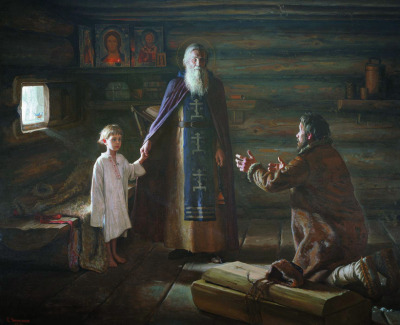
Sergei Chikunchikov-Resurrection Performed by St Sergius of Radonezh (1999)

A certain devout Christian living close by the monastery, who believed in St. Sergius, had an only son, a child who fell ill. The father brought the boy to the monastery to pray for him: but while the father was yet speaking, the boy died. The man, with his last hope gone, wept and bemoaned: “It would have been better had my son died in my own house.” While he went to prepare a grave, the dead child was laid in the saint’s cell. The saint feeling compassion for the man’s loss, fell to his knees and prayed over the dead child. Suddenly the boy came to life, and moved. His father returning with preparations for the child’s burial, found his son alive whereupon he flung himself at the feet of God’s servant and thanked him. The saint said: “You deceive yourself man, and do not know what you are saying. While on your journey hither, your son became frozen with the cold and you thought he had died. He has now thawed in the warmth of my cell and you think he returns to life. No one can rise again from the dead before the Day of Resurrection.”

The man, however kept insisting: “Your prayers brought him back to life.”

St Sergius forbade him from saying this: “If you noise this abroad you will lose your son altogether.” The man promised to tell no one and, taking his son – now restored to health- he went back home. This miracle was made known through the saint’s disciples.


St Sergius of Radonezh pray to God for us!

Wednesday, July 1, 2015

Some Recent Miracles of St. John Maximovich


Archbishop John's abundant miracles both before and after his death testify to his love for the people. People in America, Europe, and the other places of his pastoral labors have long known of the power of his heavenly intercessions. And now, with the publication of Blessed John the Wonderworker and other books and articles about him in the Russian language, the people of Russia are beginning to know, too, and have already experienced healings through his prayers, as the following accounts testify.

1) Valentina A. is a member of our parish which is dedicated to the Reigning Icon of the Mother of God. Having read the book on the healings and life of St. John of San Francisco (Blessed John the Wonderworker), she came to me after church services and asked for oil from the lampada in the sepulchre of Archbishop John, as her daughter was seriously sick. Valentina A. recounted that her daughter, an architect by profession, had a swelling in her breast. It grew and the daughter turned to a doctor for help. The diagnosis was a frightful one, cancer of the breast. I had Unction served over the daughter and later gave her cotton saturated with oil from Archbishop John’s lampada. She anointed the ailing spot several times by making the Sign of the Cross. The doctors insisted on surgery, but when she came to the hospital for observation, the doctors and the sick woman herself were amazed: the swelling had disappeared and there remained only a scar. (1994)

2) Our altar boy, Oleg S., asked me after church services to anoint his hand. There was a swelling on it the size of a chicken egg. I anointed him with the oil of Archbishop John in a cross-like form in the Name of the Father, Son and Holy Spirit, and the acolyte left for home. After a week, I asked Oleg about his hand. He said he himself did not even notice when that swelling had disappeared. (1995)

3) Some time later, after Divine Liturgy, a Moleben was served with a Blessing of the Water. At the end of the Moleben, I anointed all communicants with the oil of St. John Maximovitch. I also anointed Olga. After a week, she was again at services and stood weeping. I asked her why she was weeping and all she could say was that everything was fine. Her husband, a military man, later came to me and told me that her leg had developed some infected growths. These growths had rapidly become ulcerous and had begun to multiply. The sight was awful. She turned to doctors but they simply shrugged their shoulders and could say nothing concrete. They gave her various creams but these did not help her.

Alter Holy Communion, Alga had been anointed with the oil of St. John. At home she sprinkled her legs with holy water and went to bed. In the morning, she saw no ulcers at all on her legs. Therefore, at the next church service, Olga wept from gratitude and was too emotional to tell us by herself. June, 1995)

4) Another parishioner of mine, Nadezhda, told me that her son Michael caught a severe cold and had a convulsive cough which only grew worse. She began to treat him with various medications. In the evening he would begin to fall asleep but the cough continued to torment him. Each minute he would be racked by this cough. His mother, a professional medical worker, was very frightened because at one time he had been rushed to the hospital by ambulance with these same symptoms. At this time, Nadezhda was reading the book on St. John Maximovitch and his miraculous healings. The mother began to pray, asking help from St. John, that he would heal her son. Having prayed, she came over to her sleeping son, crossed him and turned him on the other side. Some time later, the cough stopped and the boy quietly slept until morning. She no longer gave him any medication, only some holy water. For several days, her son would occasionally cough, but the convulsive fits did not return, and he became quite well. The mother was very thankful to Archbishop John for the healing of her son and continues to pray to him with gratitude. (April, 1995)

Hieromonk Cyril Osipov

Astrakhan, Russia 


http://agapienxristou.blogspot.ca/2013/11/some-recent-miracles-of-st-john.html

Sunday, May 31, 2015

A miracle of Sts. Luke of Simferopol and Panteleimon

 A young girl was going for surgery to a hospital in Simferopol. Her situation was very serious, and the surgery was difficult and dangerous.


The physician that was operating on her called the mother of the patient and told her: “The surgery is very difficult and dangerous. I can't guarantee anything. I don't know if your girl will come out alive.”


There was no other choice. The young girl was brought to the operating room.


Throughout the duration of the surgery, the mother was sitting in the yard of the hospital, and with tears in her eyes she prayed to St. Luke the Surgeon and to St. Panteleimon to help.


At one instant, before the mother's eyes, an astonishing event occurred: the wall of the hospital became invisible, like a pane of glass. The operating room appeared. In the hospital bed was her daughter, and around her were the surgeon and his helpers. Next to her was the surgical nurse who was holding the surgical instruments.


And more wondrously: Next to the surgeon she saw the Holy Physicians to whom she was praying. To the left was St. Panteleimon with a lit lamp. To the right was St. Luke, who every so often would take the tools from the nurse and give them to the surgeon!


The mother was struck with astonishment and amazement. She felt that her prayer had been answered. When the operation was finished, the surgeon exited full of joy and enthusiasm.


He called the mother and told her: “Things went very well, unbelievably well!”


Then, the mother related to him the wondrous event that she experienced. The surgeon was stunned. He did his cross and confessed: “Now I understand. During the operation, when I would want some surgeon's tool, I didn't even get to tell the nurse. As soon as I thought that I wanted some tool, I had it in my hands.”

From the book “Tachys eis Voetheian...” (“Speedy to help...”) (A 200 page book filled with new miracles of St. Luke the Surgeon),
by Fr. Nektarios Antonopoulos, Abbot of the Holy Monastery of Sagmata, Thebes
 

http://agapienxristou.blogspot.ca/2013/06/a-miracle-of-sts-luke-of-simferopol-and.html

Monday, May 25, 2015

Three moving miracles of St. John the Russian


St. John the Russian
An unbelieving physician is miraculously healed

At Limne of Evia lived and worked a physician named Mantzoros. As a physician he was very good, but he did not believe in Christ, and of course did not wish to hear questions about religion and the soul. He was against religion, and his opinions were harsh on the subject of Christianity.

One day, he however became very sick. This illness had struck this unbelieving doctor with terrible pains as soon as it arrived. Amidst unbearable pains, he was taken to the Hospital of Chalkida. There, due to his illness, they were unable to help him, so they sent him to the Athens clinic “Pantocrator”, which is on September 3rd road. There they took x-rays and and ran blood tests, which showed that he had a problem with his large intestine...The physicians of the Hospital, therefore, said that if he agreed, he would be operated on the next day. He agreed, based on the medical knowledge that he had. But the words of his brethren: “Take hope in the Almighty, O brother”, led him to a spontaneous prayer from his soul the night before his surgery. He entreated God, not only to make him well, but to forgive him for the disbelief which he had shown for so many years.

During his prayer, someone knocked on his door and entered. It was a beautiful young man, who opened his door and entered the doctor's room.

“What do you have?” he asked.

“I am very sick” the doctor answered.

“But you don't have anything wrong with you” he replied.
“What are you saying, my Christian? I have colon cancer of the final stage, and tomorrow I am going to surgery. Do you understand what is going on?”

The young man replied “You don't have anything wrong with you anymore. I made you well.”

“Don't you have any shame talking like this to a sick man?” the doctor said, “Are you just trying to calm me down?”


“I am Saint John the Russian. If you insist, have the surgery tomorrow, and you will be convinced that nothing is wrong with you.” The young man disappeared.

The doctor was full of agony, and he rang the bell in his room to ask the nurses who the young man was who came to his room. However, not one of the nurses had seen anything. The next day, the sick physician went to the operating room for the surgery. The doctors were ready for the operation when they heard the doctor tell them that he didn't need the surgery, and that his health was good: “Saint John the Russian healed me”.

“What are you talking about?” they asked him, “We're in the 20th century, what are you talking about brother? Our brother must be out of it.”

Though the sick man had improved, they continued with the surgery. He went under anesthesia, and when they opened him up, they did not find any cancer. The Saint had done his miracle, and the doctors were astonished, and were looking at each other. The doctor was totally well. He relates this himself, wherever he goes. (from the book: “Lives of Orthodox Saints 9: Saint John the Russian”, published by Entheos Vios

"The Saint Was Helping Me To Pray"
Aikaterina M. from Athens related the following miracle of St. John the Russian in 1995, about her first visit to the Church of Saint John the Russian in Evia:
The first time I came here with my friends, I barely knew who St. John was, nor did I know what to expect, as I had never seen incorrupt relics before. At first I was shocked - the saint's body was certainly there, as it should not have been if it had been subject to the normal processes of nature, but his skin looked dark and a little withered, and I was fearful of coming any closer to the glass coffin. I finally gathered my courage and went up to look. His face was covered with a gold cloth, out of reverence, but I could clearly see his hands and wrists. I knelt down beside the coffin to pray, feeling that even if it seemed strange to me, I should still try to be respectful. I asked the saint to help me understand what I was seeing, and to know him. When I finished praying, I went to sit in a chair off to the side while I waited for my friends. I thought that I should pray some more, but I didn't know any prayers to St. John so I took out my Akathist Hymn to the Panagia, which I always carry with me, and told St. John that it was for him also. I begged him to forgive me for not having a special prayer for him alone.

Probably like most people, I often don't pray very deeply unless someone I love is ill or in danger, and this time I began read the Akathist to the Panagia in my usual way, although I tried hard to concentrate on the words. Suddenly, I felt that someone had come up and was standing next to me. I looked around quickly, but the nearest person was kneeling at the relics with his back to me, about a dozen meters away. I went back to my prayers, and although I didn't actually hear anything spoken aloud, I had the distinct impression that someone was praying to the Panagia with me, with great strength and love. I suddenly found myself praying with a depth I have never felt before or since - as if I was somehow in the middle of the prayer, and it was alive. I could feel the prayer moving up to heaven, and I knew in my soul that it was St. John himself, praying with me.

I was filled with such awe and joy at the nearness of the saint who was helping me to pray even though I had been afraid of him. It felt like Pascha, and as if I had just received the Holy Mysteries. I come to him now as often as I can.

The Cane
For many years, pilgrims to the shrine of St. John the Russian saw a simple cane standing before the glass-enclosed sepulchre. It belonged to an old woman, Maria Spaik, who was bent over from osteoporosis and had been unable to stand upright for eighteen years. In August 1978, he relatives brought her to the Church of St. John and lifted her in their arms so that she could venerate the relics. When Maria saw the incorrupt body of the Saint, she began to cry, asking St. John to help her. As she prayed over the relics, she felt an invisible hand touch her back. The old woman drew herself up erect. Tears appeared in the eyes of all the onlookers. The bells were rung, and a Supplication Service was sung in thanksgiving. The cane was left at the shrine as a memorial of the miracle. 


http://agapienxristou.blogspot.ca/2012/11/three-moving-miracles-of-st-john-russian.html

Thursday, May 21, 2015

The Icon that Saved a Life!


This icon of the “Kazan” Mother of God with the words partially worn away in Latin letters, “Eta ikona budet hranit was wsu schizn,” adorns the Church of the Joy of All Who Sorrow in St. Petersburg. One of the church’s parishioners told its amazing story.
One day, an old woman came into the church and waved her arms when she saw the Kazan icon of the Mother of God.
“Where did that icon come from? I gave it to a German soldier!” She exclaimed in amazement. I recognize it by a characteristic dent in the frame.” I explained that this icon was given to the church by the German Consulate in our city. The woman broke into tears, said that her name was Vera, and told the story of how her Orthodox family icon ended up in Germany.
“I fled my native village, which ended up in the center of the battles. I wanted to leave with my sister and three children earlier, but mama fell seriously ill, and wouldn’t have survived the journey. ‘I will come later,’ I promised my sister, sending her with the children to a place near Ryazan, where our aunt lived in a collective farm village. Mama died a month later, but before her death was able to bless me with the family icon of the “Kazan” Mother of God. My reposed grandfather in his time had blessed my mother before her wedding, and mama blessed Sasha and me with it fifteen years ago, even though my husband was in the Komsomol. Now the icon lay in my threadbare refugee bag. I myself sat down under the awning of one of the station freight houses, watching the crazy dance of whirling snow. I couldn’t think about anything; I only tried to shove my fingers into the narrow sleeves of a light overcoat. Cold and hunger—that was all I could feel. Now a train rumbled up to the station, the doors of the cars opened, and the Fritzes stood in ranks handing long boxes along to each other. ‘They’ve brought weapons,’ the indifferent thought crossed my mind. But then suddenly I felt a painful stab: “It’s going to the front! Where my Sasha is fighting! They will shoot at him with those rifles, and at other Russian soldiers… Oh, the cursed ones!’
“It is strange, but the German patrols paid no attention to me, a lonely woman, emaciated with hunger. I don’t even remember when I had eaten last. I had long ago traded my watch, wedding ring, and mama’s earrings for food. I ran my hand over the brass frame behind the frosty cloth of the bag. ‘O Intercessor, Most Holy Mother of God!’ I whispered with my frozen lips. ‘Save and guard my little ones, my sister Nadya. Save and guard my husband, slave of God, soldier Alexander.’
“’Vat? Somzing wrong?’ came the words just above my ear. I raised my head. Next to the bench stood a German soldier. I could feel sympathy in his words, and answered, “It’s bad.” The German sat down next to me. He set his bulging knapsack on the ground, fished around in it for a bit, then held out his hand. ‘Nimmt!’ There was a square piece of bread on which a slice of lard lay all pink. I took the gift and devoured it. The German pulled out a thermos, poured some steaming tea into the lid, and said, ‘Heiss! Gut!’ Probably he was part of the watch here at the station. He looked about twenty years old, blue-eyed. His face was guileless. Probably his hair was light colored, like my son’s, Andreika’s, only you couldn’t see it under his cap.
“The German pointed to the train engine, then at me, and comically furrowing his brow, apparently trying to find the word, asked, ‘Far?’ “Far! Now I won’t make it there!’ I immediately started telling him that I had hoped to go to my aunt’s but was now left without anything. Ending my story I said, ‘I have children there. Kinder. Understand? I traced with my hands, from high to low. The lad nodded, ‘Oh, ja, Kinder!’ ‘But I won’t reach them. I’ll just freeze.’ I wasn’t even aware that I was crying. The German again reached into his knapsack and pulled out a weighty package. ‘Here. Take.” He opened the package and touched its contents, then licked his finger and said, ‘Gut!’ There was salt in the package. Salt… which was then worth more than gold. For salt you could get bread, milk, well, anything… There was no less than three kilograms in the package. And here he was just handing it over to me, a completely unknown Russian woman. Seeing the shock on my face, the lad smiled and said something I didn’t understand. Then he rose, screwed the lid onto his thermos, put it back in the knapsack, waved his hand, and left.
“’Stop!’ I ran after the soldier. “Was ist es? ‘This icon will guard you all your life,’ I said with firm assurance. He didn’t understand. Again I said, ‘This icon will guard you all your life!’ The lad pulled a chemical pencil out of his pocket, wetted it with spittle, and turning over the board asked me to say it again. As I repeated it slowly, syllable by syllable, he wrote it down on the back of the icon in Latin letters: ‘Eta ikona budet hranit was wsu schizn’. We never met again… But I was able to trade the salt for warm clothes, felt boots, and bread, and I reached Ryazan. In ’45 my husband, Sasha, returned from the war.”
After listening attentively to the agitated woman, I joyfully told her that what we had heard from the representatives at the German consulate who had given the Kazan icon to our church. That German soldier went through the entire war. His comrades died before his eyes; once a truck that he was riding in exploded, but he was able to jump out of it only a moment before the explosion. The rest perished. At the end of the war, a shell hit their dugout, which he had abandoned just a twinkling before. The unseen power of the Russian icon had surely saved him. He now understood and reevaluated very much his life, and his soul opened up to prayer. He returned home, married, and raised his children. He placed the icon in a beautiful glass case in a place of honor in his home, and prayed before it all his life. When he grew old, he commanded his oldest son to take the icon to the Russian consulate after his death. “This icon lived in Russia and should return there. Let them take it to Leningrad, the city that withstood the blockade, dying from cold and hunger, but not surrendering.”
That is how in the mid 1990’s, to one of the newly-reopened churches of St. Petersburg, where the rector at the time was Archpriest Alexander Chistyakov, came the small icon of the “Kazan” Mother of God with a strange inscription in Latin letters on the back.


Irina Blinova
Translation by OrthoChristian.com
04 / 11 / 2014

When does God Perform Miracles? ( St. Paisios )


Here is a story about St.Paisios where he taught the nature of miracles.


"A group of young men, of no religious background, visited the Elder. They had heard of Father Paisios and were curious to meet him. After giving them the typical Mount Athos treat (loukoumi and water), he sat next to them to listen to what they had to say. The told him:
- Father, we want you to work a miracle in our presence, so we can believe in God.
- Wait a second, he replied.
He went inside and brought a knife and said jokingly:
- Stand up in line! I will cut your heads off and then I will miraculously glue them back to their place. But please, don't stand next to each other, in case I mix them up.
The young men reacted at once"
- No!! We want to see a different kind of miracle.
then, the Elder sat by their side and told them the following:
- It would be very easy, if God wished so, to make people believe in Him by working miracles; with His supernatural power, visible to all of us, He would make everyone believe. However, God does not want people to believe in Him out of admiration for His supernatural power; on the contrary, He wants us to believe in Him and love Him because He is extremely kind.


God will never work a miracle in order to demonstrate His power, and thus acquire more believers. He works miracles to cover up human weaknesses. ..."


We cannot put the burden on God to make us have faith in Him. This is a matter for our own free-will. The Elder is beautifully telling us that it is only through a relationship of love that we embody faith and know God's power. Miracles can happen to those of faith when they are in need due to their human weaknesses. They come when we seek with humility and faith based on a love of Him.

Thursday, April 9, 2015

Το θαυμαστό γεγονός του 1547 μετά Χριστόν, The miracle of the Holy Fire at Sepulcre church, Jerusalem, 1547


Αυτή η κολώνα της εισόδου του Ναού της Αναστάσεως στα Ιεροσόλυμα, παραμένει σιωπηλός αλλά εύγλωττος μάρτυρας του μεγάλου θαύματος.

Πρόκειται για το θαυμαστό γεγονός που συνέβη την εποχή που οι ’ραβες κατέλαβαν τα Ιεροσόλυμα (1547 μ.Χ.) και τους Αγίους Τόπους. Την εποχή που τούρκος διοικητής ήταν ο Μουράτ IV και πατριάρχης Ιεροσολύμων ο Σοφρώνιος Β΄.

Τότε οι Αρμένιοι αιρετικοί, που από χρόνια έψαχναν ευκαιρία να "βάλουν χέρι" στα Ιερά προσκυνήματα και μάλιστα στον Πανάγιο Τάφο και να "βγάλουν" αυτοί το ’γιο Φως, δωροδόκησαν τον τούρκο διοικητή να δώσει διαταγή να παραμείνουν οι Ορθόδοξοι εκτός ναού το Μ.Σάββατο κατά την τελετή αφής του Αγίου Φωτός! Και το πέτυχαν…


Αυτό έφερε μεγάλη λύπη στους Ορθοδόξους που συνέρρευσαν από όλα τα μέρη του κόσμου για να προσκυνήσουν και να δουν το γεγονός. Όλοι περίμεναν έξω από το Ναό και προσευχόταν με θέρμη στο Θεό να τους δώσει το ’γιο Φως και να δώσει διέξοδο στην κρίση. Την ίδια στιγμή ο μουεζίνης από το διπλανό μιναρέ παρακολουθούσε με περιέργεια την εξέλιξη των πραγμάτων.

Όταν λοιπόν οι Ορθόδοξοι με τον Πατριάρχη προσευχόταν έξω από το Ναό, το πρωί εκείνο του Μ. Σαββάτου του 1547, το ’γιο Φως ξεπήδησε από την κολώνα της εισόδου όπου στεκόταν και από τότε η κολώνα είναι ανοιγμένη και καπνισμένη! Έτσι οι Ορθόδοξοι άναψαν τις λαμπάδες τους, ενώ οι Αρμένιοι έφυγαν ντροπιασμένοι και δεν τόλμησαν έκτοτε να αξιώσουν το προνόμιο αυτό.

Ο μουσουλμάνος μουεζίνης που είδε το θαύμα μπροστά στα μάτια τόσων ανθρώπων, πήδησε από τη χαρά του από το μιναρέ και ομολόγησε πίστη στο Θεό των Χριστιανών. Αυτό είχε σαν αποτέλεσμα να μαθευτεί το γεγονός μεταξύ των μουσουλμάνων που το θεώρησαν προδοσία της δικής του πίστης και όρμησαν και τον αποκεφάλισαν. Αυτό ορίζει εξ άλλου ο ισλαμικός νόμος! Έτσι έγινε και μάρτυρας της πίστεως και οι χριστιανοί περιμάζεψαν το λείψανό του που σώζεται μέχρι σήμερα στην Ιερά Μονή Μεγάλης Παναγίας.


The miracle of the Holy Fire at Sepulshre church, Jerusalem, 1547

Another proof of the authenticity of the Orthodox faith

At the Great Gates themselves, on the left side, stands a column made out of marble with a fissure from which the grace, that is, the Holy Fire, came forth

Let me tell you about this: At the Great Gates themselves, on the left side, stands a column made out of marble with a fissure from which the grace, that is, the Holy Fire, came forth. This column is honored by Orthodox as well as non-Orthodox, and even the Armenians. I would like to write a little about this incident, how the Orthodox Eastern Christians unanimously speak of it and the Turks themselves confirm it. In the wall there is an inscribed marble slab, and they say that this very incident is written on it; but we could not read it because it is written in Syrian letters, in the Arab tongue; and I only heard about it, but did not read it. But the incident happened something like this: At one time when the Greeks were completely oppressed by the Turkish yoke, some rich Armenians took it into their heads to force the Greeks out of the Holy Sepulchre and out of the Church of the Resurrection. They gathered a large sum of money and bribed the Ottoman Porte and all the Jerusalem authorities, assuring the unbelievers that the Holy Fire comes forth not simply for the sake of the Greeks, but for all Christians, and "if we Armenians are there, we also will receive it!" And the Turks, who are greedy for money, accepted the bribe and therefore did as the Armenians wished, and they affirmed that only the Armenians would be allowed to receive the Holy Fire. The Armenians rejoiced greatly and wrote to all their lands and to their faithful, that more of them should go on a pilgrimage. And a great multitude of them did come. Holy Saturday approached: the Armenians all gathered in the church, and the Turkish army drove the poor Greeks out. Oh, what unspeakable grief and sorrow filled the Greeks! There was only one comfort for them — the Grave of the Saviour, and they were being kept away from it, and the Holy Gates were locked to them! The Armenians were inside the church and the Orthodox were on the streets. The Armenians were rejoicing and the Greeks were weeping. The Armenians were celebrating and the Greeks were bitterly lamenting!


The Orthodox stood opposite the Holy Gates on the court and around them stood the Turkish army, watching so that there would not be a fight. The Patriarch himself with all the rest stood there with candles, hoping that they would at least receive the Fire from the Armenians through the window. But the Lord wished to dispose things in a different way, and to manifest His true Faith with a fiery finger and comfort His true servants, the humble Greeks. The time had already come when the Holy Fire issues forth, but nothing happened. The Armenians were frightened and began to weep, and ask God that He send them the Fire; but the Lord did not hear them.


Already a half hour had passed and more, and still no Holy Fire. The day was clear and beautiful; the Patriarch sat to the right side. All of a sudden there was a clap of thunder, and on the left side the middle marble column cracked and out of the fissure a flame of fire came forth. The Patriarch arose and lit his candles and all the Orthodox Christians lit theirs from his. Then all rejoiced, and the Orthodox Arabs from Jordan began to skip and cry out, "Thou art our one God, Jesus Christ; one is our True Faith, that of the Orthodox Christians!" And they began to run about all of Jerusalem and raise a din, and to shout all over the city. And to this day they still do this in memory of the incident and they jump and shout, running around the Holy Sepulchre, and they praise the one true God, Jesus Christ, and bless the Orthodox Faith. Beholding this wonder, the Turkish army, which was standing around on guard, was greatly amazed and terrified. From amongst them one named Omir, who was standing at the St. Abraham’s Monastery on guard, immediately believed in Christ and shouted, "One is the true God, Jesus Christ; one is the true faith, that of the Orthodox Christians!" And he jumped down to the Christians from a height of more than 35 feet. His feet landed on the solid marble as if though on soft wax.

And to this day one can see his footprints imprinted as though in wax, although the non-Orthodox tried to erase them. I saw them with my own eyes and felt them with my own hands. And the column with the fissure still bears the scorch marks. As for Omir the soldier, having jumped down, he took his weapon and thrust it into the stone as though into soft wax, and began to glorify Christ unceasingly. For this, the Turks beheaded him and burned his body; the Greeks gathered up his bones, put them into a case and took them to the Convent of the Great Panagia, where they gush forth fragrance until this day. The Armenians in the Holy Sepulchre received nothing and were left only with their shame. The Pasha of Jerusalem and other Turkish authorities were greatly displeased with them and wanted to slaughter them all, but they feared the Sultan. They only punished them heavily: they say that they made each one to eat dung as he left the church. . . . . . . . . . . . . . . . . . . . . . . . . . .


Written by hieromonc Parthenius


http://agapienxristou.blogspot.ca/2013/05/1547-miracle-of-holy-fire-at-sepulcre.html

Tuesday, March 31, 2015

The complaint of St. Nektarios


St. Nektarios the Wonderworker


St. Nektarios once appeared to a most-pious cleric and complained:
"It's as if we Saints are in retirement...The people don't pray to us, don't entreat us, don't ask us for anything, don't give us any handiwork to do. They don't give us the opportunity to pray to God for them..."


Through the prayers of our Holy Fathers, Lord Jesus Christ our God, have mercy on us and save us! Amen!

http://full-of-grace-and-truth.blogspot.ca/2014/02/the-complaint-of-st-nektarios.html

Thursday, February 5, 2015

Miracles of the Mother of God ( Syria )


The Protection of the Mother of God.

When Christians are in need of quick and sure help, they have recourse to the Virgin Mary, Mother of God, who has saved people in Orthodox countries so many times that an entire history book could be compiled to describe them all. Many times the Theotokos has saved the Orthodox from attacks also by people from the Moslem East; not because she could ever be against anyone–for Moslems all also people created by God–but because Orthodox Christians have a special love for her, as for their own Mother, and she does not neglect her own.

In these terrible times, we must not forget to pray to the Theotokos with tears for the people of Syria, just as Orthodox Christians before us prayed in times of danger.

One example of this was celebrated last Sunday (September 1)–the Vladimir icon of the Mother of God, before whom medieval Russians prayed in the face of sure annihilation.

The Vladimir Icon of the Mother of God.

In 1395, Tamerlane with his Tartar horde approached Moscow. The Grand Duke of Moscow, Vasiliy Dmitrievich, requested that the Vladimir icon be carried from the city of Vladimir to Moscow. As the icon was processed from Vladimir to Moscow, people stood on their knees, begging, “O Mother of God, save the Russian Land!” The city of Moscow waited solemnly for the Vladimir icon, and when it arrived, everyone came out to meet it, praying fervently for salvation.

During the very hour that the people were meeting the Vladimir icon, Tamerlane lay sleeping in his tent. He saw a vision of saintly hierarchs with golden staffs descending from a high mountain, and a radiant Lady in the air above them, surrounded by angels and dazzling rays of light. Tamerlane woke up in fear. His soothsayers warned him that the Woman whom he had seen in the vision was the Protectress of the Orthodox, the Mother of the Christian God, and that her power is invincible. Tamerlane was so shaken by the vision that he swiftly departed, swooping down upon the steppe-cities of the Golden Horde, who had caused the Russians no little trouble. Tamerlane crippled them, effectively curing Russia of their threat.

Later, in 1521, the khan of Kazan, Mehmad-Girey, advanced toward Moscow with Kazan and Nogay Tartars. Metropolitan Varlaam prayed with the people before the Vladimir Icon. Grand Duke Vasiliy Ivanovich barely managed to gather enough soldiers to meet the Tartars at the kingdom’s border, near the Oka River. He was slowly retreating to Moscow, trying hard to hold ranks.

On the night of the siege, a nun in a Moscow convent had a vision, which she related to the people, warning them that they must pray hard to the Mother of God to avert disaster. All the citizens of Moscow gathered in the church for a heartfelt prayer. The Tartars again saw a vision of “a huge regiment in shining armor,” and ran away from the walls of the city.

Other icons of the Mother of God that are celebrated in Russia are the Kazan icon, before which Russian forces prayed when they took Kazan from the Moslem Tatars; the Smolensk icon, which saved the western lands from an attack by the Poles, and the Albazin icon, which protected Russia’s eastern borders from the Chinese.

Russians also celebrate an event that occurred in Constantinople, when the Byzantine capital was saved from… the Russians!

In October, 910 Constantinople, was under siege by the pre-Christian, barbarian Russians. The situation was desperate. The citizens gathered in the Blachernae church and prayed to the Holy Mother of God. After the Virgin’s robe, brought to Byzantine from Palestine, was cast into the sea, a storm rose up, driving the pagan ships away.

The Iveron Icon of the Mother of God.

Another miraculous icon in the Iveron Mother of God, also known as the Portaitissa, or “Gate-keeper”. This icon was preserved by a pious widow during the iconoclasm period, and made its way miraculously to a Georgian monastery on Mt. Athos. The monks placed it in the church, but it also miraculously replaced itself above the monastery gate. This happened again several times, until the Virgin appeared to the monk Gabriel in a dream, and said, “Announce to the brothers that from this day they should not carry me away. For what I desire is not to be protected by you; rather I will overshadow you, both in this life and in the age to come. As long as you see my icon in the monastery, the grace and mercy of my Son shall never be lacking!”

After a Greek uprising, when the Turks began to attack Mt. Athos, the Mother of God preserved her Holy Mountain. It has also become a tradition in monasteries all over the world to keep an icon of the Mother of God over the gates as protection.

For many centuries, Syrian Christians have been graced with the Saidnaya icon Mother of God, kept in the monastery of the Nativity of the Mother of God in the village of Saidnaya. Countless miracles have been wrought through prayer before this icon, but we recount here one that happened as recently as the year 2004. It is a story that, if it had not been broadcast on the major TV channels in the Middle East, would certainly be hard to believe, even after reading about her intercessions throughout the Christian East. Here is an account of that miracle compiled by Archimandrite Nectarios (Serfes):

The Saidnaya icon of the Mother of God.
According to tradition, this icon was painted by the Apostle Luke.

In December 2004 a Saudi Arabian man, a Moslem, appeared before several news agencies to relate the following incredible event he experienced and which changed his life (this story appeared on TV, the Internet, radio, and was circulated in newspapers, magazines, and pamphlets throughout Saudi Arbia, Syria, Palestine, and evidently in all neighboring countries.

Some years ago, this man married a Moslem woman who was very rich, but sterile. As the years passed, and despite all their efforts and significant medical expenses with many doctors, they remained childless. The man’s parents suggested to him that he marry a second woman, while upholding his initial marriage (as the local laws permits up to four concurrent marriages).

Being exhausted, worried, and downhearted, he did not accept his parents’ advice but rather chose to vacation with his wife in Syria. There they hired a limousine with a driver who would serve as tour guide for all their site-seeing excursions throughout Syria. As the vacation progressed, the driver noticed that the Saudi Arabian couple was experiencing bitterness, pain, and grief. Having gained familiarity with the couple, the driver cautiously asked them whey they appeared to be so unhappy–was it perhaps because he was not conducting the tour to their satisfaction?

The couple confided to the driver that the source of their unhappiness was their inability to have children. The driver who was also a Moslem, then told them that in Syria the Christians, specifically the Orthodox Christians, have a monastery named Panagia Saidnaya (Arabic word meaning Our Lady) and that many people who can’t have children take refuge in Her miracle-working icon. They go to the monastery, and there they are given to eat the wick form the lamp which burns before the miraculous icon. And then the “Mary” of the Christians grants them, according to their faith, what they wish.

Becoming excited, the Saudi Arabian and his wife asked the driver to take them to the “Saidnaya” monastery of “The Lady of the Christians” and said that if we have a child, then I will come back and I will give you 20,000 U.S. dollars, and I will give the monastery 80,000. So they went to the monastery and did as they were instructed. Later they returned to their homeland and after some time, his wife was found pregnant. In a few months she gave birth to a charming baby boy. It was truly a miracle of Our Lady Theotokos.

Now, as soon as his wife gave birth, the Saudi Arabian man wanted to return to Syria to uphold the promises he had made. Upon his return he called the same driver and asked to be picked up at the Damascus airport. But the driver was cunning and wicked and he persuaded two of his friends to go to the airport with him to pick up the rich Saudi Arabian man, to take his money and kill him. So they picked up the rich man at the airport and he, as they drove, without realizing that they had planned to kill him, told the friends of the driver that he would give them also 10,000 US dollars each.

These men, still not satisfied, deviated from the route to the monastery and went to a deserted place, proceeded to slay the Saudi Arabian man, and to cut off his head and other parts (hands and legs) of his body into pieces. Blinded by passion and overcome by the horrific act that they just committed, they put the man’s remains in the trunk of the car rather than just leaving him there. After taking his money, watch, and all that he had, they proceeded to find another deserted place to discard the remains.

Then, on the National highway, their car broke down and stopped in the middle of that road. The three men got out to determine why the engine had stalled. Then a passerby stopped to help them but they, afraid that their terrible act would be discovered, pretended that they did not need any help. But as the passerby motorist was leaving, he noticed blood dripping from the rear of the vehicle and he called the police to investigate, because the scene and the three men looked suspicious. The police came and saw the blood under the car and on the pavement, so they ordered that the trunk be opened.

The Saidnaya Monastery, Syria.

Well, when they opened the trunk, lo and behold, the Saudi Arabian man lifted himself out, obviously and amazingly alive and in good health, saying to them “Just now this PANAGIA finished stitching my neck, right here (showing them the area of his Adam’s Apple), after first stitching up the rest of my entire body”. Seeing this, the three criminals immediately lost their minds, becoming as if mad. The police handcuffed them, and as they were being taken away to an asylum for the insane, the criminals started raving that it could not be possible that the Saudi Arabian man whom they killed, beheaded, and dissected could yet be alive.

The Saudi Arabian went to a medical facility to undergo examination by doctors and medical examiners who confirmed and attested that the stitching was done very recently, thereby validating the miraculous event. The stitches were, and still are, obvious. When the Saudi Arabian came out of the car’s trunk, he had the appearance, literally, of just having been refabricated (put back together) to which he continuously confessed that the PANAGIA had rejoined his body and resurrected him with the help of her Son.

Immediately after this, the Saudi Arabian called his relatives to come to Syria. They all went together to the monastery of Panagia Saidnaya and offered up prayers, praises, and glorification, and instead of the initially promised gift of $80,000 he gave $800,000 to the Theotokos.

Today, as this man relates the details of that overwhelming miracle, he starts his narration with, “When I was a Moslem this happened to me”, thus indicating he is no longer a Moslem, nor is his family.

This miracle stunned with awesome surprise the entire Arabic/Moslem nation and all of the Middle East.

Let us Orthodox Christians never neglect to pray to the Mother of God for protection against all evil. She is indeed our Protectress in times of need.

http://www.pravoslavie.ru/english/64087.htm

Friday, January 23, 2015

Greek Miracles of St. Seraphim of Sarov

This story was told to us by a pious Greek Orthodox family who lives in England, but often visits its homeland. On one of their visits to the holy places of Greece, they were travelling on the Cassandra peninsula and stopped along the way at and unknown church. They went inside. It was an ordinary Greek church, but what surprised these visitors was the unusual veneration of St. Seraphim of Sarov, which could be seen from the church’s interior. Besides the usual large icon of the saint, there was also by the wall an original looking reliquary with an icon—an epitaphion (symbolical burial shroud), depicting the reposed God-pleaser, St. Seraphim.

As our Greek friends explained to us, very many people now know of Fr. Seraphim in Greece. Furthermore, the Russian Seraphim has become so dear to the hearts of simple believers that they take him to be their own Greek saint, and the less educated might even say that Sarov is somewhere in Greece. Nevertheless, it was not clear what made this particular church venerate him so, especially since it was located in “the boondocks”.

Soon a priest showed up and answered the visitors’ question, that this church was dedicated to St. Seraphim. Why and how this happened is a whole story, which he graciously offered to tell them over a cup of tea.

The story turned out to be quite extraordinary, even miraculous. Fr. Nectarios, as the church’s rector was named, once labored in obedience as a simple monk at the Lord’s Sepulchre in Jerusalem. It was his duty to arrange the schedule of services and molebens amongst the different Orthodox jurisdictions, as well as for the heterodox. There was a specific time set aside there for the Russian nuns of the Jerusalem convent who came there to chant and read akathists.

Well, one day it seemed to Fr. Nectarios that the time allotted to them was too long. So he decided to shorten it by nearly half. The nuns’ tearful pleading had no effect on the self-assured administrator. “The decision’s been made; kindly follow it—otherwise you will lose your right to pray here at all.”

The cell where Fr. Nectarios rested at night was located on the second floor of the church building itself. That night, no one remained in the church to pray, and all the doors were locked. Suddenly, a light rapping at the door of his room was heard. Fr. Nectarios was extremely amazed. Who could it be? At the second knock, he opened the door. He was not frightened, but he was puzzled. Perhaps someone had remained in the church by accident.

Before him stood an unfamiliar, gray-haired old man, who pointed a threatening finger at Fr. Nectarios and said, “Do not dare to offend my daughters!” It was said in perfect Greek, but the custodian could not make out what these words were referring to. After repeating them, the elder disappeared into the darkness of the church.

Walking around the church one more time, Fr. Nectarios did not find anyone, and went back to his cell to rest. In the morning he was almost sure that it had been just a dream. But when the Russian nuns came to the church and after setting up their little icons began to pray, the monk’s heart constricted from reverent fear. On one of the icons was depicted the very elder who had appeared to him the night before. The voice again sounded in the custodian’s ears as from someone present, saying: “Do not dare to offend my daughters!”

Falling down in prostration before the icon and kissing it reverently, Fr. Nectarios found out from the nuns the name of the saint about whom he previously knew nothing, and gave them back their time for prayer at the Lord’s Sepulcher.

Soon after that, yet another unusual event happened in the life of Fr. Nectarios. Long before the event described at the Lord’s Sepulcher, an elderly Russian bishop came and prayed so long and late there, that Fr. Nectarios invited him to rest in his cell. He gave the bishop his bed, and intended to rest on the trestle bed in the corner. But the elder-bishop did not close his eyes all night, only “pulled his prayer rope”, sitting in the armchair. Fr. Nectarios felt uncomfortable going to sleep, and so he also prayed all night with his prayer rope. Well, a couple of days after the appearance of St. Seraphim and the custodian’s subsequent repentance, Fr. Nectarios suddenly received a package from that same bishop. As it turned out, the elder-bishop had reposed in the Lord, and bequeathed the monk-custodian nothing other than a piece of the relics of St. Seraphim of Sarov.

Fr. Nectarios’s compunction and gratefulness knew no bounds. What mercy the saint has shown him, how quickly he had forgiven him, and how wondrously blessed him! Then and there he made a vow, that at the end of his service at the Lord’s Sepulcher, after he returns to Greece, he would build a church in honor of St. Seraphim. He built the grave-covering by the wall so that after his death he could be buried on the other side of that wall, outside the church, but next to the Saint!

Hieromonk Kirill (Zinkovsky), Hieromonk Methodius (Zinkovsky)

Translation by OrthoChristian.com


Sunday, January 11, 2015

St. Nephon's Visions of the Divine Liturgy


Christ and the Holy Angels in the Divine Liturgy

St. Nephon, Bishop of Constantia (4th Century), was made worthy to see many divine visions, with the illumination of the Holy Spirit, through the eyes of his soul.


Once, in a Divine Liturgy, as soon as the liturgist said: “Blessed is the Kingdom..”, the Saint saw fire descending from heaven and cover the Holy Altar, without the priest understanding anything.


Later, when the Trisagion Hymn was begun by the people, four angels descended and chanted together with them.


During the Epistle, the blessed Apostle Paul appeared to direct the reader.


During the “Alleluia” after the Epistle, the voices of the people ascended united towards heaven, like a fiery and tightly-braided rope.


And at the Gospel, every word came out like flames from the mouth of the priest, and ascended to the heavens.


A short time before the entrance of the precious Gifts, the Venerable One straightaway saw heaven open, and an unspeakable aroma surpassing the world pour forth. Angels descended from on high, chanting hymns and doxologies to the Lamb, to Christ and the Son of God!


Then there appeared a totally pure and thrice-blessed Infant!


He was held by the arms of the Angels, who brought Him and placed Him on the Holy Paten, where the Precious Gifts were found. Around Him was gathered a multitude of totally radiant youths dressed in white, who approached His divine beauty with wonder and fervor.


It was the time of the Great Entrance.


The liturgist approached to take in his hands the Holy Paten and the Holy Chalice, and raised them up above his head, lifting together with them, the Infant.


When the Holy Gifts exited, while the people chanted compunctionately, he saw the venerable angels flying over the liturgist in circles.


Two Cherubim and two Seraphim went before him, and a multitude of other Angels followed behind, chanting unspeakable hymns with rejoicing.


When the priest reached the Holy Altar and placed the Precious Gifts, the Angels covered them with their wings. The two Cherubim stood on the right of the liturgist, and the two Seraphim on his left, without [the priest] seeing them.


The divine mystagogy continued.


They said the Creed, and reached the consecration of the Precious Gifts.


The liturgist blessed them and said: “...changing them by Your Holy Spirit. Amen. Amen. Amen.” Then again, the Righteous One saw an Angel take a sword and pierce the Infant, pouring His Blood into the Holy Chalice, while His Body was cut up and placed on the Holy Paten.


Later, [the Angel] returned to his place again, and stood chastely with reverence.


When the liturgist lifted up the Holy [Lamb], crying out: “The Holy Things are for the Holy people of God”, while the people chanted: “One is holy, one is Lord...” one of the faithful approached the Saint and asked him: “Why, O Father, does the priest say: 'The Holy Things are for the Holy people of God'?”


The Saint replied: “He says this for all of us, my child, and it means: to the Holy Members of Christ, may those who are holy approach!”


“And what is holiness, O Father?” the man asked him again, who was very simple.


“If one is dissolute, let him not dare to partake of this great Mystery. If you have made an enemy of anyone, do not approach. If you have made a laughing stock of, or angered, or judged your fellow man, stay far away from Holy Communion. First test yourself, to see if you are virtuous enough to approach, and if you are not, [stay back].”


In the interim, the liturgist cried out: “With fear of God, and faith and love, draw near.”


The Saint then followed all those who communed. Some of their faces turned black as soon as they partook of the Divine Mysteries, while others shone like the sun.


The Angels stood there nearby and followed the Communion with reverence. After every faithful person communed, they placed a crown upon his head.


However, when a sinner approached, they turned their faces in aversion. Then, the spotless Mysteries appeared to disappear from the holy [spoon], so that the sinner might not take within him the Body and Blood of Christ. And the sinner left utterly black...with the disapproval of the Lord spread over his face.


When the liturgy was finished, and the priest consumed the Gifts, then, the Infant appeared whole again above in the arms of the Holy Angels!


Straightaway the roof of the church appeared to split in two. From there the Angels lifted up the Child to the heavens with hymns and doxologies, just like they had brought Him down, and an unspeakable fragrance again filled the whole area.”


Jesus Christ depicted as an Infant on the Paten, the Lamb of God Who takes away the sins of the world

Through the prayers of our Holy Fathers, Lord Jesus Christ our God, have mercy on us and save us! Amen!


http://full-of-grace-and-truth.blogspot.ca/2014/08/st-nephons-visions-of-divine-liturgy.html

A spiritual resurrection by St. Ephraim of Nea Makri


St. Ephraim of Nea Makri, the Great Martyr and Wonderworker - Commemorated May 5th and January 3rd (source)
A spiritual resurrection by St. Ephraim of Nea Makri

“O honored Abbess and Holy Mother, with respect I kiss your hand, the servant of God, A.

To begin, I ask for great forgiveness from St. Ephraim, because I was slow in relating the miracle that I was made worthy of (in order for it to be included in the books of miracles), due to many problems, after roughly nine years, when the Saint visited me the sinner.

I hope unshakably that our Lord, the Most-holy Theotokos, and our Saint will forgive me. I had very many family troubles, sicknesses and deaths, which absorbed me such that I forgot to write of the miracle. But I will never forget the great benefaction of our Saint, and I will not cease thanking him and praying to him.

It was an afternoon in November 1990, when my phone rang. It was one of my friends, who told me: “A., I learned that in Nea Makri there is a Monastery, where there is a Saint named Ephraim. Do you want to go venerate?”

Here I should say as an aside that then I was very far from God, not that I didn't believe, but I had so many family troubles, as I mentioned above, that my faith was shaken, it was lukewarm, I was going backwards, nothing was going right. I was indignant and burdened therefore, and I blasphemed with very evil words, like those used by lower classes of society [spiritually], who might be far from God, like I was.

I was working in Athens, and for 25 years, I did not go to Church of Sundays or take Holy Communion.

I would only go to Church on Pascha, along with everyone else, without understanding the deep sentiments of the faith.

I was very greatly influenced by the Killer of Man (the Devil), and he did with me whatever he wished...

Thus, that afternoon when my friend called me and told me to visit the Saint, I was still very lukewarm. My friend, in contrast, believed in God together with her family, and performed all of their religious duties. They were people of God...

Because, therefore, she was a very good friend who helped me psychologically and morally, I didn't want to hurt her feelings, and I agreed to go, myself the sinner, when I was talking on the phone. When I understood what she wanted to tell me, I groaned within myself, saying:
“Oh...now she's going to tell me to go to the Monastery, like I would ever run to Monasteries!” (I was very far away them then).

How mistaken was my thought, however. Without my knowing that this was my first visitation to the Saint, whom I had never even heard of before.

When she told me his name, and I heard it for the first time, I asked:
“What did you say the Saint was called?”

“St. Ephraim” she told me.

“What did you say? Ephraim? That's the first time I heard the name. What is it, Turkish? Egyptian? What is it?”

She told me, “No, it's Greek...”

Ultimately, we came to his grace, and venerated with reverence, because he is a Saint, but not with deep religious sentiments as every faithful person. When we exited the Holy Monastery into the courtyard, I saw the tree on which they hung our Saint, but I did not think much of this, I was very lukewarm.

In the courtyard was a bookstore. I went in alone, while my friend was likely giving priority to the Saint. There, I was reading some of the book covers:
“Visions and wonders of the Holy Great Martyr Ephraim the Wonderworker."

At that instant, I murmured:
“Ok, now we are talking about miracles? What are they saying? What miracles occur in the 20th century? Why are you talking about miracles?”

I was utterly curious and doubtful, I had darkness in my soul, and I mocked what I read at that instant.

However, at the same time that I was mocking, I was intrigued by the book, and something within me told me: “Get it...get it...”

With great hesitation and without knowing what I was doing, I stretched out my hand and bought it, as if someone was pulling my hand and telling me: “Get it...”

Ultimately, I made the decision: “I will get it out of curiosity, to see what they write...” How would I have known that the sinner, at that instant, began to experience the salvation of my soul from our Lord, while naturally, at that instant, I did not understand all the depth, but only later I understood...

I don't wish to tire you, and I ask forgiveness, but I should write this in detail. When I ultimately bought the book, I began to read it every day during my afternoon nap, and slowly I began to read more and more.

The 2-3 chapters increased, and I soon wasn't sleeping at all at noon in order to finish the book. It began to please me, and it was something that interested me, and by the time I reached the middle of the book, I greatly began to love our Saint, and I sensed that I had known him for many years, while in reality, I had never known a Saint At that instant I sensed that noetically, I was very near the Saint.

Those hours when I was reading the book, I sensed that I knew the Saint well, and I thanked him for healing all of those sick people, as if I had sent him. I sensed this joy, and wholly thanked him.

At one point, I sensed how I had been affected by those 25 years that I had not gone to Church. I had never gone to Confession, and naturally I did not take Holy Communion, and straightaway, as I was sitting on me bed, I lifted up my eyes to heaven and said:

“My God, my Christ, thank You for healing those sick people, and forgive me as well...I, O Lord, have not walked in Your Church for 25 whole years...” (even though there were four churches in my neighborhood).

And later, I began to thank our Saint again, and said:
“My Saint Ephraim, I embrace you and kiss you, for you healed those sick people through the Lord...”

And, O the wonder, at that instant, as I put in the bookmark, I turned over the book, and kissed the icon on the cover, and thanked the Saint with indescribable joy and exaltation...

Before I kissed the icon of the Saint, within me passed a very beautiful smell, like cologne.

At that instant, I did not understand that this smell was called divine fragrance, because as I wrote above, I was far from the Church and did not know these things...

At that same instant, I began to have great curiosity and I asked within myself what that beautiful smell was, and I smelled the book to understand what was that beautiful smell. The clothes that I was wearing smelled, along with the air in my room. It did not leave me thus, but my whole studio smelled beautiful. And I asked, what was this?

My ignorance, my curiosity and my intrigue was solved by my friend who had called me before, who told me: “A., St. Ephraim visited you!”

On the phone I asked: “Where is the Saint? I didn't see him enter my house.”

My friend replied: “The Saint visited you through his divine fragrance, because we went to venerate him. The smell that you sensed is called divine fragrance, and this is the presence of the Saint, because the Saint wanted to visit you...”

My friend then asked me: “Did you light your vigil lamp?”, and I responded: “Paradoxically, yes.”

In reality, I don't know how, but I had lit my vigil lamp, and all that I remember was that I was kneeling and thanking God and the Saint who enlightened me, and entreating that I be forgiven, who had been so many years away from them.

O my honored Abbess, there when I was kneeling and crying, without any depression, I felt an internal change within me, and I put my head to the ground, and sought forgiveness for all my sins, for all of the years that I was very far away from God.

At that instant I asked myself, and had the thought: how could I learn all that is read within the Church, and come to know Christ better. How could I learn that which the priest and the chanters chant, and how could I learn about our Saints?

And again a divine illumination came to me! I should go purchase the Lives of the Saints, and other Christian books, in order to learn the Divine services, and everything that has to do with the Church, along with the hymns and apolytikia of the Saints. This is what happened.

During my first Holy Confession, I said this all to my Spiritual Father, and when I left for my home, I couldn't relate to you what a weight had fled from on top of me, and I walked as if I wasn't walking at all, but like a bird in the air (I became free in reality)...

From then when I was enlightened and as if re-baptized by St. Ephraim, I entered again to a religious road, and this I attribute to our Lord and to the Most-holy Theotokos, who intervened, sending our Saint Ephraim to enlighten me. Therefore, I owe a great thank-you to the Holy Great Martyr Ephraim.

From then on, I go to Church every Sunday and Great Feast, I confess and I commune.

Because of the wonder which St. Ephraim worked for me, I glorify and thank him every day, and confess his wonder to the world, and I give people his Paraklesis, his icons and his books to read. O my honored Mother and Abbess, I ask forgiveness from the Lord and our Saint for neglecting to write of the good that he did, and I ask forgiveness for tiring you...

I hope and pray that our Saint will protect your Holy Monastery, together with the sisters, and that you might pray for me, the sinner.

With love in the Lord, your humble servant,
A. D. A.
Octover 2003, Amaliada.

From a book of miracles of St. Ephraim, Volume 18, September 2011.

Through the prayers of our Holy Fathers, Lord Jesus Christ our God, have mercy on us and save us! Amen!

http://full-of-grace-and-truth.blogspot.ca/2015/01/a-spiritual-resurrection-by-st-ephraim.html