Shortly before the year 2000, my mother came over to my house and said, “Son, a few blocks away there is a distressed family with two elementary school girls. They need to live with their grandmother because they are going through a terrible ordeal. Their father, who is about your age, is a drug addict. I know his mother. Please drop by to see what you can do, because his wife and his mother told me that he is in his last days.”
“And what do you think I can do, mom? I can hardly keep up with my own dirty messes, and now all of a sudden you think I can help others?”
“Come on, my boy, you need to go; please, don’t upset me.”
The next day, I complied with my mother’s wish. With the blessing of my mother and my spiritual father, I prayed briefly and said, “My Panaghia, I will go, but you lead and I will follow.” When I arrived at the home, his mother welcomed me with a hug and a kiss. Then she drew me aside, and while she wept, she explained her Golgotha and the heavy cross the entire family had had to bear. As she was unfolding their very painful family drama to me, occasionally, she would use her apron to wipe her eyes. The poor woman had suffered so much all these years. She had gone to various neighborhoods and local businesses to borrow money to help her son get his drugs. What pain this mother had endured! What a Golgotha! What crises families in similar situations must be going through! I couldn't endure so much pain. I hugged her, and told her to have her hope and faith in Christ. When I went to the other room, and I saw her son lying in bed, the truth is that I wasn’t prepared for it; I was shocked. I went to give him my hand, but he couldn’t even exchange a handshake, because his fingers had become deformed. I grabbed him from the wrist and attempted to speak to him, but he would fade in and out of consciousness. With a little patience, however, we became acquainted and shared a few words.
“My brother, I am your neighbor,” I told him “I don’t know you, of course, but you don't know me either. So, since we have become acquainted now, what do you say, can we help one another?”
“It’s too late for me, Thanasi,” he told me in a whispering voice, “I am in the last stage. There is no recovery for me. The doctors can't do anything.”
“Humanly, yes, we agree, but don’t forget the power and grace of our God; what is impossible for man is possible for God” (cf. Luke 18:27).
“I believe in God, Thanasi, but I have fallen into a snake pit. I have made repeated efforts to detoxify myself for many years now but all in vain. I know that I upset my mother, my wife and especially my children. What can I do? I’m not to blame. It’s the deprivation of heroin.”
“So fine, since you believe that you are in a pit with snakes, stretch out your hand and ask the help of Christ. He is the only one who is able to take you out of this pit.”
“What must I do; and how?”
And he faded out again. I needed to wait a few minutes, for him to regain consciousness. In the meantime, I prayed and said, “My Christ, is he listening to what I’m telling him? Can he even think, understand, or remember? Please Lord, only You are able to help us, especially me.” A few moments later, he opened his eyes, and we spoke a bit more. In the end I told him, “I need to leave you now, my brother. The next time I come, if you like, I can bring a priest to read some prayers over you. I think this will do you much good.”
“Yes, Thanasi, I will wait for you. Bring the priest also. I don’t have a problem with that.”
When I came out of the room, there in the hall, I met his wife and their two charming little girls for the first time. They had red swollen eyes. As soon as they saw me they lowered their heads, probably out of shame for the condition of their father. I don’t know, but my heart went out to these little innocent girls; I shared their pain and loved them very much from the first moment. I talked for quite a while with his wife. We said many things, and the poor woman was constantly crying. I left in shambles.
Two days later, I went to his home with a priest, and he read some prayers of Saint Basil over him. I will not forget that I needed to hold him from the shoulder, so he wouldn’t fall down. At the end, we told him what his next steps were. He needed to go confess with sincere repentance, to be able to commune, to take Christ in him so that he could be strengthened.
By the grace of God, my friends, he accepted all this joyfully. Not only he, but his entire family, even his little girls came and confessed to Father , filled with joy and hope for a new beginning. When everyone was finished, Father pulled me aside and told me, “Thanasi, this man needs all the help he can get; do as much as you can for him, because he is in dire straits, he is not at all well. He needs to recover for the sake of his family. Under the circumstances, he has my blessing to receive Holy Communion whenever he is able.”
“Yes father, he’s going down fast, but please let me share a thought with you.”
“Go ahead, speak up.”
“This coming Sunday, I am thinking of going to church as a family to the monastery of Saint Nicodemos at Goumenissa. I will go with Glykeria, and the young man and his wife. Allow me also to take my friend Savvas, the paralytic, with me, so he can envelop us in prayer. On Monday, with your blessing, I'd like for all three of us to venture to the Monastery of Vatopedi, Mount Athos, for all of us to venerate the Precious Belt of our Panaghia. I will make all the necessary arrangements with the fathers.”
“Very well, but are you sure you can manage all this?”
“I cannot without God’s grace and your blessing and prayers.”
“Do accordingly, however God enlightens you. As far as I am concerned I bless you with all my heart.”
Then I proceeded to relay to the lad and his wife my ideas, to see if they would agree. They joyfully accepted my suggestions, especially his wife who responded with tears of joy, perhaps because a gleam of hope was finally on the horizon. I then turned to her husband and firmly told him, “My brother, I ask you, and I beg you. Between now and Sunday, while preparing yourself for Holy Communion at St. Nicodemos monastery and during the days of our pilgrimage to Mount Athos, don’t even think about using heroin.”
“Listen, Thanasi, I will speak to you with all sincerity, especially since I just confessed. I give you my word, here and in the presence of my wife, that I will not use heroin. I will take some kind of opiate substitute, so that I can stand on my feet. If I don’t do this, my bones will be creaking. My temple blood vessels will begin to burst; I will scream uncontrollably, because the pain is excruciating at the final stage of heroin addiction.”
“What are these substitutes?”
“They come in the form of pills[1], and they help me to stand on my feet.”
“Mr. Thanasi, don’t worry. I will be very careful, and I will not let him leave from my sight. I promise you,” his wife told me.
So, early Sunday morning, we all headed out. Savvas, my paralytic friend, was sitting in the front seat, and I asked him to pray unceasingly. The young man in the back however was sweating profusely and nonstop. The sweating continued and several times during the Divine Liturgy we had to exit the Church so he could catch his breath. I made sure always to be at his side to console him and help him as needed.
Soon enough, the voice of the priest was heard, “With the fear of God, with faith and love, draw near”; I held him by the arm and we waited for all others to commune first. Then as we slowly walked towards the chalice, I turned to the large icon of the Virgin Mary and silently asked her, “My Virgin Mary, please, help us to commune today and be with us as we travel to your perivoli[2] tomorrow." It seems that my prayer was heard.
That morning, everything went well at the monastery, thank God. The Abbot, who sensed the gravity of the situation, and learned that we would be leaving the next day for the Holy Mountain, was quite moved. Upon our departure, he walked towards the lad and prayed and said in a loud voice, “May Angels accompany you." His poor wife couldn’t control her tears all day long.
The next morning, we took a taxi, and all three of us arrived at the bus station[3]. I helped the young man onto the bus, and guided him to the open seats toward the back. I then lifted Savva the paralytic on my back, carried him onto the bus and placed him next to the young man. I reminded Savva to continue with unceasing prayer.
While on the bus and later on the ferry boat, we were able to discuss various nice things. The lad was listening to me carefully although he was sweating quite a bit due to acute withdrawal symptoms. He was constantly wiping his sweat, and he struggled to stay on his feet. In less than two hours we disembarked and continued on a minibus towards Vatopedi. The driver dropped us off a few hundred yards outside of the monastery. I looked around for some help but there was no one in sight. It was very difficult to roll the wheelchair on an uphill gravel road. I remember holding the lad with one hand, and pushing the wheelchair with the other. I will not be ashamed to tell you that my tears were running, while I was pleading to the Virgin Mary, silently saying to her, “My dear Mother, help me first, and then my brethren because I am the sickest one of all." When we entered inside the gates of monastery, it was noon, and everyone was resting. There were many stairs for us to climb. I first helped the lad up the stairs and then I lifted up the paralytic on my shoulders since there was no other solution at the moment. Finally I went back down once more to bring up the wheelchair.
When we found the Archondari[4], he received us with much love. We had notified the fathers about the purpose of our visit a few days prior. They were happy to see us because Savvas and I had visited Vatopedi before.
When we got settled in a room, another monk came and told me, “Thanasi, the Geronta (Abbot) wants to see you." I immediately went to him, did a prostration and received his blessing. We talked for quite a while, about the condition of the lad. The Abbot was very moved, asked that we write down our names, and promised to commemorate us during forty successive liturgies[5]. He asked us to come to one of the chapels in the afternoon, to venerate the Holy Relics and the Precious Belt (of the Virgin Mary). Upon entering the church, the father told the lad to kneel so that he could place the Precious Belt on his head, and to pray over him. I sat back and savored every second of this most beautiful hour. These were truly heavenly moments. When the priest finished with the young man he asked the paralytic to bow and receive the Precious Belt on his head as well. Then the father took the Belt, and went to leave. While he was preparing to depart, I asked him, “Father, please, don’t deprive me of this blessing, because I am the sickest one in the group. My body is healthy, but my soul is paralyzed." The father turned back, looked at me with a blank stare, and asked, “What’s your name, my son?”
“Thanasi.”
“Kneel, Athanasios[6], and may you have all the blessings of our Virgin Mary.”
The very Belt of the Virgin Mary was now resting on my head! What an indescribable feeling this was. I have no words even to begin to tell you what this felt like. Even if I did, you would not be able to understand it.
This was such an uplifting and truly beneficial pilgrimage. When we returned home, I went to find Father, to inform him how things went. He was very pleased and said, “Thanasi, don’t worry, the Virgin Mary will do her miracle." After this the recovering young man, stayed close to Fr. Triantafyllos[7] and continued to go to holy Confession, with his entire family.
Now, I am sure you are probably anxious to find out what happened to this young man and his family. Well, he is well, very well. The same man who could hardly even exchange a handshake, nor stand on his feet without being held, now returned to his old job of hard physical labor, and even works overtime. The smile returned to his family, especially to his charming little girls. They were no longer ashamed of their father at school. More importantly, he returned to our Christ. For this we are ever so grateful to the blessing of our Virgin Mary, to the supplications of the fathers, and to the prayer of the paralytic.
[1] The irony is that most people come to this sad position because of these prescribed painkillers. Dentists and doctors often overprescribe opium derivatives such as oxycodone (Oxycontin, Percocet), hydrocodone (Vicodin, Norco), codeine, morphine, etc., for pain management. These are usually highly addictive and when these prescriptions expire, a high percentage of their victims turn to heroin which is rather inexpensive in its beginning stages but later becomes very costly and deadly as its addictive qualities totally enslave the human organism. Overdosing is now the leading cause of accidental death in the United States, accounting for more deaths than traffic fatalities or gun homicides and suicides. Fatal overdoses from opiate medications such as oxycodone, hydrocodone, and methadone have quadrupled since 1999, accounting for an estimated 16,651 deaths in 2010.
[2] According to tradition the Virgin Mary and St. John the Evangelist were on a ship to visit Lazarus who was serving as a Bishop in Cyprus. Along the way, the weather became severe, and the swollen waves carried the boat north to the present location of the monastery of Iveron, on the Athonite peninsula. The Virgin Mary was truly enchanted by the paradisiacal beauty of this location so she asked her Son to gift it to her. This is why, to this day, the Holy Mountain is the exclusive “Garden of the Panaghia” and no other female-human or animal-is permitted to set foot on it.
[3] Mt. Athos is not accessible by land so visitors and pilgrims must travel to Ouranoupolis (150 km from Thessaloniki), the last seaport with frequent ferry boat rides to Dafne, the central access point to the one-thousand year-old monastic community with twenty major monasteries and their dependencies. At present there are approximately 2000 monks on the Holy Mountain.
[4] The monk in charge of guest accommodation.
[5] The most important of all Orthodox services, also called Holy Eucharist.
[6] Thanasi, the nickname for Athanasios (immortal), changes the meaning of this dogmatic Christian name from immortal to mortal. This is precisely why the Father used Athanasi’s baptismal name.
[7] Triantafyllo (thirty petals), is the Greek word for rose.
Constantine Zalalas
http://www.saintnicodemos.com/
Shortly before the year 2000, my mother came over to my house and said, “Son, a few blocks away there is a distressed family with two elementary school girls. They need to live with their grandmother because they are going through a terrible ordeal. Their father, who is about your age, is a drug addict. I know his mother. Please drop by to see what you can do, because his wife and his mother told me that he is in his last days.”
“And what do you think I can do, mom? I can hardly keep up with my own dirty messes, and now all of a sudden you think I can help others?”
“Come on, my boy, you need to go; please, don’t upset me.”
The next day, I complied with my mother’s wish. With the blessing of my mother and my spiritual father, I prayed briefly and said, “My Panaghia, I will go, but you lead and I will follow.” When I arrived at the home, his mother welcomed me with a hug and a kiss. Then she drew me aside, and while she wept, she explained her Golgotha and the heavy cross the entire family had had to bear. As she was unfolding their very painful family drama to me, occasionally, she would use her apron to wipe her eyes. The poor woman had suffered so much all these years. She had gone to various neighborhoods and local businesses to borrow money to help her son get his drugs. What pain this mother had endured! What a Golgotha! What crises families in similar situations must be going through! I couldn't endure so much pain. I hugged her, and told her to have her hope and faith in Christ. When I went to the other room, and I saw her son lying in bed, the truth is that I wasn’t prepared for it; I was shocked. I went to give him my hand, but he couldn’t even exchange a handshake, because his fingers had become deformed. I grabbed him from the wrist and attempted to speak to him, but he would fade in and out of consciousness. With a little patience, however, we became acquainted and shared a few words.
“My brother, I am your neighbor,” I told him “I don’t know you, of course, but you don't know me either. So, since we have become acquainted now, what do you say, can we help one another?”
“It’s too late for me, Thanasi,” he told me in a whispering voice, “I am in the last stage. There is no recovery for me. The doctors can't do anything.”
“Humanly, yes, we agree, but don’t forget the power and grace of our God; what is impossible for man is possible for God” (cf. Luke 18:27).
“I believe in God, Thanasi, but I have fallen into a snake pit. I have made repeated efforts to detoxify myself for many years now but all in vain. I know that I upset my mother, my wife and especially my children. What can I do? I’m not to blame. It’s the deprivation of heroin.”
“So fine, since you believe that you are in a pit with snakes, stretch out your hand and ask the help of Christ. He is the only one who is able to take you out of this pit.”
“What must I do; and how?”
And he faded out again. I needed to wait a few minutes, for him to regain consciousness. In the meantime, I prayed and said, “My Christ, is he listening to what I’m telling him? Can he even think, understand, or remember? Please Lord, only You are able to help us, especially me.” A few moments later, he opened his eyes, and we spoke a bit more. In the end I told him, “I need to leave you now, my brother. The next time I come, if you like, I can bring a priest to read some prayers over you. I think this will do you much good.”
“Yes, Thanasi, I will wait for you. Bring the priest also. I don’t have a problem with that.”
When I came out of the room, there in the hall, I met his wife and their two charming little girls for the first time. They had red swollen eyes. As soon as they saw me they lowered their heads, probably out of shame for the condition of their father. I don’t know, but my heart went out to these little innocent girls; I shared their pain and loved them very much from the first moment. I talked for quite a while with his wife. We said many things, and the poor woman was constantly crying. I left in shambles.
Two days later, I went to his home with a priest, and he read some prayers of Saint Basil over him. I will not forget that I needed to hold him from the shoulder, so he wouldn’t fall down. At the end, we told him what his next steps were. He needed to go confess with sincere repentance, to be able to commune, to take Christ in him so that he could be strengthened.
By the grace of God, my friends, he accepted all this joyfully. Not only he, but his entire family, even his little girls came and confessed to Father , filled with joy and hope for a new beginning. When everyone was finished, Father pulled me aside and told me, “Thanasi, this man needs all the help he can get; do as much as you can for him, because he is in dire straits, he is not at all well. He needs to recover for the sake of his family. Under the circumstances, he has my blessing to receive Holy Communion whenever he is able.”
“Yes father, he’s going down fast, but please let me share a thought with you.”
“Go ahead, speak up.”
“This coming Sunday, I am thinking of going to church as a family to the monastery of Saint Nicodemos at Goumenissa. I will go with Glykeria, and the young man and his wife. Allow me also to take my friend Savvas, the paralytic, with me, so he can envelop us in prayer. On Monday, with your blessing, I'd like for all three of us to venture to the Monastery of Vatopedi, Mount Athos, for all of us to venerate the Precious Belt of our Panaghia. I will make all the necessary arrangements with the fathers.”
“Very well, but are you sure you can manage all this?”
“I cannot without God’s grace and your blessing and prayers.”
“Do accordingly, however God enlightens you. As far as I am concerned I bless you with all my heart.”
Then I proceeded to relay to the lad and his wife my ideas, to see if they would agree. They joyfully accepted my suggestions, especially his wife who responded with tears of joy, perhaps because a gleam of hope was finally on the horizon. I then turned to her husband and firmly told him, “My brother, I ask you, and I beg you. Between now and Sunday, while preparing yourself for Holy Communion at St. Nicodemos monastery and during the days of our pilgrimage to Mount Athos, don’t even think about using heroin.”
“Listen, Thanasi, I will speak to you with all sincerity, especially since I just confessed. I give you my word, here and in the presence of my wife, that I will not use heroin. I will take some kind of opiate substitute, so that I can stand on my feet. If I don’t do this, my bones will be creaking. My temple blood vessels will begin to burst; I will scream uncontrollably, because the pain is excruciating at the final stage of heroin addiction.”
“What are these substitutes?”
“They come in the form of pills[1], and they help me to stand on my feet.”
“Mr. Thanasi, don’t worry. I will be very careful, and I will not let him leave from my sight. I promise you,” his wife told me.
So, early Sunday morning, we all headed out. Savvas, my paralytic friend, was sitting in the front seat, and I asked him to pray unceasingly. The young man in the back however was sweating profusely and nonstop. The sweating continued and several times during the Divine Liturgy we had to exit the Church so he could catch his breath. I made sure always to be at his side to console him and help him as needed.
Soon enough, the voice of the priest was heard, “With the fear of God, with faith and love, draw near”; I held him by the arm and we waited for all others to commune first. Then as we slowly walked towards the chalice, I turned to the large icon of the Virgin Mary and silently asked her, “My Virgin Mary, please, help us to commune today and be with us as we travel to your perivoli[2] tomorrow." It seems that my prayer was heard.
That morning, everything went well at the monastery, thank God. The Abbot, who sensed the gravity of the situation, and learned that we would be leaving the next day for the Holy Mountain, was quite moved. Upon our departure, he walked towards the lad and prayed and said in a loud voice, “May Angels accompany you." His poor wife couldn’t control her tears all day long.
The next morning, we took a taxi, and all three of us arrived at the bus station[3]. I helped the young man onto the bus, and guided him to the open seats toward the back. I then lifted Savva the paralytic on my back, carried him onto the bus and placed him next to the young man. I reminded Savva to continue with unceasing prayer.
While on the bus and later on the ferry boat, we were able to discuss various nice things. The lad was listening to me carefully although he was sweating quite a bit due to acute withdrawal symptoms. He was constantly wiping his sweat, and he struggled to stay on his feet. In less than two hours we disembarked and continued on a minibus towards Vatopedi. The driver dropped us off a few hundred yards outside of the monastery. I looked around for some help but there was no one in sight. It was very difficult to roll the wheelchair on an uphill gravel road. I remember holding the lad with one hand, and pushing the wheelchair with the other. I will not be ashamed to tell you that my tears were running, while I was pleading to the Virgin Mary, silently saying to her, “My dear Mother, help me first, and then my brethren because I am the sickest one of all." When we entered inside the gates of monastery, it was noon, and everyone was resting. There were many stairs for us to climb. I first helped the lad up the stairs and then I lifted up the paralytic on my shoulders since there was no other solution at the moment. Finally I went back down once more to bring up the wheelchair.
When we found the Archondari[4], he received us with much love. We had notified the fathers about the purpose of our visit a few days prior. They were happy to see us because Savvas and I had visited Vatopedi before.
When we got settled in a room, another monk came and told me, “Thanasi, the Geronta (Abbot) wants to see you." I immediately went to him, did a prostration and received his blessing. We talked for quite a while, about the condition of the lad. The Abbot was very moved, asked that we write down our names, and promised to commemorate us during forty successive liturgies[5]. He asked us to come to one of the chapels in the afternoon, to venerate the Holy Relics and the Precious Belt (of the Virgin Mary). Upon entering the church, the father told the lad to kneel so that he could place the Precious Belt on his head, and to pray over him. I sat back and savored every second of this most beautiful hour. These were truly heavenly moments. When the priest finished with the young man he asked the paralytic to bow and receive the Precious Belt on his head as well. Then the father took the Belt, and went to leave. While he was preparing to depart, I asked him, “Father, please, don’t deprive me of this blessing, because I am the sickest one in the group. My body is healthy, but my soul is paralyzed." The father turned back, looked at me with a blank stare, and asked, “What’s your name, my son?”
“Thanasi.”
“Kneel, Athanasios[6], and may you have all the blessings of our Virgin Mary.”
The very Belt of the Virgin Mary was now resting on my head! What an indescribable feeling this was. I have no words even to begin to tell you what this felt like. Even if I did, you would not be able to understand it.
This was such an uplifting and truly beneficial pilgrimage. When we returned home, I went to find Father, to inform him how things went. He was very pleased and said, “Thanasi, don’t worry, the Virgin Mary will do her miracle." After this the recovering young man, stayed close to Fr. Triantafyllos[7] and continued to go to holy Confession, with his entire family.
Now, I am sure you are probably anxious to find out what happened to this young man and his family. Well, he is well, very well. The same man who could hardly even exchange a handshake, nor stand on his feet without being held, now returned to his old job of hard physical labor, and even works overtime. The smile returned to his family, especially to his charming little girls. They were no longer ashamed of their father at school. More importantly, he returned to our Christ. For this we are ever so grateful to the blessing of our Virgin Mary, to the supplications of the fathers, and to the prayer of the paralytic.
[1] The irony is that most people come to this sad position because of these prescribed painkillers. Dentists and doctors often overprescribe opium derivatives such as oxycodone (Oxycontin, Percocet), hydrocodone (Vicodin, Norco), codeine, morphine, etc., for pain management. These are usually highly addictive and when these prescriptions expire, a high percentage of their victims turn to heroin which is rather inexpensive in its beginning stages but later becomes very costly and deadly as its addictive qualities totally enslave the human organism. Overdosing is now the leading cause of accidental death in the United States, accounting for more deaths than traffic fatalities or gun homicides and suicides. Fatal overdoses from opiate medications such as oxycodone, hydrocodone, and methadone have quadrupled since 1999, accounting for an estimated 16,651 deaths in 2010.
[2] According to tradition the Virgin Mary and St. John the Evangelist were on a ship to visit Lazarus who was serving as a Bishop in Cyprus. Along the way, the weather became severe, and the swollen waves carried the boat north to the present location of the monastery of Iveron, on the Athonite peninsula. The Virgin Mary was truly enchanted by the paradisiacal beauty of this location so she asked her Son to gift it to her. This is why, to this day, the Holy Mountain is the exclusive “Garden of the Panaghia” and no other female-human or animal-is permitted to set foot on it.
[3] Mt. Athos is not accessible by land so visitors and pilgrims must travel to Ouranoupolis (150 km from Thessaloniki), the last seaport with frequent ferry boat rides to Dafne, the central access point to the one-thousand year-old monastic community with twenty major monasteries and their dependencies. At present there are approximately 2000 monks on the Holy Mountain.
[4] The monk in charge of guest accommodation.
[5] The most important of all Orthodox services, also called Holy Eucharist.
[6] Thanasi, the nickname for Athanasios (immortal), changes the meaning of this dogmatic Christian name from immortal to mortal. This is precisely why the Father used Athanasi’s baptismal name.
[7] Triantafyllo (thirty petals), is the Greek word for rose.
Constantine Zalalas
http://www.saintnicodemos.com/
 Today, the first Sunday of Great Lent, our church celebrates its victory against heresy and more specifically the decisive defeat of Iconoclasm on March 11 843 AD. We celebrate this event not only for the icons, but for the fact that the Orthodox Church is the only form of Christianity which has preserved the teachings of the seven Ecumenical Councils without addition or subtraction down through the centuries.
The 7th Ecumenical Council preserved and safeguarded the truth in its successful defense of the Holy Icons. In doing so our Holy Fathers anathematized the unrepentant icon-fighters, the Iconoclasts, who contended that since Jesus Christ is God it is not permissible to depict Him in icons because the divine is invisible and therefore it should not be depicted. This theological battle lasted over 150 years, and thousands of martyrs were added to the celestial altar. Some of our pacifist Christians in their lack of understanding often judge this element of the Orthodox Church as unnecessary triumphalism. According to them it is egotistical to claim that we the Orthodox have the entire truth.
The church being the Body and the Bride of Christ, is spotless and without wrinkle, and the pillar and the foundation of the truth. Without the absolute truth we lose the path that leads to God's likeness, which is the purpose of our creation. So why the battles, over dogma, over doctrine, over icons and biblical interpretation? The church fathers and especially the defenders of the faith were not some querulous characters. Most of them were monastics, like St. Anthony, St. Maximos the Confessor, St. Gregory the Theologian, St. Gregory Palamas, and St. Nikodemos The Hagiorite. They were hesychasts – they loved solitude!!! But they defended the faith not because God was in danger or His Church was in danger. Never! They were shepherding the flock! They fought because of their pure love for God's people who were infected by the spiritual disease of Arius, or Nestorios or Apollinarios or Dioskoros. They were defending the traffic signals, the bridges, the road signs,and the guardrails of the narrow path that leads to God, to the source of love and perfect freedom. The dogmas, the commandments, the statues found in the gospel are not some juridical, legalistic inventions of priests to keep the populations under their thumb! And, Christ did not incarnate to teach us some good manners or to give us some reward after we die!
This is the pitiable plight of the descendants of Luther, Calvin, and the early reformers who completed the derailment of their followers from the already derailed schismatic Church of Rome. Take for example some recent claims of some contemporary icons of the Protestant Mega-Churches. "Jesus had an ego. He said, 'I, if I be lifted up, will draw all men unto me. ' Wow, what an ego trip he was on! " (Robert Schuller, "The Phil Donahue Show " 9/12/1980). Ego trip? Not exactly!
This statement is totally irresponsible, and contrary to Christ's hypostatic union of the two natures, the unconfused union of divinity and humanity. Christ said, "Learn from me because I am of a meek and humble heart and I will give you rest." So Christ does not have a trace of egotism because egotism is demonic and in Christ there is no sin.
More recently this same pastor (before 9/11) professed on national television: "It would not bother me if my descendants became Moslems". More new-age psycho-babble is heard from his disciple Rick Warren of Orange County California, author of The Purpose-Driven Life. Warren states, "Learn to Love yourself… Be true to yourself… Forgive yourself… Believe in yourself" (Ladies Home Journal March 2005, page 36). Doesn't this sound like the sermon of the serpent to Eve in the garden? You can reach theosis (divinization) by yourself, you don't need to involve God!
It is no wonder that 50% of the American Christian children graduate from a four-year college not only with a college degree but with a high degree of denial of faith in Jesus Christ. False doctrines of an angry God, a God so angry that He needs to sacrifice His Own Son to satisfy His justice have deleterious effects on the minds of our American youth. True doctrines or true dogmas are not some laws written up at some conferences called Ecumenical Councils. The church Fathers had empirical knowledge of the Holy Trinity, of the two natures of Christ, of the Love of God, in the uncreated light. They experienced these revealed ontologies and then they expressed them in theological terms. The dogmas or the commandments do not necessarily save man, they simply open the road. They guide the faithful to reach catharsis and illumination to experience and taste the reality of God. This, however, cannot take place outside of the Orthodox dogma. Take the dogma of the Holy Trinity, for example. We cannot be called Christians without the dogma of the Triune God. The fact that God is Father, Son, and Holy Spirit, three persons with One Essence, is of paramount importance in our spiritual life and ultimately in our overall behavior towards our fellow human being. Dogmas influence our daily existence. In Christianity we have a personal God, not a higher power. A higher power has might and force, but not love. Salvation without love is hatred, and love that does not preserve freedom is destruction. Saint Nickolai Velimirovich observes, "For someone to conceive a God without a son translates to conceiving a God without love: without a co-eternal son, who then did God love pre-eternally before the Creation of the World? This would mean that God did not know how to love. " The repercussions of this are very overt in the religion of Islam. The Quran ridicules the teaching of the Holy Trinity. At the Temple of Omar, one of the most holy sites of Mohamedanism, the following commandment is engraved on the wall: "Faithful, know that Allah has no Son ".
The repercussions of this false teaching permeate and pervert man's entire life. If God does not love someone else before creation, then who does He love, Himself ? Such an emotion is not love but selfishness and egotism. Since God according to Islam, does not have a Son, it is not surprising that there is no mention of God's love within the Quran. Moreover, if it is not mentioned in the Quran it will not be developed by chance or flourish among its faithful. Mohammed never mentions love with regard to Allah at all. He only emphasizes might, power, justice, submission and mercy - mercy if you are obedient and if you are a good child of Allah! If you offend Mohammad or Allah, or if you choose to doubt your submission to this faith, then according to Mohammed you don't deserve to live.
Let's not go too far. The God of the West presents similar idiosyncrasies mainly because the Western theologians after the schism followed Plato and Aristotle to defend their faith against the rising threat of Islam. They confused the energies of God with the essence of God as a result of the Anselmian Theology and thus distorted the Orthodox revelation. Adam 's fall,they teach, offended the justice of God. This made God angry,so angry that He needed to sacrifice His Own Son to satisfy His "need " for justice and righteousness! If we are obedient to this God of "needs " He is happy with us, but if we cross Him His divine wrath is aroused!!! The Popes of the West needed an army to defend this ideology. Holy Inquisition and the fear of being burned at the stake defended these false religious doctrines for a number of years. After the Age of Enlightenment however, Europe fell into Deism and Agnosticism mainly because of these flaws of the Western Christian theological system. We are not immune from this issue in our Orthodox world today,especially when we reduce the gospel to morality and ethics by ignoring the main purpose of our life,the acquisition of the Holy Spirit. Doing this drives our children into the embrace of existentialism and agnosticism. According to the Fathers, true faith (Orthodoxia) will lead to true practice (Orthopraxia). True faith and true life are indispensably connected.
Returning to the subject of Icons, allow me to ask the same question I posed to some of our teenagers after Liturgy this morning: Who would you think was the first iconographer or iconmaker of our church? Most people would venture to say St. Luke. In reality, the first iconmaker, the first iconographer was God Himself. Of Course! He made us, he created us "Kat ' 'Eikova, " according to his Icon. So the first iconagrapher is the Holy Trinity, our God. In Genesis 1:36 we read, "Let us make man… " (the "us " revealing the multiplicity of persons in God)– "according to our image " or "kat 'eikona imeteran. " Therefore, according to Scripture, Christ is the Icon of God the Father and Adam was created in the image, in the "Eikona ", of Jesus Christ. The basis of this theological feud over icons was the dogma of the Incarnation. The Orthodox maintained that we came to know God because He became flesh. Our God is no longer imageless. The iconoclasts were heavily influenced by the rise of Islam which began to conquer the outer parts of the Byzantine Empire during the 7th century. Leo the Isavrian managed to have the right arm of St. John of Damascus cut off because of his brilliant theology in the defense of the icons. Syria at the time was under Moslem occupation. The iconoclasts essentially undermined God's incarnation and more specifically, they undermined the humanity of God the Logos. It is known that Islam is highly iconoclastic. No images of any kind are permitted in the Mosque. But this is the other side of the same coin of Monophysitism. The 1st Ecumenical Council safeguarded the dogma of Christ's Divinity against Arius who taught that Christ was created in time. The 7th Ecumenical Council defended the teaching of Christ 's Humanity – that is, that Christ is the God-man. The central teaching of St. Athanasios' Homily on the Incarnation revered world wide even by Protestants like C.S. Lewis was:
"God became man so man can become God by grace! " The Logos became Flesh – so man can become Logos by grace. To this day biblical fundamentalists will tell you, "I only accept the Holy Scripture. " But you wouldn't have a New Testament without the Church. The Church came first! St. Athanasios the Great filtered out for us the pseudo-gospels and the pseudo-epistles and canonized the 27 Books of the New Testament. So how can you trust these 27 books as authentic and not trust the theology or the church of the Saint who compiled them? If the Holy Spirit was with him, and it certainly was, when he was fighting Arius and selecting the authentic books of the New Testament ,it was also with him when he used the term Theotokos or Birthgiver of God for the Ever Virgin Mary. The very term Theotokos is the jetty that crushes all Christological heresies. When we name the Virgin Mary "Theotokos" we leave no doubt about the identity of Her Child.He is God or "Theos"in Greek. He is the God-man. Salvation is attainable only though the God-human person of Jesus Christ. According to the scriptural interpretation of the Church Fathers,salvation is a journey from the image to the likeness. We are created according to God's image and we are given the potential at our baptism to enter the stadium of virtues to acquire the likeness. Christ gives us the grace, the spiritual weapons, but we must exercise our free will. We do not believe in predestination because we cannot have a God of predestination and a God of freewill at the same time. One of these two Gods does not exist.
St. Gregory Palamas teaches in his homily on free will that we are not automatically children of God by our mere baptism. "He came to his own but his own received Him not, but to those who received Him He gave the power (the potential) to become children of God!" So we are becoming children of God by the grace of Christ. Our Church Fathers teach about three states of Christian development: purification, illumination, and theosis (deification). Although repenting Christians can certainly be saved in anyone of these three states of development, only those at the level of theosis reach their full potential in this life and become gods by grace. They become christs by grace and we depict their transfigured bodies on icons, we include them in our liturgical services, and we venerate their icons in our churches. The icon is a visual dogmatic method expressing the truth of our faith in the same light as the Holy Scripture. Are icons graven images or idols? Certainly Not. We stated that the first iconomaker was God and He continued to use iconography in the Old Testament. God Himself commanded Moses to make a bronze snake to heal the dying Israelites. Was that snake an idol? God Himself commanded Moses to create cherubim using pure gold with specific dimensions and place them over the Arc of the Covenant in the Holy of Holies. Were these gold cherubim idols? An idol or a graven image is a depiction of an inexistent being or an inexistent god. The bronze snake was not an idol because it pre-figured Christ on the cross, and the golden cherubim above the golden altar are existing realities of heaven. The golden calf, on the other hand, was indeed an idol because it was depicting an inexistent god. So icons are not idols but precious in the eyes of the Lord! So precious that the Most Holy Theotokos permitted St. Luke to write her personal icon. St. Luke wrote four icons of her when God's mother was still alive and he painted 70 more after her dormition.
In Russia alone we have 200 feast days of miraculous icons for the Mother of God. God is well pleased to glorify His saints and to dispense His grace through created matter. The staff of Moses worked countless miracles, the staff of Aaron budded, and the bones of Elisha resurrected a dead person in the Old Testament. The same God of the Old Testament who is Jesus Christ grants the same experiences to all those who purify themselves like Moses, Prophet Elijah, Aaron, and Elisha. So why are some icons more miraculous than others? One, and perhaps the main reason is the holiness of the iconographer. Each iconographer at the state of theosis is living the reality of Christ 's Transfiguration. As Christ 's Light became manifest it sanctified everything around a certain radius of Mount Tabor. Everything changed into the Kingdom of God. Not only John, James and Peter (who wanted to change his address at that very moment), but even the rocks, the soil, the shrubbery, the clothing of the apostles changed. Everything became brighter than the sun. Likewise a saint is someone who has become a pure vessel of the Holy Spirit – one dead to the world – one who no longer lives but invites Christ to live in him . According to St. Paul, the co-essential Trinity come and make their abode in this person, and in the environment of this saintly Christ-bearing person. So not only the icons, but the shoes, the clothing, the utensils of Saint Spiridon and St. Nektarios, and the chains and the shadow of Peter, and the work rags of St. Paul were full of healing power. So icons painted by saints are especially miraculous. And let's not think that someone needs to be 80 years old like Moses to have this grace. A young child can be at the state of theosis. This was not uncommon before the age of radio, television, cds, and gameboy. Young children at the age of ten or twelve like Father Iakovos Tsalikis, Elder Paisios, and many others had visions of God. One young man of the same caliber lived in Smyrna less than one-hundred years ago. His family was renting an apartment. This young boy was very pure, very spiritual and had an ardent love for the Theotokos, the Virgin Mary. He expressed this love by painting the icon of the Mother of God on the wall of his bedroom and by praying under this icon daily and extensively. After a number of years his family had to move and the landlady was surprised to find an icon on the bedroom wall of the apartment. The new non-Christian tenants were ready to move in and the new lease called for a fresh paint job. Strangely enough, no paint would stick to this fresco. They tried repeatedly to paint over this icon but the new paint was miraculously not only peeling, but falling off of the icon. The landlady was in despair. If the new tenants were Orthodox they would understand, but this was not the case. So she went and purchased a tall new dresser big enough to hide the icon, she pushed it up against the wall and left. The following morning she was walking through the apartment with the new tenants showing them every room. When they opened the door with the icon they found the new dresser face down on the floor of the room and the icon of the Virgin Mother staring them in the face. The icon did not wish to be hidden! God was glorifying his young servant who reached holiness from a very young age, and the Holy Spirit sanctified not only him but the works of his hands. This is central to our Orthodox Faith. The Holy Spirit does not abandon the material nature of man who reaches theosis. This is the theology behind the relics of the Saints. The relics of the Saints, the material belongings of the Saints (i.e. chairs, beds, clothing, crosses, icons) are forever energized by the presence of the Holy Spirit! They are distribution outlets of grace! It is worth mentioning here one of the great surprises relayed to me by Dr. Dimitrios Tsellegidis, Proffessor of Dogmatics of the theological department of the University of Thessaloniki. His doctoral dissertation was on the theology of icons. At some point Dr. Tsellegides visited an elder who was the spiritual father of a convent in Northern Greece. This elder who is still living today happens to be blind by birth. Although he was 100% blind, his spiritual vision is 20/20. After visiting with him and discussing various ecclesiastical topics, our Doctor Tsellegidis expressed some curiosity about the elder's cell. Their dialogue was this.
"Now elder I know that you are totally blind – why then do you have dozens of icons on the walls of your cell? " "Demitri, because of their grace! "
"Elder I understand that, I do know that icons are windows of grace, and that they somehow bring us closer to the saint they depict when we venerate them, but in your case, you cannot see. Wouldn't one or two icons be enough for you to venerate since you really don't know which icon you are venerating? "
"Demitri, of course I know which icon I venerate. Each icon has its own distinct grace! St. Irene has one grace, St. Barbara has her own grace, and St. Nicholas has an altogether different grace. "
The professor and his companions were in disbelief. "Elder I'm sorry but I have a difficult time believing this. Do you mind if we do a little test? Would you please tie your hands behind your back so I can bring you an icon to venerate? " Dr. Tselleggidis takes an icon off the wall from the back of the elder and places it on the elder's lips to venerate.
"Oh Demitri this is Saint Catherine the Great. "
"I'm sorry Elder but I think you made a mistake in this case. I hate to tell you but I think I took St. Barbara off the wall. I think you made a mistake! "
"My dear Demitri, the grace of St. Catherine is totally different. Trust me I know St. Barbara very well! Go ahead and read the name of the icon! "
The Professor was flabbergasted when he saw that the blind man could "see " much better than the PhD of dogmatics with perfect natural vision. The icon was that of Saint Catherine indeed! This had Professor Tselleggidis and his company in tears, and quite humbled. The purity and ascetical struggle of this blind elder transformed his inner vision and transfigured his cell to Mount Tabor!
Did you ever consider this? How did the eye witnesses of the Transfigured Lord recognize Moses and Elijah on either side of the Lord on Mount Tabor since they were totally blinded by the Uncreated Light – a light that turned the sunlight into candle light by comparison? Their natural eyes were useless but the eyes of their soul were wide opened! Only with the eyes of their soul did they recognize Moses and Elijah in the Holy Spirit. Does this answer how the blind monk was able to differentiate between the icons of different saints? He was a saint himself – he was at the state of theosis.
In closing I need to say that I'm not Orthodox simply because I was born to Orthodox parents. I am Orthodox because all the experiences of Moses, Aaron, Elijah, Elisha, and all the prophets are lived and experienced only in the Orthodox Church today! The Light of Mount Tabor comes out of the Holy Tomb of Christ every year on Holy Saturday only in Orthodoxy! Our Metropolitan Maximos was an eyewitness of the healing power of this holy fire. The flow of the waters of Jordan still turns backwards when our Orthodox Patriarch blesses and sanctifies the water of the Jordan every Epiphany! We have saintly elders in Orthodoxy with apostolic gifts not lesser than those of St. Paul and Saint Peter. The woman with the issue of blood in the gospel of Saint Mark was healed not by the Word of the Lord, not by His hands, but by the fringes of His cloak.
Here then is the theology of the icon, and of the relics of the Saints if you will: the icons are the FRINGES OF THE LORD'S CLOAK and by extension the fringes of all those who kept their baptismal garment pure and became christs by grace! My friends, we are surrounded by fellow citizens, very good people of many Christian denominations accentuating and emphasizing some doctrine of the gospel. Unbeknownst to them, their leaders have divided the garment of the Lord in thousands of pieces. In Orthodoxy we have not only the Lord with his garment intact but all the fringes of the Lord's Cloak, and His fringes are still miraculous today. In Orthodoxy we preserve all the trimmings of the Lord's banquet and every year during Great Lent our Holy Church invites us to come and enter the stadium of virtues, to search, touch, and taste the sweetness of its life-giving springs, to discover and see "that the Lord of Orthodoxy is good." Once we practice and apply our Orthodox faith, and we begin to explode with the love of Christ. It is then that we successfully begin to share this unfathomable treasure with the sixty million unchurched Americans, including the unchurched Orthodox who are waiting for you, the Good Samaritan, to lead them to the hospital called the Orthodox Church.
AMEN!
Constantine Zalalas
Sunday of Orthodoxy 2006
St. Nicholas Greek Orthodox Church
Bethlehem PA
Today, the first Sunday of Great Lent, our church celebrates its victory against heresy and more specifically the decisive defeat of Iconoclasm on March 11 843 AD. We celebrate this event not only for the icons, but for the fact that the Orthodox Church is the only form of Christianity which has preserved the teachings of the seven Ecumenical Councils without addition or subtraction down through the centuries.
The 7th Ecumenical Council preserved and safeguarded the truth in its successful defense of the Holy Icons. In doing so our Holy Fathers anathematized the unrepentant icon-fighters, the Iconoclasts, who contended that since Jesus Christ is God it is not permissible to depict Him in icons because the divine is invisible and therefore it should not be depicted. This theological battle lasted over 150 years, and thousands of martyrs were added to the celestial altar. Some of our pacifist Christians in their lack of understanding often judge this element of the Orthodox Church as unnecessary triumphalism. According to them it is egotistical to claim that we the Orthodox have the entire truth.
The church being the Body and the Bride of Christ, is spotless and without wrinkle, and the pillar and the foundation of the truth. Without the absolute truth we lose the path that leads to God's likeness, which is the purpose of our creation. So why the battles, over dogma, over doctrine, over icons and biblical interpretation? The church fathers and especially the defenders of the faith were not some querulous characters. Most of them were monastics, like St. Anthony, St. Maximos the Confessor, St. Gregory the Theologian, St. Gregory Palamas, and St. Nikodemos The Hagiorite. They were hesychasts – they loved solitude!!! But they defended the faith not because God was in danger or His Church was in danger. Never! They were shepherding the flock! They fought because of their pure love for God's people who were infected by the spiritual disease of Arius, or Nestorios or Apollinarios or Dioskoros. They were defending the traffic signals, the bridges, the road signs,and the guardrails of the narrow path that leads to God, to the source of love and perfect freedom. The dogmas, the commandments, the statues found in the gospel are not some juridical, legalistic inventions of priests to keep the populations under their thumb! And, Christ did not incarnate to teach us some good manners or to give us some reward after we die!
This is the pitiable plight of the descendants of Luther, Calvin, and the early reformers who completed the derailment of their followers from the already derailed schismatic Church of Rome. Take for example some recent claims of some contemporary icons of the Protestant Mega-Churches. "Jesus had an ego. He said, 'I, if I be lifted up, will draw all men unto me. ' Wow, what an ego trip he was on! " (Robert Schuller, "The Phil Donahue Show " 9/12/1980). Ego trip? Not exactly!
This statement is totally irresponsible, and contrary to Christ's hypostatic union of the two natures, the unconfused union of divinity and humanity. Christ said, "Learn from me because I am of a meek and humble heart and I will give you rest." So Christ does not have a trace of egotism because egotism is demonic and in Christ there is no sin.
More recently this same pastor (before 9/11) professed on national television: "It would not bother me if my descendants became Moslems". More new-age psycho-babble is heard from his disciple Rick Warren of Orange County California, author of The Purpose-Driven Life. Warren states, "Learn to Love yourself… Be true to yourself… Forgive yourself… Believe in yourself" (Ladies Home Journal March 2005, page 36). Doesn't this sound like the sermon of the serpent to Eve in the garden? You can reach theosis (divinization) by yourself, you don't need to involve God!
It is no wonder that 50% of the American Christian children graduate from a four-year college not only with a college degree but with a high degree of denial of faith in Jesus Christ. False doctrines of an angry God, a God so angry that He needs to sacrifice His Own Son to satisfy His justice have deleterious effects on the minds of our American youth. True doctrines or true dogmas are not some laws written up at some conferences called Ecumenical Councils. The church Fathers had empirical knowledge of the Holy Trinity, of the two natures of Christ, of the Love of God, in the uncreated light. They experienced these revealed ontologies and then they expressed them in theological terms. The dogmas or the commandments do not necessarily save man, they simply open the road. They guide the faithful to reach catharsis and illumination to experience and taste the reality of God. This, however, cannot take place outside of the Orthodox dogma. Take the dogma of the Holy Trinity, for example. We cannot be called Christians without the dogma of the Triune God. The fact that God is Father, Son, and Holy Spirit, three persons with One Essence, is of paramount importance in our spiritual life and ultimately in our overall behavior towards our fellow human being. Dogmas influence our daily existence. In Christianity we have a personal God, not a higher power. A higher power has might and force, but not love. Salvation without love is hatred, and love that does not preserve freedom is destruction. Saint Nickolai Velimirovich observes, "For someone to conceive a God without a son translates to conceiving a God without love: without a co-eternal son, who then did God love pre-eternally before the Creation of the World? This would mean that God did not know how to love. " The repercussions of this are very overt in the religion of Islam. The Quran ridicules the teaching of the Holy Trinity. At the Temple of Omar, one of the most holy sites of Mohamedanism, the following commandment is engraved on the wall: "Faithful, know that Allah has no Son ".
The repercussions of this false teaching permeate and pervert man's entire life. If God does not love someone else before creation, then who does He love, Himself ? Such an emotion is not love but selfishness and egotism. Since God according to Islam, does not have a Son, it is not surprising that there is no mention of God's love within the Quran. Moreover, if it is not mentioned in the Quran it will not be developed by chance or flourish among its faithful. Mohammed never mentions love with regard to Allah at all. He only emphasizes might, power, justice, submission and mercy - mercy if you are obedient and if you are a good child of Allah! If you offend Mohammad or Allah, or if you choose to doubt your submission to this faith, then according to Mohammed you don't deserve to live.
Let's not go too far. The God of the West presents similar idiosyncrasies mainly because the Western theologians after the schism followed Plato and Aristotle to defend their faith against the rising threat of Islam. They confused the energies of God with the essence of God as a result of the Anselmian Theology and thus distorted the Orthodox revelation. Adam 's fall,they teach, offended the justice of God. This made God angry,so angry that He needed to sacrifice His Own Son to satisfy His "need " for justice and righteousness! If we are obedient to this God of "needs " He is happy with us, but if we cross Him His divine wrath is aroused!!! The Popes of the West needed an army to defend this ideology. Holy Inquisition and the fear of being burned at the stake defended these false religious doctrines for a number of years. After the Age of Enlightenment however, Europe fell into Deism and Agnosticism mainly because of these flaws of the Western Christian theological system. We are not immune from this issue in our Orthodox world today,especially when we reduce the gospel to morality and ethics by ignoring the main purpose of our life,the acquisition of the Holy Spirit. Doing this drives our children into the embrace of existentialism and agnosticism. According to the Fathers, true faith (Orthodoxia) will lead to true practice (Orthopraxia). True faith and true life are indispensably connected.
Returning to the subject of Icons, allow me to ask the same question I posed to some of our teenagers after Liturgy this morning: Who would you think was the first iconographer or iconmaker of our church? Most people would venture to say St. Luke. In reality, the first iconmaker, the first iconographer was God Himself. Of Course! He made us, he created us "Kat ' 'Eikova, " according to his Icon. So the first iconagrapher is the Holy Trinity, our God. In Genesis 1:36 we read, "Let us make man… " (the "us " revealing the multiplicity of persons in God)– "according to our image " or "kat 'eikona imeteran. " Therefore, according to Scripture, Christ is the Icon of God the Father and Adam was created in the image, in the "Eikona ", of Jesus Christ. The basis of this theological feud over icons was the dogma of the Incarnation. The Orthodox maintained that we came to know God because He became flesh. Our God is no longer imageless. The iconoclasts were heavily influenced by the rise of Islam which began to conquer the outer parts of the Byzantine Empire during the 7th century. Leo the Isavrian managed to have the right arm of St. John of Damascus cut off because of his brilliant theology in the defense of the icons. Syria at the time was under Moslem occupation. The iconoclasts essentially undermined God's incarnation and more specifically, they undermined the humanity of God the Logos. It is known that Islam is highly iconoclastic. No images of any kind are permitted in the Mosque. But this is the other side of the same coin of Monophysitism. The 1st Ecumenical Council safeguarded the dogma of Christ's Divinity against Arius who taught that Christ was created in time. The 7th Ecumenical Council defended the teaching of Christ 's Humanity – that is, that Christ is the God-man. The central teaching of St. Athanasios' Homily on the Incarnation revered world wide even by Protestants like C.S. Lewis was:
"God became man so man can become God by grace! " The Logos became Flesh – so man can become Logos by grace. To this day biblical fundamentalists will tell you, "I only accept the Holy Scripture. " But you wouldn't have a New Testament without the Church. The Church came first! St. Athanasios the Great filtered out for us the pseudo-gospels and the pseudo-epistles and canonized the 27 Books of the New Testament. So how can you trust these 27 books as authentic and not trust the theology or the church of the Saint who compiled them? If the Holy Spirit was with him, and it certainly was, when he was fighting Arius and selecting the authentic books of the New Testament ,it was also with him when he used the term Theotokos or Birthgiver of God for the Ever Virgin Mary. The very term Theotokos is the jetty that crushes all Christological heresies. When we name the Virgin Mary "Theotokos" we leave no doubt about the identity of Her Child.He is God or "Theos"in Greek. He is the God-man. Salvation is attainable only though the God-human person of Jesus Christ. According to the scriptural interpretation of the Church Fathers,salvation is a journey from the image to the likeness. We are created according to God's image and we are given the potential at our baptism to enter the stadium of virtues to acquire the likeness. Christ gives us the grace, the spiritual weapons, but we must exercise our free will. We do not believe in predestination because we cannot have a God of predestination and a God of freewill at the same time. One of these two Gods does not exist.
St. Gregory Palamas teaches in his homily on free will that we are not automatically children of God by our mere baptism. "He came to his own but his own received Him not, but to those who received Him He gave the power (the potential) to become children of God!" So we are becoming children of God by the grace of Christ. Our Church Fathers teach about three states of Christian development: purification, illumination, and theosis (deification). Although repenting Christians can certainly be saved in anyone of these three states of development, only those at the level of theosis reach their full potential in this life and become gods by grace. They become christs by grace and we depict their transfigured bodies on icons, we include them in our liturgical services, and we venerate their icons in our churches. The icon is a visual dogmatic method expressing the truth of our faith in the same light as the Holy Scripture. Are icons graven images or idols? Certainly Not. We stated that the first iconomaker was God and He continued to use iconography in the Old Testament. God Himself commanded Moses to make a bronze snake to heal the dying Israelites. Was that snake an idol? God Himself commanded Moses to create cherubim using pure gold with specific dimensions and place them over the Arc of the Covenant in the Holy of Holies. Were these gold cherubim idols? An idol or a graven image is a depiction of an inexistent being or an inexistent god. The bronze snake was not an idol because it pre-figured Christ on the cross, and the golden cherubim above the golden altar are existing realities of heaven. The golden calf, on the other hand, was indeed an idol because it was depicting an inexistent god. So icons are not idols but precious in the eyes of the Lord! So precious that the Most Holy Theotokos permitted St. Luke to write her personal icon. St. Luke wrote four icons of her when God's mother was still alive and he painted 70 more after her dormition.
In Russia alone we have 200 feast days of miraculous icons for the Mother of God. God is well pleased to glorify His saints and to dispense His grace through created matter. The staff of Moses worked countless miracles, the staff of Aaron budded, and the bones of Elisha resurrected a dead person in the Old Testament. The same God of the Old Testament who is Jesus Christ grants the same experiences to all those who purify themselves like Moses, Prophet Elijah, Aaron, and Elisha. So why are some icons more miraculous than others? One, and perhaps the main reason is the holiness of the iconographer. Each iconographer at the state of theosis is living the reality of Christ 's Transfiguration. As Christ 's Light became manifest it sanctified everything around a certain radius of Mount Tabor. Everything changed into the Kingdom of God. Not only John, James and Peter (who wanted to change his address at that very moment), but even the rocks, the soil, the shrubbery, the clothing of the apostles changed. Everything became brighter than the sun. Likewise a saint is someone who has become a pure vessel of the Holy Spirit – one dead to the world – one who no longer lives but invites Christ to live in him . According to St. Paul, the co-essential Trinity come and make their abode in this person, and in the environment of this saintly Christ-bearing person. So not only the icons, but the shoes, the clothing, the utensils of Saint Spiridon and St. Nektarios, and the chains and the shadow of Peter, and the work rags of St. Paul were full of healing power. So icons painted by saints are especially miraculous. And let's not think that someone needs to be 80 years old like Moses to have this grace. A young child can be at the state of theosis. This was not uncommon before the age of radio, television, cds, and gameboy. Young children at the age of ten or twelve like Father Iakovos Tsalikis, Elder Paisios, and many others had visions of God. One young man of the same caliber lived in Smyrna less than one-hundred years ago. His family was renting an apartment. This young boy was very pure, very spiritual and had an ardent love for the Theotokos, the Virgin Mary. He expressed this love by painting the icon of the Mother of God on the wall of his bedroom and by praying under this icon daily and extensively. After a number of years his family had to move and the landlady was surprised to find an icon on the bedroom wall of the apartment. The new non-Christian tenants were ready to move in and the new lease called for a fresh paint job. Strangely enough, no paint would stick to this fresco. They tried repeatedly to paint over this icon but the new paint was miraculously not only peeling, but falling off of the icon. The landlady was in despair. If the new tenants were Orthodox they would understand, but this was not the case. So she went and purchased a tall new dresser big enough to hide the icon, she pushed it up against the wall and left. The following morning she was walking through the apartment with the new tenants showing them every room. When they opened the door with the icon they found the new dresser face down on the floor of the room and the icon of the Virgin Mother staring them in the face. The icon did not wish to be hidden! God was glorifying his young servant who reached holiness from a very young age, and the Holy Spirit sanctified not only him but the works of his hands. This is central to our Orthodox Faith. The Holy Spirit does not abandon the material nature of man who reaches theosis. This is the theology behind the relics of the Saints. The relics of the Saints, the material belongings of the Saints (i.e. chairs, beds, clothing, crosses, icons) are forever energized by the presence of the Holy Spirit! They are distribution outlets of grace! It is worth mentioning here one of the great surprises relayed to me by Dr. Dimitrios Tsellegidis, Proffessor of Dogmatics of the theological department of the University of Thessaloniki. His doctoral dissertation was on the theology of icons. At some point Dr. Tsellegides visited an elder who was the spiritual father of a convent in Northern Greece. This elder who is still living today happens to be blind by birth. Although he was 100% blind, his spiritual vision is 20/20. After visiting with him and discussing various ecclesiastical topics, our Doctor Tsellegidis expressed some curiosity about the elder's cell. Their dialogue was this.
"Now elder I know that you are totally blind – why then do you have dozens of icons on the walls of your cell? " "Demitri, because of their grace! "
"Elder I understand that, I do know that icons are windows of grace, and that they somehow bring us closer to the saint they depict when we venerate them, but in your case, you cannot see. Wouldn't one or two icons be enough for you to venerate since you really don't know which icon you are venerating? "
"Demitri, of course I know which icon I venerate. Each icon has its own distinct grace! St. Irene has one grace, St. Barbara has her own grace, and St. Nicholas has an altogether different grace. "
The professor and his companions were in disbelief. "Elder I'm sorry but I have a difficult time believing this. Do you mind if we do a little test? Would you please tie your hands behind your back so I can bring you an icon to venerate? " Dr. Tselleggidis takes an icon off the wall from the back of the elder and places it on the elder's lips to venerate.
"Oh Demitri this is Saint Catherine the Great. "
"I'm sorry Elder but I think you made a mistake in this case. I hate to tell you but I think I took St. Barbara off the wall. I think you made a mistake! "
"My dear Demitri, the grace of St. Catherine is totally different. Trust me I know St. Barbara very well! Go ahead and read the name of the icon! "
The Professor was flabbergasted when he saw that the blind man could "see " much better than the PhD of dogmatics with perfect natural vision. The icon was that of Saint Catherine indeed! This had Professor Tselleggidis and his company in tears, and quite humbled. The purity and ascetical struggle of this blind elder transformed his inner vision and transfigured his cell to Mount Tabor!
Did you ever consider this? How did the eye witnesses of the Transfigured Lord recognize Moses and Elijah on either side of the Lord on Mount Tabor since they were totally blinded by the Uncreated Light – a light that turned the sunlight into candle light by comparison? Their natural eyes were useless but the eyes of their soul were wide opened! Only with the eyes of their soul did they recognize Moses and Elijah in the Holy Spirit. Does this answer how the blind monk was able to differentiate between the icons of different saints? He was a saint himself – he was at the state of theosis.
In closing I need to say that I'm not Orthodox simply because I was born to Orthodox parents. I am Orthodox because all the experiences of Moses, Aaron, Elijah, Elisha, and all the prophets are lived and experienced only in the Orthodox Church today! The Light of Mount Tabor comes out of the Holy Tomb of Christ every year on Holy Saturday only in Orthodoxy! Our Metropolitan Maximos was an eyewitness of the healing power of this holy fire. The flow of the waters of Jordan still turns backwards when our Orthodox Patriarch blesses and sanctifies the water of the Jordan every Epiphany! We have saintly elders in Orthodoxy with apostolic gifts not lesser than those of St. Paul and Saint Peter. The woman with the issue of blood in the gospel of Saint Mark was healed not by the Word of the Lord, not by His hands, but by the fringes of His cloak.
Here then is the theology of the icon, and of the relics of the Saints if you will: the icons are the FRINGES OF THE LORD'S CLOAK and by extension the fringes of all those who kept their baptismal garment pure and became christs by grace! My friends, we are surrounded by fellow citizens, very good people of many Christian denominations accentuating and emphasizing some doctrine of the gospel. Unbeknownst to them, their leaders have divided the garment of the Lord in thousands of pieces. In Orthodoxy we have not only the Lord with his garment intact but all the fringes of the Lord's Cloak, and His fringes are still miraculous today. In Orthodoxy we preserve all the trimmings of the Lord's banquet and every year during Great Lent our Holy Church invites us to come and enter the stadium of virtues, to search, touch, and taste the sweetness of its life-giving springs, to discover and see "that the Lord of Orthodoxy is good." Once we practice and apply our Orthodox faith, and we begin to explode with the love of Christ. It is then that we successfully begin to share this unfathomable treasure with the sixty million unchurched Americans, including the unchurched Orthodox who are waiting for you, the Good Samaritan, to lead them to the hospital called the Orthodox Church.
AMEN!
Constantine Zalalas
Sunday of Orthodoxy 2006
St. Nicholas Greek Orthodox Church
Bethlehem PA

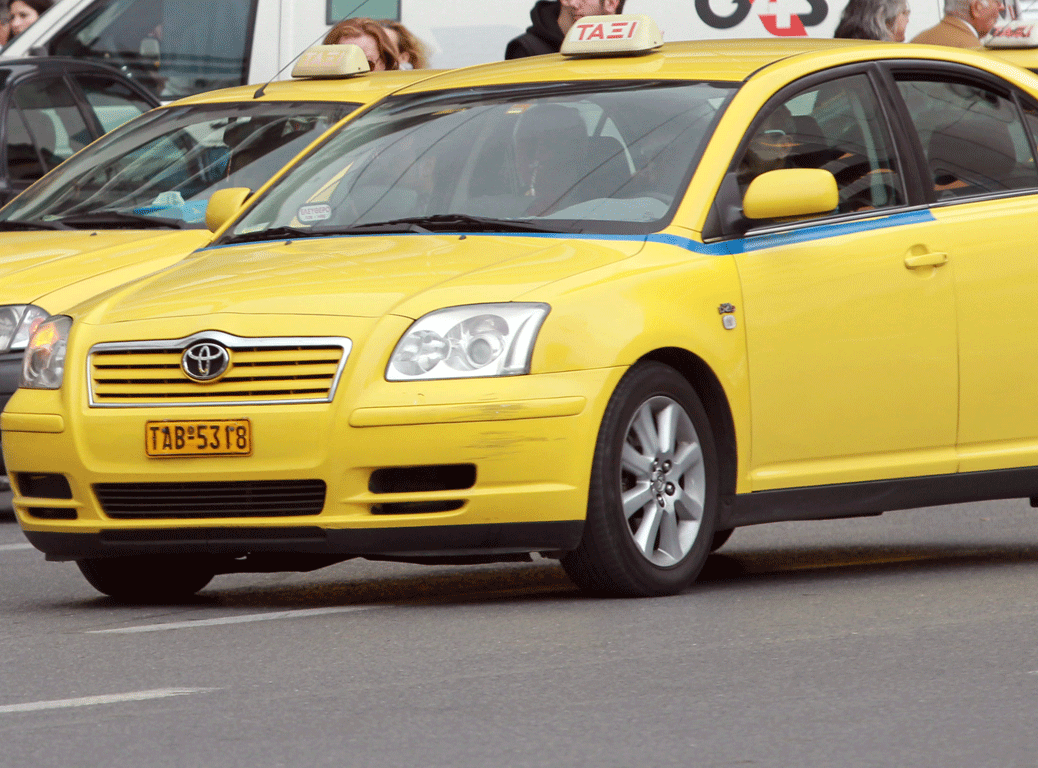
Are You Sure You Don’t Know Thanasi the Taxi Driver?
It was noontime, and I was working at the taxi plaza of Panorama. A lady around 70 to 75 years old entered the cab and directed me to transport her to the vicinity of Nomos, about a five- or six-minute drive.
“Bravo, my young man! What a beautiful thing to take a taxi and to listen to beautiful Byzantine chanting!”
“Really ma’am, do you like it?”
“Do I like it? I listen to the same station all day long in my home, and I raise the volume so that it can be heard in all my rooms. At other times, while doing my house work, I listen to some wonderful CDs of Father Athanasios Mitilinaios, Father Savvas, and Father Moses. I also listen to Thanasi, the taxi driver. Do you know him?”
Oh! What a cold splash this was at noontime! I pretended that I was concentrating on my driving. I wanted quickly to change the subject, because I didn’t want to fall into thoughts of pride, nor did I want to lie to her. I tried to ignore her question, but unfortunately the lady pressed on.
“My son, are you sure you don’t know Thanasi, the taxi driver?”
The pressure was on, and this blessed woman would not let up. I continued to try to stay incognito, but for how long I could do this I didn’t know, since this woman kept insisting that somehow I was supposed to know this man. At a certain moment I asked her, “Madam, what’s the big deal with this Thanasi the taxi driver?”
“What’s the big deal? If you hear the true experiences in Thanasi’s CD,[1] and the works of God’s grace in his taxi, you will not believe your ears.” The lady began to rave about this Thanasi and his CD, which led me to believe that she was missing most of the stories in this book. So, I proceeded to give her an MP3, which contained all my recorded audio files up to that point, and I did it discreetly enough, so she wouldn’t catch on.
As soon as she took it in her hand she asked me, “What is this?”
“Just a small gift, since I see that we are quenching our thirst from the same spiritual spring. This includes many true stories as well.” The lady accepted it with much gratitude, and she thanked me, without realizing a thing.
A little before we arrived at her home, she turned to me and said, “Oh, my son, please park your car for a moment and wait for me. I need to go into the house, so I can bring you Thanasi’s CD. You cannot imagine what amazing things you are going to hear.”
I had no other choice, my friends, but patiently to comply with my customer’s request. I parked, turned the engine off, got out of the car, and waited. In a few minutes, the lady hurriedly returned with Thanasi’s CD – in one of her own beautiful cases, no less. I thanked her, and I remember telling her, “May the Panaghia repay you for this!”
We exchanged a warm handshake and well wishes in a climate of much emotion and warm sentiments. As I drove off, I fulfilled her wish and listened to the CD from the beginning. As I kept listening, I remembered an appropriate verse in the Old Testament book of Ecclesiastes: “Cast your bread upon the waters and you will find it in time.”
So this CD, after circulating for a while, found its way back into my hands, in this amazing way. Glory to Thee, our Lord, glory to Thee!
[1] The stories in this book circulated as audio CDs for a few years in Greece and abroad, with great popularity.
Constantine Zalalas