Translate

Showing posts with label Prayer Rope. Show all posts

Monday, September 7, 2020

St. Paisios on the Prayer Rope


St. Paisios preaching to people outside his cell on the Holy Mountain 

Q-Elder, what meaning does the prayer rope (komboschoini) have?
A-The prayer rope is an inheritance, a blessing, which was left to us by the Holy Fathers. And for this alone, it has great worth. You see, when someone's grandfather leaves him a meaningless object as an inheritance, he keeps it like a talisman, how much more should we keep the prayer rope as an inheritance of the Holy Fathers!


In olden times, when there were no clocks, monks counted the time with prayer with the prayer rope, but the knots of the prayer rope were simple. Once, an ascetic was doing great struggles, many prostrations, etc. and the devil went and broke the knots of his prayer rope. The poor man then did prostrations after prostrations, because he couldn't count them, as the devil broke his prayer rope to further continue his struggle. Then, an Angel of the Lord appeared to him and taught him how to weave the knots, so that each knot might contain nine crosses. The devil afterwards, who trembles at the cross, could not break them. Thus the knots of the prayer rope have nine crosses, which symbolize the nine ranks of the Angels.


Q-Elder, what do the 33, 50, 100 and 300 knots mean on prayer ropes?
A-Only the number 33 is symbolic, for it symbolizes the 33 years that Christ lived upon the earth. The other numbers simply help us count the prostrations that we do or how many times we say the prayer.


Some machines have a rope with a grip in its side so that if you want it to go forward, you pull the rope strongly, until it warms it up with oil. Thus, the prayer rope is the rope which we pull one, two, five, ten times to warm up with spiritual oil and to move the spiritual machine forward of unceasing prayer, which afterwards, functions on its own. However, when the heart is going forward with the prayer, we still should not remove the prayer rope, so that others might not remove it, whose hearts have not moved forward with prayer.


Q-Elder, when I hold my prayer rope, and say the prayer mechanically, is there a danger of vainglory [ανθρωπαρέσκειας]?
A-If you use the prayer rope externally, out of vainglory, even though your hands start to peel, it does not benefit you at all. It will only bring you fatigue, and the illusion that you are supposedly pursuing noetic prayer.


Q-Elder, I'm not used to carrying the prayer rope.
 
A-You should carry the prayer rope, so that you might not forget the prayer, which should work internally, within the heart. When of course you exit your cell, you should remember that the enemy is ready to fight you. Thus, imitate the good soldier, who exits the barracks always with his automatic weapon “at hand”. The prayer rope has a great power, and is the weapon of the monk, and its knots are bullets, which [when fired at the feet of the demons] make their sandals dance.
 
St. Paisios

Sunday, January 12, 2020

The Prayer Rope-Design Bracelet or Prayer Rope?


Many of the Orthodox Christians piously wear at their hands a "bracelet" made of wool knots or wooden beads. Fewer however know its true significance. The first thing we should stress is that it is not a piece of jewelry but an actual prayer rope. Its purpose is not just as decoration or to show others we are Orthodox, as many believe, but to be used as an aid in accomplishing our daily prayers.


The use of the prayer ropes is ancient in itself, going back to the origins of Christian monasticism. The prayer rope, creation attributed to Saint Pachomius in the fourth century, was intended as an aid for monks that could not read to accomplish a consistent number of prayers and prostrations in their cells. The use of the rope made it possible to pray the Jesus Prayer unceasingly, whether inside the cell or out, in accordance with Saint Paul's injunction to "Pray without ceasing" (I Thessalonians 5:17).
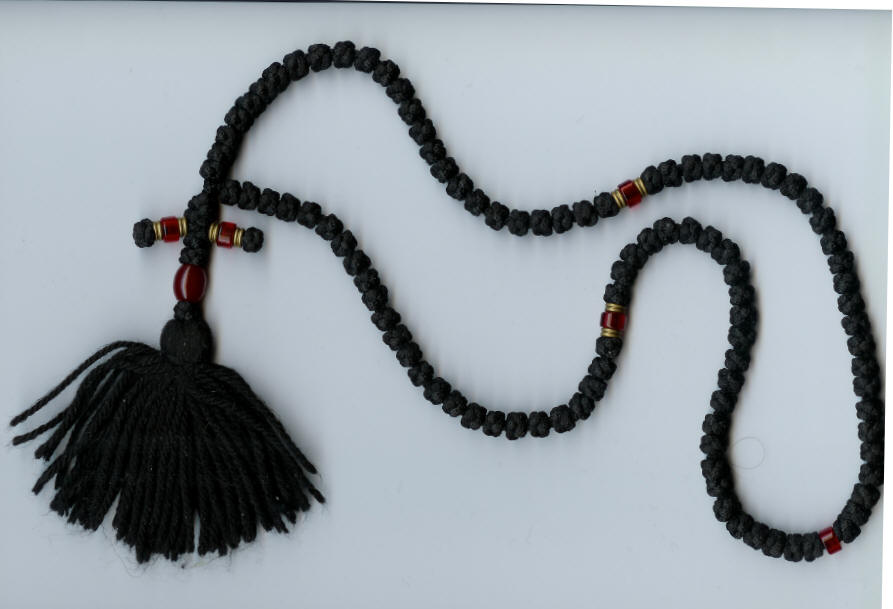
The method of tying the prayer rope also goes back to the fathers of monasticism. Saint Anthony the Great it is said to have started by tying a leather rope with a simple knot for every time he prayed Kyrie Eleison ("Lord have Mercy"), but the Devil would come and untie the knots to throw off his count. He then devised a way--inspired by a vision he had of the Theotokos--of tying the knots so that the knots themselves would constantly make the sign of the cross. This is why prayer ropes today are still tied using knots that each contain seven little crosses being tied over and over. The Devil could not untie it because the Devil is vanquished by the Sign of the Cross.
The prayer ropes are not to be confused with worry beads used as a pass-timer or calming device. The prayer ropes are to be used only in prayer. They come in various shapes and sizes but always they have a fixed number of knots or beads. This can be 33 (for the normal "bracelets") or 40, 50, 100, 200, 300, etc. for the longer ropes.


The use of the Jesus prayer with prostrations is sanctioned by our Church, which directs that one can (in cases of need) replace the common worship services with a definite number of prostrations and the Jesus Prayer (which would be difficult to carry out without the rope). Here is a guide we find at the end of some Psalter books.


Instead of the entire Psalter: 6000 Jesus Prayers
One kathisma: 300 prayers; for each stasis: 100
Midnight Service: 600
Matins: 1500
Vespers: 600
Great Compline: 700
Small Compline: 400
An Akathist to the Blessed Theotokos: 500
All those who are zealous for their salvation are invited to this unceasing remembrance of the saving name of Jesus, both laymen and monastics, for the spirit of life in Christ is one and the same for both. Many of our spiritual elders, men of prayer, ascetics and directors in faith and piety, down to the most recent time have recommended the use of the prayer rope to laymen and at times have even given them their own prayer ropes as a blessing.
For this reason we also recommend to the lay people today to properly use the prayer ropes around their hands to pray wherever they are, at home, at work, or driving, with a simple prayer: "Lord Jesus Christ Son of God have mercy on me the sinner" or simply "Lord Jesus Christ have mercy on me".

Wednesday, July 1, 2015

Prayer Rope οr Design Bracelet, which is it ?


Many of the Orthodox Christians piously wear at their hands a "bracelet" made of wool knots or wooden beads. Fewer however know its true significance. The first thing we should stress is that it is not a piece of jewelry but an actual prayer rope. Its purpose is not just as decoration or to show others we are Orthodox, as many believe, but to be used as an aid in accomplishing our daily prayers.


The use of the prayer ropes is ancient in itself, going back to the origins of Christian monasticism. The prayer rope, creation attributed to Saint Pachomius in the fourth century, was intended as an aid for monks that could not read to accomplish a consistent number of prayers and prostrations in their cells. The use of the rope made it possible to pray the Jesus Prayer unceasingly, whether inside the cell or out, in accordance with Saint Paul's injunction to "Pray without ceasing" (I Thessalonians 5:17).
The method of tying the prayer rope also goes back to the fathers of monasticism. Saint Anthony the Great it is said to have started by tying a leather rope with a simple knot for every time he prayed Kyrie Eleison ("Lord have Mercy"), but the Devil would come and untie the knots to throw off his count. He then devised a way--inspired by a vision he had of the Theotokos--of tying the knots so that the knots themselves would constantly make the sign of the cross. This is why prayer ropes today are still tied using knots that each contain seven little crosses being tied over and over. The Devil could not untie it because the Devil is vanquished by the Sign of the Cross.
The prayer ropes are not to be confused with worry beads used as a pass-timer or calming device. The prayer ropes are to be used only in prayer. They come in various shapes and sizes but always they have a fixed number of knots or beads. This can be 33 (for the normal "bracelets") or 40, 50, 100, 200, 300, etc. for the longer ropes.


The use of the Jesus prayer with prostrations is sanctioned by our Church, which directs that one can (in cases of need) replace the common worship services with a definite number of prostrations and the Jesus Prayer (which would be difficult to carry out without the rope). Here is a guide we find at the end of some Psalter books.


Instead of the entire Psalter: 6000 Jesus Prayers
One kathisma: 300 prayers; for each stasis: 100
Midnight Service: 600
Matins: 1500
Vespers: 600
Great Compline: 700
Small Compline: 400
An Akathist to the Blessed Theotokos: 500
All those who are zealous for their salvation are invited to this unceasing remembrance of the saving name of Jesus, both laymen and monastics, for the spirit of life in Christ is one and the same for both. Many of our spiritual elders, men of prayer, ascetics and directors in faith and piety, down to the most recent time have recommended the use of the prayer rope to laymen and at times have even given them their own prayer ropes as a blessing.
For this reason we also recommend to the lay people today to properly use the prayer ropes around their hands to pray wherever they are, at home, at work, or driving, with a simple prayer: "Lord Jesus Christ Son of God have mercy on me the sinner" or simply "Lord Jesus Christ have mercy on me".

http://agapienxristou.blogspot.ca/2013/07/prayer-rope-r-design-bracelet-which-is.html