My dear Christians:
Two people once came to me to confess their sins. Their names were Peter and Paul. I want you to
listen and let me know if I judged them correctly or inappropriately.
Peter came and told me, “My spiritual father, from a young age until now I have always fasted and prayed, I have given money to the poor, I built monasteries and churches, and I have done many other good things as well. However, I do not forgive my enemies.” When I heard this, I
concluded that he was headed straight for Hell.
Next, Paul came and told me, “From the day I was born until now, I have never done even one good deed. On the contrary, I have murdered others, I have fornicated, I have stolen, I have set monasteries and churches on fire. I have done every possible evil; however, I forgive my enemies.” Now pay attention to what I did. I immediately embraced him, kissed him, and gave him permission to receive Holy Communion. Did I judge them correctly or inappropriately?
Certainly you will blame me and ask, “Peter had done so many good things, and just because he did not forgive his enemy, for such a trivial thing, you concluded that he would be condemned to Hell? Whereas Paul had committed so many crimes, and just because he forgave his enemies you pardoned him and also permitted him to receive Holy Communion?”
Yes, my children, this is how I acted.
Do you want to understand why? Just as a small amount of yeast that is placed in one hundred pounds of dough has the power to ferment all the dough and make it rise, the same thing holds for all those good things that Peter did. The small amount of enmity he had, with which he did not
forgive his enemy, fermented and turned everything he had done into poison of the devil. This is why I ruled that he was going to Hell. Paul’s sins, on the other hand, resembled a large pile of sticks and twigs that were set on fire with a small flame.
The forgiveness he gave to his enemy served as a lit candle that completely burned and consumed the entire pile of kindling, that is, his sins. This is why I concluded that he would go to Heaven.
St. Kosmas Aitolos
http://www.stnektariosmonastery.org

Are you a sinner? Do not despair. Come to church with repentance.
Have you sinned? Say to God: “I have sinned.” You find it so difficult to confess your sin? But if you do not accuse yourself first, the devil will
eventually accuse you. Therefore, before he has a chance to do so, strip him of his power; because, truly, his role is to accuse us.
Erase your sin before he has a chance to blame you. For you have an accuser who will not remain silent. Have you sinned? I ask nothing else from you except this: enter the church and say to God with repentance, “I have sinned.” Because it is
written: “confess your sins first, so that you may be justified” (Isa. 43:26).
Confess your sin so that you may erase it. This does not require any effort, or many words, or large sums of money, or any other such thing. It only takes three words: “I have sinned.”
Have you sinned? Come to Church and erase your sin. Every time you fall while walking you get up. Similarly, every time you sin, repent. Do not despair; do not become indifferent, so that you do not lose hope in the heavenly riches that are in store for us. Even if you sin late in life when you
have grown old, repent and come to Church.
The Church is a hospital not a court. It bestows forgiveness; it does not demand accountability for the sin. Say to God: “Against Thee only have I sinned and done this evil before Thee” (Ps. 50:6), and He will forgive you. Show Him that you repent, and He will have mercy on you. If we do our part, God will do His part.
Since the almighty Lord is so loving and merciful, let us not remain indifferent for our salvation. Waiting for us are the Kingdom of Heaven,
Paradise, and goods that no human eye has seen, that no human ear has heard, and which no human mind can conceive. Shouldn’t we do whatever
we can in order not to lose these things? Shouldn’t we give something trivial in order to acquire these great and invaluable things?
Therefore, let us repent, let our hands become accustomed to giving to others, let us humble ourselves, let us mourn and cry for our sins. All these things are small. But great and beyond our strength are the things that will be given to us by God; that is, Paradise, and the Kingdom of Heaven. May we all be worthy of entering it, through His grace.
St. John Chrysostom
 There are people who insist on holding on to resentment, often inventing situations in their minds that never happened, justifying their bad behavior, and putting the blame on others. They see themselves as the abused party, always quick to take offense. Rarely are they able to have healthy relationships, for they are in reality, the abusers. Their world centers around them, and any attempt by others to appease them, only contributes to the anti-social behavior.
Such behavior betrays a deep spiritual and psychological illness, one that is not easily healed. Such people feel empowered by making other people uncomfortable, and normal attempts at rapprochement often end in failure, for such people are always looking for ways to continue their control over others. Their illness is difficult to heal, for their pride and deep seated sense of superiority makes repentance difficult, for they simply don’t see themselves as having a problem.
The cure for the illness of the soul is to be found in the life of the Church, where Her sacred mysteries (the sacraments), Her scriptures, and Her divine services, are the source for the healing that the heart so craves. Forgiveness Sunday Vespers is but one of the sources that can begin the process of healing, for it is during this service that the faithful, one by one, speak the words, “Please forgive me for any hurt or offense I have cause you in any way”.
The response, “God forgives. Please forgive me for any hurt or offense I have cause you in any way”, exemplifies the Church’s teaching that we can only forgive others if we have Christ in us, for it is Christ Who gives us the power to forgive. Since God forgives us, we, too, can forgive.
One of the Desert Fathers tells us of a young monk who came to his elder, complaining that he’d been wronged by one of his brothers, and following the holy tradition of the desert, had gone to the one who had wronged him, asking for forgiveness. The erring brother refused, so the wronged brother wanted to know what he should do in response. The elder told the young monk that he had walked away justified in the eyes of God, and that there was nothing left for him to do, except to pray for his erring brother.
This true story from the Desert Fathers makes clear that we must always be quick to forgive others, even if they were at fault, not remembering the wrong done to us, nor depend on the other cooperating in the reconciliation. Their repentance is not required, for we will be held accountable only for our own response. Before God, we will be justified.
When another person refuses to accept our heartfelt apology, we must be willing to let it be, and walk away, knowing that we’ve done our part. Abusive people such as these, can, if we let them, prevent us from living our own life in Christ, for they keep our focus away from the forgiveness that comes from Christ. When we walk away from such negative people, we walk away having forgiven them, and we commit ourselves to praying for their repentance. There is nothing more we can do.
Keeping our focus on Christ, we do not react, do not resent, and do not lose our inner peace. The sickness that is at the basis of controlling, abusive people, must not be allowed to take away from the inner joy and peace that comes from our personal relationship with Christ.
For your own soul’s sake, and for the soul of the abuser, continue to pray for them, but go your own way, “And the peace of God, which passeth all understanding, shall keep your hearts and minds through Christ Jesus (Philippians 4:7).” By Fr. Tryphon, Abbot of All-Merciful Savior Monastery This article originally appeared in The Morning Offering on February 28, 2012 and was posted here with permission.
http://pemptousia.com/2012/07/when-people-dont-forgive/
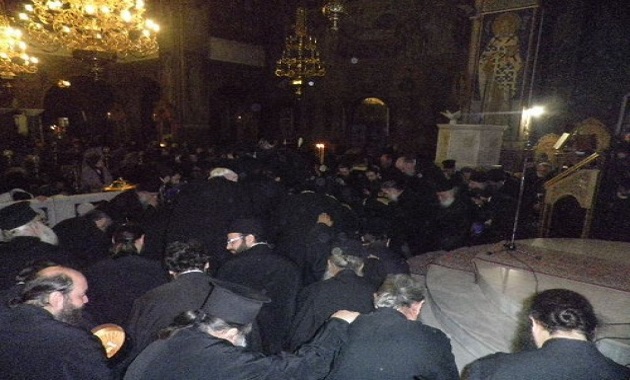 The first service of Great Lent in the Orthodox Church is “Forgiveness Vespers,” served on the eve of Monday of the First Week. There is nothing unusual about the service itself – other than the “rite of forgiveness” appended to it. In this, the priest and the faithful ask forgiveness of one another. Often this is done with mutual prostrations. Each asks the forgiveness of the other. The rite can take time, depending on the number in attendance. When it is complete, the long labors of Lent can begin. Fasting without forgiveness would be a hollow activity. This is a meditation I shared with my parish this week as the Sunday of Forgiveness approaches: Perhaps the most generous words spoken by Christ are those we hear from the Cross: “Father, forgive them, for they do not know what they are doing.” Taken at face value, the words make little sense. Surely, those who crucified Christ knew that they were killing a man. Surely they were even aware that his execution was largely political and unjust. The centurion in charge of the crucifixion is said to have stated, “Surely this man was the Son of God.” So how could Christ say, “They do not know what they are doing?” I believe this goes to the very heart of our lives and actions. We almost never know what we are doing. The greater context, the meaning of anything, is hidden from us. We have children, work at a job, and live our lives, hoping that these have been worthwhile actions. We know that much, even most of what we have done has been tainted with bad intentions and other less-than-worthy motivations. But we never actually grasp the full scope of our actions. Even those good things that we do have a hidden aspect. Did that kind word spoken earlier make a difference? Did that act of charity actually change anything? This hidden aspect of our lives is an inherent part of the human condition. We simply don’t know what we’re doing. This makes it very hard for us to judge our actions or to weigh them for their value. Christ’s words are addressed to the Father on behalf of all of humanity. For it is not just the small number of people in Jerusalem who were consenting to His death. His death is “on behalf of all and for all.” And this brings us to Forgiveness Sunday. “Why do I need to ask forgiveness of others if I have done them no wrong?” The simple answer is: You don’t know what you have or have not done. But it is commonly understood in Orthodoxy that “each person is responsible for the sins of the whole world.” Our lives are deeply connected—we are never uninvolved in the lives of others. What I have done and what I have not done both effect the lives of the whole world. A child dies on the other side of the world. I may have had no direct hand in the death, and yet I cannot excuse myself as if I have no share in what happens everywhere. The world is as we make it. I once heard a monk say, “The person of prayer does not need to go any further than his own heart to find the source of all violence in the world.” But none of this is to call us to a morbid guilt. It calls us to Christ and calls us to hear His words. On Forgiveness Sunday each of us asks forgiveness of the others around us. It is both a personal matter and collective. I have failed and need forgiveness. We have failed and need forgiveness. And perhaps the even greater call comes to us to join ourselves with Christ who says: “Father, forgive them!” “Forgive me,” we say. “God forgives us all,” comes the response. It sometimes feels awkward, even embarrassing. Some people begin to weep. Others begin to giggle. Both are part of the human condition within our shame. But the actions of Forgiveness Sunday unite us necessarily to the actions of Christ. By submitting Himself to crucifixion, Christ put Himself in the place of the sinner, the one needing forgiveness. He was displayed naked, nailed on high for all the world to see (“on His shoulders He bore our shame,” Isaiah prophesied). In the mild social embarrassment of saying, “Forgive me,” to another human being, we unite ourselves to the deep, profound healing shame of Christ. And with brazen boldness we confess, “God forgives us all!” uniting ourselves with the priestly cry of Christ Himself, “Father, forgive them!” And having read this, and done all that, we still will not know what we have done. But we are not saved by knowing what we do. We are saved by doing what He does. Forgive me. Fr Stephen Freeman Source: glory2godforallthings.com/


