Translate

Showing posts with label Panagia. Show all posts

Sunday, August 19, 2018

The snakes that venerate icons!!


Icon of Panagia Fidousa (Virgin of the Snakes)


In a tiny Greek village in the south of Kefallonia, a miracle occurs every year after the feast of the Transfiguration (Aug 6). Around the bell-tower of the chapel at Markopoulo, small venomous snakes appear. These snakes crawl around the church, and upon the icons of the Mother of God in an act of apparent veneration. The snakes remain in the confines of the chapel, docile throughout, until the feast of the Dormition (Aug 15), when they disperse and become almost impossible to find on the island. This is a strange miracle, especially given the association of the serpent with Satan, so what is the significance?


Snakes on Dormition icon


The chapel at Markopoulo is built on the ruins of a convent. In the early 18th-century, the nuns there were attacked by pirates. After praying to the Mother of God for help, the church was filled with snakes; when the pirates entered the convent they were terrified by the sight and fled. Every year since then, snakes have appeared during the Dormition fast around the church, venerating the icons there, leaving after the feast itself. In recent years, the snakes have failed to appear twice: in 1940, the year Greece was brought into the Second World War, and 1953, the year of a devastating earthquake on Kefallonia. Because of this, it is believed to be a portent of coming disaster if the snakes do not appear, or appear in small numbers. The first, straight-forward, meaning of the snakes appearance in Kefallonia is simply to remind us of one of the many times the Mother of God has helped those who prayed to her.


And I will put enmity Between you and the woman (Gen 3:15)


Yet there is much symbolic history associated with snakes in Christianity, much of it relating to the serpent being a representation of the devil (Gen 3; Ps 91:13; Rev 12:9; 20:2) and evil in general (Num 21:4-9; Matt 3:7; 23:33). This symbolism is so deeply implanted in our historically Christian culture that it may seem as though the snake by its very nature is a wily, slippery, evil creature. Yet the holy fathers remind us that our current instinctive revulsion to vipers is something that came after the Fall:


The serpent tempting Eve


Do not regard the present serpent; do not regard how we flee it and feel revulsion towards it. It was not such in the beginning. The serpent was the friend of man and the closest of those who served him. and who made it an enemy? The sentence of God: “Cursed are you above all the cattle, and above all wild animals… I will put enmity between you and the woman” (Gen 3:14-15). It was this enmity that destroyed the friendship. I mean not a rational friendship, but one of which an irrational creature is capable. Similar to the way that now the dog manifests friendship… just so did the serpent serve man. As a creature who enjoyed great closeness to man, the serpent seemed to the devil to be a convenient tool (for deception)… Thus, the devil spoke through the serpent, deceiving Adam. -St John Chrysostom, On the Creation of the World; 6.2
Blessed Theodoret and St John Damscene set forth the same teaching, the latter summarizing:

The serpent was accustomed to man, and approached him more readily than it did other living creatures, and held intercourse with him in delightful motions. and hence it was through it that the devil, the prince of evil, made his most wicked suggestion to our first parents. -On the Orthodox Faith; 2.10


Th curse is lifted

The serpent – in all its varieties and species – were thus cursed because it was used as an instrument of Satan:


But perhaps some will say: If the counsel was given by the devil, using the serpent as an instrument, why is this animal subjected to such a punishment? This was also a work of God’s unutterable love for mankind. As a loving father, in punishing the murderer of his son, breaks also the knife and sword by which he performed the murder, and breaks them into small pieces – in similar fashion the All-good God, when this animal, like a kind of sword, served as an instrument of the devil’s malice, subjects it to a constant punishment, so that from this physical manifestation we might conclude the dishonour in which it finds itself. -St John Chrysostom, Homilies on Genesis; 17.6

“In my name…they shall take up serpents”


The world suffered from the condemnation given to Adam, Eve, and the serpent, as it still does today. However, with the advent of Jesus Christ in the world, His death, resurrection, and ascension, the curse is lifted, and the means of our restoration is available. And through our restoration to our pre-fallen state, the fallen state of the world is also reversed. This is why St Paul was unharmed by the snake that bit him (Acts 28:3-5), why Jesus said we would be able to pick up serpents with our hands (Mk 16:17-18), and why numerous other Saints have lived in peace with wild beasts. These examples show to us that with faith and through God, the harmony of Paradise is restored even in this life.

The miracle bestowed upon Kefallonia every year is just another example, and a particularly fitting one. As one Sunday hymn proclaims:

You are exceedingly blessed, O Virgin Mother of God, for Hades has been taken captive by him who was incarnate of you. Adam was recalled, the curse was abolished, Eve was delivered, death was put to death and we were given life. Therefore, praising you we cry aloud: Blessed are you Christ our God, who thus was well pleased, glory to you.
Jesus redeems mankind and the entire created world, so what is true of Adam and Eve is true also of the snake. And so this animal, through which the devil tempted Eve, comes to venerate icons of the “second Eve”, Mary: the woman who brought forth the seed, Christ, through Whom “the curse was abolished.”


Monday, September 4, 2017

Mother of God appears to Vietnamese woman who subsequently converted to Orthodoxy


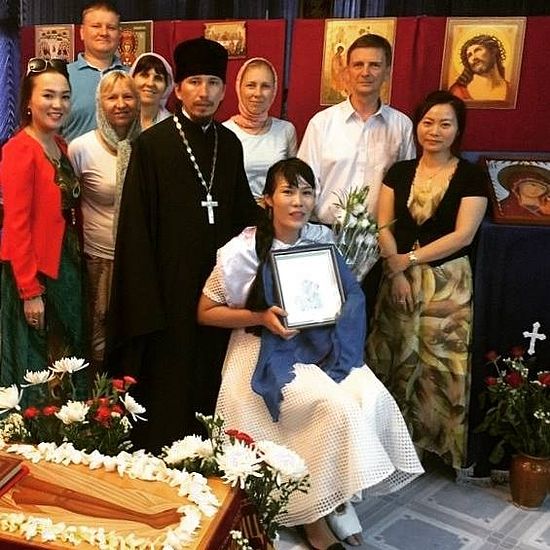
The newly-baptized Anna is seated in the picture. Photo: facebook.com

Fr. George Maximov, a Moscow priest who often serves on missionary trips throughout Asia, has posted on his Facebook page the words of a Vietnamese woman who converted to Orthodoxy after the Mother of God appeared to her.

The woman, Nguyen Thi Mai Anh, a former Buddhist living and working in Vũng Tàu, Vietnam, was baptized into Holy Orthodoxy on Holy Saturday this year.

She writes of “something incredible” happening in her life about a year ago: “I was lying in a coma in the hospital. During this time I saw a radiance, a bright light, and directly in front of me appeared the Virgin Mary Theotokos. She handed me a bottle of water and gave me to drink. As soon as I drank the water, the light and the Theotokos disappeared.”

“In the morning the next day,” she continues, “I suddenly came out of the coma after being unconscious for so long.” Nguyen survived, and she began to pray to the Lord Jesus Christ and His Mother for a speedy recovery, and decided she would become a Christian when she returned home.

“A few days later, another vision appeared to me in a dream, that there would be a man who would lead me to the Church, and that I would eat Bread there and drink Holy Water together with everyone, and walk around the church,” she continues.

After she was released and returned home, a friend came to her, bearing an icon of the Mother of God with the Savior. “I was incredibly happy, because it was the same image I had seen in my dream. I was very happy, and I told my friend about what I had seen in the dream, and he took me to an Orthodox Church where Russians pray in the 5th district of the city of Vũng Tàu, to meet the Lord and the Theotokos there,” Nguyen recalls.

The woman was later baptized in the same church and “born again under the protection of the Most-Holy Theotokos and by the grace of the Lord.”

“I am infinitely happy!” she exclaims, continuing, “Thanks to Thee, O Lord and to thee, O Theotokos, for my ‘second birth’ and the gift of the Fountain of Life!”

Fr. George notes that she broke her leg just before her Baptism, but this did not deter her. She was baptized with the name of Anna, and now reads prayers in the Vietnamese language during the services. 
http://www.pravoslavie.ru/english/106162.htm

Monday, November 30, 2015

“I went to Christouli and Panagitsa high in heaven”


I went to Christouli (Christ Jesus) and Panagitsa (Mary, Most Holy Mother of God) high in heaven” 


E. and T. T., from Drosato N. Kilkis, are the parents of three children. They relate the following: “On March 30th 2001 we took our M., four and a half years old, to the Hospital in Thessaloniki because of an unbearable stomach pain. With the appropriate tests they diagnosed him with obstructive ileus, and operated on him for three and a half hours, removing half a meter of necrotic gut.

Our doctors said that the child passed a very difficult situation, but was not out of danger yet. Monday evening he had a 40 degree (Celsius) fever. Tuesday he was transferred to the ICU with sepsis and acute respiratory shock. His hopes of living were only 10%. In the mean time, without us knowing anything, a neighbor of ours saw St. Raphael in a vision who told her: “Antonina, I’m leaving, because you don’t need me any more. I will go to E., he has need of me now!” The woman later learned about our son. A friend of our family from Goumenissa, Mr. P. S., went to St. Raphael in Griva and knelt with the priest reading the paraklesis for the…
… salvation of our child. Our brother A. went in the evening to our empty house to chant the Paraklesis to St. George for the health of M.. At one point the room started to shine, so much that he was shaken. Where did this much light come from? Most likely it was the Grace of the Saint. After these, the child’s situation began to improve, until the Saturday of Lazarus, when he opened his eyes. On Holy Monday he was totally well and exited the hospital. After being sick for 23 days, we left the hospital. When we returned, he began to tell us different things: “I went to Christouli and to Panagitsa high in heaven, where there are a lot of clouds, with the white horse of St. George. I saw uncle Fani (our neighbor who died eight months before) and Despoula (a little girl who died three years before), there were many people I didn’t know there and they wore golden angel’s clothes and everyone was singing…Christouli and Panagitsa asked me if I have any brothers and what are they called, and told me not to worry, you will go back to Mama and to your brothers. ‘I don’t know how to get back there.’ ‘With my horse’, said St. George. ‘I’m scared, I don’t know how to drive the horse.’ ‘Don’t worry, I will drive you.’ M. is near us, a strong child as he was before, and every day we glorify God, Panagia and all the Saints who gave him back to us.”

http://agapienxristou.blogspot.ca/2014/11/i-went-to-christouli-and-panagitsa-high.html

Thursday, May 21, 2015

The Icon that Saved a Life!


This icon of the “Kazan” Mother of God with the words partially worn away in Latin letters, “Eta ikona budet hranit was wsu schizn,” adorns the Church of the Joy of All Who Sorrow in St. Petersburg. One of the church’s parishioners told its amazing story.
One day, an old woman came into the church and waved her arms when she saw the Kazan icon of the Mother of God.
“Where did that icon come from? I gave it to a German soldier!” She exclaimed in amazement. I recognize it by a characteristic dent in the frame.” I explained that this icon was given to the church by the German Consulate in our city. The woman broke into tears, said that her name was Vera, and told the story of how her Orthodox family icon ended up in Germany.
“I fled my native village, which ended up in the center of the battles. I wanted to leave with my sister and three children earlier, but mama fell seriously ill, and wouldn’t have survived the journey. ‘I will come later,’ I promised my sister, sending her with the children to a place near Ryazan, where our aunt lived in a collective farm village. Mama died a month later, but before her death was able to bless me with the family icon of the “Kazan” Mother of God. My reposed grandfather in his time had blessed my mother before her wedding, and mama blessed Sasha and me with it fifteen years ago, even though my husband was in the Komsomol. Now the icon lay in my threadbare refugee bag. I myself sat down under the awning of one of the station freight houses, watching the crazy dance of whirling snow. I couldn’t think about anything; I only tried to shove my fingers into the narrow sleeves of a light overcoat. Cold and hunger—that was all I could feel. Now a train rumbled up to the station, the doors of the cars opened, and the Fritzes stood in ranks handing long boxes along to each other. ‘They’ve brought weapons,’ the indifferent thought crossed my mind. But then suddenly I felt a painful stab: “It’s going to the front! Where my Sasha is fighting! They will shoot at him with those rifles, and at other Russian soldiers… Oh, the cursed ones!’
“It is strange, but the German patrols paid no attention to me, a lonely woman, emaciated with hunger. I don’t even remember when I had eaten last. I had long ago traded my watch, wedding ring, and mama’s earrings for food. I ran my hand over the brass frame behind the frosty cloth of the bag. ‘O Intercessor, Most Holy Mother of God!’ I whispered with my frozen lips. ‘Save and guard my little ones, my sister Nadya. Save and guard my husband, slave of God, soldier Alexander.’
“’Vat? Somzing wrong?’ came the words just above my ear. I raised my head. Next to the bench stood a German soldier. I could feel sympathy in his words, and answered, “It’s bad.” The German sat down next to me. He set his bulging knapsack on the ground, fished around in it for a bit, then held out his hand. ‘Nimmt!’ There was a square piece of bread on which a slice of lard lay all pink. I took the gift and devoured it. The German pulled out a thermos, poured some steaming tea into the lid, and said, ‘Heiss! Gut!’ Probably he was part of the watch here at the station. He looked about twenty years old, blue-eyed. His face was guileless. Probably his hair was light colored, like my son’s, Andreika’s, only you couldn’t see it under his cap.
“The German pointed to the train engine, then at me, and comically furrowing his brow, apparently trying to find the word, asked, ‘Far?’ “Far! Now I won’t make it there!’ I immediately started telling him that I had hoped to go to my aunt’s but was now left without anything. Ending my story I said, ‘I have children there. Kinder. Understand? I traced with my hands, from high to low. The lad nodded, ‘Oh, ja, Kinder!’ ‘But I won’t reach them. I’ll just freeze.’ I wasn’t even aware that I was crying. The German again reached into his knapsack and pulled out a weighty package. ‘Here. Take.” He opened the package and touched its contents, then licked his finger and said, ‘Gut!’ There was salt in the package. Salt… which was then worth more than gold. For salt you could get bread, milk, well, anything… There was no less than three kilograms in the package. And here he was just handing it over to me, a completely unknown Russian woman. Seeing the shock on my face, the lad smiled and said something I didn’t understand. Then he rose, screwed the lid onto his thermos, put it back in the knapsack, waved his hand, and left.
“’Stop!’ I ran after the soldier. “Was ist es? ‘This icon will guard you all your life,’ I said with firm assurance. He didn’t understand. Again I said, ‘This icon will guard you all your life!’ The lad pulled a chemical pencil out of his pocket, wetted it with spittle, and turning over the board asked me to say it again. As I repeated it slowly, syllable by syllable, he wrote it down on the back of the icon in Latin letters: ‘Eta ikona budet hranit was wsu schizn’. We never met again… But I was able to trade the salt for warm clothes, felt boots, and bread, and I reached Ryazan. In ’45 my husband, Sasha, returned from the war.”
After listening attentively to the agitated woman, I joyfully told her that what we had heard from the representatives at the German consulate who had given the Kazan icon to our church. That German soldier went through the entire war. His comrades died before his eyes; once a truck that he was riding in exploded, but he was able to jump out of it only a moment before the explosion. The rest perished. At the end of the war, a shell hit their dugout, which he had abandoned just a twinkling before. The unseen power of the Russian icon had surely saved him. He now understood and reevaluated very much his life, and his soul opened up to prayer. He returned home, married, and raised his children. He placed the icon in a beautiful glass case in a place of honor in his home, and prayed before it all his life. When he grew old, he commanded his oldest son to take the icon to the Russian consulate after his death. “This icon lived in Russia and should return there. Let them take it to Leningrad, the city that withstood the blockade, dying from cold and hunger, but not surrendering.”
That is how in the mid 1990’s, to one of the newly-reopened churches of St. Petersburg, where the rector at the time was Archpriest Alexander Chistyakov, came the small icon of the “Kazan” Mother of God with a strange inscription in Latin letters on the back.


Irina Blinova
Translation by OrthoChristian.com
04 / 11 / 2014

Wednesday, March 4, 2015

The Mother of God gave many gifts to many saints(Part 1)


St. Gregory Palamas, who lived during the 14th century and whom our Church commemorates on the second Sunday of Great Lent, received many gifts and blessings from the Mother of God throughout his life.


When he was a young boy, he had difficulty learning in school. In the face of such difficulty, he decided to first pray and prostrate himself three times before the icon of the Theotokos prior to reading the lesson. Henceforth, with Her help he could memorize everything he read with ease.
It was not long before he excelled in his studies to such a degree that everyone marveled at his wisdom.


Two years after he became a monk, as he was praying alone and had his mind completely turned to himself and God,a reverend and heavenly gentleman (who was the holy Apostle St. John the Theologian) suddenly appeared to him. He sweetly gazed at St. Gregory and said, "My child, I have been sent by the Most-Holy Queen of heaven and earth to ask you why do you ceaselessly cry out to God at every moment, 'enlighten my darkness, enlighten my darkness'?"


St. Gregory replied, "What else should I, who am full of passions and sins, ask for other than to receive mercy and enlightenment, so I can come to know and execute His holy will?"Then St. John the Theologian stated, "The Lady of heaven and earth has sent me, Her servant, to tell you that She will be your helper."


St. Gregory asked again, "Where will the Mother of my Lord help me? In this present life or in the next life?"
"Both in this present as well as the next life," replied the Theologian. Having said these words, the Apostle disappeared, while St. Gregory's heart became filled with ineffable joy on account of the assurance he received from the Theotokos.Another time, while he was praying in his cell to the Mother of God for both
himself as well as all the members of his brotherhood, asking Her to allow them to advance spiritually and ascend to God without any hindrance, and to help them obtaintheir basic living necessities easily, so they do not have to spend all their time trying to find the essentials and are thus prevented from preoccupying
themselves with the more important spiritual matters. Soon thereafter, the Mother of God appeared to St.
Gregory during the day. She was adorned modestly as a virgin, just as she is depicted in Her icons. She then
turned to the many radiant people who were accompanying Her and ordered, “From now on, give to Gregory everything that he and his brotherhood need.” Having said this, the Theotokos disappeared. The Saint would later confess that from that point forward, “
We had everything we needed, no matter where we went.”


May we have his holy blessings, and the intercessions of the Ever-Virgin Mary. Amen.


http://agapienxristou.blogspot.ca/2013/04/the-mother-of-god-gave-many-gifts-to.html