Translate

Showing posts with label Cancer. Show all posts

Wednesday, June 13, 2018

Avoid Cancer, Live Like A Monk


A Foolproof Anti-Cancer Diet... With Just One or Two Drawbacks


If you want to avoid cancer, live like a monk. That is the inescapable conclusion from research into one of the world’s most renowned monastic communities.

The austere regime of the 1,500 monks on Mount Athos, in northern Greece, begins with an hour’s pre-dawn prayers and is designed to protect their souls.

Their low-stress existence and simple diet (no meat, occasional fish, home-grown vegetables and fruit) may, however, also protect them from more worldly troubles.

The monks, who inhabit a peninsula from which women are banned, enjoy astonishingly low rates of cancer.

Since 1994, the monks have been regularly tested, and only 11 have developed prostate cancer, a rate less than one quarter of the international average. In one study, their rate of lung and bladder cancer was found to be zero.

Haris Aidonopoulos, a urologist at the University of Thessaloniki, said that the monks’ diet, which calls on them to avoid olive oil, dairy products and wine on Mondays, Wednesdays and Fridays, helped to explain the statistics. “What seems to be the key is a diet that alternates between olive oil and nonolive oil days, and plenty of plant proteins,” he said. “It’s not only what we call the Mediterranean diet, but also eating the old-fashioned way. Small simple meals at regular intervals are very important.”

Meals on the peninsula, which the Prince of Wales has visited regularly and which can only be reached by boat, are ascetic and repetitive affairs that have changed little over the centuries, although there are variations between the 20 monasteries.

The monks sit in silence while, from a pulpit, passages from the Bible are read in Greek. They eat at speed – as soon as the Bible passage is over, the meal is officially completed.

The staples are fruit and vegetables, pasta, rice and soya dishes, and bread and olives. They grow much of what they eat themselves. Agioritiko red wine is made locally from mountain grapes. Dairy products are rare – female animals are banned from the autonomous semi-state.

Life on Athos has changed little over the past 1,043 years. Breakfast is hard bread and tea. Much of the day is taken up with chores – cleaning, cooking, tending to crops – followed by a supper, typically of lentils, fruit and salad, and evening prayers.

Some of the seaside monasteries specialise in catching octopus, a delicacy that is softened up by bashing on the rock. Fish also feeds the Athos cats, protected by the monks for their mouse-catching prowess. Of all domestic animals, only cats are exempt from the ban on females. Some of the monks live in hillside huts or cliff-side caves perched above the sea as satellites of the main establishments, perhaps the closest that modern Christianity gets to medieval hermits. They depend for their sustenance on handouts of bread and olives.

On holidays and feast days such as Christmas and Easter, when other Greeks are feasting on roast meat, the monks prefer fish, their only culinary luxury. Father Moses of the Koutloumousi monastery, one of the 20 organised cloisters scattered over the Athos peninsula, said: “We never eat meat. We produce most of the vegetables and fruit we consume. And we never forget that all year round, on Mondays, Wednesdays and Fridays, we don’t use olive oil on our food.”

The olive-oil routine, which also applies to wine and dairy products, appears to have no religious significance, but is a way of eking out their supplies.

All the monks stick to the rigorous fasting periods of the Orthodox Church, in which a strict vegan diet is prescribed for weeks at a stretch.

Michalis Hourdakis, a dietician associated with Athens University, said: “This limited consumption of calories has been found to lengthen life. Meat has been associated with intestinal cancer, while fruit and vegetables help ward off prostate cancer.”

The lack of air pollution on Mount Athos as well as the monks’ hard work in the fields also played their part, the researchers said. There was no mention, however, of whether the absence of women had any effect on the monks’ renowned spiritual calm.

Salad days: Saturday, Sunday, Tuesday and Thursday

Breakfast: Hard bread, tea
Lunch: Pasta or rice,vegetables, olive oil
Dinner: Lentils, fruit and salad, olive oil. Red wine

Monday, Wednesday and Friday: no olive oil

Holidays and feast days: Fish and seafood

Tuesday, November 3, 2015

Do you know that cancer is the greatest sickness? ( St. Porphyrios )

“Do you know that cancer is the greatest sickness? Because with the other sicknesses, you don't take the issue seriously, because you hope that you will get better and usually you don't change. With cancer, however, you say 'Here it was, it's over, the lie is finished, now I'm leaving.' Men can't help you, and you find yourself alone before God. Only hope in God remains, and you cling to this hope and are saved.”

St. Porphyrios of Kavsokalyvia
  

Monday, April 27, 2015

Avoid Cancer, Live Like A Monk


A Foolproof Anti-Cancer Diet... With Just One or Two Drawbacks

If you want to avoid cancer, live like a monk. That is the inescapable conclusion from research into one of the world’s most renowned monastic communities.

The austere regime of the 1,500 monks on Mount Athos, in northern Greece, begins with an hour’s pre-dawn prayers and is designed to protect their souls.

Their low-stress existence and simple diet (no meat, occasional fish, home-grown vegetables and fruit) may, however, also protect them from more worldly troubles.

The monks, who inhabit a peninsula from which women are banned, enjoy astonishingly low rates of cancer.

Since 1994, the monks have been regularly tested, and only 11 have developed prostate cancer, a rate less than one quarter of the international average. In one study, their rate of lung and bladder cancer was found to be zero.

Haris Aidonopoulos, a urologist at the University of Thessaloniki, said that the monks’ diet, which calls on them to avoid olive oil, dairy products and wine on Mondays, Wednesdays and Fridays, helped to explain the statistics. “What seems to be the key is a diet that alternates between olive oil and nonolive oil days, and plenty of plant proteins,” he said. “It’s not only what we call the Mediterranean diet, but also eating the old-fashioned way. Small simple meals at regular intervals are very important.”

Meals on the peninsula, which the Prince of Wales has visited regularly and which can only be reached by boat, are ascetic and repetitive affairs that have changed little over the centuries, although there are variations between the 20 monasteries.

The monks sit in silence while, from a pulpit, passages from the Bible are read in Greek. They eat at speed – as soon as the Bible passage is over, the meal is officially completed.

The staples are fruit and vegetables, pasta, rice and soya dishes, and bread and olives. They grow much of what they eat themselves. Agioritiko red wine is made locally from mountain grapes. Dairy products are rare – female animals are banned from the autonomous semi-state.

Life on Athos has changed little over the past 1,043 years. Breakfast is hard bread and tea. Much of the day is taken up with chores – cleaning, cooking, tending to crops – followed by a supper, typically of lentils, fruit and salad, and evening prayers.

Some of the seaside monasteries specialise in catching octopus, a delicacy that is softened up by bashing on the rock. Fish also feeds the Athos cats, protected by the monks for their mouse-catching prowess. Of all domestic animals, only cats are exempt from the ban on females. Some of the monks live in hillside huts or cliff-side caves perched above the sea as satellites of the main establishments, perhaps the closest that modern Christianity gets to medieval hermits. They depend for their sustenance on handouts of bread and olives.

On holidays and feast days such as Christmas and Easter, when other Greeks are feasting on roast meat, the monks prefer fish, their only culinary luxury. Father Moses of the Koutloumousi monastery, one of the 20 organised cloisters scattered over the Athos peninsula, said: “We never eat meat. We produce most of the vegetables and fruit we consume. And we never forget that all year round, on Mondays, Wednesdays and Fridays, we don’t use olive oil on our food.”

The olive-oil routine, which also applies to wine and dairy products, appears to have no religious significance, but is a way of eking out their supplies.

All the monks stick to the rigorous fasting periods of the Orthodox Church, in which a strict vegan diet is prescribed for weeks at a stretch.

Michalis Hourdakis, a dietician associated with Athens University, said: “This limited consumption of calories has been found to lengthen life. Meat has been associated with intestinal cancer, while fruit and vegetables help ward off prostate cancer.”

The lack of air pollution on Mount Athos as well as the monks’ hard work in the fields also played their part, the researchers said. There was no mention, however, of whether the absence of women had any effect on the monks’ renowned spiritual calm.

Salad days: Saturday, Sunday, Tuesday and Thursday

Breakfast: Hard bread, tea
Lunch: Pasta or rice,vegetables, olive oil
Dinner: Lentils, fruit and salad, olive oil. Red wine

Monday, Wednesday and Friday: no olive oil

Holidays and feast days: Fish and seafood 

http://agapienxristou.blogspot.ca/2013/06/avoid-cancer-live-like-monk.html

Sunday, December 7, 2014

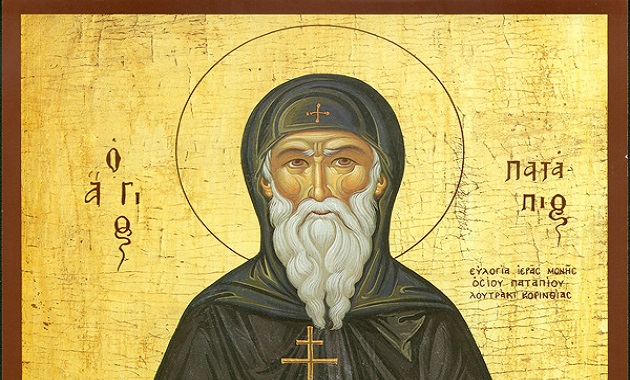
Saint Patapios (8 December), a Cancer Healing Saint


Today the Church celebrates and honours the memory of the blessed Patapios the Desert-Dweller. This is the title accorded to the saint who lived in isolation in the desert, leaving behind the turmoil and joys of the secular life. He was born in Thebes, in Egypt, of devout Christian parents, by whom he was brought up with great care and concern and from whom he learned the Scriptures. What Saint Paul wrote to Timothy applies very well to Saint Patapios: “from childhood you have been acquainted with the sacred writings, which are able to make you wise for salvation through faith in Christ Jesus”. Faith in Christ and in the Scriptures really do make people wise and save them.


When Saint Patapios came of age, he renounced his homeland, his wealth, his kin and every kind of worldly pleasure and vanity and went out into the desert. This was at the time when the eremitic and monastic way of life was at its peak in this part of Egypt. Saint Patapios quickly excelled and began to be well known for his asceticism and virtue, to so great an extent that people flocked to him to benefit spiritually from his acquaintance and influence. The same was true, as we see in the Gospels, of the Forerunner and Baptist John, to whom: “Jerusalem and the whole of Judea, as well as the area around the Jordan came out”.

We should take note of this and evaluate it properly. That is the importance and spiritual benefit conferred upon a particular place by the presence there of a saintly figure. It is not and should not be in the turmoil of the world, but in the desert, alone with God. People went to find him and listen to him, like those who are thirsty and cannot wait for water to be brought to them, but rather go themselves to the spring. It is not necessary or needful for the holy ascetics to come down and find people, but rather people should know by themselves to go to monasteries, in the way that many people now go to the Holy Mountain.

The blessed Patapios loved the peace of the desert so much that he began to be concerned when he saw crowds of people coming to him and admiring him for his ascetic way of life and his sanctity. Saints in those days did not allow themselves to think what other people thought of them: if they did, they would have lost everything. This is the great power and virtue of the saints, which is why people admire those who abandon the secular life and conceal themselves. This is what Saint Patapios did. After living so many years in the desert of Thebaïda, he left and went to Constantinople, so that people would lose all trace of him.

In Constantinople, Saint Patapios, directed by God, went and stayed at the shrine of the Mother of God of Vlakhernai (Blachernae). He remained there, poor and unknown, in harsh struggle and spiritual contemplation, as he had done in the desert. But a light cannot be concealed, and the more sanctity is hidden away in God’s people, the more it is revealed to the world. Saint Patapios, the humble and poor monk of Vlakhernai managed to become celestial and an angel on earth. This is why God granted him the grace of performing miracles. As well as the healing waters of the Life-Receiving Spring in Vlakhernai, there was also Saint Patapios, curing people’s illnesses.

Of the many miracles and healings of Saint Patapios, we would mention only one: he healed a woman who was suffering from breast cancer. This illness, which to this day is not properly treatable by medical science, was cured by Saint Patapios with prayer and the grace of Christ. This is why he is the protector and healer of those faithful women who are suffering from this wretched ailment. Even now, faithful people go to the convent of Saint Patapios, on the hill above Loutraki in Attica, to seek the grace of Christ, and also healing, through the prayers of Saint Patapios. Jesus Christ, the physician of our souls and bodies, said of His saints, and it is true, that: “those whose believe in Me will also do the works which I perform”. Amen. Metropolitan Dionysios of Servia and Kozani, Εικόνες Έμψυχοι [Souled Icons], pp. 159-61). 


http://pemptousia.com/2013/12/saint-patapios-8-december-a-cancer-healer-father/