Translate

Showing posts with label Saints. Show all posts

Wednesday, December 23, 2015

Elder Philotheos Zervakos: "It Is Not With Ease That the Saints Went to Paradise"


It is not with ease that the saints went to Paradise, but they worked and struggled against the three enemies - the flesh, the world, and the devil. To be willing and great, however, they overcame the devil and the desires of the world and the flesh. We need prayer and vigilance.

All the saints were sanctified by humility, because humility generates love and all the virtues. The humble person is the dwelling place of God and the bearer of the gifts of the Holy Spirit. If all the virtues are present and humility is absent, then they are empty, unprofitable, and harmful.

Divine Chrysostom when asked, "when will the end be?", responded, "when shame will be absent from women". And an unspoken prophecy says that the end will come when men will become women and women men. In our days we see these fulfilled.

Be careful, my beloved children, to not have in your mind the earthly, the perishable, and the vain of this world, but raise it to the country above, to heaven. May you remember always the Kingdom of God and quickly you will gain it.
 

Elder Philotheos Zervakos

Wednesday, June 10, 2015

Are Saints Faultless? ( Saint Luke Archbishop of Simferopol )


We often have the impression that saints are sinless and infallible, but this is wrong.

People who are great and triumphant in a worldly way manage to seem infallible and sinless. At their every mistake, at their every failure, they put forth an effort to convince everyone that they are in fact correct. They refuse to accept their mistakes, or seek forgiveness, so that their image is not destroyed. They therefore keep a safe distance from others, to avoid being scrutinized.

The saint, however, does not have these fears. He knows very well that "saint" does not mean one who is sinless or infallible, but one who is repentant. For this reason he is not ashamed to admit his mistakes, to ask forgiveness, or to reveal his sinful self. Whereas a great person of this world has many things to hide, the saint has nothing to hide. And the more he is scrutinized, the more he gains. For this reason one admires the majesty of his soul, his genuineness.

Taken from The Blessed Surgeon: the life of Saint Luke Archbishop of Simferopol. p 98 


http://agapienxristou.blogspot.ca/2013/06/are-saints-faultless-saint-luke.html

Sunday, June 7, 2015

St. Nikolai Velimirovich : How the Saints Face Suicidal Thoughts


Suicide is a mortal sin and an act of defiance against the Holy Spirit, Who gives life.

Suicide is a much greater sin than murder, since for the sin of murder a man can still repent; but for the sin of suicide there is no repentance.

Here are two examples of overwhelming misfortune, in the face of which a fainthearted man would commit suicide, yet in which holy men of God showed themselves to be heroes.

St. Eustathios (Sept. 20) found himself in the following predicament: he left one of his sons on the bank of a river, while he carried the other son to the opposite bank and returned for the first son. Halfway back across the river, he saw that a lion had seized his son and carried him away. He looked at the other bank and saw a wolf seize the second son and carry him away. A fainthearted man in such a situation would have drowned himself in the water, and made an end to his life. Even though drowning in sorrow, Eustathius did not commit suicide, but with hope in God lived as a hireling for fifteen years. This patient man lived to see his two sons again. Thus, God rewarded his faith and patience.

As a young man, St. Hilarion (Sept. 20) was forced to become a Muslim, but his conscience began to torment him cruelly, and he had no peace at all. He returned to the Christian Faith, was tonsured a monk, and gave his body over to intense fasting and every difficult ascetic labor. Even so, his peace of soul did not return to him. A fainthearted man of little faith would have committed suicide. But Hilarion chose an incomparably better path. He went to Constantinople with his spiritual father Bessarion, and not only openly confessed the Christian Faith at the sultan's court, but even counseled him to go to Russia and be baptized. After being subjected to mockery and torture, this courageous young man was beheaded, and God glorified him both in heaven and on earth. Even today, his holy relics are miracle-working.

But where is the glory of those who commit suicide? Where are their relics?

St. Nikolai Velimirovich 

http://agapienxristou.blogspot.ca/2013/06/st-nikolai-velimirovich-how-saints-face.html

Monday, December 8, 2014

The Veneration of Saints & Their Relics


"We carry about these clean and holy bones, O king, because we attest in due form our love of those marvelous men to whom they belong: and because we would bring ourselves to remember their wrestlings and lovely conversation, to rouse up ourselves to the like zeal; and because we would catch some vision of the rest and felicity wherein they now live, and thus, as we call them blessed, and provoke one another to emulate them, strive to follow their footsteps: because, moreover, we find thereby that the thought of death, which is right profitable, lends wings of zeal to our religious exercises; and lastly, because we derive sanctification from their touch."

—St. John Damascene, The Precious Pearl: The Lives of Sts. Barlaam and Joseph, p. 248

http://orthodoxinfo.com/general/gen_veneration.aspx

Wednesday, December 3, 2014

Orthodox reverence of Saints


During baptism, a person is given a name in honor of one of the saints, who from that moment becomes his heavenly patron. Each Orthodox Christian should know the "life" — the history — of his heavenly patron and turn to him in prayer for help and guidance. Our devout ancestors tried to commemorate the day of their saint’s memory — "the angel’s day" — by partaking of the Holy Communion and celebrating this day more festively than their birthday.

What is the meaning of the orthodox reverence of the holy servants of God? Do the saints in Heaven know of our needs and difficulties and are they interested in us? Do they hear our prayers to them and do they try to help us? Indeed should we turn to saints for help, or is it enough to pray only to the Lord God? Sectarians, who have lost the apostolic traditions, do not understand the essence and purpose of Christ’s Church and thus deny the necessity of prayers to the saints in Heaven. We will briefly outline herein the Orthodox teaching concerning this.

Orthodox reverence of the holy servants of God comes from the conviction that all of us, those seeking salvation or those already saved, living and dead, form a single family of God. The Church is a great society, encompassing the visible and invisible world. It is a huge, universal organization, built on the principle of love, in which each member must care not only about himself, but about the well-being and salvation of others. Saints are those people which during their life more than others expressed love to others.

We orthodox believe that, when a righteous person dies, he does not sever his ties with the Church, but crosses over to its higher, heavenly domain — into the Church triumphant. Once in the spiritual world, the soul of the righteous person does not stop thinking, wanting, feeling. Just the opposite, these characteristics are revealed more fully and completely.

Modern non-Orthodox Christians, having lost the active connection with the heavenly-earthly Church, have the most vague and contradicting ideas concerning the afterlife. Some of them think that after death the soul of the person falls asleep and is as though shut off from everything; others — that the soul of a person, even if it continues its activity after death, does not concern itself with the world which it has departed. Others — that as a matter of principle one should not pray to saints, because a Christian has direct association with God.

What is the teaching of the Holy Scriptures concerning the righteous who have departed the earthly world, and the power of their prayers? In apostolic times the Church was considered as one Heavenly/earthly spiritual family. The Apostle Paul wrote to newly-converted Christians: "But ye are come unto mount Sion, and unto the city of the living God, the heavenly Jerusalem, and to an innumerable company of angels, To the general assembly and church of the firstborn, which are written in heaven, and to God the Judge of all, and to the spirits of just men made perfect" (Heb. 12:22-23). In other words, you, by becoming Christians, have joined a great family and come into close contact with the heavenly world and with the righteous who are found therein. The parting words of the Apostle Peter — "Moreover I will endeavor that ye may be able after my decease to have these things always in remembrance" (2 Peter 1:15) — clearly attest to the fact that he promises to continue to care about them from that spiritual world.

The ancient practice of turning to the holy martyrs and servants of God for help is based on the recognition of the active association of the Heavenly-earthly Church and on the basis of faith in the power of prayer.

We know that not all, but only the most zealous and devout persons did God during their lifetime call His friends, and glorified them with the gifts of the Holy Spirit and miracles. Thus, Christ told the apostles at the Last Supper: "Ye are my friends!… For whosoever shall do the will of my Father which is in heaven, the same is my brother, and sister, and mother" (John 15:14-15; Mt. 12:50). The sacred history presents many examples of spiritual closeness, or "audacity," of the saints with God. For example, Abraham asks God to have mercy on the citizens of Sodom and Gomorra, and God was willing to fulfill his request, if there were at least 10 righteous persons found there. Another time God rescinded his punishment of Abimelech, king of Gerar, by the prayers of Abraham (Gen. Chap. 18, Gen. Chap. 20). The Bible relates, that God spoke with the Prophet Moses face to face, "as a man speaketh unto his friend." When Miriam, the sister of Moses, sinned and was punished with leprosy, Moses attained forgiveness for her from the Lord through prayer (Ex. 33:11; Numbers Chap. 12). Other examples can also be presented about the particular strength of the prayers of God’s servants.

The saints themselves do not overshadow God and do not weaken the need to turn to Him as the Heavenly Father. For even grown members of a family do not lessen the authority of the parents, when they care for their children together. Even more so: nothing pleases a parent more, than seeing how older brothers care for the younger. In similar fashion, our Heavenly Father rejoices, when the saints pray for us and try to help us. The holy servants of God possess a stronger faith than we, and are closer to God by their righteousness. For this reason we will turn to them as to our older brothers, appearing at the throne of the Almighty for us.

It is noteworthy that the righteous, while still living on earth, saw and knew much that was inaccessible to normal perception. Even more so should these gifts be inherent in them, when they, free from their mortal body, have passed on to the higher world. The Apostle Peter, for example, saw what was occurring in Ananias’ soul; the illegal act of his servant Giezia was revealed to Elisha and, what is more amazing, all the secret plans of the Syrian court were revealed to him, which he later related to the King of Israel. The saints, while on earth, penetrated the higher world with their spirit, and some saw hosts of angels, others earned the right to see the image of God (Isaiah, Ezekiel), others were transported to the third Heaven and heard secret indescribable words there, for example, the Apostle Paul. Even more so, being in Heaven, they are more capable of knowing what is happening on earth and hearing those who turn to them, since the saints in Heaven are "equal to the angels" (Acts 5:3; 4 [2] Kings Chapter 4; 4 [2] Kings 6:12; Luke 20:36). From the parable of the Lord about the rich man and Lazarus we find out, that Abraham, being in Heaven, could hear the cry of the rich man, suffering in hell, the "great gulf" dividing them notwithstanding. The words of Abraham: your brothers have Moses and the prophets, let them hear them — clearly show that Abraham knows the life of the Hebrew nation, occurring after his death, knows of Moses and his law, about the prophets and their writings. The spiritual vision of the souls of the righteous in Heaven, without doubt, is greater than it was on earth. The Apostle writes: "For now we see through a glass, darkly; but then face to face: now I know in part; but then shall I know even as also I am known" (1 Cor. 13:12).

The nearness of the saints to God’s throne and the power of their prayers for the faithful existing on the earth, is obvious from the book of Revelations, in which the Apostle John writes: "And I beheld, and I heard the voice of many angels round about the throne and the beasts and the elders: and the number of them was ten thousand times ten thousand, and thousands of thousands." Later he describes the vision of the righteous in Heaven, praying for the people suffering on earth: "And another angel came and stood at the altar, having a golden censer; and there was given unto him much incense, that he should offer it with the prayers of all saints upon the golden altar which was before the throne. And the smoke of the incense, which came with the prayers of the saints, ascended up before God out of the angel’s hand" (Rev. 5:11; 8:3-4).

Great is the power of prayer! "Confess your faults one to another, and pray one for another, that ye may be healed. The effectual fervent prayer of a righteous man availeth much," taught the Apostle James (Jam. 5:16). Praying for another is an expression of love for him; and the saints in Heaven, praying for us, show us their brotherly love and care.

In the Gospel and other New Testament books we find numerous examples witnessing the power of prayer for other people. Thus, for example, by request of the nobleman, the Lord healed his son; by request of the Canaanite woman her daughter was freed from the demon; by request of a father the Lord healed his possessed son; and by request of his friends, He forgave and healed the sick of the palsy, whom they lowered from the roof with ropes; by the faith of the Roman centurion, his servant was healed (John 4:46-53; Mat. 15:21-23; Mark 9:17-25; Mark 2:2-25; Mat. 8:5-13). In addition, the Lord performed most of the miraculous healings at a distance, in absentia.

In this way, if the prayers of simple people have such strength, then even more powerful are the prayers of the righteous, standing before the throne of God. "And this is the confidence that we have in him (the Son of God), that, if we ask any thing according to his will, he heareth us," urges us the beloved pupil of Christ (1 John 5:14).

This is why the Church from the very earliest times taught about the benefits of prayerful appeal to the saints. This we see, for example, from ancient liturgies and other literary monuments of apostolic fathers. In the liturgy of the Apostle James we read: "Especially we perform the memory of the Holy and Glorious Ever-virgin, Blessed Mother of God. Remember Her, Lord God, and by Her pure and holy prayers have mercy on us." Saint Cyril of Jerusalem, in describing the Liturgy of the church of Jerusalem, notes: "Thus we remember (in the Liturgy) those deceased earlier, firstly the patriarchs, the prophets, apostles, martyrs, so that through their prayers and intercessions God would accept our prayers."

There are numerous accounts of the Fathers and teachers of the Church, particularly beginning with the 4th century, of the Church’s reverence of the saints. But even from the beginning of the second century there is direct evidence of ancient Christian writings of faith in the prayers of the saints in Heaven about their brothers on earth. Witnesses of the martyrdom of St. Ignatius the God-Bearer (beginning in the second century) say "Returning home in tears, we conducted an all-night vigil… Later, dozing off, some of us saw the blessed Ignatius suddenly arisen, embracing us, and others also saw him praying for us." Similar notes containing mentions of prayers and intercessions for us by martyrs are contained in other writings from the era of persecutions on Christians.

The determination of the holiness of the dead person is confirmed by special evidence, such as: martyrdom for Christ, fearless espousal of their faith, selfless service to the Church, the gift of healing. Particularly, when the Lord confirms the holiness of the dead person through miracles after their death upon praying to them.

Besides the help of the saints through prayer, they help us attain salvation through the example of their own life. The familiarity with the lives of the saints enriches the Christian with the spiritual experience of those, who more zealously than others embodied the Gospel in their life. Here are so many clear examples of living faith, courage, patience. Being persons like ourselves, and overcoming the most difficult temptations, they inspire us to carry out our path of life patiently and uncomplainingly.

The Apostle James called upon Christians to imitate the patience of the ancient prophets and Job the Long-suffering, to acquire strong faith, like the prophet Elijah. The Apostle Peter taught Christian wives to take the example of modesty and obedience from the righteous Sarah, Abraham’s wife. The Holy Apostle Paul presents the feats of the ancient righteous, beginning with Abel and ending with the Maccabees, and urges Christians to imitate them. In the conclusion of his thorough teaching on this theme he writes: "Wherefore seeing we also are compassed about with so great a cloud of witnesses, let us lay aside every weight, and the sin which doth so easily beset us, and let us run with patience the race that is set before us" (James 5th chapter; 1 Peter 3:6; Heb. 12:1).

The Lord said: "Neither do men light a candle, and put it under a bushel, but on a candlestick; and it giveth light unto all that are in the house. Let your light so shine before men, that they may see your good works, and glorify your Father which is in Heaven" (Matt. 5:15-16). Saints are bright stars, showing us the way to the Heavenly Kingdom.

Let us treasure the closeness to God of God’s holy servants and turn to them for help, remembering that they love us and concern themselves with our salvation. Familiarity with the lives of the saints is particularly important in our time, when the general mass of "Christians" of the most varied direction has become so trivialized and the understanding of the Christian ideal has been distorted.

Thursday, November 27, 2014

How Can Saints Help Us ( Elder Cleopas )


There is no question that only Christ is able to save us from sin. So, how can saints aid us? When we honor saints and ask them to pray for us we are not putting them in the place of Christ. They are close to God, so when they pray for us they seek our salvation from Christ.

Elder Cleopa puts it this way,
When the saints pray for us, it is precisely our salvation that they seek from Christ. They interceded with Him for our salvation. From Christ they entreat our salvation. This is what we mean when we say they intercede for us. By their prayers the saints petition for our salvation -- not, however, as if they themselves have the power to save, for the only one who saves is Christ. Thus we do not venerate saints and angels as we do God. (That which we render the saints and angels is solely a veneration of honor and reverence, while God we adore and worship with perfect adoration which is thus properly called worship)


The apostle Paul reminds us that the saints are our fellow citizens who can help us. "Now therefore ye are no more strangers and foreigners, but fellow citizens with the saints, and of the household of God" (Eph 2:19).


How is we know that the saints have the ability to pray to God on our behalf? We know this from Scripture. "And when he had taken the book, the four beasts and the four and twenty elders fell down before the Lamb, having everyone of them harps, and golden vials full of orders, which are the prayers of the saints" (Rev 5:8)


Some are concerned that the veneration of saints eclipse the glory and honor that belongs to God alone. But God himself glorified His saints. "And the glory which thou gravest me I have given them; that they may be one, even as we are one" (Jn 17:22).


Elder Cleopa says,
No eclipse or depreciation of the glory of God results from the reverence and veneration of His angels. This is so, first of all, because the veneration that we offer God is one thing and the veneration we render to the angels and saints is another. The same Holy Spirit exhorts us to glorify God with His saints saying, "Praise ye God in His saints." Thus we glorify God likewise when we seek in prayer the help and mediation of the angels and saints, since the saints in their succession convey our supplications and requests together with their own prayers to God.
The saints are given special powers by God to work miracles. It says in Scripture, "In the saints that are in His earth hath the Lord been wondrous; He hath wrought all His desires in them" (Ps 15:3). Elder Cleopa lists many examples from the Old Testament of people who were given such powers and then points out the powers of the Holy Apostles, including the seventy, who are able to render all sorts of things.


He writes,
God himself glorified His saints and robed them with His glory: "And the glory which thou gravest me I have given them; that they may be one, even as we are one" (Jn 17:22). Elsewhere He says, "He that receiveth you receiveth me; and he that receiveth me receiveth him who sent me. He that receiveth a prophet in the name of a prophet shall receive a prophets reward; and he that receiveth a righteous man in th ename of a righteous man shall receive a righteous man's reward" (Mat 11:40-41). These statements prove sufficiently enough the delusion of those who repudiate the honor shown toward the saints and angels, -- those beloved servants of God -- not realizing that in practice they turn their back on God himself, the Creator and Fashioner of saints.

Reference: The Truth of Our Faith, 67-77

Wednesday, November 26, 2014

The meaning of objects held by Saints in Icons


Orthodox Iconography can be an extremely concise way of communicating the Faith. Therefore, what the Saints hold in their hands in portrait icons help in identifying them and in telling us about their lives.


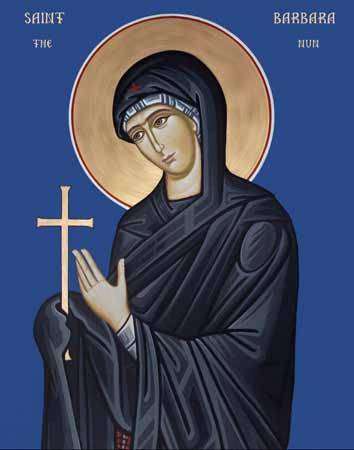
— Cross: It indicates the Saint is a Holy Martyr. The reason martyrs are shown holding a cross is two-fold: firstly, martyr comes for the Greek for witness, and so these witnesses hold the preeminent symbol of Christianity: the Cross. Secondly, the Cross symbolizes the most perfect sacrifice of life for others, Christ’s own crucifixion. Therefore, any Saints who were murdered for confessing the Faith are shown with crosses, regardless of how they died.


— Scroll: It indicates holy Wisdom, and so is often shown in the hands of the Old Testament prophets, but is also commonly seen in the hands of the Apostles. Both were given wisdom from God – the prophets through visions, the Apostles through meeting and knowing Jesus Christ. Later Saints may also be shown holding scrolls if they were also known for prophecy, percipience, and imparting divine knowledge to others.


— Gospel Book: Sainted Bishops in Icons hold their main tool: the Gospel Book, from which they proclaim the Good News to the faithful during the Liturgy. Many of the Church Fathers were also Bishops, and some of their “writings” which we read today were not writings at all, but sermons preached after the reading of the Gospel, later copied down by the congregation for other churches to benefit from. Their inspired teachings were grounded in the Gospel, and so they hold these books in Icons as the instruments through which God granted them sainthood. And they hold them with great reverence indeed, indicated by the way some Icons show the Bishops covering their bare hand with their vestments or stole.


— Crosier: Another role of the Bishop is that of a pastor, or shepherd, of Christ’s flock. This is symbolized by the Crosier, which in Orthodoxy doesn’t look the same as the “shepherd’s crook” held by bishops in the West. It is of a simpler design, usually in the shape of the Greek letter Tau, which symbolizes life, resurrection, or the Cross.


— Weapons: Often there are weapons in icons, such as lances, shields and swords. In the first few centuries of the Church, two types of martyr gained particular devotion among Christians: virgin-martyrs and soldier-martyrs.These martyr-soldiers (and they usually hold crosses too, in remembrance of their sacrifice) have through their confession of faith become “soldiers for Christ”.


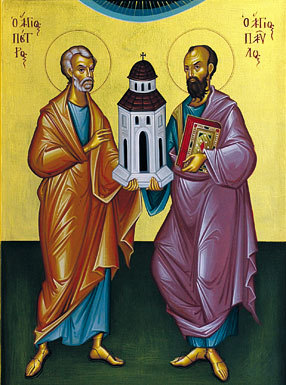
— Church Building: Some Saints are depicted holding a Church Building in their hands, just like Ss Peter and Paul. This reflects the hymnography of the Church, where the two Apostles are praised as “pillars of the Church.” Not only were they pillars of the Church, but church-builders too, establishing Christian communities (churches) around the Mediterranean and Holy Lands. Later, other Saints are remembered for their “church-building” and so are depicted holding small churches or monasteries, often in profile, shown offering the church to Christ. It is quite common for Sainted kings and queens to be shown holding churches in this way, as they are honoured for their role as protector and benefactor of the Church within their lands.

 http://agapienxristou.blogspot.ca/2012/10/the-meaning-of-objects-held-by-saints.html

Thursday, November 13, 2014

Lives of Saints in the Spiritual Life ( St. Justin Popovic )


St. Justin Popovic


1. The Significance of the Lives of the Saints

  In order to begin to understand the importance of the Lives of the Saints for our spiritual lives, I believe we can turn to no better or more thorough source than St. Justin Popovich's Introduction to his own compilation of the Lives of the Saints. A theologian, St. Justin saw no dichotomy between the Lives of the Saints and the theological writings of the Church. For him, as for the Church, theology and the Lives of the Saints form one whole. He called the Lives of the Saints "experiential theology" or "applied dogmatic theology," and he viewed them and wrote about them in a theological manner. Likewise, he viewed theological writings as an expression of the experience of the life of Grace in the Church, and not just an intellectual, abstract or polemical exercise.

How does St. Justin view the Lives of the Saints theologically? At the center of all of St. Justin's thought is the Theanthropic vision: the fact that God became man in Jesus Christ, uniting human nature with Divine Nature. The fact of the God-man, the Theanthropos, is the axis of the universe: it is the reality according to which everything else must be viewed, whether it be the nature of the Church or the problems and issues of everyday life.

Thus, when St. Justin looks at the Lives of the Saints, he does so in the light of the God-man. Real and true life—eternal life in God—became possible only with the Incarnation, death and Resurrection of the Saviour, and this life is the Life of the Saints. St. Justin saw the Lives of the Saints as bearing witness to one life: the Life in Christ.

St. Justin wrote: "What are Christians? Christians are Christ-bearers, and, by virtue of this, they are bearers and possessors of eternal life.... The Saints are the most perfect Christians, for they have been sanctified to the highest degree with the podvigs of holy faith in the risen and eternally living Christ, and no death has power over them. Their life is entirely Christ's life; and their thought is entirely Christ's thought; and their perception is Christ's perception. All that they have is first Christ's and then theirs.... In them is nothing of themselves but rather wholly and in everything the Lord Christ."[1]

The Saints live in Christ, but Christ also lives in them through His Divine Energies, His Grace. And where Christ is, there is the Father and the Holy Spirit also. Christ says, Abide in Me, and I in you; and elsewhere He says, If a man love Me, he will keep My words: and My Father will love him, and We will come unto him, and make Our abode with him (John 15:4; 14:23).

Thus, St. Justin makes bold to say that the Lives of the Saints not only bear witness to the Life in Christ: they may even be said to be the continuation of the Life of Christ on earth. "The Lives of the Saints," says St. Justin, "are nothing else but the life of the Lord Christ, repeated in every Saint to a greater or lesser degree in this or that form. More precisely, it is the life of the Lord Christ continued through the Saints, the life of the incarnate God the Logos, the God-man Jesus Christ Who became man."[2]

This is an amazing thing that St. Justin is saying: when we read the Lives of the Saints, we are reading the Life of our Lord Jesus Christ. This in itself should be enough to convince us of the importance of filling our souls with the Lives of the Saints.

St. Justin also says that the Lives of the Saints are a continuation of the Acts of the Apostles. "What are the 'Acts of the Apostles'?" he asks. "They are the acts of Christ, which the Holy Apostles do by the power of Christ, or better still: they do them by Christ Who is in them and acts through them. "And what are the 'Lives of the Saints'? They are nothing else but a certain kind of continuation of the 'Acts of the Apostles.' In them is found the same Gospel, the same life, the same truth, the same righteousness, the same love, the same faith, the same eternity, the same 'power from on high,' the same God and Lord. For the Lord Jesus Christ is the same yesterday and today and for ever (Heb. 13:8): the same for all peoples of all times, distributing the same gifts and the same Divine Energies to all who believe in Him."[3]

With these words of St. Justin before us, we might well ask ourselves if Orthodox spiritual life is even possible without the testimony of the Lives of the Saints. The answer to this, I believe, must be "no." True spiritual life begins when we live in Christ and Christ lives in us, right here on this earth. And the Lives of the Saints bear witness to us that the Life of Christ on earth did not end with His Ascension into Heaven, nor with the martyrdom of His Apostles. His Life continues to this day in His Church, and is seen most brilliantly in His Saints. And we, too, in our own spiritual lives, are to enter into that continuing, never-ending Life.

I spoke recently to an Orthodox priest who had converted to Orthodoxy from Protestantism. He told me that, when he was received into the Church, the officiating priest told him: "You will never be truly Orthodox without reading the Lives of the Saints." Later, when he himself became a priest, he found that the most pious people in the churches are those who read the Lives of the Saints, and that those who make the most progress in the spiritual life are those who read the Saints' Lives.

The Orthodox Faith is not, first of all, of the head. First of all, it is of the heart: it is felt

and believed by the heart. Through the Lives of the Saints, we develop an Orthodox heart. Our monastery's co-founder, Fr. Seraphim Rose, emphasized constantly this "Orthodoxy of the heart," especially in his writings and talks at the end of his life; and he frequently referred to Lives of the Saints as a means of developing this.

2. How to Make Use of the Lives of the Saints

Having looked at the importance and meaning of the Lives of the Saints, let us look now at the various ways we can make use of them in our spiritual lives.

First, we look to the Saints as our examples. Be ye imitators of me, even as I also am of Christ (I Cor. 11:1), the Saints say to us along with the Holy Apostle Paul. As Christians, we want to grow in the likeness of Christ, to have that likeness shine in us. For this to occur, we need to look often to the Saints to see that shining likeness: we must look to them for real, practical examples of how to live. St. Basil the Great gives this analogy:

"Just as painters, in working from models, constantly gaze at their exemplar and thus strive to transfer the expression of the original to their own artistry, so too he who is eager to make himself perfect in all kinds of virtue must gaze upon the Lives of the Saints as upon statues, so to speak, that move and act, and must make their excellence his own by imitation."[4]

Secondly, we must look to the Saints as our heavenly friends, as our brothers and sisters in the Faith, and as our preceptors. We read about them not as people who are dead, but as people who are living. And this is even more immediate than just reading a biography about someone who is still alive. Let's say we are reading the biography of some famous living person. As we read it, we may dream of perhaps one day meeting this person, or perhaps of writing him a letter and having it actually reach him, and even of receiving a reply from him, despite the fact that he is so famous that thousands of people are probably writing to him. Reading the Lives of the Saints offers us much more than this, because the Saints are alive in God, and are not bound by time and space in the same way we are. We can address them in prayer immediately and at any time, even right in the middle of reading their Lives. And they will hear us. Besides our private prayers to them, the Church offers us many other ways of communing with them as our friends and honoring them as our preceptors. We sing their troparia, we venerate their icons, we perform services to them, and with a blessing from our Bishop we can even compose services in their honor.

As we read the Lives of the Saints each day, we will discover little by little those Saints whom our hearts go out to. They will become our close friends, those whom we pray to most of all, those in whom we confide our joys and sorrows. As Archimandrite Aimilianos, the present Abbot of the Holy Monastery of Simonos Petras on Mount Athos, writes: "These close friends will be the guides of our choice and a great comfort to us along the strait and narrow way that leads to Christ. We are not alone on the road or in the struggle. We have with us our Mother, the All-Holy Mother of God, our Guardian Angel, the Saint whose name we bear, and those close friends we have chosen out of the Great Multitude of Saints who stand before the Lamb (Rev. 7:9). When we stumble through sin, they will raise us up again; when we are tempted to give up hope, they will remind us that they have suffered for Christ before us, and more than us; and that they are now the possessors of unending joy. So, upon the stony road of the present life, these holy companions will enable us to glimpse the light of the Resurrection. Let us search, then, in the Lives of the Saints, for these close friends, and with all the Saints let us make our way to Christ."[5]

St. Justin Popovich, as we have said, called the Lives of the Saints "applied dogmatic theology." The Saints are proofs and illustrations of the reality of Christ, of His saving work of redemption. The Saints are transformed human beings, proof positive that people are redeemed, purified, illumined, transformed and recreated by Jesus Christ.

St. Justin also calls the Lives of the Saints "applied ethics." They are embodiments of the life of Divine virtue that is possible only in Jesus Christ. They are embodiments of the life of Grace in the Church, through the Holy Sacraments, through the life-giving Body and Blood of the Lord.

Fr. Seraphim Rose once counseled a budding Orthodox writer to make use of the Lives of the Saints as "applied dogmatic theology" and as "applied ethics." Fr. Seraphim said that, when one is writing on a spiritual subject, one should try to not only discuss it in the abstract, but to give living examples from the Lives of the Saints. Fr. Seraphim wrote to his fellow Orthodox writer: "If I have any suggestion for your future articles, it would simply be to keep in mind the Lives of the Saints. In your article, there is a point that would be more forceful by references to the life of the author of the citations, who is a Saint. You quote St. John of Kronstadt on 'love'—but he is not merely a great Orthodox Saint of this century, he is a very incarnation of the love he talks about, and there is scarcely to be found a parallel in the Lives of other Saints to his absolute self-crucifying love and service to others, blessed by God in the manifestation of an abundance of miracles that can only be compared to those of St. Nicholas."[6]

3. An Example of How to Make Use of the Lives of the Saints

I will now attempt to implement Fr. Seraphim's advice here. In speaking about how to make use of the Lives of the Saints, I will give the example of a Saint who made use of them to an astounding degree. This is Fr. Seraphim's mentor, and the Bishop who blessed the establishment of our Brotherhood: St. John Maximovitch, Archbishop of Shanghai and San Francisco.

Archbishop John was born Michael Maximovitch in the city of Kharkov in southern Russia in 1896. As a boy he collected religious and historical books, and loved above all to read the Lives of the Saints. Being the oldest child, he had a great influence on his four brothers and one sister, who knew the Lives of the Saints through him.

When he was eleven years old Michael was sent to the Poltava Cadet Corps (military academy). When he graduated in 1914, he wished to attend the Kiev Theological Academy. His parents insisted, however, that he attend Law School in Kharkov, and out of obedience to them he put away his own desire and began to prepare for a career in law.

It was during his university years that the Orthodox education and outlook which Michael had received in his childhood came to maturity. Young Michael saw the point of this upbringing. He saw that the Lives of the Saints, in particular, contain a profound wisdom which is not seen by those who read them superficially, and that the proper knowledge of the Lives of the Saints is more important than any university course. And so it was, as his classmates noticed, that Michael spent more time reading the Lives of the Saints than attending academic lectures, although he did very well in his university studies also. One could say that he studied the Orthodox Saints precisely "on the university level': he assimilated their world-outlook and their orientation toward life, and studied the variety of their activity and ascetic labors and practice of prayer. He came to love them with all his heart, was thoroughly penetrated by their spirit—and began to live like them. Many years later, during the sermon he gave when he was consecrated a Bishop, he said: "While studying the worldly sciences, I went all the more deeply into the study of the science of sciences, into the study of the spiritual life."

In 1921, as the Russian Civil War was raging, Michael—then twenty-four years old—was evacuated with his entire family to Belgrade. There he entered the University of Belgrade, from which he graduated in 1925 in the faculty of theology. A year later he was tonsured a monk in Serbia and was given the name John, after his own distant relative, St. John Maximovitch of Tobolsk. During the same year he was ordained a hieromonk.

For five years Hieromonk John was a teacher and tutor at the Seminary of St. John the Theologian in Bitol, Serbia. The city of Bitol was in the diocese of Ohrid, and at that time the ruling bishop of this diocese was another future Saint: St. Nikolai Velimirovich. St. Nikolai valued and loved the young Hieromonk John, and exerted a beneficial influence on him. More than once he was heard to say, "If you wish to see a living Saint, go to Bitol to Father John."

One of the seminarians who was at the Bitol Seminary at that time recalls: "Bishop Nikolai often visited the seminary and spoke with the teachers and students. For us his meeting with Fr. John was unusual. After mutual prostrations, there was an unusually cordial, loving conversation. Once, before parting, Bishop Nikolai turned to a small group of students (of whom I was one) with these words: 'Children, listen to Fr. John; he is an angel of God in human form.' We ourselves became convinced that this was the correct characterization of him. His life was angelic. One can rightly say that he belonged more to Heaven than to earth. His meekness and humility were like that recorded in the Lives of the greatest ascetics and desert-dwellers."

By this time, it had indeed become evident that Fr. John was an entirely extraordinary man. It was his own students who first discovered what was perhaps his greatest feat of asceticism. They noticed at first that he stayed up long after everyone else had gone to bed; he would go through the dormitories at night and pick up blankets that had fallen down and cover the unsuspecting sleepers, making the sign of the Cross over them. Finally it was discovered that he scarcely slept at all, and never in a bed, allowing himself only an hour or two each night of uncomfortable rest in a sitting position, or bent over on the floor praying before icons. Years afterward he himself admitted that since taking the monastic vows he had not slept lying in a bed. Such an ascetic practice is a very rare one; yet it is not unknown in the Orthodox tradition of the Lives of the Saints. In the fourth century, St. Pachomius the Great of Egypt was told by an angel to have his monks follow this practice.

In 1934, Fr. John was consecrated a Bishop in the Russian Church in Belgrade, and he was assigned to the diocese of Shanghai in China. The first thing he did in Shanghai was to restore Church unity, establishing contact with the Serbs, Greeks, and Ukrainians. He paid special attention to religious education. He actively participated in charitable activities, especially after seeing the needy circumstances in which the majority of his flock, refugees from the Soviet Union, were placed. He organized a home for orphans and the children of needy parents. He himself gathered sick and starving children off the streets and dark alleys of Shanghai's slums: Russian children, Chinese children, and others. The orphanage housed up to a hundred children at a time, and some 3,500 in all.

It soon became apparent to his new flock that Archbishop John was a great ascetic. The core of his asceticism was prayer and fasting. He ate once a day at 11 p.m. During the first and last weeks of Great Lent he did not eat at all, and for the rest of this and the Christmas Lent he ate only bread from the altar. His nights he spent usually in prayer, and when he finally became exhausted he would put his head on the floor and steal a few hours of sleep near dawn.

Then it became known that Archbishop John not only was a righteous man and an ascetic, but was also so close to God that he was endowed with the gift of clairvoyance, and was a great miracle-worker. There are many, many firsthand accounts of both his clairvoyance and his miracle-working, which show him to be equal to the great Saints of ancient times. On more than one occasion, he was seen surrounded in the Uncreated Light of deification while praying.

In 1949, the Communists took over China. Archbishop John was forced to evacuate his flock, including his entire orphanage. He brought 5,000 refugees to camps in the Philippines. He himself went to Washington, D.C. to get his people to America. Legislation was changed and almost the whole camp came to the New World—thanks to St. John. Later he was assigned to Western Europe, and then to San Francisco, where reposed in 1966.[7]

Perhaps the most remarkable thing about St. John's life is that he manifested in himself so many different kinds of sanctity. It was as if, through the intense study of the Lives of the Saints that he had undertaken in his early years, he had internalized and made his own the whole realm of Orthodox sanctity, in all its varied forms. He was a true student of the Saints, one who sought to follow in their footsteps, and thus to follow in the footsteps of Christ. By living like the Saints, he became one of them.

Let's look at some of the varied forms of sanctity that could be seen in Archbishop John:

1. He was first of all a great ascetic in the tradition of the ascetic, monastic Saints of old, such as St. Macarius the Great, St. Pachomius the Great, and others.

2. He was a clairvoyant reader of hearts, and one who could identify and name people he had never seen before. Enlightened by the Grace of God, he could hear and answer people's thoughts before they would express them. He also foretold the future, including the time of his own death. In this way, he was very much in the tradition of the great monastic elders of the past, especially the clairvoyant Russian elders such as those of Optina Monastery.

3. He was an almsgiver in the tradition of St. Philaret the Almsgiver, St. John the Almsgiver, etc. We have seen how he sacrificed himself for orphaned children, going himself into dangerous slums and houses of prostitution in order to rescue children from starvation or unhealthy environments. He was constantly giving to and working to help the needy. He himself wore clothing of the cheapest Chinese fabric. He often went barefoot, sometimes after having given away his sandals to some poor man.

4. He was a hierarch and theologian, a Church writer and apologist who defended the Church against error, much in the tradition of St. Athanasius the Great, St. Gregory the Theologian, and others. Besides his many published sermons, rich in theological content, he wrote valuable theological treatises in order to defend traditional Orthodox teachings which were being undermined in modern times. One of these works, in which he presents the Orthodox teaching on the Mother of God in contrast to Protestant and Roman Catholic distortions, has been published in English.[8] He also wrote an extensive essay pointing out the fallacies of the modern teaching of Sophiology.

5. He was an apostle, evangelist and missionary to new lands, in the tradition of Sts. Cyril and Methodius, St. Nahum of Ohrid and others. When he was in Western Europe, he worked hard to establish indigenous Orthodox Churches in France and the Netherlands: churches made up of the native peoples of these lands who had converted to the Orthodox Faith. He understood that the Orthodox Church is universal, and he said that the Orthodox Gospel of Christ must be spread throughout the world. Later, when he came to America, he instituted English Liturgies in addition to Slavonic Liturgies, in a Cathedral that had only known Slavonic Liturgies. He helped and supported our newly begun St. Herman Brotherhood, which was dedicated to bringing Orthodoxy to the English-speaking world.

6. He was a healer and miracle-worker, in the tradition of St. Martin of Tours, St. Nicholas of Myra in Lycia, and others. Through his prayers, he healed people of almost every imaginable malady; and he continues to do so after his repose.

7. He was a loving and self-sacrificing pastor, in the tradition of St. John of Kronstadt and all the other hierarch and priest Saints of ages past. So great was his love that everyone felt that he or she was his "favorite." He was overflowing with self-sacrificing love for his flock, and for those outside of his flock as well, such as a dying Jewish woman whom he suddenly healed with the words "Christ is Risen."

8. He was a deliverer of his people from captivity, in the tradition of St. Moses the God-seer. As we have seen, he brought 5,000 Orthodox believers out of Communist China and into freedom in America.

9. Finally, he was to a limited degree a fool-for-Christ in the tradition of St. Andrew the fool-for-Christ and others. He could not be a fool-for-Christ in the full sense of the term, since this would compromise the dignity of his hierarchical office. And yet at many times he did things which were at odds with the ideas of the world, and thus he evoked censure from people who did not see him for what he was: a man of God. He was criticized, for example, for serving barefoot, and for wearing a collapsible cardboard mitre that had been lovingly made for him by his orphans.

We have now looked at nine different types of sanctity manifested in this one Saint, St. John of Shanghai and San Francisco. Nine types which he had learned about through his study of the Lives of the Saints.

What the contemporary hagiographer Constantine Cavarnos says of modern Saints in general applies perfectly to St. John: "Modern Saints admire and imitate the older ones: they follow closely their example, study their teaching carefully, and—what is extremely significant—they confirm it. Those of the modern Saints who write or preach amplify and illustrate the teaching of the older Saints, and relate it to modern realities."[9]

4. "Remember the Saints of God"

It should not be thought that, after his formative years at the Cadet Corps and at the University of Belgrade, St. John finished his profound study of the Lives of the Saints. Quite the contrary: he continued to learn about the Saints right up until the time of his repose.

St. John believed that, in whatever land an Orthodox Christian found himself, it was his responsibility to venerate and pray to its national and local Saints. Wherever St. John went—Russia, Serbia, China, France, Belgium, the Netherlands, Italy, Tunisia, America—he researched the Lives of the local Orthodox Saints. He went to the churches housing their relics, performed services in their honor, and asked the Orthodox priests there to do likewise. By the end of his life, his knowledge of Orthodox Saints, both Western and Eastern, was seemingly limitless.

Here is a story which illustrates St. John's love for the Saints, and how he went out of his way to learn about them and venerate them:

One of St. John's spiritual children was Archimandrite Spyridon, who later became the father confessor of our monastery in the 1970s. Like St. John, Fr. Spyridon was born in Russia, but went to Serbia following the Russian Revolution. He knew St. John from a young age, when St. John was still studying at the University of Belgrade.

When Serbia fell to the Communists, Fr. Spyridon and many of his fellow Russians settled on the border of Italy and Serbia, in a refugee camp in the Italian city of Trieste. Fr. Spyridon was ordained to the priesthood in 1951 and was assigned as a pastor of the camp church in Trieste.

At this time, St. John had just been assigned as the Bishop of Western Europe, and so he would visit Fr. Spyridon and his flock in the refugee camp in Trieste. When St. John came to the place where Fr. Spyridon served, he was already fully informed about the early Western Saints of Trieste—such as Justus the Martyr, after whom the city had originally been called Justinopolis, St. Sergio the Martyr, and St. Frugifer, the first bishop of Trieste. Finding that nothing had been done to venerate the local Saints, Archbishop John was disappointed. Fr. Spyridon later said how he regretted not having thought of it before. No one had done such a thing: the Saints of Trieste had largely been forgotten, and it was St. John who restored their local veneration. Before doing anything else in Trieste, he took Fr. Spyridon to the relics of the Saints, vested in an epitrachelion and a small omophorion. With a censer and a cross in his hand he would descend into the crypts under cathedrals where, according to his long lists of information, the Saints had been buried. He would sing troparia and kontakia written on pieces of paper which he would pull out his pockets, imploring the Saints to intercede for the city. And only then would he go to celebrate the services in Fr. Spyridon's camp church.

As Fr. Spyridon recalled, St. John acted as if the ancient local Saints were present wherever he walked. Before leaving Trieste, he contacted local Roman Catholic clergy, acquiring from them various permits so that the Orthodox church in Trieste would have free access to the relics and sites of the Saints. Then he gave Fr. Spyridon strict instructions on how to commemorate the Saints, how he should take his parishioners to the shrines of all local Saints on their feast-days, venerate them, sing services to them, and so on. St. John said that no services should be conducted without first addressing these local Saints, and no Liturgies performed without first commemorating them at the proskomedia.[10]

While in Western Europe, St. John collected the Lives and icons of Orthodox Saints from many different Western European countries, who lived before the time of the schism of the Latin Church. Since most of these Saints were included in no Orthodox Calendar of Saints, St. John compiled a list of these Saints with information about their lives, and submitted this to his Synod of Bishops for inclusion in the Orthodox Calendar.

Since he was an Apostle of Christ, St. John called upon each local Saint he learned about to provide heavenly help in evangelizing new lands. As Archbishop of San Francisco, he called upon all the Saints of America, including the most local of all Saints, the Native American St. Peter the Aleut, who was martyred in California.

Archbishop John had an especially great devotion to St. Herman of Alaska as a patron of the American Orthodox mission. He sought to have St. Herman canonized, and this occurred four years after St. John's repose, in 1970.

On June 28, 1966, St. John came to the Orthodox bookshop in San Francisco that had been started with his blessing by our St. Herman Brotherhood. After he had blessed the shop and printing room with the icon, he proceeded to talk to the brothers about Saints of various lands. As Fr. Seraphim Rose later recalled: "He promised to give us a list of canonized Romanian Saints and disciples of Paisius VelichkovskyPaisius Velichkovsky, Elder. He mentioned having compiled (when in FrancFrancee) a list of Western pre-schism Saints, which he presented to the Holy Synod."[11]

In particular, St. John Maximovitch, Archbp talked to the brothers in the shop about St. Alban, St.n, the first martyr of Britain. Out of his little portfolio he pulled a short life of the Saint, together with a picture postcard of a Gothic cathedral in the town of St. Albans, England. St. Albans near, London in which he had been buried. St. John looked into the brothers' eyes to see if they got the point. St. Alban, like most of the Saints of Western Europe, was not in the Orthodox Calendar; and St. John was letting them know that he should be venerated by Orthodox Christians, especially in English-speaking lands.

This turned out to be St. John's last contact with the shop and our Brotherhood while he was alive on this earth. Four days later he reposed in Seattle.

Right after St. John's repose, Fr. Seraphim Rose wrote in his Chronicle of our Brotherhood: "Amid the talk of the 'testament of Vladika John,' what has our Brotherhood to offer? This seems to be clearly indicated both by our very nature and by Vladika John Maximovitch, Archbp's instructions to us. On his last visit to us especially, he talked of nothing but Saints—Romanian, English, French, Russian. Is it not therefore our duty to remember the Saints of God, following as closely as possible Vladika's example? I.e., to know their lives, nourish our spiritual lives by constantly reading of them, making them known to others by speaking of them and printing them—and by praying to the Saints."[12]

This, then, is St. John's testament to our Brotherhood, and I believe to all Orthodox Christians: To remember the Saints of God.

St. John himself wrote beautiful words about the Saints. These words well express what he saw as the essence of sanctity, as well as the blueprint of his own life. "Holiness is not simply righteousness," St. John wrote, "for which the righteous merit the enjoyment of blessedness in the Kingdom of God, but rather it is such a height of righteousness that men are filled with the Grace of God to the extent that it flows from them upon those who associate with them. Great is their blessedness; it proceeds from personal experience of the Glory of God. Being filled also with love for men, which proceeds from the love of God, they are responsive to men's needs, and upon their supplication they appear also as intercessors and defenders for them before God."[13]

5. The Call to Sanctity

In remembering the Saints of God according to the testament of St. John, we must always remember, as he did, that each one of us is called to be a Saint.

The Saints, says St. Justin Popovich, are the most perfect Christians, who have been sanctified to the highest degree. The Saints, says St. John Maximovitch, are those who show forth in themselves a height of righteousness and are filled with the Grace of God to such an extent that it flows from them upon those around them. Both St. Justin and St. John are saying the same thing. The Saints are deified human beings, who are filled with the Grace, the Uncreated Energies of God, and who live the Divine-human life of Christ in the Church.

Every Orthodox Christian partakes to some extent of this Divine-human life. St. Justin Popovich writes: "Christ's life is continued through all the ages; every Christian is of the same body with Christ, and he is a Christian because he lives the Divine-human life of this Body of Christ as Its organic cell.

"Life according to the Gospel, holy life, Divine life, that is the natural and normal life for Christians. For Christians, according to their vocation, are holy." To become completely holy, both in soul and in body—that is our vocation. This is not a miracle, but rather the norm, the rule of faith. "Having united themselves spiritually and by Grace to the Holy One—the Lord Christ—with the help of faith, Christians themselves receive from Him the Holy Energies that they may lead a holy life."[14]

It is our task as Christians, then, to acquire more and more of this Divine-human life, to go deeper and deeper into it, to grow more and more in the likeness of Christ, to be filled with more and more of his Grace. Perhaps we will never acquire such Grace as was seen in St. Nicholas the of Myra in Lycia, St. Sava of Serbia, St. Seraphim of Sarov, St. Nektarios of Pentapolis, or St. John of Shanghai and San Francisco, but we are called to be growing toward such an overflowing measure of Grace.

If we have much further to go in the spiritual life, we are not alone: even the greatest Saints had further to go. "Sanctification admits of degrees," explains Constantine Cavarnos. "The sanctification or perfection of a human being attained even in theosis [deification] is not complete during this life. It is an 'unfinished perfection,' as it is called in the Ladder of Divine Ascent by St. John Climacus."[15]

Furthermore, spiritual perfection or holiness is not even complete in the other world; it grows endlessly in the life to come. St. Symeon the New Theologian, himself a deified human being, writes concerning this: "Through a clear revelation from Above, the Saints know that in fact their perfection is endless, that their progress in glory will be eternal, that in them there will be a continual increase in Divine radiance, and that an end to their progress will never occur."[16]

6. Overcoming Doubt and Discouragement

The Saints of God—the martyrs and ascetics, miracle-workers and apostles—truly did accomplish those great feats which we read about in their Lives. If we have underlying doubts regarding the veracity of these accounts, we should acquaint ourselves more thoroughly with the Lives of Saints who lived in times close to our own—Saints like Archbishop John of Shanghai and San Francisco—so that by seeing what is possible in our own times through the power of Christ, we may believe in what occurred through that same power in the remote past. St. Nicodemus of the Holy Mountain, in his Introduction to The New Martyrologion, discusses this in connection with the New Martyrs of the Church: "The antiquity of the period during which the early Saints lived, the long time that has intervened from then to the present, can cause in some, if not unbelief, at least some doubt and hesitation. One may, that is, wonder how humans, who by nature are weak and timid, endured so many and frightful tortures. But these New Martyrs of Christ, having acted boldly on the recent scene of the world, uproot from the hearts of Christians all doubt and hesitation, and implant or renew in them unhesitating faith in the old Martyrs. Just as new food strengthens all those bodies that are weak from starvation, and just as new rain causes trees that are dried from drought to bloom again, so these New Martyrs strengthen and renew the weak, the withered, the old faith of present-day Christians."[17]

What St. Nicodemus says about the relevance of the New Martyrs to contemporary Orthodox Christians can, of course, be applied to all the other orders of modern Saints: hierarchs, missionaries, monastics, etc.

Even if we do not have doubts concerning the veracity of the Lives of the Saints, we may come up against another stumbling block: discouragement that their feats of asceticism and faith are beyond us. If we ever experience this, we must pray for more humility. As Archimandrite Aimilianos of Simonos Petras says, "Reading about the exploits of the Saints discourages only the proud who rely on their own strength. For the humble it is a chance to see their own weaknesses, to weep over their insufficiency and to implore God's help."[18]

St. John Climacus tells us: "The man who despairs of himself when he hears of the supernatural virtues of the Saints is most unreasonable. On the contrary, the Saints teach you supremely one of two things: Either they arouse you to emulation by their holy courage, or they lead you by way of thrice-holy humility to deep self-contempt and the realization of your inherent weakness."[19]

As we study the Lives of the Saints, humility must be our safeguard. We need to soberly apply what we read to our own conditions and circumstances, realizing our own infirmity, not thinking too much of ourselves, not dreaming of ascetic feats that truly are beyond us. As Fr. Seraphim Rose used to say, we must take spiritual life step by step, and not expect to make one great leap into sanctity.

At the same time, however, we must not make excuses for ourselves, as if we are somehow separated from the Saints by some eternally unbridgeable gulf. The Saints are our fellow Orthodox Christians. The Saints have lived, and still live, the same life in the Church that we live. They are sinners like we are, but they have borne the fruits of repentance and have been transfigured by Christ. They are more perfect than we are, but we are called to seek their "unfinished perfection" as God gives us strength.

May St. Justin Popovich be a guide to us in understanding the theological significance of the Lives of the Saints, and may St. John Maximovitch be an example to us of how to make us of the Lives of the Saints in our own spiritual lives. The Saints are called stars in the spiritual firmament. May we, by remembering the Saints of God, also begin shine in that firmament. And by making the Saints our friends and preceptors now, may we have them as our heavenly companions in the never-ending Kingdom of Light. Amen.


From The Orthodox Word, Vol. 37, No. 6 (221, Nov.–Dec. 2001), pp. 261-281. Copyright 2001 by the St. Herman of Alaska Brotherhood, Platina, California. Used with permission. 


http://agapienxristou.blogspot.ca/2013/01/the-place-of-lives-of-saints-in.html

Monday, November 3, 2014

On the Veneration of the Saints ( Fr Georges Florovsky )


CHRIST HAS CONQUERED THE WORLD. This victory is further unveiled and fulfilled in the fact that He built His Church. In Christ and through Christ the unity of mankind was brought about truly for the first time, for those who believed in His Name become the Body of Christ. And through uniting with Christ they unite likewise with each other in a most sincere concord of love. In this great unity all empirical distinctions and barriers are done away with: differences of birth in the flesh are effaced within the unity of a spiritual birth. The Church is a new people filled with grace, which does not coincide with any physical boundaries or any earthly nation-neither Greeks nor Jews, and a struggle of faith, through the "Mystery of water," through a union with Christ in the "Mysterious font," through the "grace of becoming sons" ; i.e. "sons of God" for Whom were all things created that are in heaven and that are in earth." In Holy Christening the one to be enlightened leaves "this world" and forsakes its vanity, as if freeing himself and stepping out of the natural order of things; from the order of "flesh and blood" one enters an order of grace. All inherited ties and all ties of blood are severed. But man is not left solitary or alone. For according to the expression of the Apostle "by one Spirit are we all baptized," neither Scythians nor Barbarians-and this nation does not spring through a relationship of blood but through freedom into one Body. The whole meaning of Holy Christening consists in the fact that it is a mysterious acceptance into the Church, into the City of God, into the Kingdom of Grace. Through Christening the believer becomes a member of the Church, enters the "one Church of angels and men," becomes a "co-citizen of the saints and ever with God," according to the mysterious and solemn words of St. Paul-one comes "to mount Zion, and to the city of the Living God, the heavenly Jerusalem, and to an innumerable company of angels, to the general assembly and Church of the firstborn, which are written in heaven, and to God the judge of all, and to the spirits of just men made perfect." And in this great throng he is united unto Christ. For, "unus Christianus-nullus Christianus."* ["one Christian-no Christian." Webmaster]

The essence of the Church is in its unity, for the Church is the Mansion of the One Spirit. This is not an external and empirical unity or catholicity. The Ecumenical character of the Church is not something external, quantitative, spacial, not even any geographical quality, and does not at all depend on the universal dispersal of believers. The visible unity of the Church is merely a result but not a foundation for the catholicity of the Church. Geographical "universality" is a derivative and not an essential necessity. The catholicity of the Church was not diminished in the first ages of Christianity when communities of the faithful were scattered like small islands, almost lost in the immense world of unbelief and resistance. It is likewise not diminished now when the majority of mankind is not with Christ. "Though a town or even a province fall away from the Ecumenical Church," says Metropolitan Philaret, "the Ecumenical Church will always remain a complete and incorruptible body." Likewise the Church will remain Ecumenical in the "last days" when it will be compressed into the "little flock," when the mystery of "retreat" will be revealed and when faith will hardly be found on earth. For the Church is Catholic according to its nature.

If one seeks for external definitions, then perhaps the Ecumenical nature of the Church is best expressed by the feature of its "all-timeness" (of its running through all times). For believers of all ages and all generations, who are alive now, who lived, and who will be born, belong to it in the same way. They all form one body, and through the same prayer are united into one before the one throne of the Lord of Glory. The experience of this unity through all times is revealed and sealed in the whole cycle of Divine worship. In the Church time is mysteriously overcome. The outpouring of grace seems to stop time, to stop the run of minutes and seasons, to overcome even the general order of consecutiveness and the disconnectedness of those things which took place at different times. In a unity with Christ through grace, in the gift of communion with the One different epochs and generations become our Spirit, men of living contemporaries. Christ reigns equally in the Church among the departed and among the living, for God is not God of the dead but of the living.

The Church is a Kingdom not of this world but an eternal Kingdom, for it has an eternal King-Christ. The Church is a kind of mysterious image of eternity and a foretaste of the Resurrection of all. For Christ the Head of the Body is "the life and the resurrection" of His servants and brothers. The measure of births has not yet been filled and the stream of time still flows. The Church is still in its historical wanderings but even now time has no power and no strength in it. It is as if the Apocalyptic moment is forestalled-when there shall be no more time and all time shall cease. Earthly death, the separation of the soul from the body, does not sever the tie between those who have faith, does not part and does not separate co-members in Christ, does not exclude the deceased from the limits and composition of the Church. In the prayer for the departed and in the order for burial we pray Christ "our immortal King and God" to send the souls of the departed to the habitations of the holy, "to the abodes of the righteous," "to the bosom of Abraham," where all the righteous are at rest. And with special expressiveness in these parting prayers we remember and call on the hosts of the righteous, and on the Mother of God, and on the powers of heaven, and on the holy martyrs and on all the saints as on our heavenly co-citizens in the Church. With powerful emphasis the all-timely and catholic consciousness of the Church is disclosed in the order of burial. The faithful who attain to a genuine union with Christ Himself in their struggle and in the saving "mysteries" cannot be parted from Him even by death. "Blessed are they who die in the Lord-their souls shall abide with the blessed." And the prayers for the departed are a witness and measure of the catholic consciousness of the Church.

Reverently the Church watches for any signs of grace which witness and confirm the earthly struggle of the departed. By an inner sight the Church recognizes both the righteous living and departed, and the feeling of the Church is sealed by the witness of the priesthood of the Church. In this recognition of its brothers and members who have "attained to perfection" consists the mystical essence of that which in the Christian West is termed the "canonization of saints," and which is understood by the Orthodox East as their glorification, magnification and blessedness. And firstly it is a glorification of God "Wonderous is the Lord in His saints." "God's saints," said St. John of Damascus, "reigned over and mastered their passions and kept uninjured the likeness unto the image of God, according to which they were created; they of their own free will united themselves with God and received Him into the habitation of their heart, and having thus received Him in communion, through grace, they became in their very nature like unto Him." In them God rests-they became " the treasures and the pure habitations of God." In this the mystery was accomplished. For as the ancient fathers said-the Son of God became man so that men could be deified, so that sons of men should become sons of God. And in the righteous who attain to love this measure of growth and "likening" unto Christ is fulfilled. "The Saints in their lifetime already were filled with the Holy Spirit," continues St. John of Damascus, "and when they died the grace of the Holy Spirit was still present with their souls and with their bodies in the graves, and with their images and with their holy ikons not because of their nature but because of grace and its activity... the saints are alive and with daring they stand before the Lord; they are not dead ... the death of saints is more like falling asleep than death," for they "abide in the hand of God"; that is, in life and in light... and 11 after He Who is Life itself and the source of life was ranked among the dead, we consider no more as dead those who depart with a hope of resurrection and with faith in Him." And it is not only to get help and intercession that the Holy Spirit teaches every believer to pray to the glorified saints but also because this calling on them, through communion in prayer, deepens the consciousness of the catholic unity of the Church. In our invocation of the saints our measure of Christian love is exhibited, a living feeling of unanimity and of the power of Church unity is expressed; and, conversely, doubt or inability to feel the intercession of grace and the intervention of saints on our behalf before God witnesses not only to a weakening of love and of the brotherly and Church ties and relationships but also to a decrease in the fulness of faith in the Ecumenical value and power of the Incarnation and Resurrection.

One of the most mysterious anticipations of the Orthodox Church is the contemplation of the "Protecting Veil of the Mother of God," of Her constant standing in prayer for the world, surrounded by all the saints, before the throne of 'God. "Today the Virgin stands in the Church and with hosts of saints invisibly prays to God for us all; angels and high priests worship; apostles and prophets embrace each other-it is for us that the Mother of God prays unto the Eternal God!" Thus the Church remembers the vision which was once seen by St. Andrew, the fool for Christ's sake. And that which was then visibly revealed remains now and will stand for all ages. The "Contemplation of the Protecting Veil" of the Mother of God is a vision of the celestial Church, a vision of the unbreakable and ever-existent unity of the heavenly and the earthly Church. Arid it is also a foreseeing that all existence beyond the grave, of the righteous and the saints, is one untiring prayer, one ceaseless intercession and mediation. For love is the "union of all perfection." And the blessedness of the righteous is an abiding in love. The Great Eastern saint St. Isaac the Syrian, with incomparable daring, bore witness to the all-embracing power which crowns a Christian's struggles. According to his words this struggle for God acquires fulness and completeness and attains its aim in purity-and purity is "a heart which is merciful to every created being." And what is a heart that has its mercy? asks the saint, and answers: "A burning of the heart for all creation for men, birds, beasts, demons and all creatures. And from remembrance of them and contemplation of them such a man's eyes shed tears: because of a great and strong compassion which possesses his heart and its great constancy, he is overwhelmed with tender pity and he cannot bear, or hear of, or see any harm or any even small sorrow which creatures suffer. And therefore he prays hourly with tears for the dumb animals, and for the enemies of Truth and for those who harm him that they should be guarded and that they should be shown mercy; and also for all the reptiles he prays, from this great compassion which is constantly aroused in his heart in likeness to God." And if even on earth so fiery is the prayer of saints, even with a more fiery flame it burns "there" in the "embrace of the Father" on the bosom of Divine Love, close to God, Whose Name is Love, Whose care about the World is Love. And in the Church Triumphant prayers for the whole Catholic Church do not cease. As St. Cyprian said-Christian prayer is for all the world; everyone prays not only for himself but for all people, for all form one, and so we pray not with a particular individual prayer but with one common to all, with one soul in all. The whole deed of prayer must be determined by an ecumenical consciousness and unanimous love, which includes likewise those whose names are known to God alone. It is not characteristic of a Christian to feel himself alone and separated from all, for he is saved only in the unity of the Church. And the crown of all prayer is that flaming love which was expressed in the prayer of Moses: "Forgive their sin; and if not, blot me, I pray Thee, out of Thy book which Thou hast written... " The center of Church worship is Eucharistic worship. Here the whole Church is united also. Here a sacrifice is made and prayers are offered "for all and for all things," here the whole Church is remembered the militant and the triumphant. In the mystery-action of the Liturgy "the powers of heaven invisibly celebrate with us," they are present and celebrate with the celebrating priest. And unto great saints it was granted sometimes by God's grace to contemplate in visible form that which is hidden from the sight of the sinful-the co-celebration of the angels. Thus it is known that St. Seraphim of Sarov on one occasion was granted to see the triumphant entrance of the Lord of Glory surrounded by hosts of angels. Such an entrance of the Lord of Glory is often represented in ikon form on the walls of the holy Altar, and not only as a symbol but likewise as an indication that invisibly all this actually takes place. And all the ikon decoration of the Church generally speaks of the mysterious unity, of the actual presence of the saints with us. "We picture Christ, the King and the Lord, without separating Him from His army, for, the Army of the Lord are the saints"-said St. John of Damascus. Holy ikons are not only images of remembrance, "images of the past and of righteousness," not only pictures, but are actually sacred things with which, as the fathers explained, the Lord is "present" and by grace is "in communion 11 with them. There exists some mysterious objective tic between the "image" and the "Prototype," between the likeness and the one who is represented, which is specially marked in miracle-working ikons which show God's power. "A venerating worship" of holy ikons clearly expresses the idea of the Church's conception of the past: it is not only a remembrance directed to something gone, but a vision by grace of something fixed in eternity, a vision of something mysterious, a presence by grace of those who are dead and parted from us, "a joyful vision of a unity of all creation."

All creation has a Head in Christ. And through His Incarnation the Son of God, according to the wonderful expression of St. Irenaeus of Lyons, "again commenced a long row of human beings." The Church is the spiritual posterity of the Second Adam and in its history His redemptive work is fulfilled and completed, while His love blossoms and flames in it. The Church is a fulfillment of Christ and His Body. According to the bold words of St. John Chrysostom, "only then is the Fulfiller the Head when a perfect body shall be formed." There is some mysterious movement-which started from the awe-filled day of Pentecost, when in the face of the first chosen few it was as if all creation received a fiery christening by the Spirit towards that last aim, when in all its glory the New Jerusalem shall appear and the Bridal Feast of the Lamb shall begin. In the stretch of ages the guests and the chosen are being collected. The people of the eternal Kingdom are being assembled. The Kingdom is being selected and set aside beyond the limits of time. The fulfillment shall be accomplished in the last resurrection-then the complete fulness and glory and the whole meaning of Church catholicity shall be revealed.

From Creation and Redemption, Vol. III of the Collected Works of Georges Florovsky (Belmont, MA: Nordland Publishing Co.), 1976, pp. 201.208.


http://orthodoxinfo.com/general/florov_veneration.aspx