
Elder Sergei was born in the Netherlands in 1903. Most of his life was spent in France. His is a spiritual Child of Igumen Chariton the last abbot of Valaam before it was closed by the Communists. He spent his life in a country where there were few Orthodox Christians. His views are most helpful as he spent most of his life counseling spiritual children who lived in our secular Western society.
He taught that repentance was the “beginning, middle, and end of spiritual life.” He distinguished between two kinds of repentance: a) for a specific sin, b) for a general sinful state.
The first kind is most vital. he writes:
“There are three stage towards repentance for specific sins. 1) Repenting of the sin in your mind as soon as it is committed. 2) At the end of the day, when you are doing your examination of conscience, recall the sin and ask God for forgiveness again. 3) Confess the sin and repenting of it when you receive the sacrament of Confession.”
The first stage allows us to obtain forgiveness from God when dealing with our lesser sins and impure thoughts. He says,
“If you have wicked thought and repent it by desiring to think and act otherwise, this sin is erased immediately.”
Elder Sergei put great emphasis on the second stage. We need to make sure to set aside the time to concentrate on repentance at the end of each day. At this time we should undertake a spiritual critique of all that we did during the day reviewing both the evil as well as the good we have not done. After this examination of our conscience we then seek forgiveness from God with sincerity and contrition for all the ways we have been unfaithful to Him. He says,
“We must have a sharp conscience, so that every night we can examine ourselves and what we did during the course of the day and see what we did wrong, what good we failed to do, and what we did poorly. then, we should ask God’s forgiveness for all these things.”“Always keep repenting, not because you have necessarily done something, but because our nature is weak. We must repent for what we are. When we repent, we must consider not just what we have cone wrong, but all the good we have failed to do.”
The third stage, confession before God in the front of a priest, is imperative as it “allows us to avoid remaining psychologically and spiritually burdened by the sins we have committed in the past.”
The second kind of repentance involves our ongoing character. There are many sins were are unaware of. They have become part of our nature. In Confession we must ask God: “Forgive me my sins which I do not know, for all my unconscious sins.” He writes:
” We must also repent of all our failures and insufficiencies. We should not allow ourselves any excuses as there are no external circumstances that can justify our weaknesses.”
Repentance is necessary fro everyone as there is no one without sin. Whoever does not think they are sinful is living in delusion. Repentance is an “inner stance” of the fear of God, remembrance of death, and above all, humility. It is “the key to the spiritual life.” He advises:
“God prefers someone who sins and repents for it to someone who think that he never sins and never repents.”
For those who have not repented in a long time they must ask God for forgiveness for their lack of repentance. God knows our sinful struggle, our condition of mortality, and is forgiving with infinite mercy for those who continually repent. Elder Sergei writes:
“Our attitude towards the Kingdom of Heaven should be like that of a traveler who must not become panicked about all the things he has to do once he arrives at his destination, but must continue on, planning for his current journey. We must realize that we do not know when the train will come that will take us to the Kingdom. to be ready when it comes, we should be like the wise virgins and always have oil in our lamps.”“We must never believe that our sinful state is beyond repair. We must be confident that there is always forgiveness for us. All we need to do to be forgiven is to ask.”
According to Elder Sergei, “repentance as a permanent state is the normal state of the Christian, and is the state of all the saints. We must then strive toward this goal with all our might and all our prayer. It will then reveal itself to us as a might force of spiritual progress. He says,
“Repentance is the key to spiritual life. It allows us to have the wedding garment without which we are cast out of he wedding feast.”
Reference: Elder Sergei of Vanves: Life and Teachings, pp 29-34
Αν καταλάβει κανείς τα μυστικά της πνευματικής ζωής και τον μυστικό τρόπο με τον οποίο εργάζεται ο Θεός, παύει να στεναχωριέται για ό,τι του συμβαίνει, γιατί δέχεται με χαρά τα πικρά φάρμακα που του δίνει ο Θεός για την υγεία της ψυχής του. Όλα τα θεωρεί αποτελέσματα της προσευχής του, αφού ζητάει συνέχεια από τον Θεό να του λευκάνει την ψυχή.
Όταν όμως οι άνθρωποι αντιμετωπίζουν τις δοκιμασίες κοσμικά, βασανίζονται. Αφού ο Θεός όλους μας παρακολουθεί, πρέπει να παραδίνεται κανείς εν λευκώ σ' Αυτόν. Αλλιώς είναι βάσανο" ζητάει να του έρθουν όλα, όπως εκείνος θέλει, αλλά δεν του έρχονται όλα όπως τα θέλει, και ανάπαυση δε βρίσκει.
Εξαρτάται από το πως αντιμετωπίζει κανείς τις δοκιμασίες. Όσοι δεν έχουν καλή διάθεση, βρίζουν τον Θεό, όταν τους βρίσκουν διάφορες δοκιμασίες. «Γιατί να το πάθω εγώ αυτό; Λένε. Να, ο άλλος έχει τόσα καλά! Θεός είναι αυτός;» Δεν λένε «ήμαρτον», αλλά βασανίζονται.
Ενώ οι φιλότιμοι λένε: «Δόξα τω Θεώ! Αυτή η δοκιμασία με έφερε κοντά στον Θεό. Ο Θεός για το καλό μου το έκανε». Και ενώ μπορεί πρώτα να μην πατούσαν καθόλου στην εκκλησία, μετά αρχίζουν να εκκλησιάζονται, να εξομολογούνται, να κοινωνούν.
Πολλές φορές μάλιστα ο Θεός τους πολύ σκληρούς τους φέρνει κάποια στιγμή με μια δοκιμασία σε τέτοιο φιλότιμο, που μόνοι τους παίρνουν μεγάλη στροφή και εξιλεώνονται με τον πόνο που νιώθουν για όσα έκαναν.
Άγιος Παΐσιος
http://agapienxristou.blogspot.ca/2013/06/blog-post_891.html
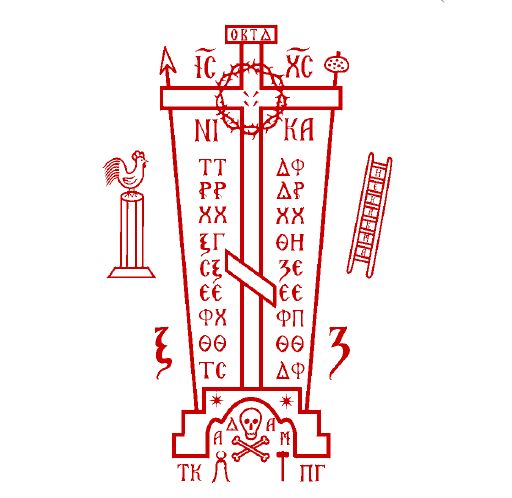
The άνάλαβος (Analab[v]os), which is the distinctive garment of a monk or a nun Tonsured into the highest grade of Orthodox monasticism, the Great Schema, is adorned with the instruments of the Passion of Christ. It takes its name from the Greek αναλαμβάνω (“to take up”), serving as a constant reminder to the one who wears it that he or she must “take up his cross daily” (St. Luke 9:23). The ornately-plaited Crosses that cover the Analabos. the Polystavrion (πολυσταύριον, from πολύς, “many,” and σταυρός, “Cross”)—a name often, though less accurately, also applied to the Analabos—reminds the monastic that he or she is “crucified with Christ” (Galatians 2:20):
With regard to each image on the Analabos, the rooster represents “the cock [that] crew” (St. Matthew 26:74; St. Mark 14:68 Luke 22:60; St. John 18:27) after Saint Peter had “denied…thrice” (St John 13:38) Him Who lamented over Jerusalem: “How often have gathered thy children together, even as a hen gathereth her chickens under her wings, and ye would not!” (St. Matthew 23:37)
The pillar represents the column to which Pilate bound Christ “when he…scourged Him” (St. Mark 15:15) “by Whose stripes we were healed” (Isaiah 53:5; I St. Peter 2:24).
The wreath garlanding the Cross represents the “crown of thorns” (St. Matthew 27:29: St. Mark 15:17; St. John 19:2. 5) that “the soldiers platted” (St. John 19:2) and “put upon…[the]…head” (St. Matthew 27:29) of “God our King of old” (Psalm 73:13), Who freed man from having to contend against “thorns…and thistles…in the sweat of …[his]…face” (Genesis 3:18-19).
The upright post and the traverse beam represent the stipes and the patibulum that formed “the Cross of our Lord Jesus Christ” (Gala-tians 6:14), upon which “all day long…[He] stretched forth…[His]… hands unto a disobedient and gainsaying people” (Isaiah 65:2; Romans 10:21).
The four spikes at the center of the Cross and the hammer beneath its base represent the “nails” (St. John 20:25) and hammer with which “they pierced” (Psalm 21:16; St. John 19:37) “His hands and His feet” (St. Luke 24:40). when they “lifted up from the earth” (St. John 12:32) Him Who “blott[ed] out the handwriting of ordinances that was against us…[by]…nailing it to His Cross” (Colossians 2:14).

The base upon which the Cross stands represents “the place, which is called “Calvary” (St. Luke 23:33), or “Golgotha, that is to say, the Place of the Skull” (St. Matthew 27:33), “where they crucified Him” (St. John 19:18) Who “wrought salvation in the midst of the earth” (Psalm 73:13).
The skull and crossbones represent “the first man Adam” (I Corinthians 15:45), who by tradition “return[ed] unto the ground” (Genesis 3:19) at this very spot, the reason that this place of execution, “full of dead men’s bones” (St. Matthew 23:27). became the place where “the last Adam was made a quickening spirit” (I Corinthians 15:45).
The plaque on top of the Cross represents the titulus, the “title” (St. John 19:19-20), with “the superscription of His accusation” (St. Mark 15:26), which “Pilate wrote” (St. John 19:19) “and set up over His head” (St. Matthew 27:37); however, instead of “Jesus of Nazareth the king of the jews” (St. John 19:19), which “was written over Him in letters of Greek, and Latin, and Hebrew” (St. Luke 23:38). the three languages being an allusion to the Three Hypostases “of the Father, and of the Son, and of the Holy Spirit” (St. Matthew 28:19), this titulus reads, “The King of Glory” (Psalm 23:7-10), “for had they known it. they would not have crucified the Lord of glory” (I Corinthians 2:8).
The reed represents the “hyssop” (St. John 19:29) upon which was put “a sponge full of vinegar” (St. Mark 15:36), which was then “put to His mouth” (St. John 19:29) when in His “thirst they gave… [Him]…vinegar to drink” (Psalm 68:21), Him of Whom it was said that “all…wondered at the gracious words which proceeded out of His mouth” (St. Luke 4:22).
The lance represents the “spear [that] pierced His side”; “and forthwith came there out blood and water” (St. John 19:34) from Him Who “took one of…[Adam's]…ribs, and closed up the flesh instead thereof (Genesis 2:21) and Who “washed us from our sins in His Own blood” (Apocalypse 1:5).
The plaque at the bottom of the Cross represents the suppedaneum of Christ, “His footstool” (Psalm 98:5), “the place where His feet have stood” (Psalm 131:7). It is slanted because, according to one tradition, at the moment when “Jesus cried with a loud voice, and gave up the spirit” (St. Mark 15:37), He allowed a violent death spasm to convulse His legs, dislodging His footrest in such a manner that one end pointed upwards, indicating that the soul of the penitent thief, Saint Dismas, “the one on His right hand” (St. Mark 15:27). would be “carried up into Heaven” (St. Luke 24:51), while the other end, pointed downwards, indicated that the soul of the impenitent thief, Gestas, “the other on His left” (St. Mark 15:27), would “be thrust down to Hell” (St. Luke 10:15), showing that all of us, “the evil and…the good. …the just and…the unjust” (St. Matthew 5:45), “are weighed in the balance” (Ecclesiasticus 21:25) of the Cross of Christ.
The ladder and the pincers beneath the base of the Cross represent the means of deposition by which Saint Joseph of Arimatruea, “a rich man” (St. Matthew 27:57) who “begged the body of Jesus” (St. Matthew 27:58; St. Luke 23:52), “took it down” (St. Luke 23:53), so that as in body He descended from the Cross, so in soul “He also descended first into the lower parts of the earth” (Ephesians 4:9), “by which also He went and preached unto the spirits in prison” (I St.Peter 3:19).
Through these instruments, “the Cross of Christ” (I Corinthians 1:17: Galatians 6:12: Philippians 3:18) became the “Tree of Life” (Genesis 2:9; 3:22, 24; Proverbs 3:18, 11:30, 13:12. 15:4; Apocalypse 2:7; 22:2, 14), by which the Lord Jesus reified His words that, “I am the resurrection, and the life: he that believeth in Me. though he were dead, yet shall he live: and whosoever liveth and believeth in Me shall never die” (St. John 11:25-26).
The Greek letters that appear on the Analabos are abbreviations of phrases that extol the Cross as “the power of God” (I Corinthians 1:18). From top to bottom:
ΟΒΤΔ Ό Βασιλεύς της Δόξης, __ “The King of Glory”
ΙC XC NIKΑ Ιησούς Χριστός νικά, ”Jesus Christ conquereth”
ΤΤΔΦ Τετιμημένον τρόπαιον δαιμόνων φρίκη,”Honored Trophy, the dread of demons”
ΡΡΔΡ Ρητορικοτέρα ρητόρων δακρύων ροή. ”A flow of tears more eloquent than orators” (or, more likely: Ρητορικοτέρα ρημάτων δακρύων ροή.”)
ΧΧΧΧ Χριστός Χριστιανοίς Χαρίζει Χάριν. ”Christ bestoweth Grace upon Christians”
ξΓΘΗ Ξύλου γεύσις θάνατον ηγαγεν, ”The tasting of the tree brought about death”
Cξζ∈ Σταυρού Ξύλω ζωήν εύρομεν, ”Through the Tree of the Cross have we found life
∈∈∈∈ Ελένης εύρημα εύρηκεν Εδέμ. ”The discovery of Helen hath uncovered Eden”
ΦΧΦΠ Φως Χριστού φαίνοι πάσι. “The light of Christ shineth for all”
ΘΘΘΘ Θεού Θέα Θείον Θαύμα, ”The vision of God, a Divine wonder”
ΤCΔΦ Τύπον Σταυρού δαίμονες φρίττουσιν. ”Demons dread the sign of the Cross”
ΑΔΑΜ Αδάμ, ”Adam “
ΤΚΠΓ Τόπος Κρανίου Παράδεισος γέγονε, ”The Place of the Skull hath become Paradise”
ξζ Ξύλον Ζωής, “Tree of life”
There are other items and abbreviations that may appear on the Analabos, but these are sufficient to demonstrate that this holy garment silently proclaims “the preaching of the Cross” (I Corinthians 1:18) through its mystical symbolism, declaring for its wearer, “God forbid that I should glory, save in the Cross of our Lord Jesus Christ, by Whom the world is crucified unto me, and I unto the world” (Galatians 6:14).
Hieromonk Gregory
St. Gregory Palamas Monastery

«Όλους τους πιστούς οφείλομε να τους βλέπομε σαν ένα και να σκεπτόμαστε ότι στον καθένα από αυτούς είναι ο Xριστός. Και να έχομε για τον καθένα τέτοια αγάπη, ώστε να είμαστε έτοιμοι να θυσιάσομε για χάρη του και τη ζωή μας. Γιατί οφείλομε να μη λέμε, ούτε να θεωρούμε κανένα άνθρωπο κακό, αλλά όλους να τους βλέπουμε ως καλούς. Kι αν δεις έναν αδελφό να ενοχλείται από πάθη, να μην τον μισήσεις αυτόν‡ μίσησε τα πάθη που τον πολεμούν. Kι αν τον δεις να τυρανείται από επιθυμίες και συνήθειες προηγουμένων αμαρτιών περισσότερο σπλαχνίσου τον, μην τυχόν δοκιμάσεις και συ πειρασμόν, αφού είσαι από υλικό που εύκολα γυρίζει από το καλό στο κακό. H αγάπη προς τον αδελφό σε προετοιμάζει ν' αγαπήσεις περισσότερο τον Θεό. Tο μυστικό, λοιπόν, της αγάπης προς τον Θεό είναι η αγάπη προς τον αδελφό. Γιατί, αν δεν αγαπήσεις τον αδελφό σου που τον βλέπεις πως είναι δυνατόν ν' αγαπήσεις τον Θεό που δεν Tον βλέπεις; «O γαρ μη αγαπών τον αδελφό αυτού, ον εώρακε, τον Θεόν, ον ούχ εώρακε, πως δύναται αγαπάν;»
Αγιος Πορφύριος
πηγη

-Elder,I often see and judge the failings and defects of others.
-Do you now what your illness is?
-No
-That's why you know the illness of others.If you knew your own illness,you wouldn't know the illness of others.I am not saying you shouldn't be concerned with their pain and suffering,but you mustn't preoccupy yourself with their faults.If a person is not concerned with his self,the tempter devil will lead him to be concerned with other people's faults.If we work on ourselves,then we know ourselves and come to know others as well.Otherwise,we judge others by wrong assumptions we make about ourselves.
-Elder,what helps the most in correcting ourselves?
-First of all,we need willpower.In a way,willpower provides the good foundation.Secondly,one must become aware that he is sick and take necessary antibiotic treatment;otherwise,if one is sick and hides the sickness,if he refuses to acknowledge it to himself and others, he will suddenly collapse one day before he realises it,and will already be beyond medical help.Let's say someone knows that he has a pretubercular condition that is causing his lack of appetite.People ask him,"Why don't you eat?""And he replies,Oh,I just don't like this food."Then he has aches and pains and can barely walk."Why are you walking like that?"they ask him.And he again says,"Oh,I like to go very slowly,why should i run like crazy."He doesn't admit to them or himself that he has aches and pains and can't walk.Then he has a cough." Why are you coughing?" "It's probably some allergy," he replies.Again,he won't admit that his lungs are a mess.In the meantime,he starts spitting blood but he still refuses to acknowledge his illness and says, "Oh,my throat must be sore!"
-And all this,Elder,simply because he refuses to acknowledge he has tuberculosis?
-Yes,he hides it and he hides from it.And while he is hiding it,he is gradually overtaken by full-scale tuberculosis.The lungs burst,he spits enough blood to fill buckets,then he collapses and the illness is exposed,but by then it is too late.But if he'd acknowledged the symptoms early on and accepted the necessary treatment,he'd have been healthier than the healthy.What I'm trying to say is that when it comes to the spiritual life,those who justify,hide or ignore their passions and faults,will in the end receive such demonic influence that they won't be able to hide.Have you any idea what it is like to accept demonic influence?One becomes like a wild beast,fiercely defensive,foul-mouthed,refusing any help from anyone.
This is why the starting point is for one not to be embarrassed,but to be gladly aware of his illness,his faults.From that point ,he must accept the necessary treatment,the appropriate medicines,and be grateful to his physicians-the Spiritual Father or the Elder-and not resist them.Look at how someone who's ill stretches out his arm to be given a blood transfusion,he's poked with the needle,it hurts,but he accepts the pain for the sake of his health.Or having an operation,we know how painful it is and yet we endure it for the sake of our health.
-Elder,when I know that a very strict remark will help me,why is it that i do not accept it gladly?
-Look,you may not be willing to accept it gladly,but do you at least realize that this is not right?
-Yes ,i do.
-Well then,if you realize it,that's something.You see,a person who is ill takes a pill that may be bitter as poison,but he accepts it better than candy,simply because he understands that it will help him.If we don't accept the bitter medicine,we can't expect to be cured.To be strengthened by Christ,one must recognize his weakness and take the medicine.
Taken from ELDER PAISIOS OF MOUNT ATHOS,Spiritual Counsels Vol3 "Spiritual Struggle"

We often have the impression that saints are sinless and infallible, but this is wrong.
People who are great and triumphant in a worldly way manage to seem infallible and sinless. At their every mistake, at their every failure, they put forth an effort to convince everyone that they are in fact correct. They refuse to accept their mistakes, or seek forgiveness, so that their image is not destroyed. They therefore keep a safe distance from others, to avoid being scrutinized.
The saint, however, does not have these fears. He knows very well that "saint" does not mean one who is sinless or infallible, but one who is repentant. For this reason he is not ashamed to admit his mistakes, to ask forgiveness, or to reveal his sinful self. Whereas a great person of this world has many things to hide, the saint has nothing to hide. And the more he is scrutinized, the more he gains. For this reason one admires the majesty of his soul, his genuineness.
Taken from The Blessed Surgeon: the life of Saint Luke Archbishop of Simferopol. p 98
http://agapienxristou.blogspot.ca/2013/06/are-saints-faultless-saint-luke.html

Have you noticed how often we find ourselves grumbling about this or that? It seems that it is our nature to complain about something.
Archimandrite Seraphim Aleksiev writes,
Grumbling is like the autumn hoarfrost which, when it falls, destroys all the labors of the gardener. Few people realize how bad grumbling is for the soul. Almost everyone considers it to a small sin, but even though it seems so, it has very grievous consequences. In the autumn before the hoarfrost falls, the experienced gardeners notice the signs of the coming cold weather and urge their young helpers to gather the peppers and the tomatoes. the young ones laugh: "Why should we gather them? the weather is still so nice!" Then the next morning they see th first frost has come over the gardens. they pick up a pepper and take a bite to taste it, but it is as bitter as poison and cannot be eaten. Thus their small carelessness has destroyed all their labors. In the same way grumbling withers all the virtues of the soul and makes bitter and useless the fruits of suffering.Why is this so dangerous? God gives us difficulties and problems to help us come closer to Him. This is His only aim. He wants us to be united with Him. But when something is not just how we like it, we grumble instead of giving thanks to God. You see, we turn away from Him rather than towards Him to seek strength and direction. This is the danger of all our grumbles. When we grumble we have separated ourselves from God. When we grumble we are not pleasant to others. As Alekiev says, "grumbling withers all the virtues of the soul."

Not grumbling, but patience in suffering––this is what God wants from us. "In your patience possess ye your souls" (Luke 21:19), the Savior has instructed us, because "we must through much tribulation enter into the kingdom of God" (Acts 14:22). Into this Kingdom of God one cannot enter with pride which teaches us to grumble, but with humility which makes us patient. There are no greater teachers of patience that sorrows. This is precisely why God sends us suffering: so that we will humble ourselves before Him. No one has been saved by pride, because "God resisteth the proud, and giveth grace to the humble" (1 Peter 5:5). The doors of the Kingdom of Heaven are too low and narrow for the proud to enter through them; only those humbled by the sufferings of life can go through them freely.
I cant tell you how often my wife and I will find ourselves in the car on the way to church grumbling about so many little things. When we are lucky, one of us catches our plight and says, "Let's thank God." This always awakens us to our sorrowful state.
A good exercise is to examine your grumbles––just for one day. Look at what it is you grumble about and reflect on why God set this discomfort in front of you. See if you can find a way to give thanks to God for all He sends you. How can you draw strength from your relationship with Him. I think you will find this to be a rewarding exercise.
Remember, God did not promises us that we would not have difficulties. But He did promise that He would give us help and comfort.
“In the world you have tribulation; but be of good cheer, I have overcome the world.” (John 16:33)
Ref: The Meaning of Suffering and Strife & Reconciliation, p 35, 39


