Οι θαυματουργικές ιδιότητες του Σταυρού
Το σημείο του Σταυρού και της ορθόδοξης χριστιανικής προσευχής είναι ικανά να σκοτώσουν μικρόβια, και να μεταβάλουν τις οπτικές ιδιότητες του νερού. Επιστήμονες έχουν αποδείξει πειραματικά τις θαυματουργικές ιδιότητες του σημείου του Σταυρού και της προσευχής.
Είναι διαπιστωμένο, το έχουμε ξαναπεί πολλές φορές εδώ στο pentapostagma.gr ότι η παλιά συνήθεια να γίνεται το σημείο του Σταυρού πάνω από το φαγητό και το ποτό πριν το γεύμα, έχει ένα προφανές μυστικό και αληθινό νόημα και αυτό δεν είναι άλλο από το μαρτύριο του Κυρίου μας Ιησού Χριστού. Πάνω στο Σταυρό έχυσε το Πανάγιο αίμα Του και με το μαρτύριο του μας έσωσε από την αιώνια καταδίκη. Πίσω από αυτό παραμένει η πρακτική χρησιμότητα με την οποία ασχολείται η επιστήμη.
Η τροφή κυριολεκτικά καθαρίζεται μέσα σε μία στιγμή. Αυτό είναι ένα μεγάλο θαύμα, που κυριολεκτικά συμβαίνει κάθε ημέρα” δήλωσε η φυσικός Angelina Malakhvskaya που προσκλήθηκε από την εφημερίδα Жизнь.
Η Malakhovskaya έχει μελετήσει την δύναμη του σημείου του Σταυρού με την ευλογία της Εκκλησίας, για 10 περίπου χρόνια τώρα. Έχει διεξάγει ένα μεγάλο αριθμό πειραμάτων που έχει επανειλημμένα επαληθευτεί, πριν τα αποτελέσματά τους έρθουν στην δημοσιότητα.
Ειδικότερα, έχει ανακαλύψει τις απαράμιλλες βακτηριοκτόνες ιδιότητες του νερού μετά την ευλογία του από μία ορθόδοξη προσευχή και το σημείο του Σταυρού. Η μελέτη επίσης αποκάλυψε μία νέα, ενωρίτερα άγνωστη ιδιότητα του λόγου του Θεού, να μετασχηματίζει την δομή του ύδατος, αυξάνοντας αξιοσημείωτα την οπτική του πυκνότητα στην περιοχή του φάσματος της βραχείας υπεριώδους ακτινοβολίας, γράφει η εφημερίδα.
Οι επιστήμονες έχουν επαληθεύσει την δύναμη της δράσης της Κυριακής προσευχής (Πάτερ ημών) και του ορθοδόξου σημείου του Σταυρού στα παθογενή βακτήρια. Δείγματα νερού από διάφορες δεξαμενές (πηγάδια, ποταμούς, λίμνες) πάρθηκαν για έρευνα. Όλα τα δείγματα είχαν goldish staphylococus, ένα κολοβακτηρίδιο. Αποδείχθηκε εν τούτοις, ότι αν η Κυριακή προσευχή λεχθεί και το σημείο του Σταυρού γίνει επάνω τους, ο αριθμός των βλαβερών βακτηριδίων θα μειωθεί επτά, δέκα, εκατό, ακόμη και πάνω από χίλιες φορές.
Τα πειράματα έγιναν με τέτοιο τρόπο, ώστε να αποκλείουν και την ελάχιστη πιθανή νοητική επιρροή. Η προσευχή ειπώθηκε και από πιστούς και από απίστους, αλλά ο αριθμός των παθογόνων βακτηρίων σε διαφορετικό περιβάλλον με διαφορετικές ομάδες βακτηρίων ακόμη και τότε μειώθηκε, συγκρινόμενος με τα πρότυπα αναφοράς.
Οι επιστήμονες απέδειξαν επίσης την ευεργετική επίδραση που η προσευχή και το σημείο του Σταυρού έχουν πάνω στους ανθρώπους. Όλοι οι συμμετέχοντες στα πειράματα είχαν την πίεση του αίματός τους να τείνει να σταθεροποιηθεί, και τους αιματικούς δείκτες βελτιωμένους. Κατά τρόπο εντυπωσιακό, οι δείκτες άλλαζαν προς την ίαση που χρειαζόταν. Στους υποτασικούς η αιματική τους πίεση ανέβηκε, ενώ στους υπερτασικούς κατέβηκε.
Επίσης παρατηρήθηκε ότι το σημείο του Σταυρού εάν γίνεται πρόχειρα, με τα τρία δάκτυλα βαλμένα μαζί απρόσεκτα η τοποθετούμενα εκτός των απαραιτήτων σημείων (στο μέσο του κούτελου, το κέντρο του ηλιακού πλέγματος, και στα κυκλώματα κάτω από το δεξί και αριστερό ώμο), το θετικό αποτέλεσμα ήταν πολύ πιο αδύνατο, η απουσίαζε εντελώς.
Έτσι γίνεται κατανοητό το αναλλοίωτο του αγιασμού, το ανέβασμα του ζυμαριού από τα σταυρολούλουδα. (λουλούδια του Επιταφίου), η διατήρηση φρέσκου του Πασχαλιάτικου αυγού μέχρι τον επόμενο χρόνο, όταν τοποθετείται στο εικονοστάσι. Η έρευνα επιβεβαιώνει τις θέσεις της αληθινής Ορθόδοξης Εκκλησίας.
http://agapienxristou.blogspot.ca/2014/10/blog-post_16.html

At a time when more and more people feel the need, because of the profound crisis affecting mankind, to deal with eschatological events as described in the Apocalypse of Saint John the Theologian, as well as those things revealed by the Grace of God to the Prophets, the Fathers of the Church and contemporary saintly elders like Elder Paisios, we must especially stand with the view of Elder Porphyrios, and decode why such a great Saint of our time, while knowing with precision and detail everything that we are living and where things come from, avoided talking about these things.
It must especially puzzle us why the Elder didn't speak at all about what is coming, but only revealed what was necessarily required for certain people.
The core thought of Elder Porphyrios was that people need to consolidate and grow in love towards their Creator, not through fear of things to come, but through a selfless relationship, as an affectionate father towards his child.
Because the unity that was the greatest legacy of Christ to His Apostles, can be ensured when the child is joined with his Father primarily through love and not fear.
Elder Porphyrios aptly likened the times we live in to the years just before Jesus came.
What existed then? A Roman "peace" in power and idolatry, and a priesthood alienated by the passion for power that was hypocritical without being beneficial, but rather distanced the people from God. And finally there was a small portion of pure and good people.
All this describes in detail what is going on today, and the repetition of this in our era should probably strongly trouble us.
Before Christ there existed prophecies about His coming as well as warnings for repentance to the people of God, as in the case of Jonah and Ninevah.
However, these prophecies were sent by God for those few good and pure people of each era, as I said before, because they had the goodwill to receive the messages and know what to do.
Elder Porphyrios acted with this in mind, calling people to approach Christ with love and not the fear of terrible events.
He knew but he did not say. He spoke laconically and in codes, understanding that in our era there was a great gap between the spirituality of people on Mount Athos with the outside world.
For this reason he sent a man to notify Elder Paisios to stop speaking about the Antichrist, the mark, imminent wars, etc.
Not because it was wrong that which was informed to Elder Paisios through Divine Illumination, but because the spiritual measure of the world is at such a level that fear has no practical effect and that the only approach needed was love for Christ.
For if man loved God, then God, when people change, will change history. The same happened with the imminent destruction of Ninevah.
The same Elder Porphyrios, during his last days, stressed the moral degradation and misery which we find ourselves in as people, and stressed to his spiritual children to find a verse in the Old Testament that says "You have a cloak, you be our leader" (Is. 3:6).
There we were told describes clearly the current situation. The same situations of "old Israel" with the "new Israel" and the same symptoms.
The "old Israel" lost its unity with God and the "new Israel" lost exactly this path of unity with Christ.
This was the great longing of the Elder and he served it literally till his last breath.
The Hierarchical Prayer of Christ, "that all may be one", was what the Elder served as long as he lived and he slept with it on his lips. Because he knew that when mankind is ensured with unity with Christ, then they will fear neither wars nor the Antichrist.
In contrast, today we approach evil and examine those things that are coming as an inevitable evil. Here we lose the entire essence.
Wars, calamities and upcoming events are the ultimate remedy to human apostasy, which is why Elder Porphyrios would say: "The Apocalypse was written for it not to happen".
The Apocalypse has as its purpose to alert, and the way to avoid it is to serve the unity which Christ left to us as a legacy.
This is the therapeutical treatment to the sick, because if the sickness progresses, the events of the Apocalypse will be the amputation caused by the physician when gangrene sets.
The Elder would say: "Our time is like the time of Christ. Then the world had reached a terrible state. But God spared us. And now we must not despair. I see through the calamity to appear some very important person of God, who will rally and unite the world for good."
It was one of the few occasions when the Elder spoke about that which we are living and is upcoming. He stressed that the justice of God is changing and that our situation is miserable.
But he saw that the mercy of God will once again visit mankind. Elder Paisios said the same thing when visitors approached him with evident anxiety about upcoming events and when he was asked when the wrath of God will come. He would say: "We need to ask that His mercy comes, not His wrath."
This is what humanity needs and this is how we must approach what the Saints told us. That which was prophesied in our time are for those few who, like before the time of Christ, have the goodwill to serve their unity in Christ.
The tabloids, the foreign press, the electronic media channels deal systematically with what Elder Paisios and other contemporary elders said. I don't know if they do it for the sake of advertising, trade, etc. But we must think. We must think to look for the substance in all this.
In 2009 while visiting Russia, as part of the effort of issuing the letters of the first Ruler of Greece, Ioannis Kapodistrias, we met with senior officials of the Russian Federation. With surprise I heard a question that relates to all of the above.
He asked me:
"Elder George, the fathers of Mount Athos say there will be a war between Russia and Turkey for Constantinople. What do you say about this?"
I answered him without thinking, in a way I believe Elder Porphyrios would answer:
"Saint Kosmas Aitolos, who is a great Saint of Orthodoxy, said: 'They will try to resolve it with the pen, but will not be able to. 99 times with war, and once with the pen.' However, us, we are with the pen," I said.
The Greeks I believe had the blessing to be sent by God a revealing personality like Elder Porphyrios to show us the way and the path to avoid calamities and difficulties.
It is up to us to manage the legacy he left to us, and not wait for the ship to collide with the iceberg.
If each of us acts alone and cut off from Christ, it is certain that we will say that which the Holy Elder said: "He may, however, according to the plan of God, come; to come so that people can acquire an awareness, to see the chaos alive in front of them, and to say: 'Oh, we are falling into chaos, we are being lost. Everyone back, everyone back, turn back, we have been deluded.' And they will return again to the path of God and the Orthodox faith will shine."
The last days of Elder Porphyrios were the most revealing for his spiritual children and for all of humanity. The Elder gathered us in his Cell in Kaufsokalyvia and told us: "I don't like to prophesy, but I will tell you one prophecy."
The Elder told us about what will happen in Greece and what its future will be. It was revealing for the future of Greece. All of these have now begun to be realized. Today we are living all that he told us and began to take place with exactitude.
The greatest revelation of God was the last night of his life, when for a half hour he prayer the Hierarchical Prayer of Jesus: "That all may be one".
The same Holy Spirit prayed within Elder Porphyrios for the unity in Christ of all Christians and for all of humanity, so that the sufferings of the Apocalypse would not come.
This prayer is the greatest legacy of Christ to humanity. May the unity of humanity with God materialize.
This legacy today, 21 years after the repose of Elder Porphyrios, remains alive and is depicted in an icon: the Panagia "That All May Be One" Patriotissa, a prophetic and escatological icon, which all of Christendom knows.
We his children serve today this legacy and hope in it.
Saint Porphyrios

Αν ξύπνησες σήμερα το πρωί με περισσότερη υγεία παρά αρρώστια, είσαι πιο προνομιούχος από ένα εκατομμύριο ανθρώπους που δεν θα επιζήσουν μέχρι το τέλος της εβδομάδας.
Αν δεν έχεις ζήσει ποτέ τον κίνδυνο της μάχης, την μοναξιά της φυλάκισης, την αγωνία των βασανιστηρίων η την πείνα, είσαι πιο καλά από 500 εκατομύρια ανθρώπους στον κόσμο.
Αν μπορείς να πας στην εκκλησία, δίχως τον φόβο της τιμωρίας, της σύλληψης, των βασανιστηρίων η του θανάτου, είσαι πιο προνομιούχος από τρία δισεκατομύρια ανθρώπους στη γη.
Αν έχεις φαγητό στο ψυγείο σου, αν φοράς ρούχα, αν είσαι κάτω απο μια στέγη και ένα κρεβάτι για να κοιμηθείς, είσαι πιο πλούσιος από το 75% των κατοίκων της γης.
Αν έχεις χρήματα στην τράπεζα, μέσα στο πορτοφόλοι σου, και μπορείς να δώσεις έστω και ψιλά σε κάποιον, είσαι ανάμεσα στο 8% των πιο πλούσιων ανθρώπων της γης.
Αν οι γονείς σου ζουν και είναι ακόμα παντρεμένοι, είσαι πολύ σπάνιος.
Αν μπορείς να κρατήσεις το χέρι κάποιου, να τον αγκαλιάσεις, αλλα ακόμα να τον αγγίξεις στον ώμο, είσαι ευλογημένος επειδή μπορείς να προσφέρεις ένα θεραπευτικό άγγιγμα.
Αν διαβάζεις αυτές τις λέξεις, ήδη έχεις άλλη μια ευλογία επειδή δύο δισεκατομύρια άνθρωποι στον κόσμο δεν μπορούν να διαβάσουν.
Αν σηκώνεις το κεφάλι σου με χαμόγελο και είσαι πραγματικά ευγνώμων, είσαι ευλογημένος, επειδή η πλειονότητα των ανθρώπων μπορεί να το κάνει, αλλά οι περισσότεροι δεν το κάνουν.
http://agapienxristou.blogspot.ca/2013/10/blog-post_9848.html
 Η Τουρκία είναι σαν την αλεπού. Όλο πονηριές κάνει. Όταν καταλάβει ότι έχουν στήσει δόκανα για να την πιάσουν, αρχίζει να πηδάει και με τα τέσσερα πόδια κι έτσι πιάνεται και με τα τέσσερα. Αυτό θα πάθει και η Τουρκία.
Αγιος Παϊσιος
Ο διάβολος πολεμάει τους πιστούς με τον οικουμενισμό, τούς πλούσιους με τον μασονισμό και τούς πτωχούς με τον κομμουνισμό”, παρετήρησε ο γέρων..
Αγιος Παϊσιος
 The video recording from which this transcript was taken was made almost twenty-nine years ago, on May 18, 1987. In those days, in connection with the millennial of the Baptism of Russia, international conferences were held in the Publishing Department of the Moscow Patriarchate. On that day, Metropolitan Anthony (Bloom) of Surouzh appeared with his famous report, “Spirituality and the Role of a Spiritual Father.” His talk was unforgettable for both its essence and the power of its pastoral word. The videotape of this film that I made after Metropolitan Pitirim had given me my own wonderful video camera was recently unearthed, and I was filming everything I could get my hands on. I needed experience, and that is how this film came into being. The films were somewhat mediocre, but I am just happy that they were preserved. How is it that this tape was not lost? If I find the time, I will be looking for other interesting films, and I will definitely put them on our website. Archimandrite Tikhon (Shevkunov) * * * I should first of all ask forgiveness for not having a text for this talk; am hoping in the prayers of some of you here that this talk will turn out well today. The theme of my talk is spirituality and the role of a spiritual father, or if you prefer, spiritual nourishment, or care of souls. I would first like to define the word “spirituality”. Usually when we talk of spirituality, we are talking about specific religious expressions of our spiritual life—such as prayer and ascetic struggles (podvigs); this is all clearly expressed in such books as those of St. Theophan the Recluse, for example. Just the same, it seems to me that in speaking of spirituality, we have to remember that spirituality consists in what the movement of the Holy Spirit works in us, and what we usually call spirituality is the manifestation of this mysterious movement of the Holy Spirit. This places us in a very specific position with regard to the role of a spiritual father, because we are thus not educating a person according to one or another principle or teaching him how to grow in prayer or asceticism along the lines of a template. The role of a spiritual father does not consist in this, but rather in the fact that regardless of his spiritual level, the spiritual father must pay sharp attention to what the Holy Spirit is bringing to pass in a person and enable this process, protect him from temptations, falls, or wavering in his faith. As a result, the work of a spiritual father may seem on the one hand much less active, but on the other hand much more significant than we often think. I would like to say a couple of words before going on about how the role of a spiritual father is not an unambiguous concept. There are, as it seems to me, three degrees, or three types of spiritual fathers. On the one hand, on the very basic level, he is a priest to whom is given the grace of the priesthood, which consists not only in the right, but also the grace-filled power to serve the sacraments—the Eucharist, Baptism, and Chrismation, and also Confession, which is peace-making between man and God. There is great danger lurking for a young, inexperienced priest, just graduated from seminary full of enthusiasm and hope, who imagines that ordination has given him intelligence, experience, and “discernment of spirits”, and then becomes what in ascetical literature is called a “young elder”. We are talking about young men who have not yet reached spiritual maturity, do not yet possess even the knowledge that comes with basic personal experience, but who think that they have been taught everything needed to help take a repentant sinner by the hand and lead him from earth to heaven. Unfortunately this happens all too often, in all different countries: a young priest, by virtue of his priesthood—not because he is spiritually experienced, not because God had led him to it—begins to direct his spiritual children and command them: Don’t do this; do that; read this or that spiritual literature; go to church; make prostrations… As a result, his victims become caricatures of spiritual life, doing everything that the ascetics of piety did. However, the ascetics of piety did all this out of their spiritual experience, and not because they were trained animals. For the spiritual father this is a catastrophe, because he has intruded upon a realm where he has neither the right nor the experience to intrude. I emphasize this because it is an essential matter for a priest. One becomes an elder only by God’s grace; it is a charismatic phenomenon, a gift. A person cannot learn how to be an elder no more than he can choose to be a genius. We can all dream of becoming geniuses, but we know perfectly well that Beethoven or Mozart, Leonardo da Vinci or Andrei Rublev possessed genius that cannot be learned in any school, not even through long experience, and which is a divine gift of grace. I am belaboring this point, perhaps for too long, because it seems to me to be an essential theme, here in Russia perhaps even more that in the West, because the role of a priest here is much more central. Often priests who are young, either in years or in spiritual maturity or immaturity, direct their spiritual children instead of cultivating them. Cultivating them means treating them and working with them as a gardener would with flowers or other plants. He has to know the soil, the nature of the plant, the climactic or other conditions they are set in, and only then can he help. And help is all he can do, because one or another plant can only grow into what it should be by nature. We should never break a person in order to make him like ourselves. One religious writer in the West said: A spiritual child can only be brought to his own self, and the road in his life can be very long. If you read the lives of the saints you will see how great elders were able to do this, how they were able to be themselves, but also see in another person his exclusive, inimitable qualities, and to give that person—and another, or a third person—the opportunity to also be himself and not a replica of an elder; or in the worse case, a cookie-cutter repeat. Take an example from the history of the Russian Church, the meeting of Saints Anthony and Theodosius of the Kiev Caves. Anthony was Theodosius’s spiritual father, but their lives were completely different in the sense that St. Anthony was a recluse while Theodosius was a founder of coenobitic life. One might ask, how could St. Anthony prepare Theodosius to do what he himself would not do, to become a man that he himself did not want to be, to fulfill a divine calling entirely different from his own? It seems to me that here we can clearly discern the difference between the desire to make a person like ourselves and the desire to make him like unto Christ. As I have said, eldership is a gift of grace, it is spiritual genius, and therefore none of us can think about behaving the way an elder would. But there is a middle realm—spiritual fatherhood. Very often, just because both young and not so young priests are called “father”, they imagine that they are not only confessing priests, but true fathers in the sense that the Apostle Paul said of himself in the Epistles: “You have many schoolmasters, but I have given birth to you in Christ.” St. Seraphim of Sarov said the same thing in his time. Fatherhood consists in a person—and he or she may not even be a priest—giving another person birth to spiritual life. Looking at his spiritual father, that person saw, as the old saying goes, the radiance of eternal life in his eyes, and therefore was able to approach him and ask him to be his instructor and guide. The second thing that distinguishes a father is that a father is as if of the same blood and spirit as his disciple; and he can guide his disciple because there is not only a spiritual but also a psychological resonance between them. Probably you remember how the Egyptian desert was once filled with ascetics and instructors, but people did not choose their instructors according to signs of his glory. They did not go to the one about whom they had heard the best reports, but rather sought out instructors who they understood, and who understood them. This is very important, because obedience does not mean blindly doing what someone who has either material-physical or emotional-spiritual authority over us says. Obedience is when a novice has chosen an instructor whom he trusts unconditionally, in whom he finds what he has sought for. He hearkens not only to his every word, but even his to tone of voice, and tries through all of what manifests the elder’s personality and his spiritual experience to re-cultivate himself, to partake of that experience and become a human being who has grown beyond the limits of what he could have done by himself. Obedience is first and foremost a gift of hearing—not only with the mind, or with the ear, but with one’s whole being, with an open heart; a reverent contemplation of the spiritual mystery of another human being. On the part of the spiritual father, who has perhaps given you birth or received you already born but became a father to you, there should be a deep reverence for what the Holy Spirit is working within you. A spiritual father, just as the simple and ordinary, commonplace priest, should be in a condition to see the beauty of God’s image in a person that cannot be taken away. (This condition often takes effort, thoughtfulness, and reverence for the person who comes to him.) Even if a person is marred by sin, the priest should see an icon in him that has been harmed either by conditions in life, from human neglect, or blasphemy. He should see an icon in him and have reverence for what has remained of this icon; and only for the sake of this, for the sake of the divine beauty within that person, he should labor to remove everything that deforms that image of God. When Fr. Evgraf Kovalevsky was still a layman, he once said to me that when God looks at a human being, He does not see the virtues that he may lack, or the successes he has not attained—He sees the unshakeable, radiant beauty of His own Image. Thus, if a spiritual father is incapable of seeing this eternal beauty in a person, to see the beginning of the process of fulfilling his call to become a God-man in the image of Christ, then he is not capable of leading him, for people are not built or made. They are only aided in their growth according to the measure of their own calling. At this juncture, the word “obedience” calls for a bit of an explanation. Usually we talk about obedience as submission, being under authority, and often as a kind of enslavement to a spiritual father or a priest whom we call our spiritual father or elder—not to own our detriment only, but also to his. Obedience consists in, as I have said, hearing with all the powers of our soul. However, this obligates both the spiritual father and the “listener” equally, because a spiritual father should also be listening with all his experience, all his existence, and all his prayer. I will even go further to say that that he should listen with all the power of the Holy Spirit working in him to what the Holy Spirit is bringing to pass in the person entrusted to his care. He should know how to search out the paths of the Holy Spirit in him, to be in awe before what God is doing, and not bring him up according to his own image or how he thinks he should develop, making him a victim of his spiritual guidance. This also requires that both have humility. It is easy and expected for a spiritual child to have humility. But what humility a priest or spiritual father must have in order not to intrude upon that sacred realm, to treat a person’s soul in the way that God commanded Moses to treat the ground surrounding the Burning Bush! Every human being—potentially or actually—is that very Bush. Everything surrounding him is sacred ground upon which the spiritual father may step only after removing his shoes, never stepping in any other way than that of the publican who stood in the back of the temple, looking in and knowing that this is the realm of the Living God, that this is a holy place, and he has no right to enter unless God Himself commands him, or as God Himself suggests he proceed or what words to say. One of the tasks of a spiritual father consists in educating a person in spiritual freedom, in the royal freedom of God’s children. He must not keep him in an infantile state all his life, running to his spiritual father over every trifle, but growing into maturity and learning how to hear what the Holy Spirit is wordlessly speaking to him in his heart. Humility in Russian means a state of being at peace, when a person has made peace with God’s will; that is, he has given himself over to it boundlessly, fully, and joyfully, and says, “Lord, do with me as Thou wilt!” As a result he has also made peace with all the circumstances of his own life—everything for him is a gift of God, be it good or terrible. God has called us to be His emissaries on earth, and He sends us into places of darkness in order to be a light; into places of hopelessness in order to bring hope; into places where joy has died in order to be a joy; and so on. Our place is not necessarily where it is peaceful—in church, at the Liturgy, where we are shielded by the mutual presence of the faithful—but in those places where we stand alone, as the presence of Christ in the darkness of a disfigured world. On the other hand, if we think about the Latin roots of the word humility, we see that it comes from the word humus, which indicates fruitful earth. St. Theophan writes about this. Just think about what earth is. It lies there in silence, open, defenseless, vulnerable before the face of the sky. From the sky it receives scorching heat, the sun’s rays, rain, and dew. It also receives what we call fertilizer, that is, manure—everything that we throw into it. And what happens? It brings forth fruit. And the more it bears what we emotionally call humiliation and insult, the more fruit it yields. Thus, humility means opening up to God perfectly, without any defenses against Him, the action of the Holy Spirit, or the positive image of Christ and His teachings. It means being vulnerable to grace, just as in our sinfulness we are sometimes vulnerable to harm from human hands, from a sharp word, a cruel deed, or mockery. It means giving ourselves over, that it be our own desire that God do with us as He wills. It means accepting everything, opening up; and then giving the Holy Spirit room to win us over. It seems to me that if a spiritual father would learn humility in this sense—seeing the eternal beauty in a person; if he would know his place, which is nothing other (and this is a place that is so holy, so wondrous) than the place of a friend of the bridegroom, who is appointed to safeguard the meeting of the bride—not his own bride—with the Bridegroom. Then the spiritual father can truly be a travelling companion to his spiritual child, walk with him step by step, protect him, support him, and never intrude upon the realm of the Holy Spirit. Then the role of the spiritual father becomes a part of that spirituality and that maturing into the sanctity to which each of us is called, and which each spiritual father should help his spiritual children attain. Metropolitan Anthony of Sourozh

O Lord God, Great and Eternal King! Send, O Lord, Thy Archangel
Michael to help Thy servant (name), and to deliver me from all my enemies, visible and invisible.
O Archangel Michael, angel of the Lord and vanquisher of demons! Suppress all my combatants, make them meek as sheep, and disperse them like dust before the wind.
O great Michael, Archangel of the Lord, six-winged high prince, leader of the heavenly host, the Cherubim and the Seraphim! O kind Archangel Michael, be my helper in all offenses, sorrows and woes, in the desert, at the crossroads, be a safe haven on rivers and seas. Deliver me, O great Archangel Michael, from all the temptations of the demons, when they hear me, thy sinful servant (name), praying to thee, and calling upon thee, and entreating thy holy name: hasten to assist me and heed my prayer.
O great Archangel Michael! Vanquish all my opponents by the power of the Holy and Life-giving Heavenly Cross of the Lord, by the prayers of the Most-holy Theotokos and the holy apostles, the holy prophet of God Elias, Saint Nicholas the wonder worker, Saint Andrew the fool-for-Christ, the holy great martyrs Nikitas and Eustace, the venerable fathers and holy hierarchs, martyrs, and all the heavenly host. Amen.
Whosoever reads this ancient prayer – on that day will he be touched neither by the devil, nor by any evil man, nor will any temptation seduce his heart. If he should pass from this life – hell will not take in his soul.

"Μόλις ο άνθρωπος πεθάνει, το σώμα του γίνεται λείψανο. Τότε αυξάνει και ο σεβασμός μας σ΄αυτό. Το λείψανο αποτελεί την ανάμνηση μιας ιερουργίας που μέσα του επιτελείτο - της σωτηρίας της ψυχής- και την υπόμνηση μιας άλλης που τώρα "αγνώστως" συνεχίζεται έξω από αυτό- της δόξης της ψυχής. Το σώμα δεν περιμένει την καταστροφή του, αλλά την "ετέρα μορφή του"(Μάρκ. ιστ΄12), την αναμόρφωσή του "εις το αρχαίον κάλλος". Αυτή είναι η αιτία που η Εκκλησία προσεγγίζει το σώμα με ιδιαίτερο σεβασμό και αισθήματα ιερά. Δεν καίμε τους ναούς, πολλώ δε μάλλον τους έμψυχους ναούς.
Αυτό βέβαια δεν σημαίνει ότι το σώμα είναι κάτι που δεν εγγίζεται και στο οποίο αρνούμεθα κάθε παρέμβαση. Το σώμα είναι το υποκείμενο στη φθορά στοιχείο του ανθρώπου Η φυσική φθορά είναι η ισχυρότερη ίσως υπόμνηση της πτωτικής μας φύσεως. Κάθε βίαιη κίνηση που συνηγορεί στη συρρίκνωσή του, προσβάλλει και την ψυχή. Για τον λόγο αυτό, στο σώμα παρεμβαίνουμε μόνο θεραπευτικά, αναστέλλοντας την εξέλιξη της φθοράς, όταν και οδό μπορούμε. Η διαδικασία της πρέπει να είναι εντελώς φυσική και ποτέ εξαναγκασμένη. Την αναλαμβάνει μόνον ο Θεός μέσα από τις συνθήκες που ο ίδιος προνοεί ή η φύση μέσα από την ευθύνη που της έχει ανατεθεί. Αυτός είναι ένας άλλος λόγος που η Εκκλησία μας αρνείται την καύση των νεκρών. Αφήνει στη φύση να αναλάβει την ευθύνη της φθοράς του σώματος. Δεν το καίει, αλλά το αφήνει να σβήσει. Αυτό σημαίνει ότι από τη στιγμή που η φύση επιτρέπει να μείνει κάποιο υπόλειμμα, αυτό έχει το λόγο του. Όταν και η φύση αρνείται την ολοσχερή διάλυσή του ανθρωπίνου σώματος, τότε η νομοθετημένη καύση του δεν είναι πράξη επιλήψιμης βίας;
Οι νεκροί δεν είναι "πεθαμένοι" αλλά κεκοιμημένοι. Τοποθετούνται με σεβασμό στον τάφο, στραμμένοι προς ανατολάς με την προσδοκία της αναστάσεώς τους. Η Εκκλησία συνειδητά αρνείται τον όρο "νεκροταφεία" και επιμένει στον όρο "κοιμητήρια". Και το κάνει αυτό όχι για λόγους ψυχολογικού -για να μην αγριεύουμε- αλλά για λόγους καθαρά πνευματικούς: νεκρός δεν σημαίνει τελειωμένος (που έχει τελειώσει) αλλά τετελειωμένος (που έχει τελειωθεί). Τέλος δεν σημαίνει λήξη, αλλά τελείωση. Τα οστά των νεκρών αποτελούν ανάμνηση της παρελθούσης ζωής τους, ενθύμηση της παρούσης καταστάσεως τους, αλλά και υπόμνηση της μελλούσης προοπτικής μας. Αυτά με κανένα νόμο δεν καίγονται.
Η Εκκλησία δεν τιμά το σώμα και χωριστά την ψυχή, αλλά τον σύνδεσμο των δύο, τον άνθρωπο ως όλον. Στον κίνδυνο να ξεχαστεί ο άνθρωπος, επειδή δεν φαίνεται η ψυχή του, διατηρούμε το σώμα, που δεν μας την θυμίζει μόνο όταν λειτουργεί αλλά και όταν απλά υπάρχει. Η οριστική καταστροφή του σώματος, η καύση του, δεν είναι καύση νεκρού ανθρώπου -κάτι που καίγεται - αλλά προσπάθεια καύσης της ζωντανής ψυχής του, κάτι που δεν καταστρέφεται.
Η ψυχή ζει. Αυτό φαίνεται από το ότι τα λείψανα έχουν ζωή όχι βιολογική βέβαια αλλά κάποιας μορφής πνευματική, που όμως διαπιστώνεται. Όταν έχουμε άτομα που η βίωσή τους της πνευματικής πραγματικότητος ήταν τόσο έντονη ώστε και από τότε που ζούσαν εν χρόνω την παχύτητα αυτού του κόσμου, αυτά να λειτουργούν στις συχνότητες του άλλου, τότε ο θάνατός τους είναι κοίμηση που αποτυπώνεται στα λείψανά τους. Είναι πολύτιμη εμπειρία της Εκκλησίας, διαρκώς επαληθευόμενη, ότι πλείστα όσα εξ αυτών εμφανίζουν ιδιάζουσα χάρι. Είναι γνωστό ότι συχνά τα λείψανα των αγιορειτών μοναχών αλλά και των άλλων εξαγιασμένων ανθρώπων που η ζωή τους τίμησε το σώμα και η ψυχή τους φανέρωσε μεγαλύτερη ευρωστία και ζωτικότητα από αυτό, διατηρούν μια εντυπωσιακή ευκαμψία για ώρες μετά θάνατον. Δεν κοκαλώνουν!
Αλλά και η αποδεδειγμένη ευωδία, το κέρινο χρώμα τους, η θαυματουργική χάρι τους ή η φυσική αφθαρσία ολόσωμων αγίων, στοιχεία ασυνήθη και φυσικώς ανεξήγητα, είναι αναμενόμενα φαινόμενα της πνευματικής πραγματικότητος. Αυτά τα λείψανα, για την ορθόδοξη εκκλησιαστική παράδοση και συνείδηση, αποτελούν περιουσία πολυτιμότερη και από τη διδασκαλία της θησαυρούς αναγκαιότερους και από τα σκεύη της. Στα λείψανα των μαρτύρων της εδράζονται οι άγιες τράπεζες της. Αν αυτά κάψει θα έχει ήδη θυσιάσει τα ιερά θυσιαστήριά της θα έχει καταστρέψει τα ζωτικά σπλάχνα της.
Αν μας ρωτούσαν πως θα προτιμούσαμε να φύγει απ΄ αυτόν τον κόσμο κάποιος δικός μας: από εγκεφαλική αποπληξία, από καρδιακή ανακοπή, με παραμορφωτικά εγκαύματα, ή να αποτεφρωθεί από ανάφλεξη και πυρκαγιά, έχω την εντύπωση πως ο τραγικότερος τρόπος θα ομολογούσαμε πως είναι ο τελευταίος.

Ο Χριστός στον Άδη, ανάμεσα στους νεκρούς, αφού πέθανε στο σταυρό και πριν την ανάστασή Του. Από εκεί τους πήρε και τους ανέβασε στον (πνευματικό) ουρανό, όπου περιμένουν την ανάστασή τους στη δευτέρα παρουσία. Από το άρθρο Τα πνεύματα των νεκρών και εμείς.
Είναι φυσικό στον άνθρωπο, όταν αποχαιρετά τον άνθρωπό του, να θέλει να αντικρύσει για τελευταία φορά την οικεία σ΄αυτόν όψη και όχι το αποτρόπαιο κατάντημά του σε απάνθρωπη, ανοίκεια και απρόσωπη στάχτη. Η λεπτή αγάπη των στιγμών εκείνων εκφράζεται ως ανάγκη να αγκαλιάσει κανείς, να φιλήσει, να χορτάσει το βλέμμα του, να εκδηλωθεί τρυφερά πάνω στο άψυχο σώμα. Αν μας πληγώνει η βία της φύσεως, πώς εμείς επιλέγουμε τη βία του αυτεξουσίου μας; Όταν κάτι είναι πολύτιμο και το χάνουμε, προσπαθούμε να κρατήσουμε όσο περισσότερο απ΄αυτό μπορούμε. Ποτέ δεν νομοθετούμε τη βίαιη μείωση του τελευταίου ανεκτίμητου υπολείμματός του.
Η απόφαση ότι δεν έχουμε χώρο στα κοιμητήριά μας ισοδυναμεί με προσβολή. Αν δεν έχουμε, να δημιουργήσουμε χώρο. Η αγάπη δημιουργεί και χώρο και προϋποθέσεις. Η χρηστική ανάγκη ποτέ δεν είναι ουσιαστική και πάντα πιστοποιεί τη στενότητα του καρδιακού χώρου. Η ανάγκη του σεβασμού είναι πολύ μεγαλύτερη γι΄αυτόν που τον εκχωρεί παρά γι΄αυτόν που αποδέχεται.
Έτσι που βαδίζει η κοινωνία μας δεν θα έχει μόνον έλλειψη χώρου, αλλά και ανθρώπους δεν θα βρίσκει για να θάψουν, ίσως και να κάψουν, τους νεκρούς της. Στο απέραντο γηροκομείο του "πολιτισμένου" κόσμου μας, όπου οι νέοι τείνουν να γίνουν πολύ λιγότεροι από τους ηλικιωμένους και οι γεννήσεις πολύ πιο σπάνιες από τους θανάτους, θα υπάρχουν νεκροί και όχι νεκροθάφτες. Αντί να ενδιαφέρεται η κοινωνία μας για την αρχή της ζωής, π.χ. το δημογραφικό πρόβλημα, υπεραπασχολείται με το τέλος, την καύση. Η ίδια νοοτροπία που αποφεύγει, τη γέννηση, δηλαδή τη ζωή, αυτή που απορρίπτει και τους γέρους, αυτή που προτείνει την ευθανασία, αυτή που η ίδια δεν αντέχει και τους νεκρούς αρνείται τη δημιουργία και επιλέγει την καύση. Αυτή υπογράφει το οριστικό τέλος του τέλους το τέλος του σκοπού το τέλος του ανθρώπου.
Η κοινωνία με την καύση των νεκρών προσυπογράφει το δικό της τέλος. τον μηδενισμό της. Μια κοινωνία που δεν αντέχει τον άνθρωπο ούτε στην ασθένειά του, ούτε στην αδυναμία του, ούτε στον θάνατό του, μια κοινωνία που καίει τους νεκρούς της, μια κοινωνία που καταστρέφει και την ανάμνηση της ζωής και την ενθύμηση των μελών της -αυτό είναι τα λείψανα- μια κοινωνία που κάνει την αρχή του ανθρώπου τεχνητή και μηχανική και το τέλος του οριστικό και αμετάκλητο, μια κοινωνία που αρνείται την πνοή του αιώνιου και εγκλωβίζεται στην ασφυξία του εφήμερου, τι σχέση μπορεί να έχει αυτή η κοινωνία με τη ζωή; Ακόμη και οι άθεοι υπογράμμιζαν την ανάμνηση των επίγειων θεών τους με ταριχεύσεις των σωμάτων τους (περίπτωση Λένιν) ή όπου αυτό δεν ήταν δυνατόν με κατασκευές αγαλμάτων και ψεύτικων ομοιωμάτων.
Κατόπιν τούτων, δεν είναι ότι δεν της επιτρέπεται, αλλά η Εκκλησία αδυνατεί και αρνείται να δεχθεί μια απλά χρηστική και καθόλου πειστική λύση ελάσσονος πρακτικής βαρύτητος και να θυσιάσει το βίωμα του σεβασμού της στη θεϊκότητα του προσώπου του κάθε ανθρώπου, πολλώ μάλλον του ανθρώπου που αυτή βάφτισε στη κολυμβήθρα της τιμώντας ταυτόχρονα και την ψυχή και το σώμα του. Το μείζον δεν μπορεί να υποταχθεί στο έλασσον. Είναι αδύνατον όποιος πιστεύει στην Εκκλησία και αποδέχεται την πρόταση ζωής της, όποιος ζει την πραγματικότητα της ψυχής, όποιος σέβεται τον άνθρωπο να μην τιμά και το σώμα. Το σώμα χρήζει μεγαλύτερης τιμής και σεβασμού από την κοινωνία μετά θάνατον απ' όση περιποίηση και προστασία δέχθηκε από τον ίδιο τον άνθρωπο κατά τη διάρκεια της ζωής του.
http://agapienxristou.blogspot.ca/2013/10/blog-post_2.html

An icon is an image, but an image which is meant to be a statement of faith. It is a statement of faith in line and colour as definite, as completely rooted in the faith and experience of the Orthodox Church as any written statement and in that respect icons must correspond to the experience of the total community, and the artist who paints them is only a hand, only one who puts into line and colour what is the faith and the knowledge of the Christian body in the same way in which a theologian is the expression of his Church, and the Church has a right to judge him. That explains why one of the rules given to icon-painters when they learn their trade is that they should neither copy slavishly an icon painted before them, nor invent an icon. Because one can not identify slavishly with the spiritual experience expressed by another person, on the other hand, one cannot invent a spiritual experience and present it as though it was the faith of the Church.
Now, an icon is a proclamation of faith primarily, in the sense that an icon of Christ, an icon of the Mother of God or of saints is possible only since the Incarnation because they all relate to the Incarnation and its consequences. The Old Testament taught us that God can not be represented because indeed, the God of the Old Testament was the Holy One of Israel, He was a spiritual Being that has revealed Himself but had never been visibly present face to face with anyone. You remember the story of Moses on Sinai when he asked God to allow him to see Him and the Lord answered, “No man can see My face and live.” And He allowed Moses to see Him moving away from him, as it were, from the back but never meet Him face to face. It is in Incarnation, through the historical fact that God became man, that God acquired a human face and that it became possible by representing Christ, the incarnate God to represent indirectly God Himself.
Now, there is one thing which is absolutely clear to all of us is that no-one knows what Christ looked like. So an icon is never meant to be a portrait, it is meant to convey an experience and this is different. The difference between, perhaps I should have used the word “snapshot” rather than “portrait”, any attempt at saying, “this is what Christ looked like” is fantasy. We have no likeness of Christ, but what we know is that from the experience of the Church and of the saints, Who He was and this “Who He was” can be expressed in line and in colour. And this is why so many icons do not aim at beauty, at comeliness, we do not try to represent Christ in the Orthodox tradition as the most beautiful, virile man whom we can imagine. We do not try to represent the Mother of God as the most comely and attractive young woman, what we try to represent or to convey through the icon is something about their inner self.
And this explains why certain features in an icon are underlined out of proportion while other features are just indicated. If you look at an icon, a good icon, not the kind of thing which you find commonly, say in Russian or in Greek churches, but icons painted by the great painters of Orthodoxy, you find that certain things are singled out — the brow, the eyes that convey a message, while the cheeks or the mouth are just indicated as common features. And the aim of an icon is not to present you with a likeness of the person but with the message, to present you with a face that speaks to you in the same way in which a portrait is different from a snapshot. A snapshot is a very adequate image of the person photographed at a given moment. It’s exactly what at that given moment the person was, but it leaves out very often most of the personality of this particular person, while a good portrait is painted in the course of many sittings that allow the artist to look deeply into the face of a person, to single out features, which are fluid, which change, which move but which, each of them, express something of the personality. And so that the portrait is something much more composite, much more rich and much more adequate to the total personality than a snapshot would be although at no moment was this particular face exactly as the painter has represented it on the portrait. It is not an attempt at having a snapshot in colour but of conveying a vision of what a person is.
Now, this being said, we treat icons with reverence, and number of people in the West think that to us icons are very much what idols were in older times for pagan nations. They aren’t. They are not idols because they do not purport or even attempt at giving an adequate picture of the person concerned. This I have already mentioned abundantly but I will add this. Whether it is in words, in theological statements, in doctrinal statements, in the creeds, in the prayers and the hymns of the Churches, no attempt is ever made in the Orthodox Church at expressing, at giving a cogent, a complete image of what God is. Already in the IV century St. Gregory of Nazianze wrote that if we attempted to collect from the Old Testament, from the New Testament, from the experience of the Church, from the personal lives of saints their sayings and their writings, all the features which reveal to us what and who God is and try to build out of them a completely coherent, a complete picture of God, what we would have achieved is not a picture of God, it would be an idol because it would be on our scale, it would be as small as we are indeed, smaller than we are because it could be contained in our vision, in our understanding.
If we want to understand what a theological statement is — and that applies not only to written statements but also to icons, I should think the nearest approximation would be to say that theological statement either in words or in lines, or colours, or indeed in music, or in the pageant which the liturgical service is, is very much like the sky at night. What is characteristic of the sky at night is that we see against the darkness of the sky, the translucent darkness of the sky, we see stars, which are combined in constellations. These stars are points of light and these constellations are recognisable, so that by looking at the sky at night we can find our way on earth; but what is important in the sky at night is all these stars are separate from one another by vast spaces. If you collected all the stars in one place, you would indeed have in front of you a glowing mass of fire but you would have no pointer to any direction, you would be unable to find your way not only in heaven but also on earth. What is important is the vastness between the stars and so are also the statements which are being made theologically, again in word or in line, in colour. They give us a glimpse and they leave a vast space into which we must penetrate in silence, in veneration. And the silence and veneration which is paid to them, I think, can be well expressed by the word “mystery”.
I know that in colloquial language “mystery” is something mysterious, something which is secrete, hidden and should be unveiled and seen through. The Greek word “mystery” comes from a verb “muen”, which means “to be spell-bound”, to be held absolutely mute in silence because of the deep impression something makes on us. It has given the French word “muet” which means “dumb”. Confronted with the overwhelming sense of the divine presence all we can do is to bow down in adoration. We are silenced in mind, in emotion, we become totally receptive and not passive but actively receptive. If I was to give an image, I would say our attitude at those moments is that of the bird-watcher. You know what happens to the bird-watcher. He gets up early in the morning before the birds are awake, goes into the wood, goes into the field, settles down and then he remains intensely alert at the same time as he is totally immobile because if he budges, he moves, if he doesn’t become part of the background, the birds will have disappeared long before he has noticed them. And so the attitude of the bird-watcher is this intense alertness that combines a total liveliness with a total stillness. This is what one could call the attitude of a believer has with regard to the mystery of God and also with regard to any statement, any expression that conveys God or things divine to us. We look at things in silence in order to receive a message and the deeper the silence, the more perfect the silence, the more completely and perfectly the message can reach us.
Obviously, when we look at an icon, we may discover that it has got features, which we apprehend or analyse intellectually. When it is a face, the impact may be more direct but when it is a scene, like an icon of Christmas, an icon of the entry of Christ into Jerusalem, an icon of the Crucifixion, there are features, which we can examine with our eyes and take in with our mind, but once it is done, we are confronted with something which is an object of contemplation. And I’ll give you an example or two.
The first example I wish to give you is an icon of the Mother of God which probably no-one of you has seen. It is in the South of Russia, there are very few reproductions because it is not considered as being one of the great and beautiful and classical icons of Orthodox Christendom. What it represents is – against a darkish background, the face of what I would call a peasant young Woman, square face with a parting in the middle, her hair falling on her shoulders, without a veil and looking straight not at you, as most icons do, but simply straight ahead into the vastness, into eternity, into infinity, — you must find out into what. And then the second thing you notice is that in front of Her chest there are two hands in agony clasped in pain and anguish. And when you ask yourself, why is this young Woman dishevelled, why has She lost her veil, why is Her hair falling like this? Why is this fixed gaze and this agonised hands? And you look at the icon, you see in a corner of this icon painted in very pale yellow colour the Cross, a Cross without a body. It is the Mother of God who is confronted with the death of Christ, not the dying, not the mystery of Her own offering of Her Son to God and to men but of His being dead, of the seeming defeat, of the end of all Her hopes, of the serene pain of Her heart.
This is one example, but once you have analysed these elements, looked at the face, asked yourself, what do these eyes see and seen it in the corner of the icon what do these hands speak about and understood, then you are confronted with the same thing, which confronts the Mother, – with the Crucifixion, with the love of God revealed as life and death, with the love of God, which says to us, “What you, — each of us singly, not the collectivity of mankind, each of us singly — means to Me can be measured by all the life and all the death of the Only-Begotten Son of God become man through the Incarnation born of the Virgin, crucified on Calvary after the tragic week of the passion.” So at that moment the icon is no longer a story, it is a direct challenge, a confrontation with an event to which we can respond by adoration, by conversion, by a change in us, by prayer in the vastest possible sense of this word. Not by repeating words of prayer, not by doing what a boy of our congregation, when he was seven, said to his mother, “Now that we have finished prayering, could we pray a little?” — which mean:, now that we have said all these words which are written in the book, which I can’t read yet but which you rehearse to me very evening, can’t I stay before God and tell Him that I am sorry for one thing or another, that I love Him, that I am happy and then say “Good night” and send a kiss to the icon which is too high for me to kiss...
The other example which I wanted to give is that of an icon of the Incarnation, a Christmas icon — a mountain, a cave, in one corner the Angels singing to the shepherds, on the other hand, the three kings travelling, in another corner Joseph sitting and being tempted by Satan who whispers to him that there is there something quite wrong in the whole situation, and then the Mother of God and the Child. But this icon, of which I am thinking in particular, does not show us the Child in the manger. It’s not the classical half emotional picture, which we see so often. Instead of the manger there is in pink stone an altar of sacrifice and the Child lying on it. And this icon is a theological statement not only about the Incarnation as the divine act that made God immanent in the world that the world may be saved, it speaks to us of the fact that the Son of God became Son of man in order to die, that His birth was the beginning of entering a world of suffering, of pain, of rejection and of death. And once we have discovered that the mountain matters nothing, that the shepherds and the kings, that Joseph and his tempter are features of the past that has simply brought the message to us, we are confronted with the central event – God has become man and by becoming man He has accepted to become helpless, vulnerable and enter into the realm of suffering and death. And then we are confronted with a God Whom we can worship in a new way, not a God Whom we worship in the great cathedrals because of the unsurpassed beauty He represents, not the All-Mighty one but the God Who has chosen to become one of us, frail, unprotected, helpless, given to us, and we see what mankind has done to this God, who had taken full responsibility for His creative act by dying of it and of its consequences.
So this leads me to the last point, which is obviously very short. Confronted with an icon, we receive a message and this message is always exactly as a passage of the Gospel is or a prayer written by a saint is, is a challenge for us – how do you respond to what you see, what do you do? Who are you in relation to this event, to this person, to this face, to this particular experience of the Church of God, of the Mother of God, of the saints of God, of the martyrs, of the Apostles and so forth. And this is the beginning of an act of prayer. Now, we treat icons with veneration not because they are beautiful and not even because they convey an essential message but because somehow we are aware of the fact that they are connected with the person represented on them and the event. I will give you one more of those flat analogies which are natural to me.
We don’t treat an icon as an idol but we treat it exactly in the way in which you would treat the photograph of someone whom you love dearly. It may be your departed parents, it may be your parents alive, it may be the girl or the boy whom you love with all your heart. You look at these photographs and you do not imagine that they are the person, you do not worship them but there are things which you would do and things which you would not do to them. If you have the photograph of someone whom you love with your whole heart alive or departed, you will not simply take your teacup and plant it on top of it because it is the best way of protecting the table. And you will be probably foolish enough at a moment when there is no-one who looks at you to take the photograph and give it a kiss. Well, it’s exactly what we do about icons. We give them a kiss, we are less shy and we do it publicly, but we do it because they are the only way in which we can kiss the person who is absent in a way, who is present in spirit, yes, whose image is there being like a window, like a link, like a connection with this person.
And our praying to icons is not praying to the wood or to the paint or even to the scene or the face represented. All these things become transparent in the way in which the photograph is transparent to us because it is the person whom we perceive, whom we see, whom we love, whom we treat with tenderness and reverence when we hold a photograph of a beloved person. And our praying to the icon is a praying that reaches through the icon. It may be a help to us because it is not everyone of us who is capable of shutting his eyes, abstracting himself or herself from all surrounding and feeling that he is or she is in the presence of God, and there is nothing between God and him, there is nothing that he needs to connect him with God. But ultimately we must come to the point when having looked at an icon, receive its message, received indeed its challenge, its call, we must be able to shut our eyes and be in the presence of God Himself and the saint who is represented in it. And this is what St. John Chrysostom says in one of his sermons. He says to us, “If you want to pray, take your stand in front of your icons, then shut your eyes and pray.”
Apparently, what’s the point of having icons if you shut your eyes and don’t look at them? The point is that you have taken one look and this look must have awoken you, you must have had one look and be alive to all the message and all the challenge that it has and now you must be free from the particular elements of this icon and be able to pray, to sing to God.
And I will end by an example, by an image, which is not properly of an icon but which convey to you probably better than I can this idea of our whole self beginning to sing and to respond. I was nineteen then. and I was reading together with an old deacon in one of the small churches in Paris. He was very old, he had lost all his teeth with age and the result was that when he read and sang, it was not as clear as one might have hoped for, and to add insult to injury, he read and sang with a velocity that defeated me, my eyes could not follow the lines. And when we finished the service, being as arrogant as one may be, some may be at nineteen, I said to him, “Fr. Evfimiy, you have robbed me of all the service with your reading and singing so fast. And what is worse, you have robbed yourself of it, I am sure, because I am sure, you couldn’t understand a word of what you were saying.” And so the old man looked at me (I don’t know why but he liked me) and he said to me, “O, I am so sorry, but you know, I was born in a very-very poor family in a very poor village of Russia, my parents were not in a position to keep me because they were too poor to feed me, so they gave away at the age of seven to a neighbouring monastery where they fed me, they gave me education, they taught me to read and to sing, and I never left the monastery until the revolution. And I have been reading these words and singing these words day in, day out, day in, day out for all my life. And now, you know what happens? When I see words, it is as though a hand was touching a string in my soul, and my soul begins to sing as though I was a harp, which is being touched by a hand. I don’t cling to the word. You still need it, but for me seeing it or seeing the notes is enough. I begin to sing with all my being.”
Well, this is what we should become when we can look at an icon and immediately receive the impact of it, so that our whole being begins to sing and sing and sing to God in whatever tune. It may be repentance, it may be joy, it may be gratitude, it may be intercession, it does not mean anything, what means something, which is essential is that we should sing to God as a harp sings under the hand that has touched it.

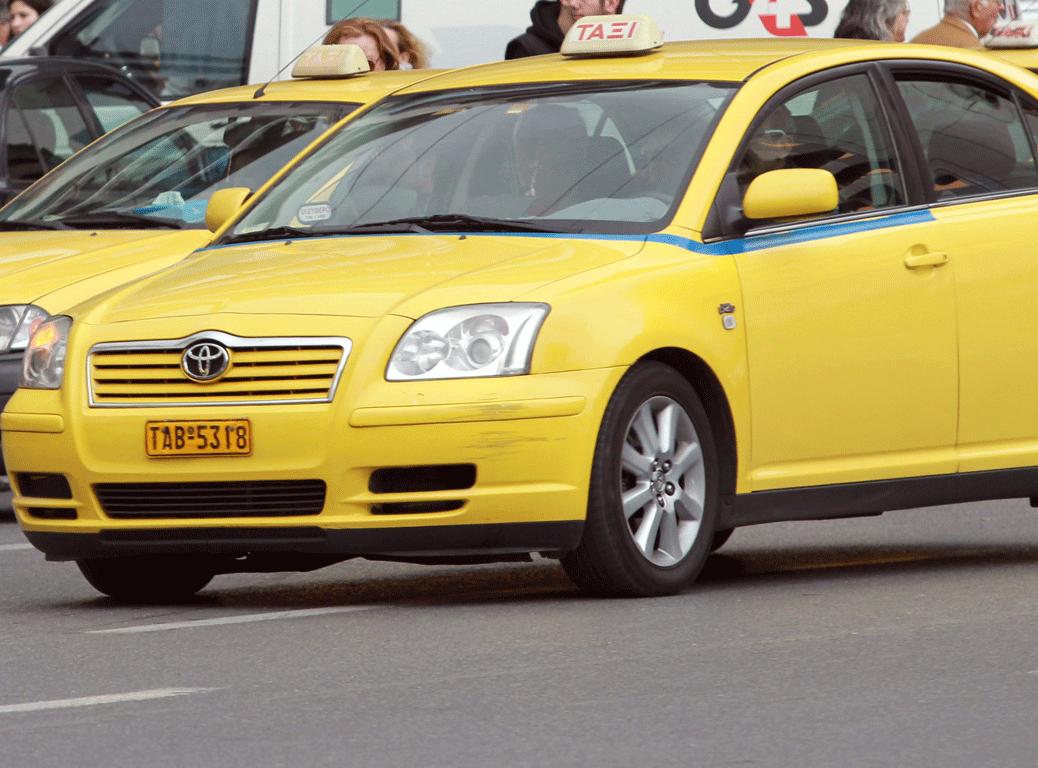
Are You Sure You Don’t Know Thanasi the Taxi Driver?
It was noontime, and I was working at the taxi plaza of Panorama. A lady around 70 to 75 years old entered the cab and directed me to transport her to the vicinity of Nomos, about a five- or six-minute drive.
“Bravo, my young man! What a beautiful thing to take a taxi and to listen to beautiful Byzantine chanting!”
“Really ma’am, do you like it?”
“Do I like it? I listen to the same station all day long in my home, and I raise the volume so that it can be heard in all my rooms. At other times, while doing my house work, I listen to some wonderful CDs of Father Athanasios Mitilinaios, Father Savvas, and Father Moses. I also listen to Thanasi, the taxi driver. Do you know him?”
Oh! What a cold splash this was at noontime! I pretended that I was concentrating on my driving. I wanted quickly to change the subject, because I didn’t want to fall into thoughts of pride, nor did I want to lie to her. I tried to ignore her question, but unfortunately the lady pressed on.
“My son, are you sure you don’t know Thanasi, the taxi driver?”
The pressure was on, and this blessed woman would not let up. I continued to try to stay incognito, but for how long I could do this I didn’t know, since this woman kept insisting that somehow I was supposed to know this man. At a certain moment I asked her, “Madam, what’s the big deal with this Thanasi the taxi driver?”
“What’s the big deal? If you hear the true experiences in Thanasi’s CD,[1] and the works of God’s grace in his taxi, you will not believe your ears.” The lady began to rave about this Thanasi and his CD, which led me to believe that she was missing most of the stories in this book. So, I proceeded to give her an MP3, which contained all my recorded audio files up to that point, and I did it discreetly enough, so she wouldn’t catch on.
As soon as she took it in her hand she asked me, “What is this?”
“Just a small gift, since I see that we are quenching our thirst from the same spiritual spring. This includes many true stories as well.” The lady accepted it with much gratitude, and she thanked me, without realizing a thing.
A little before we arrived at her home, she turned to me and said, “Oh, my son, please park your car for a moment and wait for me. I need to go into the house, so I can bring you Thanasi’s CD. You cannot imagine what amazing things you are going to hear.”
I had no other choice, my friends, but patiently to comply with my customer’s request. I parked, turned the engine off, got out of the car, and waited. In a few minutes, the lady hurriedly returned with Thanasi’s CD – in one of her own beautiful cases, no less. I thanked her, and I remember telling her, “May the Panaghia repay you for this!”
We exchanged a warm handshake and well wishes in a climate of much emotion and warm sentiments. As I drove off, I fulfilled her wish and listened to the CD from the beginning. As I kept listening, I remembered an appropriate verse in the Old Testament book of Ecclesiastes: “Cast your bread upon the waters and you will find it in time.”
So this CD, after circulating for a while, found its way back into my hands, in this amazing way. Glory to Thee, our Lord, glory to Thee!
[1] The stories in this book circulated as audio CDs for a few years in Greece and abroad, with great popularity.
Constantine Zalalas