Translate

Saturday, April 18, 2015

The Faithful Husband That Would Not Abandon His Unfaithful Wife ( Elder Joseph of Vatopaidi )


I will tell you of another characteristic of a proper spouse, which is extremely difficult to find in our day. But we did encounter one such person. He was in every way a perfect character, a Christian, and completely social. He married late, around thirty years old, not because he was averse to marriage, but because he thought that was how it should be. So he said his prayers with faith, and found himself a young girl and married her. The girl was young, ten years younger than him. Soon after he married her, she began her mischief. He pretended not to notice; he regarded her as his daughter and himself as her father. However, they had important business interests overseas and they had to go there, even if only temporarily. So he took her and they went abroad. When they arrived, she became very obstinate, and would say to herself: "He did this on purpose, to estrange me from my environment. I will desert him." So she abandoned and left him. She came back to Greece, and where do you think she went? To one of those "casino" places, and began to live the life of a free woman - one who is paid.

The husband however, from the day that she left him, never stopped praying with tears and insisting - in fact exhorting God: "All Good One, I will not retreat, I will not leave You alone; You were the One who gave me my wife. 'By the Lord is a man and woman harmonized' (according to the Bible). I want my wife. If the young girl has been deceived, must she be lost? Why did You come down to earth? Didn't You come to find the lost ones, to heal the sick, to resurrect the dead? I will not retreat. I will not let You rest. I want my wife; bring her back to me." He wept for two whole years.

His prayer was eventually heard and the young woman came to her senses. "Oh my," she confessed, "God will have to create another Hell, because this one is too small for me!"


So she sat down and wrote him a letter, saying: "I dare not address your name; I have no such right. If I return, will you accept me as your servant?"

He replied: "My love, why did you mention that word and hurt my feelings? Wasn't it me who sent you on a vacation and I was longing for my love to return to my open arms?"

So, he went and waited for her at the airport, as they had arranged. When she arrived, she fell down and began to beat herself and cry. He took her in his arms.

"My love, why are you like this and hurt my feelings? I was longing to see you again. Let's go home now; we never parted - I was always with you."

And this young girl proved herself to be a faithful wife from then on.

And that is the stance that a man - a husband - should take.


Elder Joseph of Vatopaidi 


http://agapienxristou.blogspot.ca/2013/05/the-faithful-husband-that-would-not.html

Friday, April 17, 2015

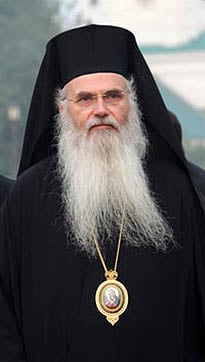
Holy Mountain: a universal presence and a heavenward orientation ( Metropolitan of Nikolaos of Mesogaias and Lavreotikis )


Metropolitan Nikolaos of Mesogaias

The spiritual influence of Mount Athos is indisputable and certainly stems from the fact that many men have attained holiness through their secret ascetic struggles there. In recent years many pilgrims have found peace of mind and repose on the Mountain, together with spiritual guidance and support.

The higher one rises, scientists tell us, the weaker the force of gravity becomes, the less one feels the pull of the earth, the looser one’s connection with it becomes, the easier one can shrug off its pressures and demands, the lighter one becomes.

The closer, too, one feels to heaven, which, though so vague, is so real and so desirable. Although less tangible, it seems more real than the earth. The higher one rises, the clearer the air becomes, the sharper one’s hearing, the broader the horizon, the closer one draws to the truth, and the truth is more convincing than reality.

Of all the holy sites in the Orthodox world, Mount Athos is the place where for over a thousand years the monastic life has been lived in its most absolute form. The passing centuries may have stamped their ‘worldly’ influence on the Mountain; even there men may display their weaknesses or even passions, which is only natural, and modern ‘civilisation’ may have done its damage, but in an inexplicably mystical way the Mountain has retained its blessed character, the constant and unique evidence of its grace, its rare and singular spiritual strength, and its dynamic relationship in space and time with the Lord God and the Kingdom of Heaven. Its philosophy of life has not been jeopardised by wrong choices, has not been harmed by a bad process of modernisation, and has not been corrupted by the times or by men, whoever they may be. Its truth endures.

It is like a rock which problems like changing political influences, the immoderate use of technology, tourism, parochial views, inter-monastic feuds, rivalries and even hatred, and all kinds of hostile forces only succeed in briefly washing over or moistening the surface of, without in the least disturbing its inner core.
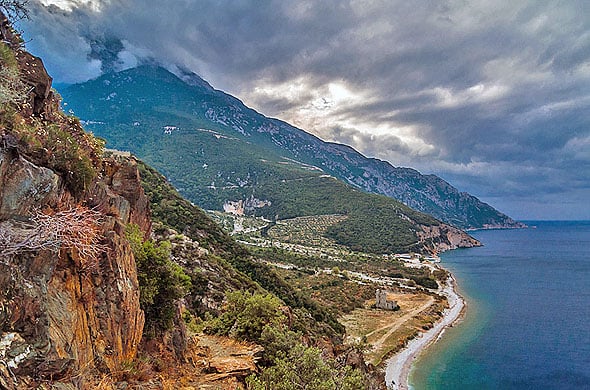
There is something that does indeed protect it. Perhaps it is its monastic diversity, perhaps it is its enduring quality, perhaps the naturalness of its monastic expression, perhaps its treasures, relics and splendour, perhaps the abaton1 and its administrative autonomy, perhaps its ecumenical character, perhaps the care and protection of the Mother of God, perhaps its special grace. Despite its theocratic character, after eleven centuries of glorious existence Byzantium fell. Athos, on the other hand, is now in its fourteenth century of life but it moves at the pace of the world to come and gives you the impression that it is a place which is ‘not of this world’ (John 18: 36), one whose relationship with time is like that of its surface with the air and whose ‘citizens dwell in heaven’ (Philippians 3: 20).


‘A rich mountain, a firm mountain’ (Psalms 68: 15)

With its slender connection with ephemeral and worldly things and its attention constantly focused on lofty matters of the soul, the Holy Mountain seems to embrace the whole of mankind and to possess a gaze that can see beyond the limits of time and reason. In geographical terms, the Mountain is situated in Greece but it does not belong to her.

Perhaps it is that part of Orthodox life which best emphasises the catholicity and universality of the Church. Its monasteries include a Russian, a Serbian and a Bulgarian foundation. There are two Romanian sketes2 and monks from distant countries and civilisations, such as Peru and Colombia. Within its geographical borders God is worshipped in numerous languages and a wide variety of cultures and traditions find expression here: there is a marvellous, well-balanced diversity. Nothing in all this obstructs the unity of faith, the catholicity of the Orthodox spirit, the universality of the Church’s witness.

On the contrary, all of this proves that the Word of God is not restricted by language or confined within borders, and is not stifled by different forms of cultural expression or perhaps even different religions. It is an interesting fact that only a third of the members of the ‘Friends of Mount Athos’ society in England are Orthodox. The number of non-Orthodox writers recording their admiration of Athos and their sense of its mystical power is increasing all the time. The Mountain moves all people.


Here space and time acquire another dimension and perspective. One’s relationship with earthly, ephemeral and perishable things is an entirely perfunctory one. Concepts like ‘money’, ‘property’, ‘wealth’, ‘investment’, ‘entertainment’, ‘competition’ and ‘interest’ completely lose their importance. Here only the most essential worldly concerns are allowed to occupy one’s thoughts. The soul opens itself up to heavenly things. Here the main focus of interest is eternity and God’s kingdom. The purpose of history is not to serve as an object of worship but to build the foundations of the present. The future is not seen as a way of relieving suppressed emotions but as a way of transforming the present. The whole of time is held within its embrace. Athos follows the Old Style Calendar knowing that it is wrong but without being bothered by the fact, believing that it is a system that works well for it. Even the Byzantine cycle of daily time, which is so cumbersome in practice, seems to have a good reason for existing here. The Mountain lives in its own time. It has escaped the most pressing demands and defeated the most powerful oppressors.

Time is not binding. Tradition is not restrictive. The liturgical rite is not a shackle. National identity and language do not count for everything. Education is not a privilege. There is no discrimination. Comparisons are avoided. The most important thing is being constantly in God’s presence and embracing the whole world.


‘I lift up my eyes to the hills – where does my help come from?’ (Psalm 121: 1)

The first thing that can be said about Athos is that it is a mountain, and in a notional sense at that. It is a high point. It represents a life that consists of an uphill struggle, that can be enjoyed ‘in a state of spiritual exaltation’, that involves a ‘heart which contemplates the heavens’ and seeks the ‘one who dwells on high’, the Almighty. It is an interesting fact that in the Orthodox tradition there are four hagiographical allusions to mountains on which revelations took place.

On Mount Sinai Moses received the Ten Commandments, the expression of God’s will. Moses spoke with Him, heard His voice and saw Him from behind (Exodus, chapters 19 and 20).

On Mount Carmel the Prophet Elijah prayed and God heard his prayer and answered it. Elijah felt God’s presence and experienced the manifestations of His power (I Kings, chapters 18-20).

The Mount of Olives was the scene of the Lord’s ascension into heaven. Christ deified human flesh and ‘took sinful human nature upon himself and offered it up to God the Father’, thus revealing a glimpse of the glory and honour of human nature (Acts 1: 12).

Finally, on Mount Tabor the Lord revealed as much of His glory as could be borne by human nature and emanated His divine light (Matthew 17: 1-8).

The Mountain is a place where God reveals His commandments; it is a place for a practical way of life, a place where patience, humility and love prevail, a place where man can clothe himself in divine raiment. It is a place where ‘nature is constantly constrained and the senses ceaselessly imprisoned’, a place of extreme, unceasing and persistent askesis3 and submission.

It is a place of prayer and signs. Prayer is unceasing, and in the cases of many monks extensive and long-lasting. At sundown the ascetics begin their all-night vigil, the coenobites take over with nocturns, in the morning the Divine Liturgy is celebrated, and during the day the Hours are performed by the monks in the course of their duties or while in their cells; during the times of quiet and pious chatter the repetition of the divine meanings of the Jesus Prayer can be constantly heard on numerous lips. Tongues pray; the architecture of the churches underscores the intensity of the prayers; the daily routine, the long services, the hearts of the monks are all imbued with the sweet melody of prayer.

The Mountain reveals the extremity of human situations. It is moderate in its discreet character but also displays a divine extremeness – though without foolish extremes – in its absolute and uncompromising lifestyle and philosophy. The daily vigils, the absence of a comforting female presence (even in pictorial form), the customary obedience, the life devoid of personal choices emphasises the naturalness of the ‘supernatural’ state. The Mountain is a place where the majesty of human nature is displayed. It functions as a kind of training ground for achieving deification. ‘The angels’ ranks were awed by thy life in the flesh’, chants the Athonite world, in honour of its father, St. Athanasios of Athos. Human limits are pushed to their utmost. Here saints like Gregory Palamas become beholders of divinity. Saints like Maximos the Kafsokalyvitan cast off their earthly gravity and appear to fly. Saints like Nikodemos Hagioreites express their intelligence as light, while their knowledge assumes the character of revelation. Saints like our modern-day saints Païssios, Ephraim and Elder Joseph the Hesychast combine rigorous discipline in their lives with grace, like the old elders in our ascetic literature. Saints like Kosmas the Aetolian or Fathers Sophronios and Porphyrios, also from our own time, draw strength from Athos’s springs for a few years and then become lifelong reformers, preachers and theologians of worldwide renown.

But the Mountain is not only a place for man’s spiritual glory. On all of the four mountains mentioned earlier God’s presence is marked by the appearance of a cloud. On Mt. Sinai as a ‘dense cloud’ which Moses enters, sensing but not actually seeing the Lord (Exodus, chapters 16, 19 and 24). On Mt. Carmel the ‘cloud’ breaks the silence of the heavens and brings forth rain in a miraculous manner (I Kings 18: 44). On the Mount of Olives, the Mount of the Ascension, the Lord ‘was taken up into a cloud’ and carried off to Heaven (Acts 1: 9). Finally, on Mt. Tabor ‘a bright cloud overshadowed’ the disciples and the voice from the cloud saying ‘This is my beloved Son, with whom I am well pleased: listen to Him’ shows that God the Father was present there with them (Matthew 17: 5).

The Mountain lives within a cloud of God’s graces. Sacred relics emit a sweet fragrance, holy icons exude myrrh, events take an unexpected turn, expectations are exceeded, rare surprises occur, God works with a power greater than the force of natural laws and logic. You enter the cloud of Athos as a visitor and, like Moses, you discover the tablets with God’s commandments in your hands. You find it easier to observe them. You are surprised by the presence of the cloud and are startled by the ‘sign’ of God’s grace flowing down like rain. You are struck by the cloud’s mystical character and ‘fall on your face in great fear’, like the disciples on Mt. Tabor. You behold the cloud and hear the voice of God the Father within you. You sense its intangible divine majesty and ‘gaze up at heaven’ like the Apostles on the Mount of Olives and you ‘return’ with great mystical ‘joy’.


If the Mountain of God’s presence illuminates with its apocalyptic visions, the cloud of the divine mystery fills the heart with the humility of uncreated grace. On the Holy Mountain you experience miracles, you perceive holiness, you are illuminated by whatever you can see, you are nourished by whatever lies within your reach, you have the ‘same mind that was in Christ Jesus’ (Philippians 2: 5).

A long time ago I was approached by a young student. Very hesitantly, but with the intensity of someone who is determined to find out something, he declared that, although he was an atheist and found it hard to believe, he very much wanted to find faith. He had tried and searched for years but all to no avail. He had talked with professors and educated people but his thirst for something serious was not satisfied. He heard about me and decided to share his existential need with me. He asked me for a scientific proof of God’s existence.

‘Do you know anything about integrals or differential equations?’ I asked him.

‘Unfortunately not,’ he replied, ‘I’m an Arts student.’

‘What a shame! I knew a proof like that,’ I said in a deliberate attempt to be funny.

He felt awkward and fell silent for a while.

‘Look,’ I said, ‘I’m sorry I teased you like that but God is not an equation or a mathematical proof. If He was, then all educated people would believe in Him. You know, there is a different way of approaching God. Have you ever been to Mount Athos? Have you ever met any ascetics?’

‘No, father, but I’m thinking of going. I’ve heard so much about it. If you tell me to, I’ll even go tomorrow. Do you know any well-educated person I could meet?’

‘Which would you prefer: a well-educated person who would confuse you, or a saint who might wake you up?’

‘I’d prefer a well-educated person. I’m afraid of saints.’

‘Faith is a matter of the heart. Try talking to a saint. What’s your name?’ I asked him.

‘Gabriel’, he replied.

I sent him to an ascetic. I told him how to get there and gave him the necessary instructions. We even drew a sketch-map.

‘You must go and ask the same thing,’ I said. ‘“I’m an atheist”, you must say, “and I want to believe. I want some proof of God’s existence”.’

‘I’m afraid, I’m too shy,’ he replied.

‘Why are you afraid and shy of the saint when you’re not afraid or shy of me?’ I asked him. ‘Just go and ask him the same thing.’

A few days later he went, and he found the ascetic talking with a young man in the yard of his cell. Opposite, four other young men sat waiting on some logs. Gabriel gingerly took his place amongst them. About ten minutes later the elder finished his discussion with the young man.

‘How are you, boys?’ he asked. ‘Have you had a loukoumi?4 Have you had a drop of water to drink?’

‘Yes, thank you, father,’ they replied with conventional worldly politeness.

‘Come here,’ he said to Gabriel, picking him out from the others. I’ll get some water and you take this box with the loukoumia. And come closer so that I can tell you a secret: it’s okay being an atheist, but to be an atheist and have an angel’s name, well… It’s the first time I’ve ever come across anything like that.’

Our friend almost fainted with shock at this sudden revelation. How did he know his name? Who had told him about his problem? And what did the elder want to say to him?

‘Father, can I have a brief word with you?’ he uttered in a faint voice.

‘Look, my son, the sun is going down: take the loukoumi, have a drink of water and go to the nearest monastery for the night.’

‘Father, I’d like to speak to you, if that’s possible.’

‘What is there for us to say, my child? Why have you come?’

‘On hearing this question I immediately felt a huge weight off my chest,’ he told me later. ‘My heart began to overflow with faith. My inner world began to glow. My questions began to be solved without any logical arguments, without any discussion, without any clear answers. All the “ifs”, “whys” and “maybes” were banished at a stroke, leaving only the “hows” and “whats”.’

What the knowledge of educated men was unable to give him he gained from the kind allusion of a saint, who had completed only four years at junior school. Saints are very discreet. They operate on you without an anaesthetic and there is no pain. They perform a transplant without cutting you open. They raise you to lofty heights without using the steps of earthly logic to get there. They plant faith in your heart without tiring your mind.


‘Inviolate and God-trodden mountain’

The Holy Mountain is a training school of the heart, a place of healing for the inner man. It raises you up to spiritual heights which cannot be reached even by the most modern balloon of worldly reasoning. Here Grace expresses truth in unexpected ways.

The basic question on the Mountain is not whether God exists. This question seems to have been decisively resolved a long time ago. Neither is it whether our God is better than other people’s gods. Here ‘our’ does not have a possessive sense – as in the phrase ‘God is mine’ – but the sense of a child selflessly wishing to join its father – ‘I am striving to become His’. All efforts are directed at partaking of God’s divine nature (2 Peter 1: 4), at making the most of our kinship with Him, at gaining a sense of His presence, of learning the benefits and ways of experiencing Him.

The Mountain’s value does not lie in its individual charismatic monks, however many or great they may be. Its majesty is concealed in the fact that it is a resting-place for God. Just as, for reasons that remain unknown to us, in some icons that depict exactly the same figure as others God works in different ways, and imparts a special grace to some that He does not give to others; just as amongst His twelve beloved disciples the Lord had a favourite; just as from amongst all His peoples he selected His ‘chosen people’; just as He performed the miracles that revealed His glory only in certain places like the Pools of Bethsaida and Siloam, so too does He select certain places in His creation to be special expressions of His grace. The Holy Mountain is the Mountain of God.

Paper presented at the Inter-Orthodox Theological Conference ‘Russia and Athos: A Thousand Years of Spiritual Unity’ held in Moscow, 1-4 October 2006.

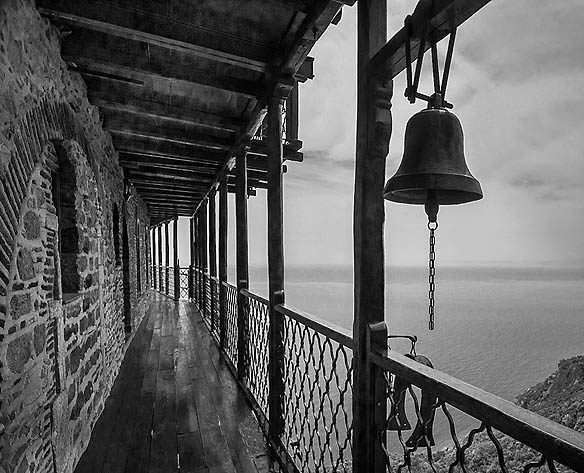
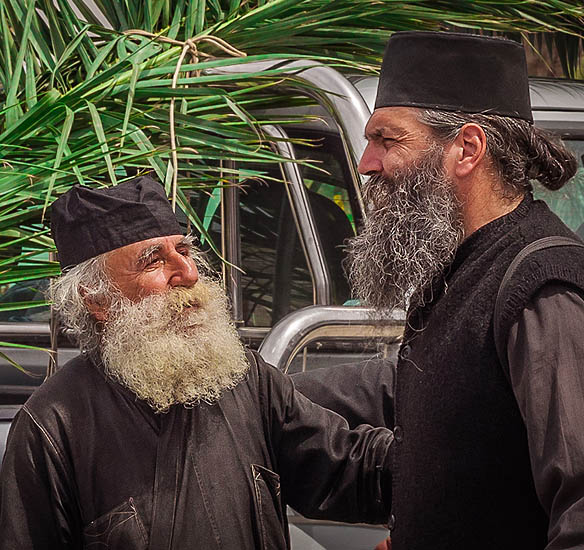
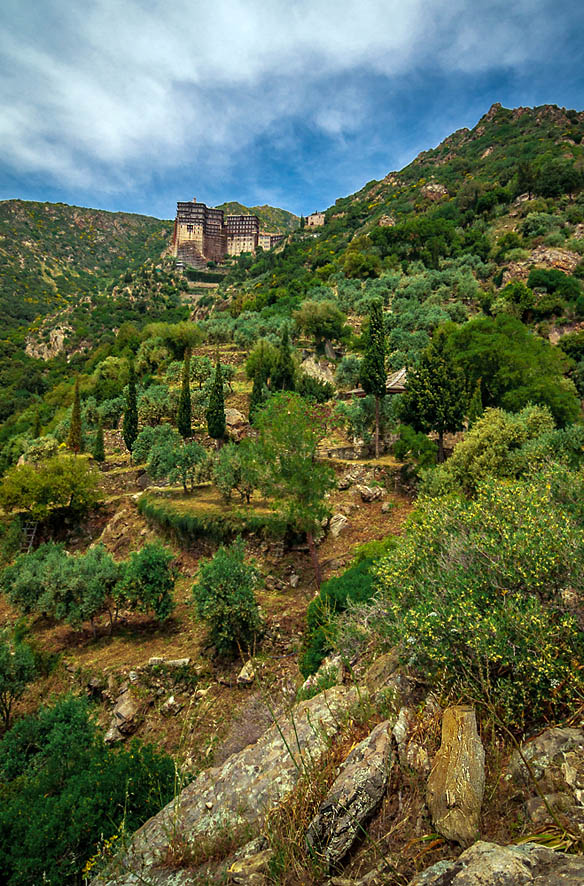
All photographies: Copyright Fr. Constantine Prodan
(http://sfantulmunte.wordpress.com/)

Translator’s notes:

1 The regulation forbidding the entry of women to Mount Athos.

2 Skete (plural sketes): a small monastery.

3 Spiritual exercise or training.

4 A piece of Turkish delight, a traditional hospitality offering on Athos.

Of all the holy sites in the Orthodox world, Mount Athos is the place where for over a thousand years the monastic life has been lived in its most absolute form.


http://agapienxristou.blogspot.ca/2014/10/holy-mountain-universal-presence-and.html

http://pemptousia.com/

Συγκλονιστικό περιστατικό με τον γέροντα 'Ιάκωβο Τσαλίκη - ...είδα τον άγγελο σου...


ΚΛΕΙΤΟΣ ΙΩΑΝΝΙΔΗΣ: Κύριε Παπαζάχο, σεις πώς τον γνωρίσατε;

ΓΕΩΡΓΙΟΣ ΠΑΠΑΖΑΧΟΣ: Είχε έρθει στο Γενικό Κρατικό Νοσοκομείο Αθηνών για τα προβλήματα, πού είχε με την καρδία του. Μόλις έμαθα ότι ήταν εκεί, πήγα να τον δω. Ήταν ή μέρα, πού τον είχαν μετακινήσει από τη Μονάδα Εντατικής Παρακολούθησης σ' ένα δωμάτιο με τρία κρεβάτια κι ένα ράντζο, πάνω στο όποιο είχαν βάλει τον Γέροντα Ιάκωβο. Ή πρώτη εντύπωση μου μόλις τον είδα είναι κάτι πού δεν περιγράφεται. "Αν σας πω ότι ό άνθρωπος αυτός ακτινοβολούσε, θα είναι λίγο. Ή μορφή του ήταν το κάτι άλλο, πράγματι ακτινοβολούσε. Την ώρα πού μπήκα στο δωμάτιο του, ήταν εκεί οι γιατροί, πού έκαναν την καθημερινή επίσκεψη τους στους θαλάμους των ασθενών. Κατά σύμπτωση οί γιατροί εκείνοι ήταν πρώην φοιτητές μου στο Πανεπιστήμιο. Έτσι, μόλις με είδαν, ήρθαν κοντά μου καί με ενημέρωσαν για την κατάσταση της υγείας του Γέροντα. Όταν τελείωσαν κι έφυγαν οί γιατροί, πήγα καί κάθησα δίπλα στο Γέροντα Ιάκωβο, ό οποίος, μόλις με είδε, μου είπε το εξής, το όποιο μ' εκανε πραγματικά ν' άνατριχιάσω,γιατί ήταν κάτι που δεν είχα σκεφτεί ποτέ.

- Δεν σε ξέρω. Πρώτη φορά σε βλέπω. Άλλα βλέπω ότι πίσω σου στέκεται ό άγγελος σου.

Με συγκλόνισε κυριολεκτικά αυτό πού μου είπε. Δεν το λέω για υπερηφάνεια, Καί πρόσθεσε:
- Όλοι οι άνθρωποι έχουν άγγελο. Άλλα τον δικό σου τον είδα. Πρόσεξε να μη τον διώξεις από κοντά σου. Ανατριχιάζω ολόκληρος κάθε φορά, πού το σκέφτομαι, το ίδιο όπως την ώρα εκείνη. Κι ολοκλήρωσε ό Γέρων Ιάκωβος: -Αυτός ό άγγελος έχει κατονομασθεί την ήμερα της βαπτίσεώς σου. Από την ήμερα της βαπτίσεώς σου σε συνοδεύει καί δεν πρέπει να φεύγει από κοντά σου. Είναι αυτός, ό οποίος τελικά θα πάρει την ψυχή σου στα χέρια του καί θα την οδηγήσει την ήμερα της Κρίσεως. Κι όταν θα έρχονται οί δαίμονες καί θα λένε «αυτός έκανε εκείνο, έκανε το άλλο, διέπραξε αυτή την αμαρτία καί την άλλη», τότε ό άγγελος σου θα λέει «ναι, τα έκανε αυτά, αλλά ταυτόχρονα έκανε κι αυτό το καλό, έκανε καί το άλλο καλό». Αυτός είναι ό δικηγόρος, πού θα σε υποστηρίξει. Πρόσεξε, λοίπόν, να μη τον απομακρύνεις. Τον είδα να είναι κοντά σου. Από εκείνη την ώρα, ουδέποτε σταμάτησα να έχω την αίσθηση ότι δίπλα μου υπάρχει ένας άγγελος, ό δικός μου, προσωπικός άγγελος. Αυτό είναι ένα μέγα μήνυμα χαράς προς όλους όσους βαπτιστήκαμε Όρθόδοξοι χριστιανοί.

ΚΛΕΙΤΟΣ ΙΩΑΝΝΙΔΗΣ: Αληθινά εντυπωσιακή εμπειρία αυτή, κύριε Παπαζάχο να δεί ό Γέρων Ιάκωβος το φύλακα άγγελο σας.

ΓΕΩΡΓΙΟΣ ΠΑΠΑΖΑΧΟΣ: Όταν έβλεπες τον Γέροντα Ιάκωβο είχες την αίσθηση ότι ήταν άλλου κόσμου, ότι μιλούσε μεν για τα προβλήματα σου, αλλά με μια άλλη προοπτική. Καταλάβαινες ότι, όντας δίπλα σου, ζούσε κάπου άλλου. Κι αυτό σε γέμιζε μ' ένα αίσθημα πανηγύρεως.

ΚΛΕΙΤΟΣ ΙΩΑΝΝΙΔΗΣ: Ήταν απ'άλλου φερμένος.

ΓΕΩΡΓΙΟΣ ΠΑΠΑΖΑΧΟΣ: Καί σου μετέδιδε ότι κι εσύ είσαι για άλλου πλασμένος,ότι δεν είσαι για εδώ.

Από το βιβλίο του ΚΛΕΙΤΟΥ ΙΩΑΝΝΙΔΗ, «Σύγχρονοι Άγιοι Γέροντες», έκδ. Ι.Μ. Αγ. Μαρίνας καί 'Αγ. Ραφαήλ Ξυλοτύμπου, Λευκωσία 1994

Thursday, April 16, 2015

TO BE A RUSSIAN , IS TO BE AN ORTHODOX CHRISTIAN


Christ and the End of Satan’s Dominion ( St. Nikolai Velimirovich )


"O thou enemy, thy destructions are come to a perpetual end, even as the cities which thou hast destroyed; thy memorial is perished with a roar" (Psalm 9:6).

The enemy of the human race, the murderer of men from the very beginning, has used every weapon and intrigue against man. He thinks up new weapons and new intrigues day and night, in order to destroy someone as a roaring lion, "seeking whom he may devour" (I Peter 5:8). He hides like a poisonous snake and awaits his prey; he stretches his webs everywhere, like a spider, with the sole purpose of ensnaring some human soul and entrapping it in his foul kingdom.

Pagan peoples were his cities. Until the coming of Christ, he ruled untroubled and absolutely in them. When they served idols, they served him; the practices of soothsaying and fortune-telling served him; he protected, directed and enhanced men’s unbridled licentiousness; human sacrifice, fiery passions, discord, war, evildoings of all descriptions – this was all pleasure for him. But in the end, no weapons remained in him; his "cities" were destroyed and his memorial is perished with a roar.

This "end" of which the prophet speaks is the coming of Jesus Christ the Lord into the world. The Lord manifested His power over the devil when He overcame his temptations on the mountain. He manifested His authority in driving demons out of men, commanding them to go this way or that; He manifested His invincible lordship over sin and death by His suffering and Resurrection. And, what is perhaps most important, He harrowed hell and scattered the demonic power. He did not desire to utterly destroy the demons, but to disperse them and smash their weapons; He smashed them and scattered them as He later did the Jews, but more terribly than He did the Jews. He freed the people from their domination; and even more importantly, He gave men authority over the demons, such that they can drive the demons out by the power of His name.

Do you see how the Lord linked His victory over the demons with His mercy toward men? He so weakened and broke them, He so confused and dispersed them, that He placed them under the authority of men. Even so, the Lord did not grant authority over demons to all men, but only to those who believe in Him and who follow His commandments. He gave them authority, and He also gave them a weapon. That weapon is the Cross.
O Lord our God, our Savior from the dominion of the devil, help us also to do that "least part" that Thou hast left us to do. To Thee be glory and praise forever. Amen. 

Ποτέ δεν έχουμε δίκιο; ( Γεροντισσα ΓΑΒΡΗΙΛΙΑ )


Όταν ο άνθρωπος έχει Αγάπη, Υπομονή, Υπακοή και Ταπείνωση, έχει κερδίσει και αυτόν τον κόσμο και τον Παράδεισο. Αλλά ποιο είναι το δύσκολο; Είναι πάντα αυτή η Δύναμις του Σκότους, που μας λέει ότι εμείς έχουμε Δίκηο.
-Ποτέ δεν έχουμε δίκηο;

-Ποτέ! Πάντα «έχει» ο άλλος! Εδώ είναι το σπουδαίο …
Ξέρετε γιατί; Γιατί αυτός, με το Εγώ του έχει δίκηο. Γιατί λοιπόν να προσπαθήσω να τον πείσω με το δικό μου Εγώ;

-Υποτασσόμεθα δηλαδή στο Εγώ του άλλου και στο δίκηο του άλλου …
-Δεν υποτασσόμεθα όπως το εννοείτε. Κάνουμε εκείνο που εμείς θεωρούμε σωστό, αλλά δεν θα ‘χουμε μαζύ του άσκοπες συζητήσεις, δεν θα ‘χουμε κατάκριση, δεν θα έχουμε χάσιμο της γαλήνης μας. Αυτός θα συνεχίσει τον δρόμο του και θα τον εμπιστευτούμε στο Θέλημα του Θεού. Δεν μπορεί να μας βλάψει. Γιατί εμείς έχομε κάποια Αρχή πάνω μας που είναι σύμφωνη με την δική μας δικαιοσύνη. Υπάρχει ο Πνευματικός μας, υπάρχει η Γερόντισσα μας, υπάρχει ο Δεσπότης μας, υπάρχει η Εκκλησία ολόκληρη που συμφωνεί.…

Αλλά να σας πω, γι’ αυτού του είδους της σκέψεις όλες, εγώ έχω ένα καλάθι που το λέω το Καλάθι της Ματαιότητος, και όπως ρίχνουμε τα άχρηστα χαρτιά, έτσι κι αυτές τις σκέψεις εκεί μέσα τις ρίχνω και δεν με στεναχωρούν. Γιατί δεν πρέπει να στεναχωριέται ο άνθρωπος με τέτοια.}217} … Γιαυτό προπάντων όχι θυμό! Γιατί σου λέει ο Κύριος Μη αντιστήναι τω Πονηρώ. Γιατί όταν πάμε ενάντια σε κάτι, σκοτωνόμαστε στον καβγά. Αν έρθει κάποιος μετά από λίγο και μας δει θα καταλάβει ποιος είχε δίκηο και ποιος είχε άδικο; Ποτέ!

Γινόμαστε και οι δύο πονηροί και του Πειρασμού. Γι’ αυτό σας λέω, όταν αρχίζει μία συζήτηση που πάει να εξελιχθεί σε καβγά, ο ένας από τους δύο, εάν είναι του Θεού άνθρωπος, πρέπει να σωπάσει και να λέει μέσα του Κύριε Ιησού Χριστέ ελέησον ημάς … Σε δύο λεπτά σταματούν όλα.


Γεροντισσα ΓΑΒΡΗΙΛΙΑ 


http://agapienxristou.blogspot.ca/2013/04/blog-post_8162.html

Ἡ φιλαυτία ( Αγίου Μαξίμου του Ομολογητού )


Πρόσεχε τον εαυτό σου από την μητέρα των κακών, την φιλαυτία, η οποία είναι μια παράλογος αγάπη προς το σώμα. Από αυτήν γεννώνται δικαιολογημένα οι πρώτοι και εμπαθείς και γενικώτατοι λογισμοί, δηλαδή της γαστριμαργίας, της φιλαργυρίας και της κενοδοξίας. Οι λογισμοί αυτοί σχηματίζονται με αφορμή τις απαραιτήτους, δήθεν, ανάγκες του σώματος, και από αυτούς γεννώνται όλα τα κακά...

Πρέπει λοιπόν, νά προσέχομε και κατ' ανάγκην να πολεμούμε την φιλαυτία με πολλή επαγρύπνηση διότι όταν αυτή εξουδετερωθεί, αχρηστεύονται και όλοι οι λογισμοί πού γεννώνται από αυτήν. Τό πάθος της φιλαυτίας σιγοψιθυρίζει στον νου του Μοναχού ότι, απλώς, λυπείται το σώμα και τον παρακινεί νά ενδιαφέρεται περισσότερο από όσο πρέπει γιά την καλή τροφή, χάριν οικονομίας δήθεν και κυβερνήσεως του σώματος• έτσι, σιγά-σιγά, παρασύρεται ώστε νά πέσει στον βόθρο της φιληδονίας. Στον κοσμικό εμβάλλει τον λογισμό νά φροντίζει περισσότερο γιά τον εαυτό του και νά ικανοποιεί τις επιθυμίες του.

Από τά πάθη άλλα μεν οδηγούν την ψυχή στην ακολασία, άλλα στο μίσος και άλλα στην ακολασία και μίσος μαζί. Η πολυφαγία και καλοφαγία προξενούν ακολασία, η φιλαργυρία και η κενοδοξία γεννούν το μίσος προς τον πλησίον. Η μητέρα δε αυτών, η φιλαυτία, είναι η αιτία που δημιουργεί και τα δύο• Σε αυτήν την φιλαυτία αντίθετος είναι η αγάπη και η εγκράτεια. Εκείνος λοιπόν που νικάται από την φιλαυτία, έχει στην ψυχή του όλα τα πάθη. «Κάνεις δεν εμίσησε την σάρκα του, λέγει ο Απόστολος Παύλος• αλλ' όμως την βασανίζει και την μεταχειρίζεται ως δούλο, χωρίς να της παρέχει τίποτα περισσότερο εκτός από διατροφή και σκεπάσματα και αυτά μόνον όσα είναι απαραίτητα γιά τήν διατήρηση της ζωής. Έτσι λοιπόν αγαπά κανείς χωρίς πάθος την σάρκα του ως υπηρέτρια του Θεού• την διατρέφει και την ζεσταίνει τόσον μόνον όσο χρειάζεται για την ικανοποίηση των στοιχειωδών αναγκών αυτής.
Όποιον αγαπά κανείς, εκείνον προ παντός φροντίζει να περιποιείται• αν λοιπόν κανείς αγαπά τον Θεό, φροντίζει οπωσδήποτε να πράττει και όσα ευχαριστούν τον Θεό αν, πάλι, αγαπά την σάρκα αυτήν, τότε εκτελεί εκείνα πού τήν ευχαριστούν. Στον Θεό αρέσει αγάπη και σωφροσύνη και θεωρία και προσευχή, ενώ στην σάρκα αρέσουν η λαιμαργία, η ακολασία και όσα αυξάνουν αυτά τα πάθη• γι' αυτό οι φιλόσαρκοι δεν ημπορούν να αρέσουν στον Θεό. «Οι αληθινοί μαθητές του Χριστού έχουν σταυρώσει τον σαρκικό άνθρωπο, μαζί με τα πάθη και τις αμαρτωλές επιθυμίας» (Γαλ. ε', 24). Ο νους αν μεν στραφεί προς τον Θεό, έχει δούλο το σώμα και δεν του παρέχει τίποτα περισσότερο από όσα είναι απαραίτητα για την ζωή. Αν, πάλιν, στραφεί προς την σάρκα, τότε υποδουλώνεται στα πάθη και επιθυμεί συνεχώς να φροντίζει γι' αυτήν.


Αγίου Μαξίμου του Ομολογητού 


http://agapienxristou.blogspot.ca/2013/04/blog-post_2333.html

Wednesday, April 15, 2015

All Good Things Come From God ( St. Nikolai Velimirovich )


A young and inexperienced man in spiritual combat underlines his every good work by self-praise. But the experienced soldier in the midst of struggles with passions and demons minimizes his every deed and intensifies his prayer for God's help. Abba Matoes used to say: "The closer a man is to God, the more sinful he sees himself to be." He also was known to say: "When I was young, I thought perhaps that I was doing some good; and now when I am old, I see that I do not have any good deed." Did not our Lord say: "No one is good but One, that is God" (Matthew 19:17). Therefore, if only the one God is good and the source of all good, how can a good deed be done that is not from God? And, how can someone who does a good deed ascribe it to himself and not to God? If this is so, with what then can mortal man be praised? By nothing, except with God and the goodness of God!

Two Sayings of Abba Agathon Relating To This Issue

1. It was said concerning Abba Agathon that some monks came to find him having heard of his great discernment. Wanting to see if he would lose his temper they said to him:

'Aren't you that Agathon who is said to be a fornicator and a proud man?'

'Yes, it is very true,' he answered.

They resumed, 'Aren't you that Agathon who is always talking nonsense?'

'I am."

Again they said 'Aren't you Agathon the heretic?'

But at that he replied 'I am not a heretic.'

So they asked him, 'Tell us why you accepted everything we cast at you, but repudiated this last insult.'

He replied 'The first accusations I take to myself for that is good for my soul. But heresy is separation from God. Now I have no wish to be separated from God.'

At this saying they were astonished at his discernment and returned, edified.

2. The old men said of Abba Agathon to Abba Elias in Egypt: 'He is a good Abba.'

The old man answered them, 'In comparison with his own generation, he is good.'

They said to him, 'And what is he in comparison with the ancients?'

He gave them this answer, 'I have said to you that in comparison with his generation he is good but as to that of the ancients, in Scetis I have seen a man who, like Joshua the son of Nun could make the sun stand still in the heavens.'

At these words they were astounded and gave glory to God. 


St. Nikolai Velimirovich

Όσοι ασχολούνται με μάγια λένε και πολλά ψέματα ( Αγιος Παϊσιος )

-Γέροντα, οι μάγοι έχουν κάποια πληροφορία;

-Έχουν πληροφορία από τον διάβολο, αλλά λένε και πολλά ψέματα. Κι εσείς να προσέχετε εκεί στο αρχονταρίκι. Πρέπει να ελέγχετε την κατάσταση. Να βλέπετε τι άνθρωποι είναι αυτοί που έρχονται, γιατί μπορεί να έρθει και κανένας που ασχολείται με μαγικά. Σας φαίνεται παράξενο; Σε μια αγρυπνία εδώ ήρθαν δύο άτομα που ασχολούνταν με μαγικά. Πλησίαζαν τους ανθρώπους και τους έλεγαν διάφορα. Έλεγαν και ψέματα ότι έχουν σχέση και με τον Καντιώτη. Σε μια γυναίκα είπαν: «Σου έχουν κάνει μάγια. Θα’ ρθούμε στο σπίτι σου, να τα λύσουμε με έναν σταυρό που έχουμε». Έρχονται στην αγρυπνία, μιλούν και λίγο πνευματικά, οπότε σου λένε οι άλλοι: «αφού έρχονται στην αγρυπνία, είναι πιστοί άνθρωποι», και ανοίγουν την καρδιά τους.

Πώς μπερδεύουν τον κόσμο με τα ψέματα που λένε! Για να ξεγελάσει κάποιος μια κοπέλα της είπε: «Ο πατήρ Παΐσιος είδε όραμα ότι θα σε παντρευτώ· πάρε να φορέσεις αυτό χωρίς να εξετάσεις τι είναι», και της έδωσε κάτι που ήταν μαγικό αλλά εκείνη ευτυχώς δεν το φόρεσε. «Καλά ο πατήρ Παΐσιος με τέτοια ασχολείται!», είπε και πιάνει και μου γράφει ένα γράμμα, τέσσερις σελίδες με πυκνά γράμματα, γεμάτο βρισιές. Τέτοιο βρισίδι! «Δεν πειράζει, λέω, βρίσε με. Χαλάλι να γίνει το βρισίδι, αφού δεν ξεγελάστηκες να φορέσεις αυτό το σατανικό!».

-Σας ήξερε, Γέροντα;

-Όχι δεν με ήξερε. Κι εγώ δεν τους ήξερα, ούτε αυτήν ούτε εκείνον.

Αγιος Παϊσιος

Tuesday, April 14, 2015

The Work of Prayer ( Saint Seraphim of Sarov )


Daily prayer is the foundation of a spiritual life in Christ. We pray in the morning and the evening and throughout the day, with an aim for our entire life to be one of prayer. Saint Seraphim places the emphasis on saying the Jesus Prayer.


Saint Seraphim says,
Those who have truly decided to serve the Lord God should practice the remembrance of God and uninterrupted prayer to Jesus Christ, mentally saying: Lord Jesus Christ, Son of God, have mercy on me a sinner... By such exercises in preserving oneself from dispersion and keeping peace of conscience one may draw near to God and be united to Him. The daily practice of the Jesus Prayer involves numerous disciplined repetitions of this short but all powerful prayer. As we practice it, our mind is reshaped, our thoughts are tamed, our soul's orientation is pointed towards God, and prayer is always on our lips.


Saint John Chrysostom says,
"Prayer is a great weapon, a rich treasure, a wealth that is never exhausted, an undisturbed refuge, a cause of tranquility, the root of a multitude of blessings and their source and mother"
In prayer we lift ourselves above our thoughts. It is our thoughts that destroy prayer. The main struggle in prayer is not to allow our thoughts to take away our prayer.


Saint Seraphim says,
One must always strive to give oneself up to dispersion of thoughts: for through this the soul turns away from remembrance of God and love of Him...
This is how we get the benefit from prayer, by controlling our thoughts. And it is by regular prayer where we learn to concentrate on God that we learn to control our thoughts.


Saint Seraphim says,
When the mind and the heart are united in prayer and the soul's thoughts are not dispersed, the heart is warmed by spiritual warmth in which the light of Christ shines, making the whole inner man peaceful. This is our aim, to be united with God. 


http://agapienxristou.blogspot.ca/2013/05/the-work-of-prayer.html