Translate

Sunday, May 13, 2018

Ten Point Program For Orthodox Life


Translating Orthodox Christian Ideals Into Daily Life

By living the Orthodox Life you put Christ’s commandments and way of life deep into your consciousness. You learn to deal more effectively with stress. You release reserves of untapped energies. You transform anger. You heal relationships. You leave behind painful memories and live a life fully in the present. You develop unsuspected capacities for insight and understanding. You learn to love more fully than you thought possible. You discover your unique contribution to life. You walk a path towards eternal life in Paradise.


Introduction


1. Praying Daily

Have a regular prayer rule that includes morning and evening prayer.

2. Worshiping and Participating in Sacraments

Attend and participate in the Divine Liturgy receiving Holy Communion regularly as well as regular participation in Confession.


3. Honoring the Liturgical Cycle of the Church

Follow the seasons of the church and participate in the fasts and feasts of the Church.

4. Using the Jesus Prayer

Repeat the Holy name whenever possible throughout the day or night.

5. Slowing Down and Ordering Your Life


Set priorities and reduce the stress and friction caused by a hurried life.

6. Being Watchful

Give full attention to what you are doing at the moment.

7. Taming the Passions

Overcome your habits, attachment to your likes and dislikes, and learn to practice the virtues.

8. Putting Others First

Free yourself from your selfishness and find joy in helping others.


9. Spiritual Fellowship

Spend time regularly with other Orthodox Christians for support and inspiration.


10. Reading the Scriptures and Holy Fathers

Be inspired by the lessons of the Holy Scriptures, the wisdom of the Holy Fathers and the lives of the Saints of the Church.

Wednesday, May 9, 2018

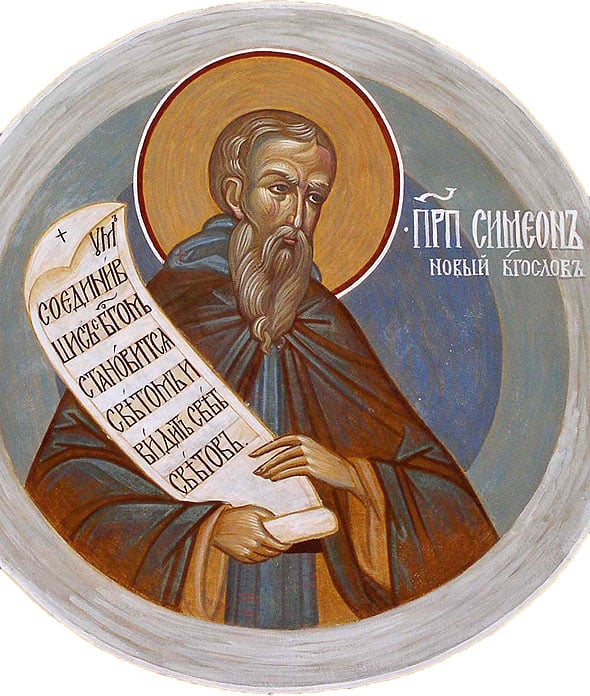
Nameday celebration ( Saint Symeon the New Theologian )


When you celebrate your nameday, do so with the aim of obtaining mercy from God through the intercessions of your Saint. 


Saint Symeon the New Theologian

Sunday, May 6, 2018

On Amassing Wealth For Old Age While Neglecting the Wealth of Grace ( St. Nikolai Velimirovich )


In ignorance, many people labor more to avoid suffering in old age and terminal illness than to avoid the torments of hell in the life after old age and death.

Such was the case of an unmarried and avaricious man who, from year to year, and with ever greater passion, amassed for himself unnecessary wealth. When asked why he strove so much to pile up excess wealth he replied: "I am gathering it for my old age. This wealth will heal and feed me in old age and sickness."

And indeed, his foreboding came true. In old age, a grave and long-lasting illness befell him. He distributed his accumulated wealth to physicians so they would heal him, and to servants so they would care for him and feed him. His wealth was soon spent, and the illness continued. The physicians and servants abandoned him, and he fell into despair. His neighbors brought him bread until his death, and he was buried at the expense of the community. He had used his wealth for that which he had intended it.

God had even done for him according to the man's will. God had sent him the illness that he had, in a sense, desired, and for which he had prepared great wealth. Nevertheless, all his wealth was unable to alleviate his sufferings in this world - so with what would he be able to alleviate his sufferings in the other world? Nothing, if he took with him neither faith, nor hope, nor charitable deeds, nor prayers, nor repentance!

Someone saw a departed man in the great glory of Paradise, and asked him how he had become worthy of that glory. The man replied: "In my earthly life I was the hireling of an evil-doer who never paid me. But I endured all and served him to the end, with hope in God." Then the onlooker saw another man in even greater glory, and when he asked him, that one replied: "I was a leper, and to the very end I offered gratitude to God for that." But no one saw in the glory of Paradise the man who had amassed money for illness in old age. 
St. Nikolai Velimirovich

Friday, May 4, 2018

Lay not up Treasures on Earth, but in Heaven where Nothing is Lost ( St. John Maximovitch )


The Lord speaks to all people of all times and races, and tells them something clear and well-known. Today a person is alive, but tomorrow he dies and everything that he has is lost to him. But the soul, which moves the body, continues to live and it is either comforted and happy, or sad and burdened. Man is created thus; the body must live as the soul desires. At the moment of death the soul continues to live without the body. Everything will perish except that which the soul has gathered through love and prayer. Everything virtuous done by a man is written in the soul and will not be taken from him. While a person is alive, he finds himself paying attention to many things: clothing, health, his job, studies. There are times when he is concerned only with the thought of war or a failed harvest - of everything that is necessary for life on earth.

So, too, in spiritual life there are times of special attention to what is needful for the soul. Such is Great Lent - a time of special attention, examination, of the freeing of spiritual forces. Fasting is established by the Holy Spirit. Righteous men, striving towards God, through life experience came to know the meaning of fasting and bear witness that without fasting there can be no spiritual life. All the various attacks of the devil, all his temptations, everything concerning the diabolic world, is cast aside -becomes powerless and is shamed-when a person firmly follows the words of the Saviour Himself, the Lord Jesus Christ: " .. . This kind goeth not out but by prayer and fasting" (Matt. 17:21).

Now is a time of fasting, a suitable time for cleansing the soul. This is the most important thing, for a soul to be able to accept the grace of God, so that those treasures will be stored up in the soul, which will not be taken from it. And then the path of its life will be straight; in the soul there will be peace and joy.

"Create in me a clean heart, O God, and renew a right spirit within me."

St. John Maximovitch

Tuesday, May 1, 2018

How To Set Up An Icon Corner at Home


Quantity and quality are two different things. It would be naive to assume that the more sacred images there are in an Orthodox Christian’s home, the more pious his life. A disorganized collection of icons, reproductions, and religious wall calendars covering a significant amount of living space can often have a contrary effect on one’s spiritual life.
A poorly thought-out collection of icons can turn into something simple and meaningless, in which the prayerful purpose of the icon has no place whatsoever.
Nonetheless, it is essential to have icons in one’s home in sufficient numbers, but within reasonable limits.
In the past, whether on a farm or in the city, every Orthodox family’s home would always have a shelf with icons, or an entire home iconostasis, located in the most visible place. The place where the icons were installed was known as the front corner, the beautiful corner, the holy corner, God’s place, or the kiot.
For Orthodox Christians, an icon is not just a depiction of the Lord Jesus Christ, the Mother of God, the Saints, or events from Sacred and Church History. An icon is a sacred image, i.e., it is outside the realm of ordinary reality; it is not to be confused with ordinary daily life; and it is intended only for communion with God. Thus, the primary purpose of icons is prayer. An icon is a window from our world, the earthly world, into the world above. It is God’s revelation in form and color.
In this way, an icon is not simply a family relic to be passed on from generation to generation, but a holy thing that unites all family members during communal prayer – for prayer in common can take place only if those standing before the icons have mutually forgiven one another’s offenses and achieved unity.
Today, of course, when the television set ­– which is itself a kind of a window into the motley world of human passions – has taken the place of icons in the home, the purpose of the family icon, the tradition of common prayer at home, and the consciousness of the family as the “little Church” have been lost.
Therefore, an Orthodox Christian today might ask: What icons should I have in my home? How should they be arranged? Can I use reproductions of icons? What do I do with old, dilapidated icons?
Some of these questions merit an unequivocal answer, while others do not demand any kind of strict recommendations.
Where should one place icons at home?
In a free and accessible place.
The terse nature of such an answer is prompted by the realities of life, rather than by the absence of canonical requirements.
Of course, it is preferable to place icons on the eastern wall of the room, because the “East” as a theological concept has special significance in Orthodoxy.
And the Lord God planted a garden eastward in Eden; and there he put the man whom he had formed (Genesis 2:8).
O Jerusalem, look about thee toward the east, and behold the joy that cometh unto thee from God (Baruch 4:36).
Moreover the spirit lifted me up, and brought me unto the east gate of the Lord’s house, which looketh eastward (Ezekiel 11:1).
For as the lightning cometh out of the east, and shineth even unto the west; so shall also the coming of the Son of man be (Matthew 24:27).
But what should one do if there are windows or doors on the eastern side of one’s home? In that case, use the southern, northern, or western walls.
One should not combine icons with decorative objects of a secular nature, such as statuettes, various types of pictures, etc.
It is inappropriate to put icons on a bookshelf next to books having nothing in common with the Orthodox faith or that conflict with Christian teaching on love and charity.
It is absolutely impermissible to have icons next to posters or calendars depicting rock musicians, athletes, or politicians – the idols of the current age. This not only diminishes reverence for the holy images to an unacceptable degree, but also puts holy icons on par with the idols of the contemporary world.
The home icon corner can be decorated with live flowers. Traditionally, larger icons are often framed with towels. This tradition dates back to antiquity and has a theological basis. According to tradition, an image of the Savior miraculously appeared on a towel during His earthly life to help a suffering man. After washing His Face, Christ wiped His Face with a clean towel, on which an image of His Face appeared. The towel was sent to King Abgar, who was afflicted with leprosy, in the city of Edessa in Asia Minor. Upon healing, the ruler and his subjects adopted Christianity and the Image-Not-Made-By-Hands of Jesus Christ was affixed to a “permanent panel” and raised above the city gates.
In times past, August 29 (new style), the day the Church commemorates the translation of the Image Not-Made-By-Hands of our Lord Jesus Christ from Edessa to Constantinople in 944, was known among the people as the feast of the “canvas” or “linen Savior,” and in some places fabric and towels made of homespun yarn were blessed.
These richly embroidered towels were reserved for use in the icon corner. Likewise, icons were framed by towels for use during weddings and the Blessing of Waters. Thus, for example, after the service for the Blessing of Waters, when the priest sprinkled the icons with abundant Holy Water, people would wipe the icons with special towels that they would incorporate into the icon corner.
There is a tradition that, following the celebration of the Lord’s Entry into Jerusalem (Palm Sunday), pussy willow branches that have been blessed in church are kept near the icons until the following Palm Sunday.
It is customary that on Pentecost, the Day of the Holy Trinity, homes and icons are decorated with birch branches as a symbol of the flourishing Church, bearing the grace-filled power of the Holy Spirit.


Which icons should you have at home?


It is essential to have icons of the Savior and the Mother of God. The Image of the Lord Jesus Christ, which bears witness to the Incarnation and to the salvation of mankind, and of the Theotokos – the most perfect of those who have lived on earth, who was made worthy of deification, and who is venerated as more honorable than the Cherubim and beyond compare more glorious than the Seraphim – are an essential part of the Orthodox Christian home. The icon of Christ ordinarily selected for prayer at home is a waist-length depiction of Christ Pantocrator.
Those with room for a greater number of icons in the home may supplement their icon corner with depictions of various revered saints.
Russian Orthodoxy has a strong tradition of special veneration for St. Nicholas the Wonderworker; almost every Orthodox family has an icon of him. One should note that, together with the icons of the Savior and the Mother of God, the image of St. Nicholas the Wonderworker has always occupied a central place in Orthodox Christian homes. People revere St. Nicholas as a saint endowed with special grace. This stems in large part from the fact that, according to the Church’s Typikon, every Thursday, when the Church offers up prayers to the Holy Apostles, is also dedicated to St. Nicholas the Wonderworker, Archbishop of Myra in Lycia.
Among the icons of the Holy Prophets of God, that of the Prophet Elias holds a prominent place; prominent among the icons of the Holy Apostles is that of the Sts. Peter and Paul, the chiefs among the Apostles.
Among the images of martyrs for Christian Faith, those encountered most often are icons of the Holy Great Martyr and Trophy-bearer George and the Holy Great Martyr and Healer Panteleimon.
It is recommended to have depictions of the Holy Evangelists, of St. John the Baptist, of the Holy Archangels Gabriel and Michael, as well as icons of the Feasts, to make a home icon corner complete.
The selection of icons for one’s home is always an individual matter. The best person to help one make these choices is one’s priest – the family’s spiritual father – and it is to him, or to another clergyman, that one should turn for advice.
As for icon reproductions and color photographs, sometimes it makes more sense to have a good reproduction than a painted icon of poor quality.
An iconographer should maintain a very demanding attitude toward his work. Just as a priest does not serve the Liturgy without due preparation, the iconographer must approach his service with full awareness of his responsibility. Unfortunately, both in the past and today, one often encounters vulgar examples of images that bear no resemblance to icons. Thus, if a given depiction does not evoke a sense of piety and a sense of contact with the holy, or if it is theologically suspect and its technical execution is unprofessional, it would be best not to purchase such an item.
However, reproductions of canonical icons, mounted on a firm backing and blessed in church, can occupy a place of honor in the home iconostasis.


How and in what order should icons be arranged?


Are there strict rules in that regard?


In church, yes. As to the home prayer corner, we may limit discussion to a few principal rules.
For example, a collection of icons hung without a sense of symmetry, without a well thought-out arrangement, evokes a constant sense of dissatisfaction with the arrangement and a desire to change everything – something that often distracts from prayer.
It is likewise essential to remember the principle of hierarchy: for example, do not place an icon of a locally-venerated saint above an icon of the Holy Trinity, the Savior, the Mother of God, or the Apostles.
Just as on a classic iconostasis, the Icon of the Savior should be to the right, and the Mother of God to the left.


What should be our attitude toward holy things?


As one of the attributes of God (Isaiah 6:3), holiness is also reflected in God’s saints and in physical objects. Therefore, reverence for holy people and sacred objects and images, as well as personal striving for authentic communion with God, are manifestations of a single order.
And ye shall be holy unto me: for I the Lord am holy (Leviticus 20: 26).
Family icons have always been held in particular reverence. Following baptism, an infant was brought before and icon and the priest or master of the house would read prayers. Parents blessed their children with an icon to pursue studies, to go on extended journeys, or to engage in public service. As a sign of their approval of a wedding, parents likewise blessed newlyweds with icons. Moreover, a person’s departure from this life took place in the presence of icons.
It is improper to have arguments or to engage in rowdy or otherwise improper behavior before the images of the saints.
One should instill proper reverence for holy images in children from a very early age.


What should you do if an icon’s condition has rendered it unfit for use and it cannot be restored?


Under no circumstance should such an icon, even one that has not been blessed, simply be thrown away. A holy item, even if it has lost its original appearance, should always be treated with reverence.
If the condition of the icon has deteriorated with age, it should be taken to church to be burned in the church furnace. If that proves impossible, you should burn the icon yourself and bury the ashes in a place that will not be sullied or disturbed, e.g., in a cemetery or under a tree in the garden.
The faces that look at us from icons belong to eternity. Gazing upon them, raise up your prayers to them, asking for their intercessions. We, the inhabitants of the earthly world, should never forget our Savior’s eternal call towards repentance, perfection, and the deification of every human soul. 

Source: Russian Orthodox Cathedral of St. John the Baptist

Thursday, April 26, 2018

All sins are repulsive before God, but the most repulsive of all is pride of the heart... ( St. Anthony the Great )

Learn to love humility, for it will cover all your sins. All sins are repulsive before God, but the most repulsive of all is pride of the heart. 
 Do not consider yourself learned and wise; otherwise, all your efforts will be destroyed, and your boat will reach the harbor empty. 
If you have great authority, do not threaten anyone with death. Know that, according to nature, you too are susceptible to death, and that every soul sheds its body as its final garment.

St. Anthony the Great

Monday, April 23, 2018

When vigilance is absent... ( St. Paisios )

When vigilance is absent, absent also are our minds from our heads (they are stolen by the devil), and we remain with our bodies alone, without our minds, like logs. Later, when we collect our minds, they are heavy-laden with trash, which the cunning devil uses as kindling wood to light the log of our flesh on fire. Then he mocks us, leaping for joy from wickedness.

In order for our minds not to wander, we must accustom them to suckling on the sweet name of Jesus inside our hearts, so as to make spiritual progress. For, when the mind is absent, it is as if the master of the house is absent, and that’s when the house becomes a wreck.

If our minds are not present at the hour of spiritual study, we receive no benefit, but simply dally about and tire ourselves in vain, since we cannot remember anything. It is like a printer who has his mind elsewhere and does not put ink in the machines, for then the printing press runs in vain, without printing anything.

Likewise, those who are mindful in spiritual study, but only so as to entertain themselves, without employing it for their spiritual progress, resemble farmers who are too bored to grab the plow and instead snatch a spot in the dense shade. There they read agricultural books continually and learn of many theories, but in practice they remain inactive and miserable.

Women also enjoy and find rest in reading and are able to be benefited more than men since they are lacking in much logic and have more faith. Unfortunately, however, few are those who are benefited and make progress. Most, when they lay hold of themselves, are in turn seized by the "funeral dirge," and continually wail and complain, conducting microscopic spiritual tests on themselves, without first cutting off their weighty passions and later the minor ones, which, by the Grace of God, gradually vanish by themselves.

Although most women have great prerequisites for the spiritual life, they make little progress. They have less logic, a trait that is not harmful but rather beneficial in regards to faith, whereas men undermine their faith with their logic. While women possess love in their nature and can dedicate themselves wholeheartedly to God, men need work in order to make their hearts beat for God. When man’s heart does not work for God, he is in no way different from a stone statue.

Hence, we all have prerequisites for the spiritual life, both men and women. We have no excuse, for it is sufficient for us to want to utilize the abilities God has given us respectively, so that we might attain Paradise near Him — so that He may rejoice and that we, His children, may rejoice with Him.

Inasmuch as the Good God treats us with love and kindness and invites us to Paradise, so must we not treat our fellow men barbarously, setting our conscience at rest with the thought that we send souls to Paradise with our cruel ways.

Whoever behaves in a barbaric way, ostensibly to benefit souls spiritually, is worse than Diocletian, for Diocletian was an idolater and not a Christian.

Christ does not commend killing people with cruel behavior and sending souls to Paradise, but He wants us to help our fellow men so that we might all go to Paradise together. Those who endure martyrdom from Christians receive a greater reward than the Martyrs, if they suffer with joy and do not judge those who torture them, but are grateful to them for the recompense of their sins, or, if they were not blameworthy in their life, for the reward and crown they will receive from Christ.
St. Paisios

Thursday, April 19, 2018

Perfect love for God... ( St.Seraphim of Sarov )

He who has acquired perfect love for God goes through this life as if he did not exist. For he considers himself a stranger to all that is visible, and awaits with patience that which is unseen. He is completely transformed into love for God and has abandoned all worldly attachments.

He who truly loves God considers himself a wanderer and newcomer on earth, for in him is a striving towards God in soul and mind, which contemplates Him alone.

As for care of the soul, a person in his body is like a lighted candle. The candle must burn out, and a person must die. But as our soul is immortal, so our cares should be directed more toward the soul than the body: "For what is a man profited, if he shall gain the whole world, and lose his own soul? or what shall a man give in exchange for his soul? (Mt. 16:26)" for which, as is known, nothing in the world can serve as ransom? If the soul alone is worth more than all the world and the worldly kingdom, then the Kingdom of Heaven is incomparably more precious. We consider the soul as most precious for the reason stated by Macarius the Great, that God did not desire to bond and unite His spiritual essence with any visible creation except man, whom He loves more than any of His creations.

St.Seraphim of Sarov

Saturday, April 14, 2018

The Cross Preserves the Universe ( St. John Maximovitch )

In the Prophet Ezekiel (9:6), it is said that when the Angel of the Lord was sent to punish and destroy the sinning people, it was told him not to strike those on whom the "mark" had been made. In the original text this mark is called "tau," the Hebrew letter corresponding to the letter "T," which is how in ancient times the cross was made, which then was an instrument of punishment.

So, even then, it was foretold the power of the Cross, which preserves those who venerate it. Likewise, by many other events in the Old Testament the power of the Cross was indicated. Moses, who held his arms raised in the form of a cross during the battle, gave victory to the Israelites over the Amalekites. He also, dividing the Red Sea by a blow of his rod and by a transverse blow uniting the waters again, saved Israel from Pharaoh, who drowned in the water, while Israel crossed over on the dry bottom (Exodus, ch. 14, 17).

Through the laying on of his hands in the form of a cross on his grandsons, Jacob gave a blessing to his descendents, foretelling at the same time their future until the coming of the "expectation of the nations" (Genesis, ch. 48).

By the Cross, the Son of God, having become man and accomplished our salvation. He humbled Himself and became obedient unto death, even death on the Cross (Phil. 2:8). Having stretched out His hands upon the Cross, the Savior with them as it were embraced the world, and by His blood shed on it, like a king with red ink, He signed the forgiveness of the human race.

The Cross of the Lord was the instrument by which He saved the world after the fall into sin. Through the Cross, He descended with His soul into hell, to raise up from it the souls who were awaiting Him. By the Cross Christ opened the doors of paradise which had been closed after our first ancestors had been banished from it. The Cross was sanctified by the Body of Christ which was nailed to it when He gave Himself over to torments and death for the salvation of the world. Then it was filled with life-giving power. By the Cross on Golgotha the prince of this world was cast out (John 12:31) and an end was put to his authority. The weapon by which he was crushed became the sign of Christ's victory.

The demonic hosts tremble when they see the Cross, because the kingdom of hell was destroyed by the Cross. They do not dare to draw near to anyone who is guarded by the Cross.

The whole human race, by the death of Christ on the Cross, received deliverance from the authority of the devil, and everyone who makes use of this saving weapon is inaccessible to the demons.

When legions of demons appeared to St. Anthony the Great and other desert-dwellers, they guarded themselves with the sign of the Cross, and the demons vanished.

When there appeared to St. Symeon the Stylite, who was standing on his pillar, what seemed to be a chariot to carry him to heaven, the Saint, before mounting it, crossed himself and it disappeared. The enemy, who had hoped to cast down the ascetic from the height of his pillar, was put to shame.

One cannot enumerate all the various incidents of the manifestation of the power of the Cross. Invisibly and unceasingly, Divine grace that gushes from it saves the world.

The sign of the Cross is made at all the Mysteries and prayers of the Church. With the making of the sign of the Cross over the bread and wine, they become the Body and Blood of Christ. With the immersion of the Cross the waters are sanctified. The sign of the Cross looses us from sins. "When we are guarded by the Cross, we oppose the enemy, without fearing his nets and barking." Just as the flaming sword in the hands of the Cherubim barred the entrance into paradise of old, so the Cross now acts invisibly in the world, guarding it from perdition.

The Cross is the unconquerable weapon of pious kings in the battle with enemies. Through the apparition of the Cross in the sky, the dominion of Emperor Constantine was confirmed and an end was put to the persecution against the Church. The apparition of the Cross in the sky in Jerusalem in the days of Constantius the Arian proclaimed the victory of Orthodoxy. By the power of the Cross of the Lord, Christian kings will continue to reign until Antichrist, barring his path to power and restraining lawlessness (St. John Chrysostom, Commentary on II Thes. 2:6-7).

The "sign of the Son of Man" (Matt. 24:30), that is, the Cross, will appear in the sky in order to proclaim the end of the present world and the coming of the eternal Kingdom of the Son of God. Then all the tribes of the earth shall weep, because they loved the present age and its lusts, but all who have endured persecution for righteousness and called on the name of the Lord shall rejoice and be glad. The Cross then will save all who conquered temptations, from eternal perdition by the Cross, who crucified their flesh with its passions and lusts, and took up their cross and followed afar Christ.

However, those who hated the Cross of the Lord and did not engrave the Cross in their soul will perish forever. For "the Cross is the preserver of the whole universe, the Cross is the beauty of the Church, the Cross is the might of kings, the Cross is the confirmation of the faithful, the Cross is the glory of angels and the scourge of demons" (Octoechos: Exapostilarion, Monday Matins).

Shanghai Exaltation of the Cross, 1947

Wednesday, April 11, 2018

How mistaken are those people who seek happiness outside of themselves... ( St. Nektarios of Aegina )

How mistaken are those people who seek happiness outside of themselves, in foreign lands and journeys, in riches and glory, in great possessions and pleasures, in diversions and vain things, which have a bitter end! In the same thing to construct the tower of happiness outside of ourselves as it is to build a house in a place that is consistently shaken by earthquakes. 
Happiness is found within ourselves, and blessed is the man who has understood this. Happiness is a pure heart, for such a heart becomes the throne of God. Thus says Christ of those who have pure hearts: "I will visit them, and will walk in them, and I will be a God to them, and they will be my people." (II Cor. 6:16) What can be lacking to them? Nothing, nothing at all! For they have the greatest good in their hearts: God Himself! 

St. Nektarios of Aegina